West
Captain gets 4 years for negligence in California dive boat fire that killed 34

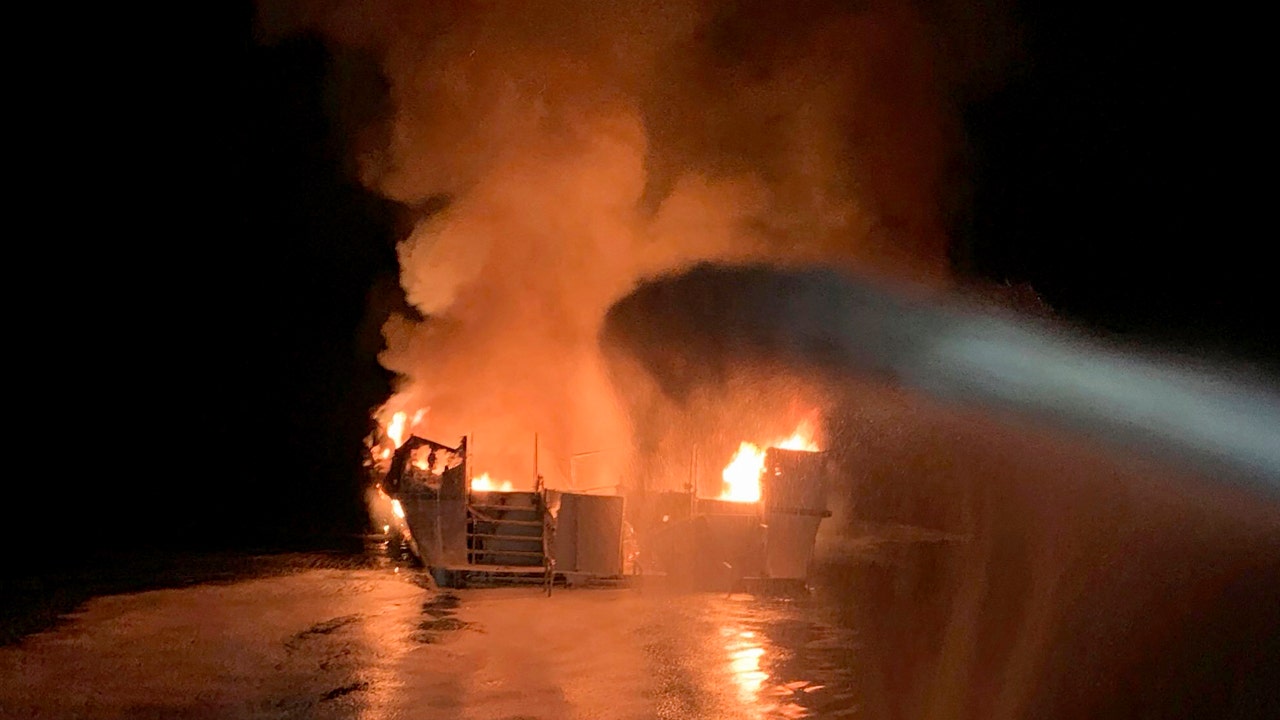
- Jerry Boylan, the captain of a scuba dive boat that caught fire off California’s coast in 2019, killing 34 people, has been sentenced to four years in prison.
- Boylan was convicted on a single count of misconduct or neglect of ship officer, a pre-Civil War statute designed to hold captains and crew criminally responsible for maritime disasters.
- “Mr. Boylan lives with significant grief, remorse, and trauma as a result of the deaths of his passengers and crew,” his attorneys wrote in a sentencing memo.
A federal judge on Thursday sentenced a scuba dive boat captain to four years in custody and three years supervised release for criminal negligence after 34 people died in a fire aboard the vessel.
The Sept. 2, 2019, blaze was the deadliest maritime disaster in recent U.S. history, and prompted changes to maritime regulations, congressional reform and several ongoing lawsuits.
Captain Jerry Boylan was found guilty of one count of misconduct or neglect of ship officer last year. The charge is a pre-Civil War statute colloquially known as seaman’s manslaughter. It was designed to hold steamboat captains and crew responsible for maritime disasters.
MAGNITUDE 4.1 EARTHQUAKE RATTLES CALIFORNIA’S INLAND EMPIRE
Boylan’s appeal is ongoing. He faced up to 10 years behind bars.
The defense had asked the judge to sentence Boylan to a five-year probationary sentence, with three years to be served under house arrest.
“While the loss of life here is staggering, there can be no dispute that Mr. Boylan did not intend for anyone to die,” his attorneys wrote in a sentencing memo. “Indeed, Mr. Boylan lives with significant grief, remorse, and trauma as a result of the deaths of his passengers and crew.”
The Conception was anchored off Santa Cruz Island, 25 miles south of Santa Barbara, when it caught fire before dawn on the final day of a three-day excursion, sinking less than 100 feet from shore.
Thirty-three passengers and a crew member died, trapped in a bunkroom below deck. Among the dead were the deckhand, who had landed her dream job; an environmental scientist who conducted research in Antarctica; a globe-trotting couple; a Singaporean data scientist; and a family of three sisters, their father and his wife.
Boylan was the first to abandon ship and jump overboard. Four crew members who joined him also survived.
FILE – In this photo provided by the Ventura County Fire Department, VCFD firefighters respond to a fire aboard the Conception dive boat fire in the Santa Barbara Channel off the coast of Southern California on Sept. 2, 2019. A scuba dive boat captain is scheduled to be sentenced by a federal judge Thursday, May 2, 2024, on a conviction of criminal negligence after 34 people died in the fire aboard the vessel nearly five years ago. (Ventura County Fire Department via AP, File)
Thursday’s sentencing was the final step in a fraught prosecution that’s lasted nearly five years and repeatedly frustrated the victims’ families.
A grand jury in 2020 initially indicted Boylan on 34 counts of seaman’s manslaughter, meaning he could have faced a total of 340 years behind bars. Boylan’s attorneys argued the deaths were the result of a single incident and not separate crimes, so prosecutors got a superseding indictment charging Boylan with only one count.
In 2022, U.S. District Judge George Wu dismissed the superseding indictment, saying it failed to specify that Boylan acted with gross negligence. Prosecutors were then forced to go before a grand jury again.
Although the exact cause of the blaze aboard the Conception remains undetermined, the prosecutors and defense sought to assign blame throughout the 10-day trial last year.
The government said Boylan failed to post the required roving night watch and never properly trained his crew in firefighting. The lack of the roving watch meant the fire was able to spread undetected across the 75-foot boat.
But Boylan’s attorneys sought to pin blame on Glen Fritzler, who with his wife owns Truth Aquatics Inc., which operated the Conception and two other scuba dive boats, often around the Channel Islands. They argued that Fritzler was responsible for failing to train the crew in firefighting and other safety measures, as well as creating a lax seafaring culture they called “the Fritzler way,” in which no captain who worked for him posted a roving watch.
The Fritzlers have not spoken publicly about the tragedy since an interview with a local TV station a few days after the fire. Their attorneys have never responded to requests for comment from The Associated Press.
With the conclusion of the criminal case, attention now turns to several ongoing lawsuits.
Three days after the fire, Truth Aquatics filed suit under a pre-Civil War provision of maritime law that allows it to limit its liability to the value of the remains of the boat, which was a total loss. The time-tested legal maneuver has been successfully employed by the owners of the Titanic and other vessels, and requires the Fritzlers to show they were not at fault.
That case is pending, as well as others filed by victims’ families against the Coast Guard for what they allege was lax enforcement of the roving watch requirement.
Read the full article from Here


Despite San Diego’s abundant marine life, the region’s commercial fishing industry is in decline.
In 2020, the Scripps Institution of Oceanography started an apprentice program to help reverse the trend — but the program has had mixed results, reports Deborah Brennan at our partner CalMatters.
Globalization is partly to blame for the busted economics of San Diego’s fishing industry. Higher wages and stricter regulations in the U.S. mean that fish caught in other countries are often cheaper. A 2016 report found that just 10 percent of seafood consumed in San Diego is caught locally.
Wages have plummeted for U.S. fishing captains and their crews in the last decade. A deckhand in San Diego can expect to earn between $15,000 and $50,000 per year.
The apprentice program doesn’t just teach people to fish, but to navigate, repair engines and even business skills. It hasn’t been without success — despite a Covid hiatus. Of 11 graduates, 6 are still fishing. But some of the captains who said the program was necessary have also been reluctant to mentor apprentices.
Peter Brownell used to be research director for San Diego’s Center for Policy Initiatives. He studied, incidentally, poverty. Wanting to transition away from a desk job, he entered the program and is now scratching out an existence on the water.
“If you’re entirely reliant on commercial fishing for all your economic needs, that’s a hard puzzle to put all the pieces together to make that work consistently year after year,” he said.
Read the full story here.
Council Considers Junk Fee Ordinance
The San Diego City Council heard details of a proposed “junk fee” ordinance that would cap extra fees for renters and require landlords to disclose fees before a lease is signed.
The proposal, introduced by Councilmembers Sean Elo-Rivera and Henry Foster, would cap fees at no more than five percent of the price of rent. It would also prohibit things like charges for basic building operating expenses, such as pest control.
“What I’ve heard is a general consensus around the transparency components and agreement that people should know what they’re going to be asked to pay,” said Elo-Rivera during a hearing on the fee Tuesday. “They should know that at the beginning of their search and before they sign a lease, not after.”
The Council only heard details on the new proposal. It did not vote on the ordinance.
AI-Powered Humanoid Robots Take Over the Web
It’s always strange when a story you write starts spreading. This week, I’ve been watching it happen with a story we published about a local charter network that spent $500,000 on two ChatGPT-powered humanoid robots.
I wasn’t shocked the story struck a nerve. It had a built-in, WTF factor that seemed guaranteed to draw eyeballs. But more importantly, it comes at a moment when people across the world are grappling with what it means to live alongside technology. It’s playing out in skirmishes over edtech, battles over data centers, and now the question of humanoid robots in the classroom.
The story has moved from the new media food chain. First came news aggregators like the New York Post, then aggregation scavengers you’ve never heard of, and now even AI aggregators, which create something akin to news hot dogs — if hot dogs used an excessive amount of subheads and bullet points.
Underneath that hollow feeding frenzy, though, are real, local news organizations. The reporters and editors report on the communities you love, because they love them too. If you haven’t already, you should consider supporting this one.
Rabbitholed
University Heights’ neon street sign — with its iconic trolley car logo — is set to go dark.
Locals were warned recently that city workers plan to turn off the 30-year-old sign due to wear and tear. Burned-out neon had already left some portions of the sign nonfunctioning.
Members of the University Heights Community Association say the city’s to blame. They allege city officials have drained funds from the neighborhood’s Maintenance Assessment District, which would normally pay for repairs. Now, they’re pressuring the city to pony up for fixes.
But behind the faulty neon is the fascinating, 130-year-plus origin of the sign’s trolley logo. It commemorates a time before the city was carved up by freeways — and instead had a thriving network of streetcars extending from Ocean Beach to La Jolla and Chula Vista. Many of those cars were repaired at a warehouse located at the site of Trolley Barn Park, hence the name – and the sign.
The streetcar network had plenty of ups and downs, like when John Spreckles, the richest man in San Diego at the time and owner of the network, ordered his workers to secretly dig up the tracks under the cover of night due to a dispute with city officials. Here’s an interesting story about how the actual streetcars evolved over the years.
The system ultimately went defunct in 1949.
What’s your take? Do you wish the city still had an urban streetcar system?
In Other News
- Two San Marcos residents say their homeowners association is violating their rights to fly American flags outside their home. But legal experts say people do have the right to fly their flags even in homes subject to rules by homeowners associations. (inewsource)
- Longer meetings are coming to San Diego City Hall. As part of a new set of policies to boost public participation, city officials will allow group presentations during online meetings. (Union-Tribune)
- Speaking of City Hall, the San Diego City Council will soon create an affordable housing preservation fund backed by $8.5 million. Along with other funding sources, the fund will work to preserve affordable housing. (KPBS)
- The former news director of KPBS, Terrence Shepherd, is suing the outlet, alleging he was wrongfully terminated after recommending a reporter be fired because they’d “staged a protest scene” during a television shot. Exactly what Shepherd’s claim of a “staged protest” entails isn’t entirely clear. A spokesperson for KPBS declined to comment on the situation. (Current)
The Morning Report was written by Jakob McWhinney, Mariana Martínez Barba and Will Huntsberry. It was edited by Will Huntsberry.
Related Posts

OPINION: Alaska’s LNG future requires creative thinking
Published 1:30 am Wednesday, July 1, 2026
Many Alaskans have grown increasingly skeptical that the proposed liquefied natural gas (LNG) pipeline is not moving forward because of its escalating cost. Early estimates placed the project near $44 billion; more recent figures — though unofficial — suggest costs approaching $60 billion or more. When projects reach this scale, uncertainty alone can stall even the most ambitious development plans.
That uncertainty is reflected in the caution shown by Alaskan major energy companies such as Exxon, ConocoPhillips, and BP. Their hesitation is not surprising: projects of this magnitude carry significant capital exposure, and investors require a clear path to profitability before committing. In practical terms, that means LNG prices would need to be high enough to recover costs and provide returns, even in a global market where competing supply — including underdeveloped reserves in Russia and elsewhere — continues to exist.
This cost pressure is also evident in current negotiations with prospective project partners. Currently, one example is Glenfarne, which has reportedly emphasized that state corporate taxes would need to be waived as part of any development agreement. While tax incentives are common in large infrastructure deals, the scale of the requested waiver raises legitimate questions about long-term public benefit and fiscal sustainability.
Alaska has faced similar debates before. During the Trans-Alaska Pipeline negotiations, tax structures were part of the broader discussion, but they were not treated as a condition that undermined the project’s feasibility. More recently, companies such as Hilcorp — now a major operator in Cook Inlet following acquisitions from BP — have benefited from favorable operating conditions, as a sub chapter S Corp, and therefore tax exempt.
Yet declining natural gas production in Cook Inlet has already raised concerns about long-term energy security for the Anchorage region, underscoring the need for new reliable supply sources. The central question is: if a project is only viable with extensive tax waivers and escalating public concessions, does it truly serve Alaska’s long-term economic interests? The state relies heavily on a limited set of revenue streams to fund education, transportation, and public services, including the Alaska Highway System. At the same time, Permanent Fund Dividend levels have become increasingly constrained. Against that backdrop, LNG development is often presented as one of the few significant new revenue opportunities on the horizon.
However, waiving broad categories of taxation for a single project could set a dangerous precedent with long-term consequences. Alaska must balance the need to attract investment with the responsibility to maintain a stable and equitable revenue base.
Infrastructure costs are only part of the challenge. Alaska’s unique land ownership structure — where the federal government controls roughly two-thirds of land within the state — adds complexity to large-scale development. This makes innovative approaches to transportation and energy export even more important.
It has been suggested that the proposed LNG line from the North Slope to Kenai be built in two phases. The first would be to build the line to initially serve the Fairbanks and Anchorage metro areas. Later, the final section, including the export dock, would be constructed on the Kenai. The drawback with this approach is the first section would not distribute enough LNG to cover operating costs or debt reduction.
An interesting group that continues to research the Arctic proposal of LNG by ice-breaking tanker to Asia is Oilak, associated with Lloyd Energy Company, with estimates of nearly 40% cost savings in transportation by the Arctic tanker route suggested.
Ice-breaking LNG tanker technology is already in use in Arctic regions, including Russia. Similar approaches could allow North Slope gas to reach Asian markets more directly. This would involve specialized loading facilities and seasonal shipping strategies designed around Arctic conditions.
During the 1967-68 period I worked in state government and during that time, we maintained a State office in Tokyo, Japan. The purpose was to promote Alaska resource potential to the Asian countries. This resulted in stimulating Alaska’s timber and fisheries industry, resulting in pulp mills in Sitka and sawmills in Ketchikan, Wrangell, Haines and Metlakatla, as well as several fish processing plants throughout Alaska.
I believe there is an opportunity to consider international equity partnerships in any LNG proposal. Countries such as Japan, South Korea, the Philippines and Taiwan, as well as other major LNG importers, could potentially participate as investors in infrastructure development in exchange for long term supply agreements. Similar models have been used in Alaska’s resource history, including earlier investment in timber, pulp and sawmills and fisheries operations across Alaska. Our state’s presence in Tokyo, as I’ve indicated, helped facilitate trade relations and market development.
These kinds of partnerships are not without complexity, but they reflect a broader truth: large-scale resource development increasingly requires creative financing structures and shared risk models.
Ultimately, the most expensive component of any LNG strategy is not just production, it is transportation to market. Whether through pipelines, rail systems, or Arctic shipping corridors, the chosen infrastructure path will determine the project’s viability more than resource availability itself.
Alaska should be cautious about allowing enthusiasm for a single project structure to override broader fiscal considerations. The goal should not be development at any cost, but development that strengthens the state’s long-term economic foundation. I believe if consideration of the potential of the Alaska Arctic tanker route were given genuine support by our governor and the legislature, the Arctic route would advance far beyond the current debate over foreign tax forgiveness. The state would generate greater revenue from the cost savings on transportation alone. Let’s take a look at how they are doing it from the Russian Arctic.
Frank Murkowski is a former U.S. senator and Alaska governor.

MARANA, AZ (AZFamily) — Proposals for data centers and ICE detention facilities in Marana are dividing neighbors and turning some against their local leaders.
These are two issues that some Republicans and Democrats are finding themselves agreeing on, as people try to take charge of who and what ends up in their communities.
“Well, first I think everyone on our city council needs to be replaced. What they are doing to Marana and surrounding areas is destroying our future and our kids’ futures,” a Marana resident said.
A recent proposal by the Department of Homeland Security would create an ICE detention center about 3 miles from the community center.
The property proposed for the ICE facility was a minimum-security prison with a capacity of about 500 people. The release said that renovations will increase capacity to 775, but could expand to over 1,300.
DHS officials say the facility would include more exam rooms, a dental area, and other features.
Arizona’s Family asked DHS for some clarification on those numbers and details. DHS released a statement saying, “ICE does not discuss individual pre-decisional conversations, but when a new facility contract is finalized, information will be available on ICE.gov.”
Data center concerns
Meanwhile, a rezoning application for a data center surfaced on the Town of Marana’s website last week.
It’s the second potential data center in the area and has people itching to get to public comment to voice their concerns.
“The detention center- we don’t need that here; no one wants that here. The data center- I mean, we already don’t have water and it’s awful; we don’t need another data center. Look at the ones across the country and what they’re doing,” the Marana resident we spoke with said.
Marana Town Manager Terry Rozema said nothing is set in stone.
“There’s so many factors that could come into considering whether or not something is beneficial to a community,” Rozema said.
Supporters of these projects said they will create jobs.
See a spelling or grammatical error in our story? Please click here to report it.
Do you have a photo or video of a breaking news story? Send it to us here with a brief description.
Copyright 2026 KTVK/KPHO. All rights reserved.
-

 San Diego, CA1 minute ago
An Apprentice Program for Commercial Fishing
-
Milwaukee, WI6 minutes ago
Connecting Milwaukee teens to summer work
-

 Atlanta, GA13 minutes ago
Conference offers safe space for gay men to unpack the stigmas, challenges of adoption and surrogacy
-

 Minneapolis, MN16 minutes ago
Westbound I-94 reopens in Minneapolis after fatal crash
-

 Indianapolis, IN21 minutes ago
Edwards Checks Out At Indianapolis – SPEED SPORT
-

 Pittsburg, PA23 minutes ago
Analysis: Here’s why the Pittsburgh Symphony’s budget just jumped by $7 million to $42 million
-

 Augusta, GA28 minutes ago
Augusta’s role in the American Revolution: An underdog story 250 years in the making
-

 Washington, D.C31 minutes ago
Looking for indoor July 4 plans in DC? Try these America250 exhibits


