California
Push for stricter cap on rent increases dies in the California Legislature

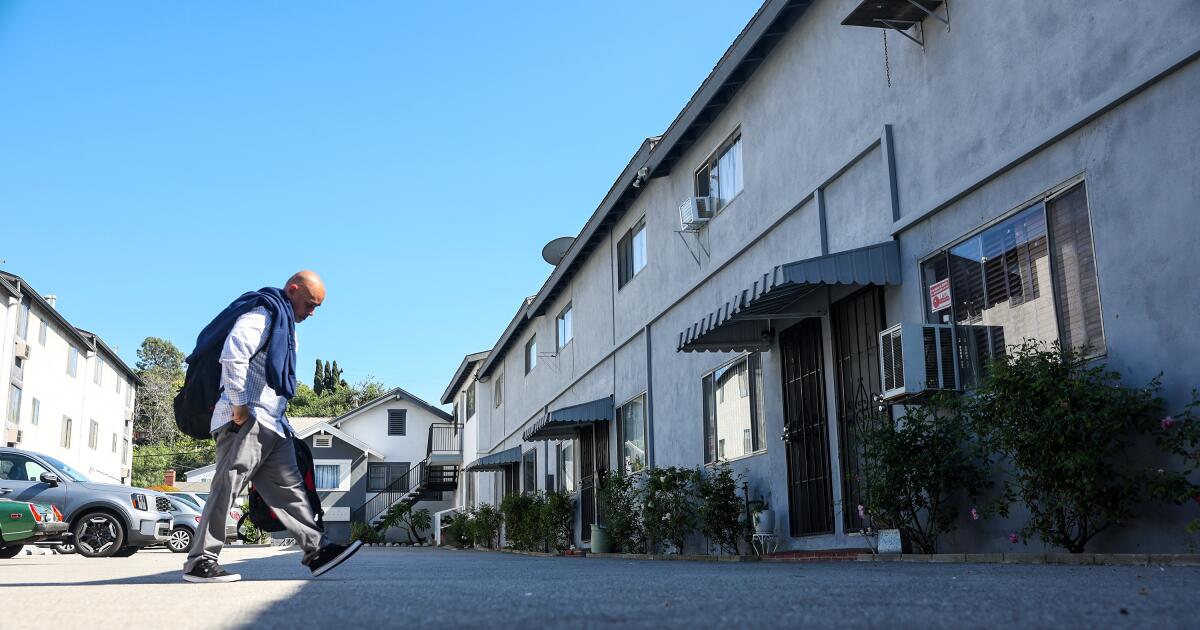
A contentious housing bill that would have capped rent increases to 5% a year died in the Assembly on Tuesday, a decision greeted with boos and cries of disapproval from spectators packed inside the committee chamber.
Assembly Bill 1157 would have lowered California’s limit on rent increases from 10% to 5% annually and removed a clause that allows the cap to expire in 2030. It also would have extended tenant protections to single-family homes — though the bill’s author, Assemblyman Ash Kalra (D-San José), offered to nix that provision.
“Millions of Californians are still struggling with the high cost of rent,” Kalra said. “We must do something to address the fact that the current law is not enough for many renters.”
Assemblymember Diane Dixon (R-Newport Beach) said she was concerned the Legislature was enacting too many mandates and restrictions on property owners. She pointed to a recent law requiring landlords to equip rentals with a refrigerator.
“That sounds nice and humanly caring and all that and warm and fuzzy but someone has to pay,” she said. “There is a cost to humanity and how far do we squeeze the property owners?”
The California Apartment Assn., California Building Industry Assn., California Chamber of Commerce and California Assn. of Realtors spoke against the legislation during Tuesday’s hearing before the Assembly Judiciary Committee.
Debra Carlton, spokesperson for the apartment association, said the bill sought to overturn the will of the voters who have rejected several ballot measures that would have imposed rent control.
“Rather than addressing the core issue, which is California’s severe housing shortage, AB 1157 places blame on the rental housing industry,” she said. “It sends a chilling message to investors and builders of housing that they are subject to a reversal of legislation and laws by lawmakers. This instability alone threatens to stall or reverse the great work legislators have done in California in the last several years.”
Supporters of the bill included the Alliance of Californians for Community Empowerment Action, a statewide nonprofit that works for economic and social justice. The measure is also sponsored by Housing Now, PICO California, California Public Advocates and Unite Here Local 11.
The legislation failed to collect the votes needed to pass out of committee.
On Monday, proponents rallied outside the Capitol to drum up support. “We are the renters; the mighty mighty renters,” they chanted. “Fighting for justice, affordable housing.”
“My rent is half of my income,” said Claudia Reynolds, who is struggling to make ends meet after a recent hip injury. “I give up a lot of things. I use a cellphone for light; I don’t have heat.”
Lydia Hernandez, a teacher and renter from Claremont, said she used to dream of owning a home. As the first person in her family to obtain a college degree, she thought it was an obtainable goal. But now she worries she won’t even be able to keep up with her apartment’s rent.
Hernandez recalled noticing a woman who had recently become homeless last week on her way to school.
“I started to tear up,” said Hernandez, her voice cracking. “I could see myself in her in my future, where I could spend my retirement years living an unsheltered life.”
After Tuesday’s vote, Anya Svanoe, communications director for ACCE Action, said many of their members felt betrayed.
“While housing production is a very important part of getting us out of this housing crisis, it isn’t enough,” she said. “Families are in dire need of protections right now and we can’t wait for trickle-down housing production.”
In California, 40.6% of households are spending more than 30% of their income on housing, according to an analysis released in 2024 by the Pew Research Center. The U.S. Department of Housing and Urban Development considers households that spend more than 30% of their incomes on housing to be “cost burdened.”

California
California lawmakers seek $32M to combat invasive pest found on grapevines sold at Costco

FRESNO COUNTY, Calif. (FOX26) — California lawmakers are now asking the federal government for more than $32 million in emergency funding to stop the spread of an invasive insect that was recently discovered on grapevines sold at Costco stores across the state.
The request comes about a month after Fresno County agricultural officials discovered grapevine plants infested with the glassy-winged sharpshooter, a pest capable of spreading Pierce’s Disease, a deadly infection that can kill grapevines.
In a letter sent to U.S. Agriculture Secretary Brooke Rollins, Sens. Adam Schiff and Alex Padilla joined Reps. Mike Thompson, David Valadao and other members of California’s congressional delegation in requesting $32.2 million in emergency funding to contain and eradicate the pest.
[RELATED] Fresno County grapevine plants shipped to Costco were infested with bugs
Lawmakers say the infected nursery stock was identified Mat 19 by the California Department of Food and Agriculture and the Fresno County Agricultural Commissioner’s Office.
The plants had been distributed to Costco stores in more than two dozen California counties before being sold to customers.
Officials believe some of the infested plants have since been transported to homes in at least 38 counties across the state.
The movement of infested nursery stock into and near key grape-producing regions, including areas critical to California’s winegrape and fresh table grape production, significantly elevates the urgency of this response.
The glassy-winged sharpshooter feeds on grapevines and spreads Pierce’s Disease, an incurable bacterial infection that can destroy vineyards by preventing vines from transporting water.
Lawmakers warned that the pest poses a serious threat to California’s wine and table grape industries.
According to the Wine Institute, California’s wine industry supports 1.1 million jobs nationwide and generates an economic impact of more than $170 billion.
California also produces 99% of the nation’s table grapes, with an annual crop value estimated at $2.59 billion.
If the pest spreads unchecked, the California Department of Food and Agriculture estimates losses associated with Pierce’s Disease and the glassy-winged sharpshooter could exceed $104 million annually.
The requested funding would support emergency response efforts, including tracing the movement of infested plants, surveying affected areas and expanding trapping programs.
Additional funding would also be used for long-term monitoring and eradication efforts over the next several years.
The lawmakers are asking the U.S. Department of Agriculture to immediately release the funding through the Commodity Credit Corporation, arguing that the outbreak meets the federal definition of an agricultural emergency.
Growers have already contributed more than $62 million toward research and mitigation efforts over the past 25 years through industry assessments, according to the letter.
Federal officials have not yet announced whether the funding request will be approved.
California
California Now Offers Free Passes to State Historic Parks (Just Don’t Miss the Deadline) | KQED

An annual pass that’s usually $50 is free in honor of Juneteenth — and to mark the 250th anniversary of the signing of the Declaration of Independence.
Historical buildings are visible at Sonoma State Historic Park, Sonoma, California, May 31, 2026. Until July 6, Californians can download the state historic park pass for free and use it as many times as they want through the end of 2026. (Smith Collection/Gado via Getty Images)
“California doesn’t hide from hard truths and uncomfortable history – in fact, we embrace it and learn from it,” Newsom wrote.
Until July 6, Californians can download the state historic park pass for free and use it as many times as they want through the end of 2026. The pass gives free entry to state historic parks for up to four people.
Jump to:
The Historian Passport grants entry to more than 30 state historic parks, including parks like Olompali and Malakoff Diggins which, rather than just providing outdoor recreation, also have an educational emphasis on the state’s history.

Many of these parks tell the story of the state’s cultural or indigenous history, from missions and museums to temples and the site that sparked the California Gold Rush.
Newsom made a similar move to make state parks free for Martin Luther King Jr. Day this year, in response to Trump’s decision to eliminate the holiday from the list of fee-free days at national parks across the country, replacing it with his birthday on Flag Day.
How to get your free Historian Passport for up to four people
You must make an account with the state’s reservation site ReserveCalifornia.com to obtain a Historian Pass. Then, visit the site’s Advance Passes page and select “Special Edition Historian Passport” from the dropdown menu, which will show as costing $0. No payment information is required.
After checking out, you’ll receive an email with an attached PDF version of your Historian Passport.
The state recommends you print off this PDF to present at any California state historic park for free entry, although you may just be able to show the image on your phone too.
Bear in mind that cellphone service may be poor at many state historic parks, so it’s worth screenshotting the PDF to save it as an image on your phone in case you’re unable to search your email.
Looking for free entry to other state parks that aren’t included in the Historian Passport? Consider checking out a parks pass from your local library, which provides these passes as part of the California State Library Parks Pass program.
Northern California State Historic Parks to visit for free this year with a Historian Passport
Bay Area
Sacramento area
Sierra foothills
KQED’s Carly Severn contributed to this report.

A 33-year-old Northern California man was sentenced to three years in prison after he was found passed out drunk behind the wheel in the drive-thru of an In-N-Out Burger, marking his seventh arrest and conviction for driving under the influence.
According to the Monterey County District Attorney’s Office, California Highway Patrol officers were alerted to the June 2025 situation by a store employee.
Responding officers approached the vehicle and reported smelling urine and vomit, along with the odor of alcohol inside the car, the Los Angeles Times reported.
Officers arrested the man, identified as Carlos Alvarez of Salinas, on suspicion of felony DUI.
This was his fourth DUI conviction in the past 10 years, The Times reported.
It was not immediately clear what sentences were imposed in Alvarez’s prior DUI convictions or whether he has previously served jail time for any of the other felony convictions.
-

 Fitness21 seconds ago
When is the best time to exercise in the heat?
-

 Movie Reviews10 minutes ago
‘Maa Inti Bangaram’ Movie Review: Samantha Rocks, Writing Suffers
-

 World23 minutes ago
US tells ASML it is concerned China may have top chip tool, Bloomberg News reports
-

 News25 minutes ago
San Francisco Film Patrons Are Found Dead on Side of Highway
-

 Politics31 minutes ago
Video: Reflecting Pool Turns Green, Paint Peels After Renovation
-

 Health45 minutes ago
New At-Home DNA Test Reveals if GLP-1 Weight-Loss Drugs Will Work for You
-
 Lifestyle1 hour ago
What does freedom actually look like? : It’s Been a Minute
-

 Technology1 hour ago
Barret Zoph is out at OpenAI again after just five months

