California
Missing house cat makes incredible trek from Yellowstone to California


At the edge of their campground in Yellowstone National Park in June, Susanne and her husband, Benjamin “Bennangy” Anguiano, gazed at the lodgepole pine tree forest. The ground was covered with piles of broken branches and dry, old trees that had fallen on top of each other.
The Anguianos felt overwhelmed and distraught: Somewhere in that forest was their small, brownish seal point Siamese cat that had run off from the Fishing Bridge RV Park.
For five days the couple searched the area, calling out for their 2-year-old cat named Rayne Beau (pronounced “rainbow”). They used cat food and toys to try and lure him back.
Benjamin and Susanne Anguiano in Yellowstone National Park.
(Benjamin and Susanne Anguiano)
But it would be weeks before they would reunite with their beloved pet, a tearful reunion that by some miracle would also take place hundreds of miles west in California.
There is no shortage of stories about pets traveling great distances to get home. In 2012, a black Labrador named Bucky walked 500 miles from Virginia to South Carolina, eventually reuniting with his owner.
Hollywood has even made movies about them — take 1993’s “Homeward Bound,” in which an American bulldog, a golden retriever and a Himalayan cat make their way through the Sierra Nevada to San Francisco to reunite with their family.
And now, there’s Rayne Beau.
Although it has been a month since the cat returned home, it wasn’t until this weekend that the Anguianos felt comfortable enough to talk about the incident, in part because they want to know if anyone helped the cat travel more than 800 miles from Yellowstone to California.
In a phone interview Friday, Susanne Anguiano said everything began June 4 when the couple arrived at the campground. She said she was trying to transfer Rayne Beau and his sister, Star, a flame point Siamese cat, from the truck to the traveling trailer.
Anguiano said she was untangling the cats’ leashes when Rayne Beau jumped out of the vehicle, slipping out of his collar before dashing toward the forest.
“I screamed,” she said. “I swear, I think the whole campground heard me.”
She ran after Rayne Beau, leaving the truck door open and the other cat behind. She said her husband shut the door to prevent the other cat from escaping.
She said Rayne Beau ran under a log, where she tried to scoop him up, but that caused him to run off again, this time deeper into the woods. Eventually, she lost sight of him.
The next day they reported the cat missing with the ranger’s office, providing a photo.
“Every morning I went out for an hour and called,” she said. “Even his sister, from the safety of the screen door of the trailer, meowed for him.”
The couple spent days searching the forest, calling out for him, trying to entice him with tuna and toys well into the night.
“But he never showed up,” she said. “Then came the day when we had to leave and that was horrible.”
“It felt like I was abandoning him,” she said.
As their truck pulled out of the campground on June 8, Anguiano looked out the window, crying, calling and scanning the road.
“I knew it was hopeless to do that but I did it anyway,” she said.
The ride home was somber. The couple didn’t talk, and Star clung to Susanne. She worried about Rayne Beau getting stuck in a tree or falling from one. Would he starve? No, she told herself, there were plenty of mice he could live off.
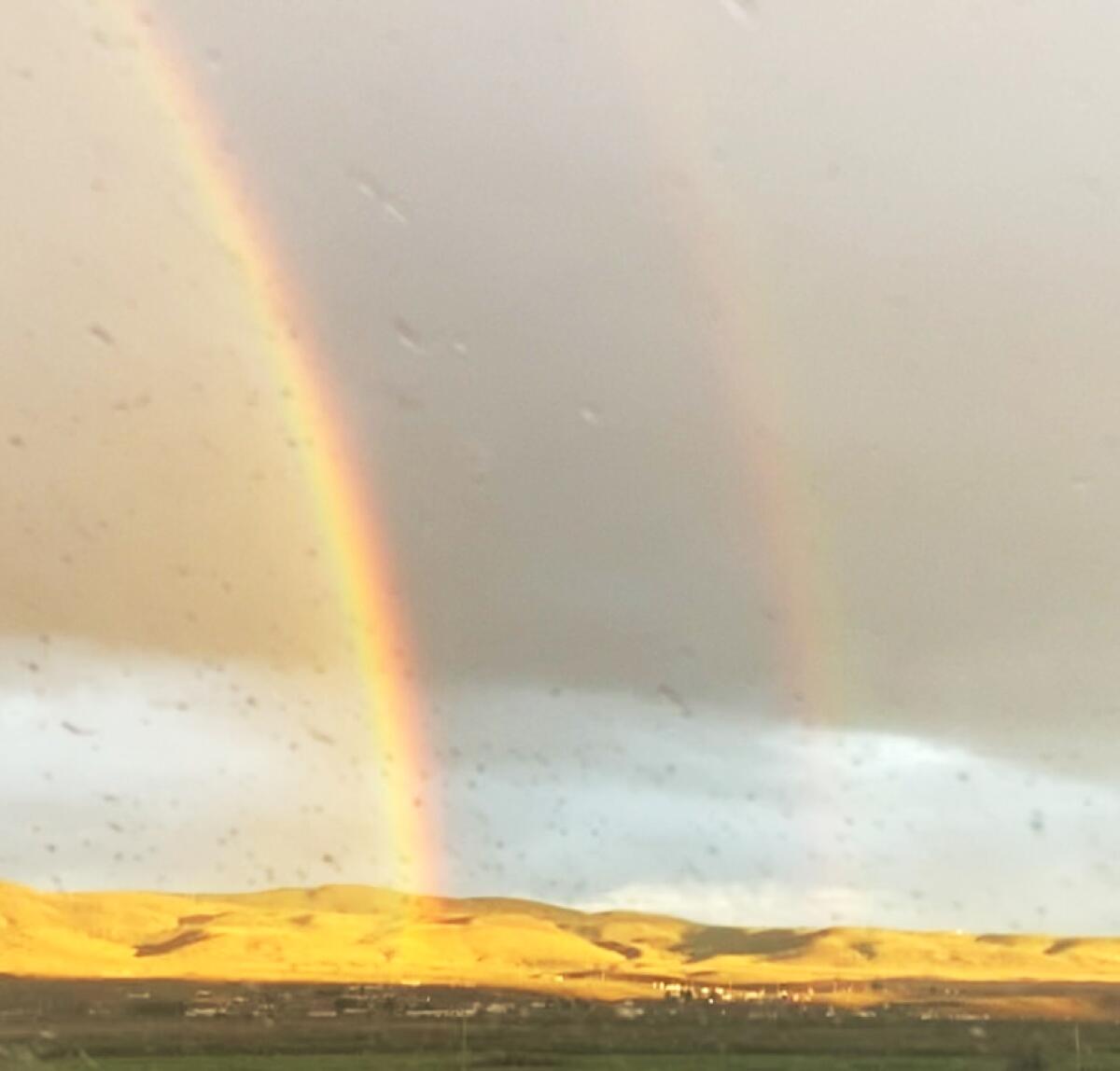
Susanne Anguiano took a sighting of a double rainbow in the Nevada desert as a sign of hope.
(Benjamin and Susanne Anguiano)
As they were entering the Nevada desert, the couple saw a double rainbow. For Anguiano, it was a sign that their cat was safe.
“I’m a Christian and I was praying the whole time,” she said. “God told me: ‘I have him safe,’ and that’s what I hung on to.”
It was July 31 and Alexandra Betts had arrived at her job at Sutter Roseville Medical Center in Roseville, Calif. It was hot and temperatures were in the triple digits, she recalled. She was making her way from the parking lot to the hospital when she heard yowling coming from some bushes.
Betts said it sounded like a cat in heat or in labor, so she walked over to take a look. There, she noticed saw a small brownish cat near a storm drain.
She stayed with it for a few minutes before going into work. Her co-workers told her the cat had been there for days and likely belonged to someone nearby. Betts didn’t buy that. A cat yowling and in the same spot for days didn’t seem right to her.
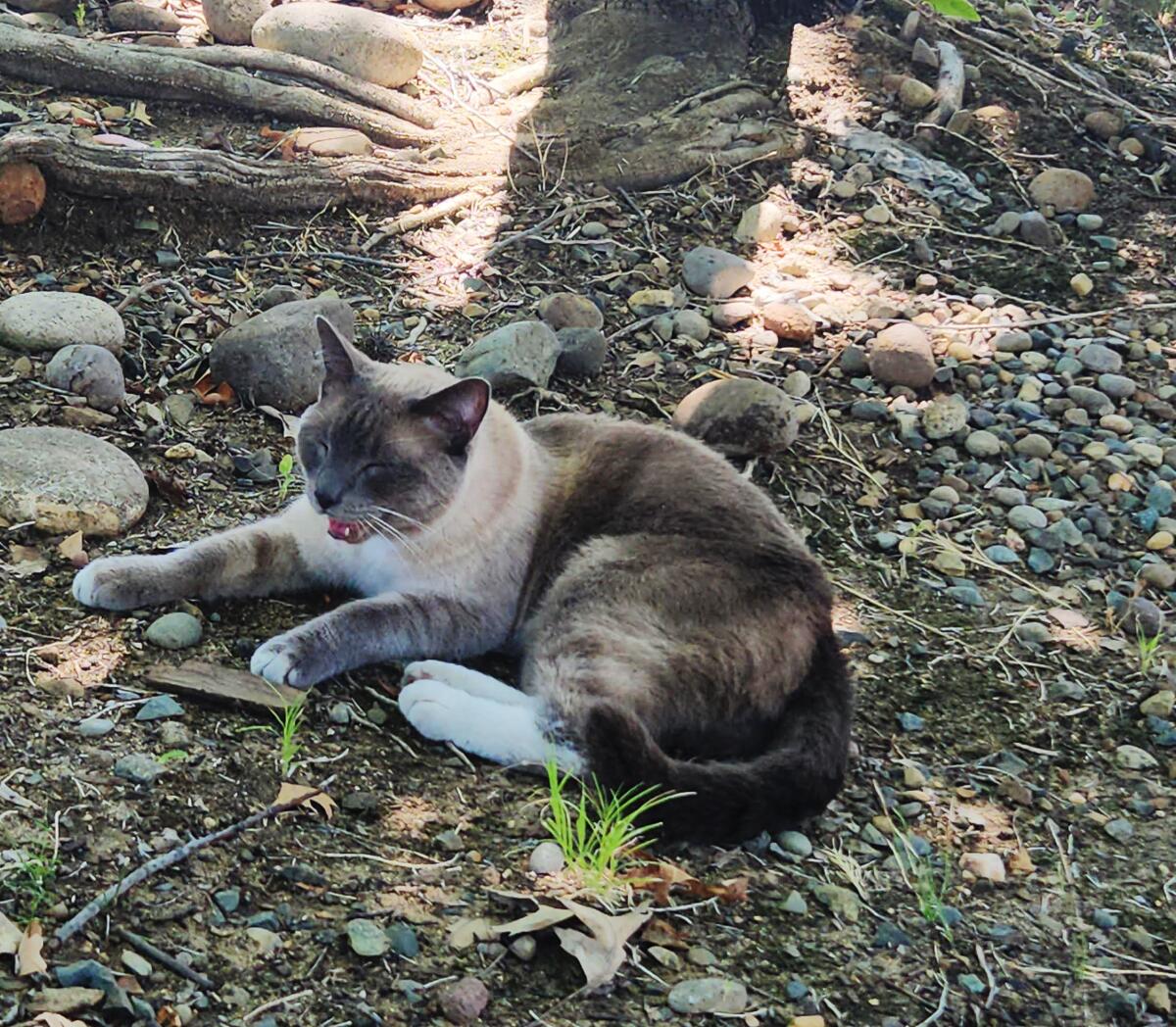
Alexandra Betts found a panting cat during triple-digit temperatures in Roseville, Calif. She took it home and posted pictures in hopes of finding the owner.
(Alexandra Betts)
She checked in with her sister, who once worked at an animal shelter, and learned that cats that yowled were either in distress, in heat or lost.
Betts ordered cat food from DoorDash. On her lunch break, she went out to feed it.
“I could tell it was a house cat of some kind because it could register what the sound of a can opening was,” she said.
But the hot weather was starting to take its toll on the cat. Betts said it was panting, and she felt she needed to bring the cat home.
Betts was no stranger to helping animals. She owned a cat herself and often fostered many felines for many years. The next day, a Thursday, she brought the cat home in a carrier.
That night, she said, she took photos and uploaded them to the Facebook account for Roseville Lost and Found Pets.
The cat stayed with the family until Saturday, snuggling and playing.
“It was just the sweetest cat,” Betts said. “My son wanted to keep him but I told him: ‘if your cat Ninja got out, how would you feel if you never got to see him again?’”
She told him they needed to do everything they could to get the cat back to its owner.
On Aug. 3, she took the cat to the Placer Society for the Prevention of Cruelty to Animals in Roseville. She updated her post on Facebook that day to let people know where she took the cat.
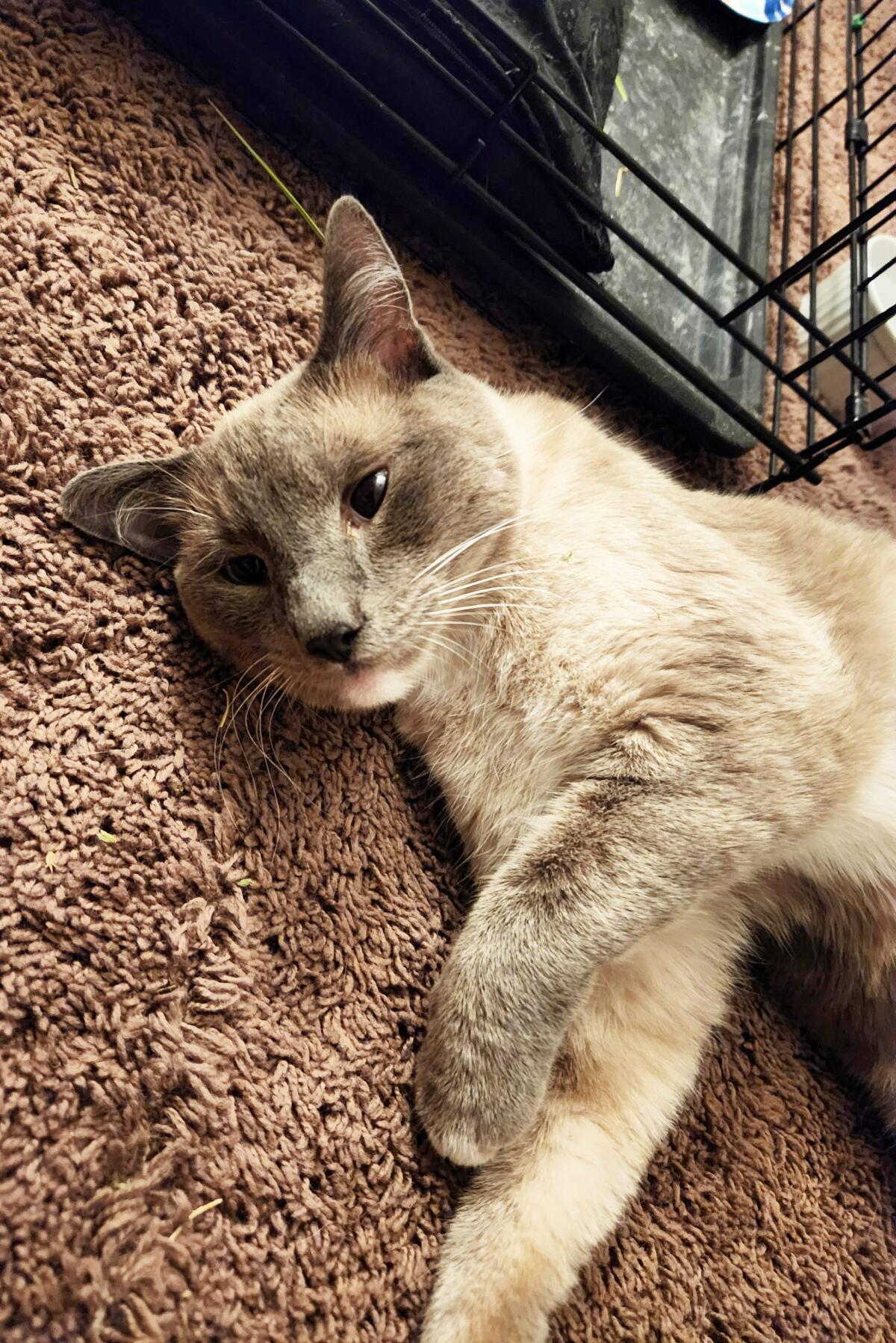
Betts took more photos of the cat after bringing it home, where she said it loved to cuddle. Her son wanted to keep it, but she took it to a shelter so it could have a chance of being reunited with its owners.
(Alexandra Betts)
Leilani Fratis, chief executive with Placer SPCA, said the cat was in fairly good condition when it arrived at the shelter. She said staff immediately scanned the pet for a microchip, and it had one.
“What’s really incredible is that we get over 1,000 cats that come through our shelter,” she said. “Only 23 are ever reunited with their owners and of that number, a teen of them are microchipped.”
“Microchipping is especially important for cats,” she added, “as it can be hard to keep a collar on them.”
She hoped the story will encourage more people to microchip their pets if they haven’t done so.
It was Saturday afternoon when Susanne Anguiano got the call, but she didn’t pick up. The number didn’t show up as Placer SPCA. In fact, the shelter had to call her daughter to inform them of the news.
Even then, Anguiano didn’t believe it. She thought it was a scam. She Googled the number to make sure it matched that of Placer SPCA in Roseville.
She called them and asked if they had Rayne Beau. They told her they did. She asked them to describe the cat and they did that too.
As she was on the phone, her husband walked in and told her he had received a text message that Rayne Beau had been found.
“Wait, is this really happening?” she recalled telling herself.
She said her husband asked the shelter to provide photos. When they received them, the couple was stunned: It was Rayne Beau.
“Eight weeks of hoping and praying just came full circle,” she said. “We were blown away, we hugged and cried, it was just so surreal.”
The next morning, they drove to Roseville, about four hours from their home in Salinas. They walked into the shelter and reunited with Rayne Beau.
Shortly after, Anguiano said she took the cat to the vet.
“He was so skinny,” she said. “He had lost 40% of his body weight.”
She said his blood work showed low protein levels, and the pads on his paws were dry, cracked and calloused, proof that he had spent a lot of time on his own.
Anguiano said they wanted to thank the person who had found their cat but for privacy reasons the shelter couldn’t release that information.
A few days later, however, her husband stumbled upon Betts’ Facebook post. They were able to thank her and provide some details of the story.
“She’s the only one who did something,” she said. “She’s our hero, our angel.”
Betts was elated to hear that the family had reunited with their pet. She was also happy that she decided to help Rayne Beau after learning about his long journey.
“I think everything lined up perfectly for it to work out the way it was supposed to work out.”

California
California Islamic calligraphy artist preserves ancient tradition during Arab American Heritage Month

As Arab American Heritage Month is celebrated, one Northern California artist is keeping the centuries-old tradition of Islamic calligraphy alive, one carefully measured stroke at a time.
Sehar Shahzad is a student calligrapher. Before starting any project, Shahzad said “one of the first things that calligraphers learn is how to cut their pens.”
Her tools must be in pristine condition.
“Your instruments are just as important as anything else in this art,” she said.
Shahzad said that as a young girl growing up in Toronto, she took up Islamic calligraphy while reflecting on her religion.
“It’s not like I’d never seen it before, but it was my first time kind of trying it,” she said. “And there’s no other way to say it except that I just fell in love with it.”
Now married with three children, Islamic calligraphy is very much part of her life.
“I remember thinking that this isn’t something that I just want to learn for fun,” she said. “I really want to be able to master it.”
Shahzad said that every angle and curve follows strict geometric rules and is measured with dots.
“For example, this letter here was just a little bit too long, so we use these nuqtas to help us guide and understand how long that letter should be,” she said.
Like the Arabic language, Islamic calligraphy is read from right to left. Its bold simplicity requires precision and a deep understanding of proportion.
“When you’re creating a composition, it’s not only about the letter itself,” Shahzad said. “It’s about composition as a whole and making sure that everything balances together.”
Even though she’s still mastering her form, Shahzad’s work is featured in the prayer room of a Muslim cemetery in Napa and in the domes of mosques in San Jose, Hayward, and San Francisco.
Still, she considers her work on paper the most special.
“A form of meditation, a form of worship, requires focus, requires discipline, really brings me to a different space,” Shahzad said. “And I think that’s what I love most.”
Proving that in this fast-paced world, this millennia-long tradition is far from disappearing.
Shahzad’s work will be featured at the upcoming Light Upon Light art exhibit at the Tarbiya Institute in Roseville from April 24-26.

LOS ANGELES (KABC) — California Attorney General Rob Bonta on Tuesday highlighted what he called historic progress in the state’s fight against gun violence.
“California has achieved something historic with the lowest rates of firearm deaths, suicides and homicides on record,” he said during a press conference.
According to Bonta, in 2024, California saw the lowest numbers of firearm-related deaths since 1968. That also drove the state’s overall homicide rate to its lowest level on record in Centers for Disease Control and Prevention data, Bonta’s office said.
However, Bonta warned lawmakers that those gains could be at risk without continued investment.
“This progress is fragile,” he said. “It was driven in part by significant investments that are now declining or disappearing, and without continued and increased investment, we risk losing it.”
Bonta urged policymakers to continue advancing gun violence prevention efforts and education initiatives.
To learn more, click here.
Copyright © 2026 KABC Television, LLC. All rights reserved.
California
California lawmaker introduces bill to protect wildlife from euthanasia, create coexistence program

A Southern California state senator has proposed a new law that would prevent euthanasia in the state’s wildlife just a month after a mother bear was put down for swiping at a woman in Monrovia, feet away from where her two cubs were located.
The legislation, SB 1135, which was introduced by Sen. Catherine Blakespear (D-Encinitas), calls for the establishment of a state program that promotes the coexistence with wildlife and codifies a wolf-livestock coexistence and compensation program. The move comes two years after funding for a similar wildlife coexistence program expired.
“We can and must responsibly support people and wild animals to exist in a California where we are all under growing pressures and cumulative threats like extreme heat, frequent drought and intense wildfires that animals respond to by moving in search of resources to survive,” Sen. Blakespear said in a statement. “That means investing in science-based, situation-specific, proactive strategies to minimize negative interactions and prevent escalation to conflicts that pose risks for people and animals. SB 1135 proposes a program to better protect people, wildlife and communities.”
The proposed coexistence program, which would be allocated nearly $50 million through the state’s 2026-27 budget, would build on the previous version, which deployed trained regional human-wildlife conflict staff around the state. The absence was noted by CDFW leaders during a state Assembly meeting in January, according to Blakespear.
“Over the last five years, wildlife incident reports logged by the California Department of Fish and Wildlife (CDFW) increased by 31 percent and calls, emails and field contacts rose by 58 percent,” Blakespear’s proposal says.
She noted the recent headline across the state, including “Blondie,” the Monrovia mother bear who was captured and put down by wildlife officials in March after it swiped at a woman near the home it was living under with its two cubs.
The home in question belongs to Richard Franco. He, along with many other Monrovia residents, has documented his encounters with bears over the years, even setting up a system of trail cameras to track the bears’ movements.
“Getting to know her, you could see what a devoted mother she was,” Franco said. “She was always building a nest.”
Read more: Orphaned bear cubs taken to San Diego for care after mom is euthanized for attacking people
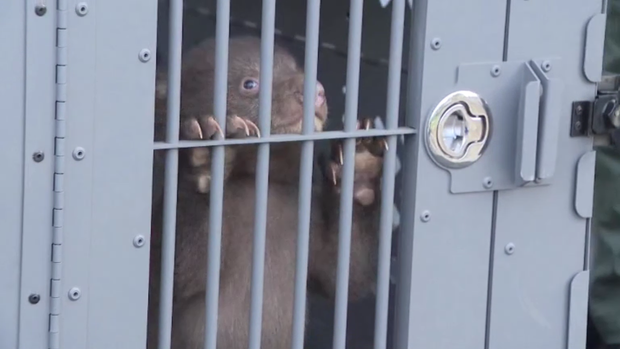
Franco and many of his neighbors were angered upon learning that CDFW officials had euthanized Blondie after her capture, which they credited to the fact that she had swiped at the woman days earlier and another person in 2025.
“Forcing them out, and then euthanizing the mom was just traumatic for us,” said one Monrovia couple. “It was just tragic, and there was no need for it; it was completely unnecessary.”
Situations like this are what caught Blakespear’s attention, leading to her proposal last week.
“It is really my desire to make sure that wild places stay wild, and not be having to resort to lethal measures like killing bears or killing wolves,” Blakespear said, while speaking with CBS LA. “We need to have a program that is up and going so we can be educating people.”
The program calls for focus on public education, maintaining a statewide incident reporting system and deploying devices like barriers, noise and light machines and other technology that would deter predators from places where they shouldn’t be.
SB 1135 passed on a 5-1 vote and will now be considered by the Senate Appropriations Committee.
-

 Seattle, WA5 minutes ago
Brock: 2 drafts fits at edge rusher for Seattle Seahawks
-

 San Diego, CA11 minutes ago
Joseph Allen Oviatt – San Diego Union-Tribune
-

 Milwaukee, WI17 minutes ago
Milwaukee Brewers overpower Detroit Tigers to win 12-4
-

 Atlanta, GA23 minutes ago
What this food hall could mean for a south Atlanta neighborhood
-

 Minneapolis, MN29 minutes ago
Ellison, Minneapolis, St. Paul update lawsuit against Operation Metro Surge with new data
-

 Indianapolis, IN35 minutes ago
Indianapolis, Carmel area fails air pollution measures in new report
-

 Pittsburg, PA41 minutes ago
Callie DiSabato: Unregulated short-term rentals hurt Pittsburgh
-

 Augusta, GA47 minutes ago
Attention, shoppers: Augusta-area Walmarts to be remodeled in 2026