California
‘I’ve never had an identity crisis’: Kamala Harris and the power of mixed-race California

Hi and welcome to the L.A. Times Politics newsletter. I’m Shelby Grad, deputy managing editor for news, filling in for David Lauter today.
A generational shift
Thirty years ago, the Los Angeles Times polled residents of Orange County about their attitudes on interracial dating and romantic relationships. The poll found young people were highly supportive, with nearly 60% of those ages 18 to 34 saying they had dated someone from another racial or ethnic group.
Orange County was just beginning to shed its image as a conservative white bastion, and the survey underscored big divides between the older generation and the younger.
“My boyfriend is Latino,” a white Fullerton bank teller told the paper. “I haven’t run up against any resistance from my parents, but my grandparents don’t like it.”
I was a young reporter in the newsroom when the poll came out, and I remember being impressed with the findings. And that sentiment came to represent the way a new generation of Californians defined their experience — with the belief that the mixing of races is not only our strength, but our secret weapon.
Today, nearly 16% of Californians identify as being of two or more races. And that includes the woman who is poised to be the Democratic presidential nominee.
A 78-year-old man’s recent comments questioning Kamala Harris’ multiracial identity could easily be written off as the outdated notion of earlier generations. But it was Donald Trump, and his words had a political purpose.
Trump falsely claimed that Harris “was Indian all the way and then all of a sudden she made a turn, she became a Black person.”
The news cycle since his comments Wednesday during a session with three reporters at the annual convention of the National Assn. of Black Journalists has thoroughly discredited and dissected his words.
A California childhood
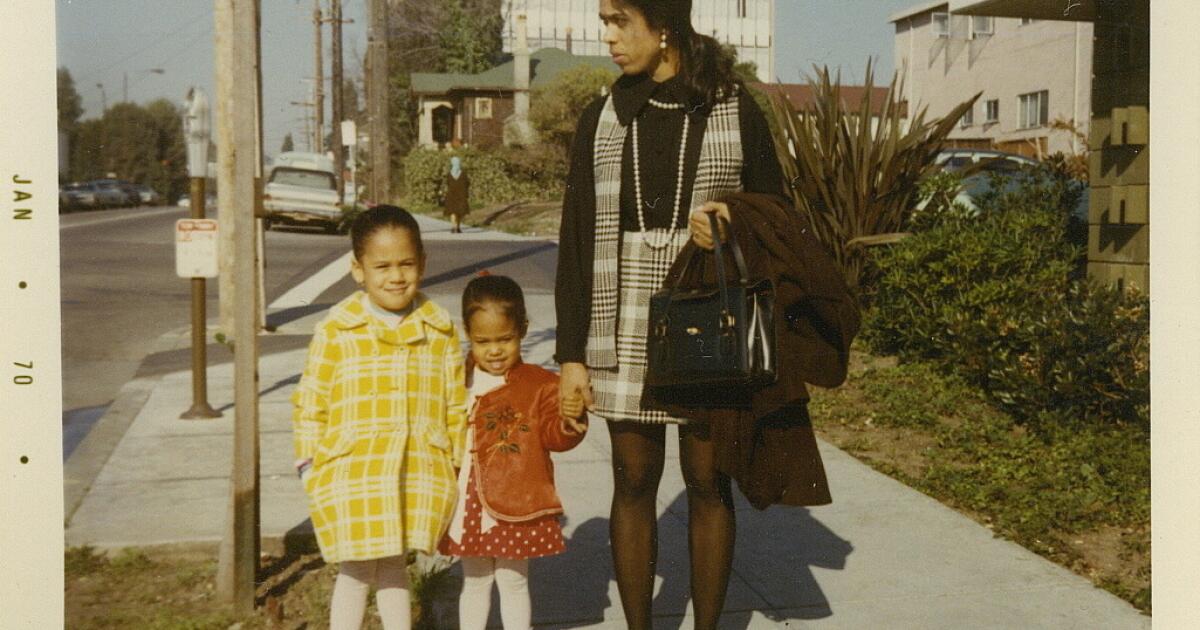
But perhaps it is more instructive to hear in Harris’ own words what it was like to grow up as a mixed-race Californian, born in Oakland to an Indian mother and a Jamaican father.
“My Indian mother knew she was raising two Black daughters,” Harris told The Times’ Michael Finnegan in 2019. “But that’s not to the exclusion of who I am in terms of my Indian heritage.
“I grew up going to a Black Baptist church and a Hindu temple,” she explained.
She described a rich childhood of family visits to India and of Aretha Franklin’s gospel rendition of “Young, Gifted and Black“ as a soundtrack of her youth in a Black middle-class neighborhood in the flats of Berkeley.
Explaining identity to others
Harris went even deeper during an “Asian Enough” podcast interview with Frank Shyong and Jen Yamada in 2020. She talked about the challenges of explaining your identity to those unfamiliar with it.
“You’re required to explain things about yourself that otherwise you may not be required to explain. And that can be challenging for a number of reasons, including because you know, at that moment, you might prefer that the interview was about your plan for the economy,” she said with a laugh. “But you’re trying to help people figure out who you are even though you’re really comfortable in your own skin.”
Harris said she understood the need for voters — especially those never exposed to the diversity of her California — to get to know her.
“The challenge becomes, then, when you don’t fit in someone’s preconceived notion of who is president of the United States, because their only reference point is who has been president of the United States, and not one of those people looks like you, it presents a challenge,” she told Shyong and Yamada.
But Harris made a point of saying those struggles were never hers.
“I’ve never had an identity crisis,” she said, adding, “The frustration I have is that people think I should have gone through such a crisis and need to explain it.”
And she credited growing up in the Bay Area as one reason for that clear sense of identity : “There was such a cultural mix of people in the community. … It just wasn’t an issue for me.”
What else you should be reading
The must-read: Why California’s surge in immigration is lifting our economy
The exodus: Chevron, the oil giant born in California 145 years ago, is moving to Texas
The L.A. Times special: Tired of text spam from political fundraisers? Here’s what to do
Until next time,
Shelby Grad
—
Was this newsletter forwarded to you? Sign up here to get it in your inbox.



SACRAMENTO, Calif. (FOX26) — California’s privacy watchdog has ordered PlayOn Sports to pay a $1.10 million fine and change how it handles consumer data after finding the company’s practices violated state law in ways that affected students and schools in the state.
The California Privacy Protection Agency Board issued the decision following a settlement reached by CalPrivacy’s Enforcement Division.
The decision is the first by the board to address privacy violations involving students and California schools.
Schools across the country use PlayOn Sports’ GoFan platform to sell digital tickets to high school sporting events, theater performances, and homecoming and prom dances, with attendees presenting tickets at the door on their mobile phones.
Schools also use PlayOn Sports’ platforms for other sports-related activities, including attending games, streaming them online, and looking up statistics about teams and players.
In California, about 1,400 schools contract with PlayOn Sports for these services.
[RELATED] X faces possible fines as EU probes Grok nonconsensual, sexualized deepfakes
GoFan is also the official ticketing platform for the California Interscholastic Federation, the governing body for high school sports.
According to the board’s decision, PlayOn Sports used tracking technologies to collect personal information and deliver targeted advertisements to ticketholders and others using its services.
The company allegedly required Californians to click “agree” to tracking technologies before they could use their tickets or view PlayOn Sports websites, without providing a sufficient opt-out option.
“Students trying to go to prom or a high school football game shouldn’t have to leave their privacy rights at the door,” said Michael Macko, CalPrivacy’s head of enforcement. “You couldn’t attend these events without showing your ticket, and you couldn’t show your ticket without being tracked for advertising. California’s privacy law does not work that way. Businesses must ensure they offer lawful ways for Californians to opt-out, particularly with captive audiences.”
The decision also describes students as a uniquely vulnerable population and warns that targeted advertising systems can subject students to profiling that can follow them for years, expose them to manipulative or harmful content, and develop sensitive inferences about their lives.
Instead of providing its own opt-out method, PlayOn Sports directed students and other users to opt out through the Network Advertising Initiative and the Digital Advertising Alliance, which the decision said violated the company’s responsibility to provide its own way for consumers to opt out. The company also allegedly failed to recognize opt-out preference signals and did not provide Californians with sufficient notice of its privacy practices.
“We are committed to making it as easy as possible for all Californians — from high school students to older adults, and everyone in between — to make the choice of whether they want to be tracked or not,” said Tom Kemp, CalPrivacy’s executive director. “Californians can opt-out with covered businesses, and they can sign up for the newly launched DROP system to request that data brokers delete their personal information.”
Beyond the $1.10 million fine, the board’s order requires PlayOn Sports to conduct risk assessments, provide disclosures that are easy to read and understand, and implement proper opt-out methods.
The order also requires the company to comply with California’s privacy law prohibiting the selling or sharing of personal information of consumers between 13 and 16 without their affirmative opt-in consent.

Wednesday, March 4, 2026 4:43AM

SACRAMENTO, Calif. (KABC) — A bill that would prevent police officers from moonlighting with federal immigration enforcement agencies, such as U.S. Immigration and Customs Enforcement, is advancing through the California State Assembly.
AB 1537 passed the State Assembly’s committee on public safety on Tuesday.
The bill also requires that officers report any offers for secondary employment related to immigration enforcement to their place of work.
Those failing to comply could face decertification as a peace officer in California.
The bill was introduced by Assemblymember Isaac Bryan, whose district includes Mar Vista, Ladera Heights, Mid-Wilshire and parts of South Los Angeles.
Copyright © 2026 KABC Television, LLC. All rights reserved.


Newsom slams Trump amid U.S. military action in Iran
Newsom criticized Trump for spending little time acknowledging four U.S. service members killed in the conflict with Iran during recent remarks.
California Democrats running for governor, your party has a message for you. Think carefully about your candidacy and campaign ahead of the swiftly approaching filing deadline.
California Democratic Party Chair Rusty Hicks urged candidates looking to assume the state’s highest office to “honestly assess the viability of their candidacy and campaign” as March 6, the final day to declare candidacy, nears. Hicks said that concerns about the crowded field of Democrat candidates “persist” in an open letter on Tuesday, March 3.
It comes as five leading candidates, several of which are Democrats — Katie Porter, Eric Swalwell, and Tom Steyer — are in a “virtual tie” per a recent poll, the Desert Sun reported, which is part of the USA TODAY Network.
Two Republican candidates pushing out California democrats in the gubernatorial bid may be “implausible,” but “it is not impossible,” Hicks said of the reasoning behind his latest message. Steve Hilton and Riverside County Sheriff Chad Bianco, both Republicans, lead in RealClear Polling’s average of various polls.
The party chair spotlighted the need for California Democrats’ leadership, particularly over Proposition 50, the voter-approved measure that will temporarily implement new congressional district maps, paving the way for Democrats to secure more seats in the U.S. House of Representatives.
“If in the unlikely event a Democrat failed to proceed to the general election for governor, there could be the potential for depressed Democratic turnout in California in November,” Hicks said. “The result would present a real risk to winning the congressional seats required and imperil Democrats’ chances to retake the House, cut Donald Trump’s term in half, and spare our nation from the pain many have endured since January 2025.”
During a press conference on March 2, Gov. Gavin Newsom said that when he is out in communities, people aren’t talking about the governor’s race. It’s an observation he called “interesting,” considering voting in the primary election starts in May.
“It’s been hard, I think, to focus on that race,” Newsom said, pointing to the attention on President Donald Trump, redistricting, and other matters.
What exactly is California Democratic Party asking of candidates?
In his open letter, Hicks gave directions to candidates.
First, assess your candidacy and campaign. If you don’t have a viable path to the general election, don’t file to get your name on the ballot for the primary election in June. Also, be prepared to suspend your campaign and endorse another candidate by April 15 if you decide to file but can’t show “meaningful progress towards winning the primary election.”
When is the next California election? Primary election in 2026
California voters will trim the field of candidates for governor on June 2. Only the two candidates who receive the most votes, regardless of party preference, will move on to the November election.
Paris Barraza is a reporter covering Los Angeles and Southern California for the USA TODAY Network. Reach her at pbarraza@usatodayco.com.

Same DNA, new address: Muchacho expands to West Midtown

What is a data center?

Indianapolis Colts’ Best and Worst Free-Agent Signings of Last Decade

Can Pittsburgh Handle an NFL Draft Crowd?

Augusta Boxing Club faces financial uncertainty after nonprofit funding cuts

Florida High School Football Rankings: Top 25 teams – Oct. 21

Cleary's 21 help Le Moyne down Central Connecticut State 69-64 in OT

How old is Bo Nix? What to know about Oregon quarterback ahead of 2024 NFL Draft

99th annual Pony Swim held in Virginia

Indiana Members Credit Union announced as new anchor tenant at Bottleworks District

US submarine sinks Iranian warship by torpedo in a first since World War II

Which oil and gas facilities in the Gulf have been attacked?

Mojtaba Khamenei, son of former supreme leader, tipped to become Iran’s next head of state

Video: Senators Question Kristi Noem on ICE Immigration Tactics

Combustible Republican Senate primary in Texas heading into overtime
-

 World7 days ago
Exclusive: DeepSeek withholds latest AI model from US chipmakers including Nvidia, sources say
-

 Massachusetts1 week ago
Mother and daughter injured in Taunton house explosion
-

 Denver, CO1 week ago
10 acres charred, 5 injured in Thornton grass fire, evacuation orders lifted
-

 Louisiana1 week ago
Wildfire near Gum Swamp Road in Livingston Parish now under control; more than 200 acres burned
-

 Florida4 days ago
Florida man rescued after being stuck in shoulder-deep mud for days
-

 Wisconsin3 days ago
Setting sail on iceboats across a frozen lake in Wisconsin
-

 Maryland4 days ago
AM showers Sunday in Maryland
-

 Oregon5 days ago
2026 OSAA Oregon Wrestling State Championship Results And Brackets – FloWrestling