Michael Newman, head of the civil rights enforcement section in California Atty. Gen. Rob Bonta’s office, was exhausted.
Newman and his legal team had just worked all weekend, straight through that Monday and overnight into Tuesday on a growing pile of legal challenges to the Trump administration, and were overdue for some sleep.
But on his drive home, he was alerted that the administration “cut half the Department of Education’s workforce,” Newman said. “And it’s like, ‘OK, well … That’s not happening.’”
Senior Assistant Atty. Gen. Michael Newman, center, along with members of his Civil Rights Enforcement Section on litigation challenging the Trump administration.
Advertisement
(Allen J. Schaben / Los Angeles Times)
The team went back to work, along with others in Bonta’s office, and by Thursday joined with other Democrat-led states to file a new lawsuit to block the firings.
“That’s kind of an idea of what life is like for the litigators,” Newman said. “Just when you think it’s safe to log off from your laptop, you get the text that [says], ‘Did you see this newest order that just came out?’”
For months now, President Trump’s pace of pronouncements, executive orders and dramatic policy shifts has been so swift, their reach so sweeping, that many Trump critics have felt overwhelmed and alarmed. They have also bemoaned the Democratic response as inept, haphazard and ineffective, particularly in Congress.
Advertisement
But since Trump’s January inauguration, attorneys in Bonta’s office — and in the offices of Democratic attorneys general nationwide — have been in an all-out sprint to keep up and push back. They’ve been carefully planning for even longer, including by reviewing litigation from Trump’s first term; listening to Trump’s promises on the campaign trail; assessing lawsuits against the Biden administration by conservative states; and culling through Project 2025, the controversial game plan for the president’s second term.
The result has been a rapid-fire slate of lawsuits challenging Trump’s policies, including his order purporting to end birthright citizenship for the American-born children of immigrants, his attempt to cut off trillions of dollars in federal funding already appropriated by Congress for programs in California and across the country, and his firing of federal probationary employees in veterans programs, national parks and other agencies.
They also have sued to block cuts to National Institutes of Health funding for universities and other research institutions, the termination of K-12 teacher training and preparation grants, billionaire Elon Musk’s informal but prominent role in federal government and access to sensitive data by his Department of Government Efficiency, which is not a real government agency.
In addition to their own lawsuits, Bonta and other Democratic attorneys general have supported challenges to Trump administration attacks on transgender service members, refugees, immigrants, a National Labor Relations Board official, the Consumer Financial Protection Bureau and law firms that have angered Trump with their legal work.
Trump administration officials have defended all of the policies as fulfilling the president’s promises to voters. They have dismissed California’s legal objections as misguided attempts to interfere with Trump’s presidential authority, and denounced court rulings halting or limiting their policies as the work of liberal “activist” judges.
Advertisement
California sued the first Trump administration about 120 times over four years, often with success. In the first eight weeks of the current administration, Bonta’s office joined other states in filing eight legal actions, a pace that if maintained would lead to more than 100 lawsuits against the new administration in its first two years. And that’s not counting filings in support of other lawsuits, of which there have been at least a half-dozen.
In February, Gov. Gavin Newsom signed legislation authorizing an additional $25 million to finance the state’s court battles with the Trump administration, plus another $25 million to support legal services for immigrants.
Bonta said his office is not working to assert a liberal agenda, but to uphold the Constitution and other federal law — and that it is the Trump administration setting the pace for lawsuits.
“If they decide they’re going to stop breaking the law, then we’ll stop filing lawsuits,” he said. “It’s that simple.”
‘We’re ready, we’re doing this’
After Trump won the election, Newman — a 46-year-old Los Angeles native and Pepperdine Law grad — gathered his team of civil rights attorneys, paralegals and others for a pep talk. There was sadness and some fear in the room, but also confidence, “like, we’re ready, we’re doing this, we’re getting on it,” he said.
Advertisement
“If we’re going to be in this world, in this country, at this time,” he told them, “I think it’s actually very empowering for us to be able to be the tip of the spear in the fight to prevent the worst-case scenarios.”
The team got to work refreshing its arguments from the last Trump administration and zeroing in on new policies it expected Trump to roll out, Newman said.
Still, there was a lot it didn’t know.
Every new policy requires a different legal analysis, not just of its substance and detail but of the administration’s legal justification for it, Newman said. “It’s not just what they do, it’s how they do it,” he said. “And so a lot of that stuff does require fine-tuning at the end.”
The state also needs to be able to clearly articulate how a federal policy it intends to challenge would harm California, a process Newman said Bonta has been particularly and personally engaged in — “making those decisions and determinations himself.”
Advertisement
By Inauguration Day — which fell on the Martin Luther King Jr. holiday — attorneys throughout Bonta’s office stood ready to launch. They were all watching Trump’s speeches that day and “in real time sorting out what the priorities were,” Newman said.
Bonta, left, is briefed by Newman.
(Allen J. Schaben / Los Angeles Times)
Bonta said Trump’s “blitz of executive orders” was clearly intended to create “shock and awe,” to “flood the zone” and create “confusion and chaos” — enough to overwhelm the administration’s opponents.
But his team was ready, he said.
Advertisement
Their first target was Trump’s order purporting to end birthright citizenship. It was something Trump had telegraphed he would do, and something they — and other blue states — were confident was illegal and could be overturned in court. They sued the very next day, calling the order unconstitutional. Judges quickly agreed, blocking the order from taking effect.
Another early target — the Office of Management and Budget memo purporting to halt trillions of dollars in federal funding — was not something they anticipated, Bonta said, and so they tackled it on the fly.
Bonta learned of the memo, issued a week after Trump’s inauguration, on his way home from an event with law students in San Francisco, and was caught off guard, he said. “That wasn’t necessarily on our bingo card that you might want to, overnight, try to pause $3 trillion in critical essential federal funding,” he said.
Texts and emails began flying between his leadership team and those of other Democratic attorneys general, he said, and they quickly agreed that “we had to file something immediately, the next day,” Bonta said — and “that meant some folks are not getting any sleep.”
That night stands out vividly for Christina Bull Arndt, who as chief counsel for special litigation in Bonta’s office helped coordinate the response among the states.
Advertisement
The night began with emails asking attorneys across the country if they were up for an all-nighter.
Attorneys on the East Coast worked feverishly until about 2 a.m. — 11 p.m. in California — and then handed their work off to their West Coast counterparts, who continued working deep into the morning until the East Coast attorneys woke up, took back over and filed the case that day in federal court in Rhode Island, Arndt said.
Arndt — a 57-year-old UCLA Law grad who grew up in San Diego — said she will never forget sitting in her home office that night “looking at that screen with all these people from across the country saying, ‘OK, who’s doing what? We gotta get this done.’”
It was inspiring, she said.
“This is gonna sound sappy, and I don’t care: I work with a bunch of people who care tremendously about what they’re doing, who really want the best for Californians, who want to do the right thing by the people of this country,” she said. “I am grateful all the time that I get to work with these people — who just want to get after it.”
Advertisement
A federal judge has since blocked the funding freeze, though Bonta’s office is still asking the court to better enforce its order, citing failures by the administration to release Federal Emergency Management Agency funding for wildfire recovery.
A legal war
With Congress firmly in Republican control, resistance to Trump’s many novel and legally dubious actions has fallen almost entirely to those willing to challenge the administration in court — an endeavor more perilous than expected.
Trump and his allies have not only criticized legal rulings against their policies, but called for individual judges to be impeached for issuing such decisions. Those calls, an astonishing affront to the rule of law from a presidential administration, drew a rare rebuke from Chief Justice John G. Roberts Jr., but that hasn’t stopped them.
Trump also has gone after law firms that have helped clients challenge him or his agenda in the past, targeting them for punishment unless they fall in line with his demands. And he recently stunned the legal world by issuing a presidential memorandum threatening all law firms with sanctions, revoked security clearances and other punishments if his administration determines that they have improperly sued the federal government.
The administration also has sought to rein in the power of states to sue the federal government, including in arguments to the Supreme Court in the birthright citizenship litigation. Legal experts say such state lawsuits have expanded exponentially under recent administrations of both parties, and that there is legitimate legal disagreement over their validity, particularly in cases where state powers are not at stake.
Advertisement
California’s attorney general is the state’s top law enforcement official, and is charged with defending the civil rights and legal and consumer interests of California residents and serving as legal counsel to state officials and agencies, among other things.
According to legal experts, state attorneys general have always been empowered to sue the federal government, particularly in order to challenge federal statutes or regulations that they believe overreach or undermine state law. Their legal authority to challenge federal policies for other reasons, such as when they harm or infringe on the rights of state residents, is more muddled, the experts said.
Bonta, center, as well as Arndt, left of Bonta, and Newman, right of Bonta, is briefed by members of his Civil Rights Enforcement Section.
(Allen J. Schaben / Los Angeles Times)
Tara Leigh Grove, a University of Texas School of Law professor who has written about state standing in such cases, said state attorneys general have been building out their litigation capabilities for the last 40 years, but have increasingly sued the federal government since a 2007 Supreme Court decision was interpreted within the legal community as bolstering their standing to do so.
Advertisement
Bonta said he is not surprised the Trump administration is challenging the power of states to sue now, given their stack of wins against the administration.
“We’re active, we’re organized, we’re making a difference. We’re stopping their unlawfulness. We’re standing up for the rule of law and the Constitution, and they don’t like it, so they want to reduce our power and influence,” he said.
Newman said the attorneys on his civil rights team are certainly up for the fight. They are “clear-eyed” about the Trump administration’s retaliation efforts — “We know that they’re obsessed with enemies and people who stand in their way,” he said — but undaunted.
That work is “exhausting and frustrating,” he said, but also incredibly rewarding.
“There’s no better feeling in the world,” he said, “than stopping an abuse of power based on the legal principles and strategy that you have developed.”
Oakdale’s first Pride event is moving forward this weekend after organizers changed venues following pushback over its original location and a planned drag performance.
Some residents pushed back over the event’s original location at Dorada Park and a planned drag performance.
“I also understand staff has issued a permit for a so-called Pride event,” one speaker said during the latest City Council meeting.
Another speaker raised concerns about the event being advertised as open to all ages, including children, and having a drag queen host.
Advertisement
After the public pushback, organizers moved the event indoors to the Bianchi Center.
“It was a huge upgrade to be able to provide a more accessible space in the heart of Oakdale,” said Ryan Hall, president of CalPride.
Hall said the idea to bring Pride to the city did not come from outside Oakdale, it came from people living there.
“That’s my place as a mom of rainbow kids, absolutely,” said Elizabeth May, owner of Sisters Coffee.
May’s coffee shop hosts a monthly LGBTQ+ social.
Advertisement
“I had a young man walk in here and say, ‘We don’t have anywhere to have a social here for LGBTQ.’ I said, ‘Heck yes,’” May said.
Still, the backlash has left parents like May concerned.
“How does it feel? Scary. I’m excited, but as a mom of a kid in the community, I’m nervous for them,” May said.
May said the venue change helped ease some of the tension.
“The different venue made a win-win situation for everyone. I was very proud of the kids for making that hard decision,” May said.
Advertisement
For organizers, the drag performance is part of the celebration.
“Enjoy some line dancing, enjoy some live music, enjoy the drag show, and then also enjoy community members and our local businesses, our local artists and partner organizations,” Hall said.
Oakdale Pride is scheduled for Sunday from 10 a.m. to 2 p.m. Entry is free.
California Gov. Gavin Newsom, a Democrat who is considering a run for president as he approaches the end of his term, called for a national “billionaires’ tax” on Friday even as he fights another proposal targeting the wealthy in his home state.
Newsom also said the U.S. government should own a stake in artificial intelligence companies. His proposals, outlined in a Substack post, aligns him with the Democratic Party’s populist left, and he argued that urgent changes are needed to prevent the elite concentration of wealth and power from undermining democracy.
“It’s time for an economic reset for America,” Newsom wrote.
The governor announced his agenda a day after an influential health care union in California pledged to go forward with a ballot measure that would impose a one-time 5% tax on the assets of billionaires living in the state as of Jan. 1, 2026.
Advertisement
Newsom opposes that measure, as do many of the liberal interest groups that typically favor higher taxes. They fear it would drive billionaires out of California, eroding the state’s tax base over the long term for a one-time influx of cash. A technology mecca, California has more billionaires than any other state — a few hundred, by some estimates.
“You may not be able to pick up and move to Texas or Florida to shelter your income from taxation, but I promise you that billionaires can, and do,” Newsom wrote. “Wealth is movable, and it shops for the state with the lowest taxes. The fight belongs at the federal level, where this broken system was created in the first place.”
A minimum tax on large net worths
Newsom said the solution is a new national tax policy, rather than a state-by-state system. He proposed a minimum tax on anyone with a net worth above $100 million. He also wants to make it illegal for the wealthy to borrow against their stock portfolios to fund their luxury lifestyles tax free.
Newsom said there should be new rules for inheritance taxes, warning that “the transfer of wealth among the ultra-wealthy will lock in a permanent American aristocracy of inherited wealth.” And he wants to raise corporate tax rates to where they were before President Donald Trump’s first-term tax cut.
READ MORE: Sanders and Newsom clash over proposed tax on California’s billionaires
Advertisement
The need is especially urgent as artificial intelligence threatens to displace workers and further concentrate wealth, he wrote.
“We need to ensure every American owns a stake in the future being built by AI through a national public equity fund that takes a major stake in the new economy,” he wrote. “Simply, as artificial intelligence reshapes the country, every American should own a piece of the future it builds.”
Revenue generated by his proposals could be used to retrain workers, fund universal child care, make college free and increase funding for health care.
‘Money buys influence’
Newsom, who has drawn attention as one of Trump’s most high-profile political antagonists, is getting an early start on laying out a policy framework for his potential White House bid months before the midterm elections, which have typically marked the informal start of overt presidential campaigning.
WATCH: News Wrap: Newsom says Trump ordering DOJ to investigate him and wife
Advertisement
The embrace of a wealth tax by Newsom, a moderate on tax policy despite his liberal reputation, signals a notable shift in the political landscape since Massachusetts Sen. Elizabeth Warren struggled to get traction in her 2020 campaign, which she largely centered around a 2% levy wealth tax.
Newsom portrayed the nation’s tax code as a corrupt system built to help an elite few.
“Money buys influence, and influence rewrites the rules,” he wrote. “Those rewritten rules funnel even more wealth to the few. Under this weight, democracy itself starts to buckle.”
A free press is a cornerstone of a healthy democracy.
This is the latest instalment of The Inside Story, Wallpaper’s series spotlighting intriguing, innovative and industry-leading interior design.
Nestled at the base of the San Gabriel Mountains in Sierra Madre, a 1947 adobe home – a traditional building method using sun-dried bricks of organic materials – has been reimagined. Removed from the noise and polish of Los Angeles, this neighbourhood is shaded by California oaks, eucalyptus and pine, and shares its hillside with bears. It’s an unusual setting for a design story.
(Image credit: Michael P.H. Clifford)
Advertisement
(Image credit: Michael P.H. Clifford)
The home’s transformation began with a fire that destroyed much of the structure, leaving only the original adobe brick wall standing. Rather than rebuild from scratch, designer Kirsten Blazek of A1000XBetter chose to work with what remained.
‘The overall vision was to maintain as much of the original character and style of the home as possible, while making it more functional for modern living,’ she explains. New rooms were added – a kitchen, a primary suite, a family room – though the expansion was restrained. ‘We worked mainly within the original footprint,’ the designer notes, ‘only adding a small amount of square footage for the primary closet.’
(Image credit: Michael P.H. Clifford)
(Image credit: Michael P.H. Clifford)
Advertisement
(Image credit: Michael P.H. Clifford)
On the original adobe side, the layout was left untouched. The hallway windows, original to the 1947 build and ‘one of [Blazek’s] favourite features’, were preserved. ‘I wanted the house to feel like a modern California hacienda,’ she says of her guiding aesthetic, ‘and embraced that through every colour choice and finish.’
That palette draws directly from the landscape. Dunn-Edwards paints in warm, grounded tones – including an exterior shade named ‘Wild Horses’ – echo the surrounding terrain and scrubland. ‘I very much gravitate to an earth-based palette,’ says Blazek, ‘and the location at the base of the San Gabriel Mountains made that feel completely natural.’
Recreate the mood
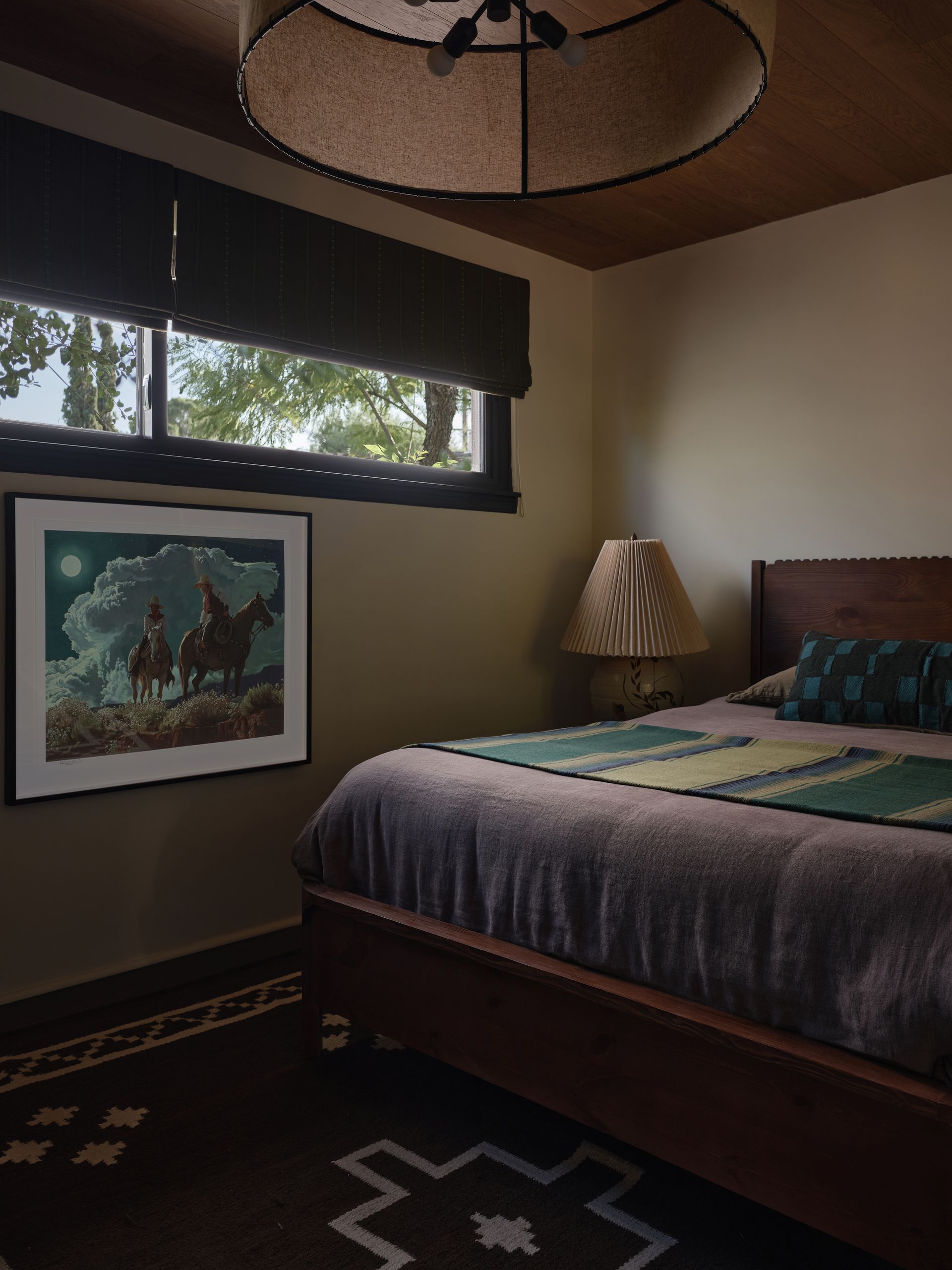
The interiors, meanwhile, speak to a lifelong passion. ‘I have a deep connection with the American Southwest and have long collected Native American and western-influenced art and objects,’ she says. Yet the rooms never tip into pastiche. Midcentury furniture – sourced from MidcenturyLA, Amsterdam Modern and Lawson-Fenning – grounds the collected pieces with clean, modern lines. Rugs from Pampa and Salam Hello add warmth underfoot; drapery by Zak and Fox frames the windows. ‘I never want my work to feel too referential,’ Blazek reflects. ‘I love midcentury lines, so there’s a pleasing blend of both genres throughout.’
Advertisement
Receive our daily digest of inspiration, escapism and design stories from around the world direct to your inbox.
(Image credit: Michael P.H. Clifford)
(Image credit: Michael P.H. Clifford)
Among her favourite moments is the dining room fireplace – original to the house, but updated with dimensional tile from Lofa Tile. Nearby, a framed print by artist Mark Maggiori anchors the wall. ‘It’s one of my favourite pieces,’ she says. ‘I was grateful to finally find the perfect place for it.’
(Image credit: Michael P.H. Clifford)
Advertisement
(Image credit: Michael P.H. Clifford)
Between the ancient craft of adobe and the clean geometry of midcentury design, this renovation represents both preservation and reinvention – a modern hacienda rooted in its land, its past and the strength of Blazek’s vision.