California
California regulators propose plan that could close Aliso Canyon. Or is it just 'kicking the can'?

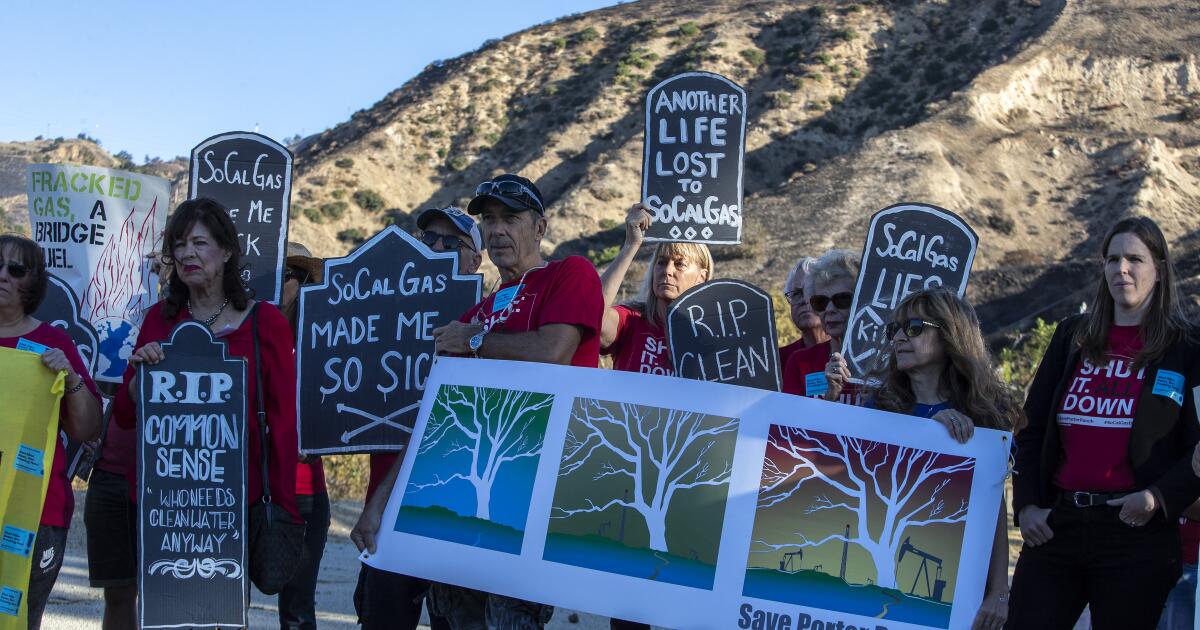
The California Public Utilities Commission this week unveiled a proposal that could potentially close the Aliso Canyon gas storage field in the coming years, but local activists and politicians say it doesn’t provide a fast or clear enough timeline to shut down the site of the largest natural gas leak in American history.
Residents in Porter Ranch and surrounding San Fernando Valley communities have been clamoring to close the Southern California Gas Co.-owned site ever since the leak took place over a four-month period in late 2015 and early 2016. The disaster spewed about 100,000 tons of methane and other chemicals into the air, forcing more than 8,000 families to flee their homes, with many reporting headaches, nosebleeds and nausea.
On Wednesday, the CPUC unveiled a proposed decision regarding the future of Aliso Canyon. The plan, which will be discussed at the commission’s Dec. 19 meeting, calls for moving ahead with potentially closing the site once Southern California’s demand for natural gas declines to a level at which peak demand can be served without Aliso Canyon.
Demand is expected to continue its downward trajectory in the coming years as California increases its utilization of renewable energy sources.
The CPUC proposes initiating proceedings to review and potentially close the facility once the peak demand forecast for two years out decreases to 4,121 million metric cubic feet per day — and a biennial assessment shows that doing so would not jeopardize natural gas reliability or reasonable rates. Current peak demand forecast is 4,618 million metric cubic feet per day, and that is expected to drop to 4,197 million in 2030, according to a CPUC information sheet.
“We continue to review the decision but share the commission’s view that Aliso Canyon is a necessary part of California’s energy infrastructure today,” SoCalGas spokesperson Chris Gilbride said in a statement Friday.
Several politicians who represent Porter Ranch and support closing Aliso Canyon said they are frustrated by what they see as a lack of urgency and clarity around when the site will realistically cease operation.
“The optimism part is that there is a path to shut it down,” Assemblywoman Pilar Schiavo (D-Chatsworth) said in a phone interview. “The skeptical side, however, is there really is no timeline. It’s unclear.”
State Sen. Henry Stern (D-Calabasas) said he wants the CPUC to provide evidence for why a gradual timeline is in the public’s best interest.
“The burden is on the CPUC to prove to the public that this proposal to extend the life of Aliso Canyon is not just a give away to the SoCalGas Company at the expense of the community,” he said in a statement on X.
Los Angeles County Supervisor Lindsey Horvath called the draft decision “unacceptable” in a statement, and said it “fails to prioritize the health and wellbeing of a community that bore the brunt of the worst natural gas leak in American history.”
“My position is unchanged: We need a clear end date and plan for full closure,” she said.
This sentiment was echoed by Matt Pakucko, the president of the advocacy group Save Porter Ranch, which has fought to close the storage facility since shortly after the leak.
He said the commission was “kicking the can down the road” with its proposed biennial assessment process.
“They’re checking every two years instead of immediately closing down the facility as residents and our group have been asking for for years,” Pakucko said.
The company has a contentious relationship with the Porter Ranch community and, in the aftermath of the leak, faced a litany of lawsuits alleging it knew about issues at the site and failed to address the problems. Firefighters also filed suits alleging that the company failed to inform them about the extent of their exposure to harmful chemicals when responding to the leak.
In 2016, SoCalGas pleaded no contest to a misdemeanor count of failing to immediately report the gas leak and, in 2021, agreed to pay up to $1.8 billion to settle the claims of more than 35,000 victims.
Since then, the company has implemented a number of safety improvements at Aliso Canyon as part of various legal settlements and agreements with government agencies.
This includes installing an infrared methane monitoring system, having a state agency complete safety tests on all 114 wells, hiring employees to operate new leak-detection systems 24 hours a day, adopting new reporting policies for releases of hazardous materials and increasing employee safety training.
Pakucko said he places the blame for the gas facility’s continual use on Gov. Gavin Newsom.
“This isn’t an energy issue, it’s a health issue,” Pakucko said.
In 2019, Newsom called on the CPUC to look into accelerating the facility’s permanent shutdown. But in 2023, his appointees to the CPUC voted 5-0 in favor of allowing SoCalGas to store far more fuel at the site to help bring down gas rates.
In a 2023 email, Newsom spokesperson Alex Stack said the governor “appreciates the [Public Utilities Commission’s] efforts to maintain affordable and reliable energy for ratepayers, and he continues to encourage the commission to expedite their work to permanently close the facility as part of California’s transition away from fossil fuels.”
Rising natural gas costs were a big issue last winter when SoCalGas said the average bill for its 21.8 million customers in January 2023 was about $300, more than twice the average of January 2022.
The company blamed unusually cold winter weather and constraints on pipelines and gas storage facilities for the spike in prices. Others blamed the company for mismanaging its inventory and increasing exports to Europe to take advantage of high prices due to the Russia-Ukraine war.

California
California Islamic calligraphy artist preserves ancient tradition during Arab American Heritage Month

As Arab American Heritage Month is celebrated, one Northern California artist is keeping the centuries-old tradition of Islamic calligraphy alive, one carefully measured stroke at a time.
Sehar Shahzad is a student calligrapher. Before starting any project, Shahzad said “one of the first things that calligraphers learn is how to cut their pens.”
Her tools must be in pristine condition.
“Your instruments are just as important as anything else in this art,” she said.
Shahzad said that as a young girl growing up in Toronto, she took up Islamic calligraphy while reflecting on her religion.
“It’s not like I’d never seen it before, but it was my first time kind of trying it,” she said. “And there’s no other way to say it except that I just fell in love with it.”
Now married with three children, Islamic calligraphy is very much part of her life.
“I remember thinking that this isn’t something that I just want to learn for fun,” she said. “I really want to be able to master it.”
Shahzad said that every angle and curve follows strict geometric rules and is measured with dots.
“For example, this letter here was just a little bit too long, so we use these nuqtas to help us guide and understand how long that letter should be,” she said.
Like the Arabic language, Islamic calligraphy is read from right to left. Its bold simplicity requires precision and a deep understanding of proportion.
“When you’re creating a composition, it’s not only about the letter itself,” Shahzad said. “It’s about composition as a whole and making sure that everything balances together.”
Even though she’s still mastering her form, Shahzad’s work is featured in the prayer room of a Muslim cemetery in Napa and in the domes of mosques in San Jose, Hayward, and San Francisco.
Still, she considers her work on paper the most special.
“A form of meditation, a form of worship, requires focus, requires discipline, really brings me to a different space,” Shahzad said. “And I think that’s what I love most.”
Proving that in this fast-paced world, this millennia-long tradition is far from disappearing.
Shahzad’s work will be featured at the upcoming Light Upon Light art exhibit at the Tarbiya Institute in Roseville from April 24-26.

LOS ANGELES (KABC) — California Attorney General Rob Bonta on Tuesday highlighted what he called historic progress in the state’s fight against gun violence.
“California has achieved something historic with the lowest rates of firearm deaths, suicides and homicides on record,” he said during a press conference.
According to Bonta, in 2024, California saw the lowest numbers of firearm-related deaths since 1968. That also drove the state’s overall homicide rate to its lowest level on record in Centers for Disease Control and Prevention data, Bonta’s office said.
However, Bonta warned lawmakers that those gains could be at risk without continued investment.
“This progress is fragile,” he said. “It was driven in part by significant investments that are now declining or disappearing, and without continued and increased investment, we risk losing it.”
Bonta urged policymakers to continue advancing gun violence prevention efforts and education initiatives.
To learn more, click here.
Copyright © 2026 KABC Television, LLC. All rights reserved.
California
California lawmaker introduces bill to protect wildlife from euthanasia, create coexistence program

A Southern California state senator has proposed a new law that would prevent euthanasia in the state’s wildlife just a month after a mother bear was put down for swiping at a woman in Monrovia, feet away from where her two cubs were located.
The legislation, SB 1135, which was introduced by Sen. Catherine Blakespear (D-Encinitas), calls for the establishment of a state program that promotes the coexistence with wildlife and codifies a wolf-livestock coexistence and compensation program. The move comes two years after funding for a similar wildlife coexistence program expired.
“We can and must responsibly support people and wild animals to exist in a California where we are all under growing pressures and cumulative threats like extreme heat, frequent drought and intense wildfires that animals respond to by moving in search of resources to survive,” Sen. Blakespear said in a statement. “That means investing in science-based, situation-specific, proactive strategies to minimize negative interactions and prevent escalation to conflicts that pose risks for people and animals. SB 1135 proposes a program to better protect people, wildlife and communities.”
The proposed coexistence program, which would be allocated nearly $50 million through the state’s 2026-27 budget, would build on the previous version, which deployed trained regional human-wildlife conflict staff around the state. The absence was noted by CDFW leaders during a state Assembly meeting in January, according to Blakespear.
“Over the last five years, wildlife incident reports logged by the California Department of Fish and Wildlife (CDFW) increased by 31 percent and calls, emails and field contacts rose by 58 percent,” Blakespear’s proposal says.
She noted the recent headline across the state, including “Blondie,” the Monrovia mother bear who was captured and put down by wildlife officials in March after it swiped at a woman near the home it was living under with its two cubs.
The home in question belongs to Richard Franco. He, along with many other Monrovia residents, has documented his encounters with bears over the years, even setting up a system of trail cameras to track the bears’ movements.
“Getting to know her, you could see what a devoted mother she was,” Franco said. “She was always building a nest.”
Read more: Orphaned bear cubs taken to San Diego for care after mom is euthanized for attacking people
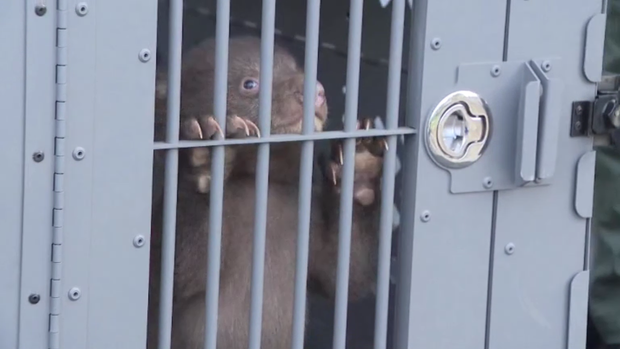
Franco and many of his neighbors were angered upon learning that CDFW officials had euthanized Blondie after her capture, which they credited to the fact that she had swiped at the woman days earlier and another person in 2025.
“Forcing them out, and then euthanizing the mom was just traumatic for us,” said one Monrovia couple. “It was just tragic, and there was no need for it; it was completely unnecessary.”
Situations like this are what caught Blakespear’s attention, leading to her proposal last week.
“It is really my desire to make sure that wild places stay wild, and not be having to resort to lethal measures like killing bears or killing wolves,” Blakespear said, while speaking with CBS LA. “We need to have a program that is up and going so we can be educating people.”
The program calls for focus on public education, maintaining a statewide incident reporting system and deploying devices like barriers, noise and light machines and other technology that would deter predators from places where they shouldn’t be.
SB 1135 passed on a 5-1 vote and will now be considered by the Senate Appropriations Committee.
-

 Health5 minutes ago
Aging in Place: How Technology Might Help You Grow Old at Home
-

 Culture17 minutes ago
Book Review: ‘Israel: What Went Wrong?,’ by Omer Bartov
-

 Lifestyle23 minutes ago
Street Style Look of the Week: Airy Beachy Clothes
-

 Education29 minutes ago
École des Sables, Africa’s Premier Dance School, Faces a Precarious Future
-

 Technology35 minutes ago
It’s amazing how good Alienware’s $350 OLED monitor is
-

 World41 minutes ago
Iran reportedly fires on three ships in Strait of Hormuz
-

 Politics47 minutes ago
WATCH: Sen Warren unloads on Trump’s Fed nominee Kevin Warsh in explosive hearing showdown
-

 Health53 minutes ago
Grieving mom hospitalized with rare ‘broken heart syndrome’ after veteran son’s suicide