Arizona
Top Arizona water official has backup plan if states can't work out deal to divide Colorado River water

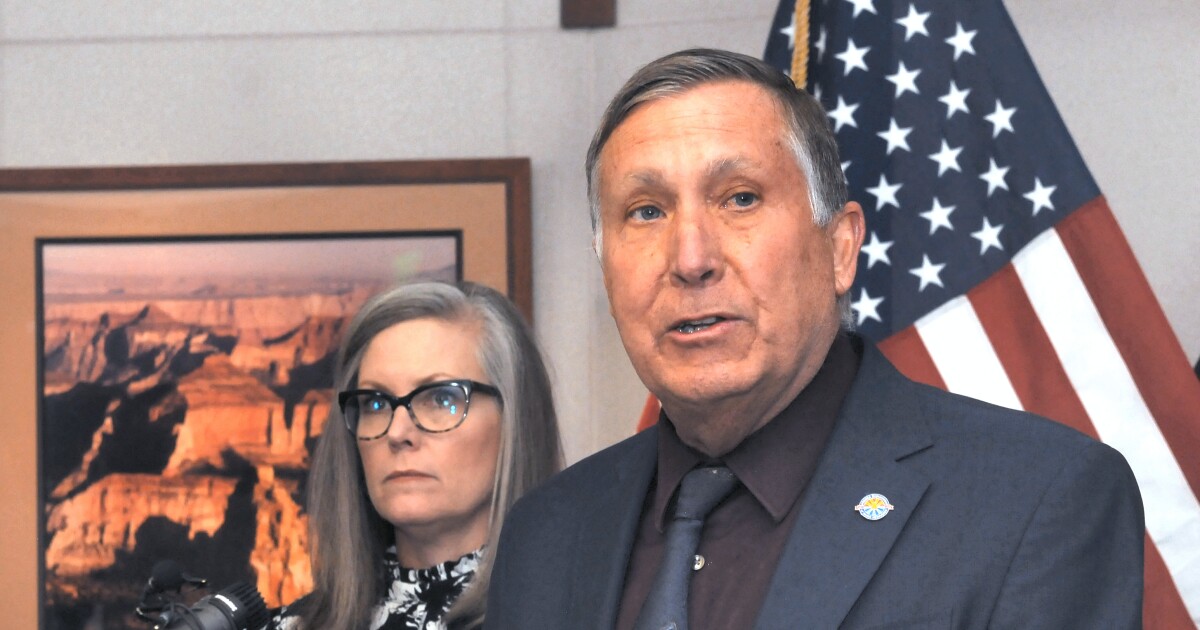
By Howard Fischer
Capitol Media Services
PHOENIX — The state’s top water official is making contingency plans for a court fight if a deal can’t be worked out with other states for how to divide up Colorado River water in 2026 and beyond.
Tom Buschatzke wants Gov. Katie Hobbs and state lawmakers to give him $1 million in what he is calling a “set-aside appropriation” in case there is no agreement — at least not to the state’s satisfaction — in the ongoing negotiations over the river.
Ideally, he said, it won’t be necessary and the seven states, various tribes and federal agencies will work out a deal. But the director of the Department of Water Resources told Capitol Media Services that is far from a sure thing.
“We don’t want war, we want peace,” he said of himself and water officials from the other six states that share in river water. “We want a collaborative solution.”
That also means working it out among themselves versus having something imposed on them by then courts or Congress, a fiat that could result in orders to make nearly impossible reductions in Arizona’s access to the river.
And it’s not like conditions are likely to get better.
“We’re getting projections from climate change scientists that our future is more drier — and maybe even more drier than maybe over the last 20 or so years,” Buschatzke said.
The immediate problem is that the federal Bureau of Reclamation says that climate and other projections show that total available water in the system will need to be cut by up to another 4 million acre feet a year — above and beyond already imposed and voluntary reductions.
More to the point, the upper basin states of Colorado, New Mexico, Utah and Wyoming don’t want to share in the burden. Instead, they want all of that reduction to come from the lower basin states of Arizona, California and Nevada which they say have drained the reservoirs and should be responsible for refilling them
“There is a significant possibility that this process could result in litigation between the states,” Buschatzke said. “In the event that there is litigation, the most likely venue for the proceedings would be federal court, the U.S. Supreme Court, or both.”
Hence, he said, the need for the money.
“If the collaborative and cooperative partnership does not bear fruit, Arizona may need to react/engage in legal action to protect its current 2.8 million acre feet of Colorado River entitlement,” Buschatzke said. “Litigation can be a very lengthy and expensive process.”
But the request for funds is more than about having $1 million set aside to hire lawyers should a court fight become necessary. Buschatzke also is seeking to send a message to the other states that Arizona will not be bullied.
“It is a significant commitment to demonstrate Arizona’s commitment to protecting its entitlement from the Colorado River,” he said.
All this comes as the current guidelines for operations of the river expire at the end of 2025. And the director of the Department of Water Resources said his agency is currently involved in negotiations with the seven “basin” states that all claim a share of the Colorado River as well as the U.S. Bureau of Reclamation.
What Buschatzke wants is to maintain its current entitlement to 2.8 million acre feet a year. An acre foot is generally considered enough to supply three homes for a year. That, on paper, is Arizona’s share of the 15 million acre feet of river water.
States, however, haven’t taken their full allocation for years amid historically dry weather.
The lower basin states are entitled to 7.5 million acre feet. This past year they took less than 5.9 million acre feet.
And this year Arizona is taking only about 1.9 million acre feet of its 2.8 million allocation, agreeing to leave water in Lake Mead to ensure that does not dry up to a point where no water flows through the dam.
Now it’s about what happens next.
The Bureau of Reclamation is set to issue an Environmental Impact Statement in December. That should have the final numbers of what the agency expects to be available in Colorado River water for the foreseeable future.
A balanced approach, said Buschatzke, would be for half of that 4 million acre feet — or whatever the final number will be — allocated among the upper basin states, with the balance among the lower basin states. Put simply, it’s easier — and less painful — on any one state if all share.
And that’s particularly important for Arizona which has a “junior priority” over the available water.
But to this point, he said, the upper basin states want no part of it. In fact, Buschatzke said, the upper basin states want more water left in Lake Powell, something he said would have the ripple effect of making less water available for Lake Mead.
“We can’t come to a place where Lake Powell is three-quarters full and Lake Mead is essentially empty,” he said.
What’s also important, said Buschatzke, is coming up with more than a stop-gap plan that lasts just three or four years. He said any agreement should go out at least 20 years or more.
All this comes back to Buschatzke’s decision to request $1 million for the legal fight that may be on the horizon.
“I have a responsibility to do due diligence and be prepared for multiple potential outcomes,” he said.
“One of those potential outcomes could be a time at which the Central Arizona Project could be completely dry because of certain interpretations of what a junior priority might mean,” Buschatzke said. “And I think you could imagine that that would be quite an economic and political disaster for that outcome.”
A spokesman for Gov. Katie Hobbs said no decision has been made whether to include his request in what she submits to the Legislature in January.
And if its not funded this coming year?
“Arizona faces the possibility of being unprepared for legal action regarding its Colorado River entitlement in the event that the current collaborations and negotiations do not bear fruit,” he said.
—–
On X and Threads: @azcapmedia



PHOENIX (AZFamily) — A ceasefire announced Tuesday will suspend the war in Iran for two weeks and Iranian officials said they will negotiate with the United States starting Friday.
President Donald Trump agreed to a deal hours after he posted “a whole civilization will die tonight” on social media.
Before news broke about the cease-fire, Democratic Rep. Yassamin Ansari of Arizona introduced articles of impeachment Monday against Defense Secretary Pete Hegseth.
Ansari, the daughter of Iranian immigrants, is also part of a growing list of Democrats calling for Trump to be impeached.
“Iran is a country of 90 million people. Threatening them with annihilation is a monstrous war crime and puts them and American service members and Americans at grave risk,” Ansari said in a video posted Monday on social media. “As a chief enabler of this illegal war, Pete Hegseth is responsible for directing this insane military action against Iran, which has already killed thousands of civilians, led to the unnecessary deaths of American service members, and displaced over a million people in the region.”
Not everyone with strong ties to Iran agrees with her.
“I don’t see why they should be impeached,” said Amirdanial Azimi. He is the president of the Iranian Students Association at Arizona State University (ASU). He grew up in Iran and has family and friends there right now.
“Speaking to my friends and relatives, I’ve realized that they’re more scared of their own government than they are like external forces like the United States and Israel,” Azimi said.
Azimi predicted Trump would not follow through with his threat to destroy Iran.
“I do take offense, like Iranians do take offense, like they don’t want their civilizations to be wiped off,” Azimi said. “This is the fault of the Iranian regime, their government, because they’ve been chanting death to Israel, death to America for the past years.”
Hessam Rahimian is a refugee turned American citizen. He said he escaped Iran decades ago, where his uncle was murdered and his cousins remain in jail. He said schoolchildren are taught to chant “death to America” every day.
He said he has hundreds of family members and friends still in Iran. In Arizona, Rahimian organizes rallies in support of the war to raise awareness about the reality of life in Iran and the thousands of protesters killed by the Iranian government.
Before the attack was called off, Rahimian said it was challenging to process Trump’s threat to wipe out his home country.
“So he did say that, but he has also said, in the same token today, that the Iranian people are good people, and he will do his best to make sure that they’re safe. So which one you go with, again, I go back to his actions in the past year, it has been against the Islamic regime and not the Iranian people,” Rahimian said. “Would I like for him not to use that language? Of course, absolutely. But we also know that the war talk takes place and they say things to create fear.”
Daniel Rothenberg is a politics and global studies professor at ASU. He said the biggest question is why the U.S. is at war in the first place.
“This is, above all, a war of choice. The U.S. was not attacked. There was no imminent threat from Iran,” Rothenberg said.
Rothenberg said Trump has not clearly explained the point of the war that is costing billions of dollars a day and countless human lives or what a victory would look like.
“Wars tend to end through negotiations, not through military victory,” Rothenberg said. “I mean, what does it mean to wipe out a civilization? And frankly, why would you even make that sort of threat? What’s the purpose?”
See a spelling or grammatical error in our story? Please click here to report it.
Do you have a photo or video of a breaking news story? Send it to us here with a brief description.
Copyright 2026 KTVK/KPHO. All rights reserved.
Arizona
Kroger, Albertsons sued by Arizona, seven other states seeking antitrust lawsuit expense reimbursement

Kroger Co. and Albertsons Cos. Inc. have been sued by Arizona and seven other states and the District of Columbia, all of which are seeking to be reimbursed for costs they incurred while fighting a merger between the two grocers that later failed on antitrust grounds.
The coalition of plaintiffs, which also includes the Federal Trade Commission, is seeking $10.3 million from Cincinnati-based supermarket giant Kroger and Boise, Idaho-based grocery rival Albertsons, according to the lawsuit filed March 31 in U.S. District Court in Portland, Ore.
Kroger is the parent company of Fry’s Food Stores in the Valley, and Albertsons owns the Safeway brand in Arizona.
Read more of this story from the Business Journal.

Amid the ongoing spring heat, Arizona is in store for even hotter summer months. FOX 10’s Irene Snyder learns how Arizonans can stay safe and cool, while avoiding fire risks.

Byron Allen’s “Comics Unleashed” replacing Colbert’s “Late Show”

SoMa residents file complaint with state, accusing SF of pushing unhoused resources to their area

CGY@DAL Postgame: Wyatt Johnston | Dallas Stars

Strong storm topples trees, damages homes in a Miami-Dade neighborhood, with days of cleanup ahead for residents

How RFK Jr. changed my mind about Dunkin’ – The Boston Globe

Florida High School Football Rankings: Top 25 teams – Oct. 21

How old is Bo Nix? What to know about Oregon quarterback ahead of 2024 NFL Draft

Cleary's 21 help Le Moyne down Central Connecticut State 69-64 in OT

99th annual Pony Swim held in Virginia

Indiana Members Credit Union announced as new anchor tenant at Bottleworks District

Democrat swing candidate called Biden’s border handling ‘a huge misstep’ after backing his approach as mayor

‘Policy of abuse’: Women march in Cuba against US energy blockade

Acting AG says ‘Nobody has any idea why’ Pam Bondi was fired except for Trump | CNN Politics

Ilhan Omar calls Trump an ‘unhinged lunatic,’ urges booting him out of office
Between Budapest and Brussels: Péter Magyar’s political tightrope
-

 Atlanta, GA3 days ago
1 teenage girl killed, another injured in shooting at Piedmont Park, police say
-

 South-Carolina1 week ago
South Carolina vs TCU predictions for Elite Eight game in March Madness
-

 Movie Reviews6 days ago
Vaazha 2 first half review: Hashir anchors a lively, chaos-filled teen tale
-

 Vermont1 week ago
Skier dies after fall at Sugarbush Resort
-

 Politics1 week ago
Trump’s Ballroom Design Has Barely Been Scrutinized
-

 Politics1 week ago
JD Vance says he was ‘obsessed’ with UFOs, believes aliens are actually ‘demons’
-

 Atlanta, GA1 week ago
Fetishist ‘No Kings’ protester in mask drags ‘Trump’ and ‘JD Vance’ behind her wheelchair
-
 Entertainment6 days ago
Inside Ye’s first comeback show at SoFi Stadium