Arizona
Autopsies show Arizona teens were both shot in the head while camping


Man arrested in connection to teens’ shooting deaths appears in court
Thomas Brown, who was arrested in connection to the shooting deaths of Evan Clark and Pandora Kjolsrud, appeared in court on Oct. 3, 2025.
A 17-year-old boy who was fatally shot while camping with a female classmate northeast of Phoenix died from gunshot wounds to the head, according to the first page of his autopsy report.
Evan Clark, 17, and Pandora Kjolsrud, 18, were camping just off State Route 87 near Mount Ord when the two were shot and killed. Investigators discovered their bodies, which had been moved into nearby brush to conceal them, on May 26, 2025.
The first page of Clark’s autopsy report, which The Arizona Republic obtained March 3, found that his death was a homicide with multiple gunshot wounds to the head. The first page of Kjolsrud’s autopsy report also ruled her death a homicide with her cause of death being gunshot wounds to the head and upper body.
Maricopa County Sheriff’s Office detectives ultimately arrested Thomas Brown, 31, of Chandler on Oct. 2, 2025, in connection with their deaths. Brown was indicted on two counts of first-degree murder and remained in jail on a $2 million cash-only bond.
Detectives found Brown’s DNA on gloves inside Clark’s SUV that had Kjolsrud’s blood on them as well, the Sheriff’s Office said.
Partial autopsy reports made available following legal fight
While The Republic has obtained the first pages of both Clark’s and Kjolsrud’s autopsy reports, the remaining pages appeared to remain sealed as of March 3 since Simone Kjolsrud, Pandora’s mother, petitioned to have the autopsy reports sealed or redacted. Simone Kjolsrud argued that various details about her daughter and aspects of her personal life, potentially included in such documents, should remain private and outweigh the public’s right to know.
A Sept. 25, 2025, motion that sought to block the report’s release argued the report could contain information law enforcement hasn’t yet shared and could impair the ongoing criminal investigation.
“Simone Kjolsrud fears that, if released, her daughter’s Medical Examiner’s Report may end up on the internet or be broadcast on the news, which would undoubtedly cause additional trauma and even jeopardize her constitutional right to justice in this case,” the motion stated.
Kjolsrud asked that Clark’s autopsy be sealed as well, arguing that it would likely contain details similar to her daughter’s.
Matthew Kelley, an attorney representing The Republic and other Arizona media outlets, previously objected to the autopsies being sealed and asked that the temporary protective order be vacated.
“To be sure, these killings are particularly traumatic for a surviving family member,” Kelley wrote in his objection. “But the pain felt by a family member cannot override the public’s right to inspect public records reflecting the performance of law enforcement and other public agencies entrusted with investigating such crimes. A veil of secrecy only raises unnecessary speculation about such public performance.”
It was not immediately clear whether Maricopa County Superior Court Judge Geoffrey Fish, who initially ordered the autopsies remain sealed as he reviewed their contents, would unseal additional pages in their entirety or with redactions.
Reach the reporter Perry Vandell at perry.vandell@arizonarepublic.com or 602-444-2474. Follow him on X, formerly known as Twitter, @PerryVandell.



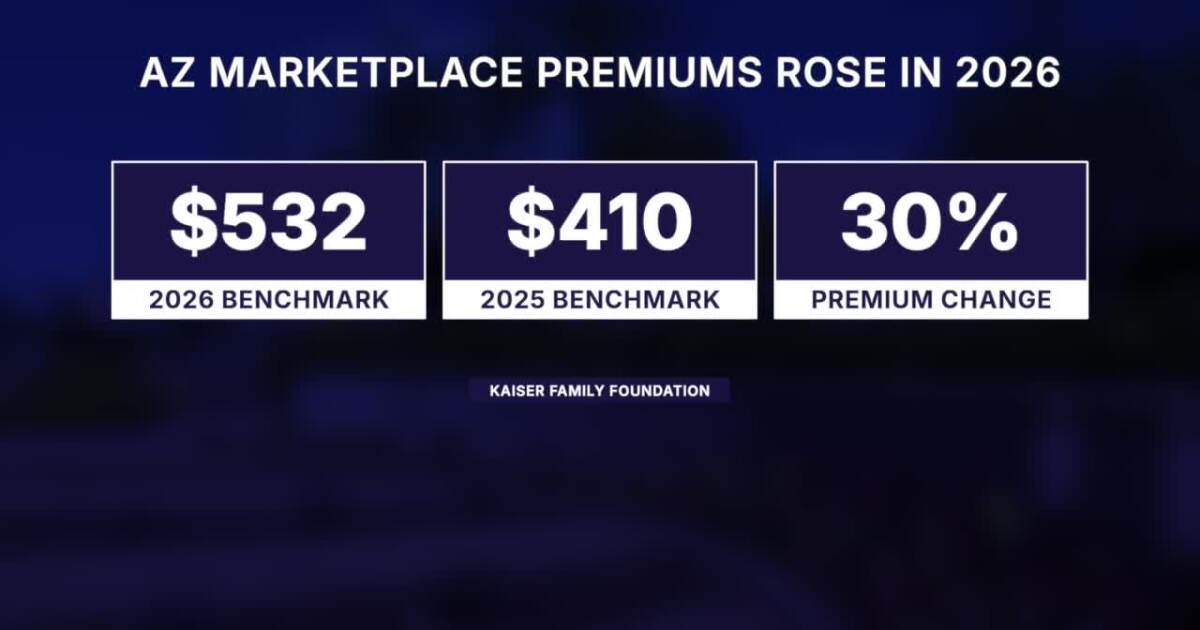
PHOENIX — Arizona’s ACA marketplace enrollment fell from 363,000 to just over 255,000 in a single year — a nearly 30% decline and the third-largest annual drop in the country.
Rising premiums and expired tax credits are driving the trend, with the average benchmark plan premium in Arizona now at $532 — up 30% from 2025.
In the player above, ABC15 Data Analyst Garrett Archer takes a look inside the numbers on how healthcare premiums are impacting health insurance enrollment.
This story was reported on-air by a journalist and has been converted to this platform with the assistance of AI. Our editorial team verifies all reporting on all platforms for fairness and accuracy.
Want more news in your community? Add ABC15 as a preferred source on Google below:

Arizona
Arizona man pleads guilty after illegally living in forest for years among ‘1,000lbs of trash’

A man in Arizona has pleaded guilty to violating federal fire restrictions and unlawfully residing in a national forest, after authorities said he spent years living at a makeshift campsite surrounded by what officials described as “approximately 1,000 pounds of trash”.
Mark Aaron Gatz was arrested on 25 June at his illegal campsite in Arizona’s Tonto national forest, according to court records. A United States Forest Service (USFS) officer wrote in documents submitted to court that Gatz had been operating an “illegal campsite” with a “hot wood burning campfire” despite fire restrictions and that he had told investigators that he had been living in the forest for about eight years.
The officer wrote that a records check found that Gatz had previously received multiple citations and was the subject of six outstanding federal arrest warrants for earlier violations, including for building fires during fire restrictions, constructing on national forest service lands, unsanitary conditions and occupying national forest as a residence.
Gatz “said that he knew about current fire restrictions but had to have fire to eat”, authorities said. The documents show that USFS officers made contact with Gatz multiple times over the last year or so, and issued him warnings as well as a violation notice for having campfires during fire restrictions.
Notes from officers’ previous encounters with Gatz earlier this year, submitted into the court docket, state that authorities observed “trash such as clothing, pans, tools, and plastic cups scattered throughout the campsite along with a structure that was four feet in height build using wood panels”.
During an encounter with Gatz in May, officers reported observing “approximately 1,000 pounds of trash” at the site, which they said included tires, plastic bags, trash bags, aluminum cans and other items. They also wrote that they found that the campfire site had been left unattended by Gatz the previous day while still hot.
In a separate report filed by law enforcement from an encounter in February, one officer wrote that “upon arrival at the camp, I was flabbergasted by the amount of debris in the area”.
Investigators said that during that encounter, the debris consisted of three ladders, six to eight totes “overfilled with debris”, five 55-gallon drums, eight tires, multiple bicycle frames, 5 gallons of motor oil, plywood and other “miscellaneous lumber”, and they wrote that trash was scattered over approximately half an acre of Forest Service land and creating what officers described as public safety concerns.
In a separate report from July 2025, officers said they observed what they described as a “large messy campsite” while patrolling the area due to complaints “from the district office abut one large messy camp”.
“There was roughly half an acre of resources ruined due to so much trash and goods on the ground for an extended period of time,” the officer wrote.
This week, after Gatz pleaded guilty, he was sentenced to time served and three years of probation, according to court records.
A representative for Gatz did not immediately respond to a request for comment.

Odds of winning the Powerball and Mega Millions are NOT in your favor
Odds of hitting the jackpot in Mega Millions or Powerball are around 1-in-292 million. Here are things that you’re more likely to land than big bucks.
The Arizona Lottery offers multiple draw games for those aiming to win big.
Here’s a look at Tuesday, July 7, 2026 results for each game:
Winning Mega Millions numbers
02-31-35-36-63, Mega Ball: 12
Check Mega Millions payouts and previous drawings here.
Winning Pick 3 Evening numbers
Evening: 4-7-2
Winning Fantasy 5 numbers
03-05-10-14-37
Check Fantasy 5 payouts and previous drawings here.
Winning Triple Twist numbers
03-06-18-23-27-32
Check Triple Twist payouts and previous drawings here.
Feeling lucky? Explore the latest lottery news and results
What time is the Powerball drawing?
Powerball drawings are at 7:59 p.m. Arizona time on Mondays, Wednesdays and Saturdays.
How much is a Powerball lottery ticket today?
In Arizona, Powerball tickets cost $2 per game, according to the Arizona Lottery.
How to play the Powerball
To play, select five numbers from 1 to 69 for the white balls, then select one number from 1 to 26 for the red Powerball.
You can choose your lucky numbers on a play slip or let the lottery terminal randomly pick your numbers.
To win, match one of the 9 Ways to Win:
- 5 white balls + 1 red Powerball = Grand prize.
- 5 white balls = $1 million.
- 4 white balls + 1 red Powerball = $50,000.
- 4 white balls = $100.
- 3 white balls + 1 red Powerball = $100.
- 3 white balls = $7.
- 2 white balls + 1 red Powerball = $7.
- 1 white ball + 1 red Powerball = $4.
- 1 red Powerball = $4.
There’s a chance to have your winnings increased two, three, four, five and 10 times through the Power Play for an additional $1 per play. Players can multiply non-jackpot wins up to 10 times when the jackpot is $150 million or less.
Are you a winner? Here’s how to claim your lottery prize
All Arizona Lottery retailers will redeem prizes up to $100 and may redeem winnings up to $599. For prizes over $599, winners can submit winning tickets through the mail or in person at Arizona Lottery offices. By mail, send a winner claim form, winning lottery ticket and a copy of a government-issued ID to P.O. Box 2913, Phoenix, AZ 85062.
To submit in person, sign the back of your ticket, fill out a winner claim form and deliver the form, along with the ticket and government-issued ID to any of these locations:
Phoenix Arizona Lottery Office: 4740 E. University Drive, Phoenix, AZ 85034, 480-921-4400. Hours: 7:30 a.m. to 5 p.m. Monday through Friday, closed holidays. This office can cash prizes of any amount.
Tucson Arizona Lottery Office: 2955 E. Grant Road, Tucson, AZ 85716, 520-628-5107. Hours: 7:30 a.m. to 5 p.m. Monday through Friday, closed holidays. This office can cash prizes of any amount.
Phoenix Sky Harbor Lottery Office: Terminal 4 Baggage Claim, 3400 E. Sky Harbor Blvd., Phoenix, AZ 85034, 480-921-4424. Hours: 8:30 a.m. to 5 p.m. Monday through Sunday, closed holidays. This office can cash prizes up to $49,999.
Kingman Arizona Lottery Office: Inside Walmart, 3396 Stockton Hill Road, Kingman, AZ 86409, 928-753-8808. Hours: 8 a.m. to 8 p.m. Monday through Friday, 8:30 a.m. to 5 p.m. Saturday and Sunday, closed holidays. This office can cash prizes up to $49,999.
Check previous winning numbers and payouts at https://www.arizonalottery.com/.
This results page was generated automatically using information from TinBu and a template written and reviewed by an Arizona Republic editor. You can send feedback using this form.
-

 Sports6 minutes ago
Caitlin Clark’s return falls flat after Fever coach limits her in loss to shorthanded Sparks
-
Business14 minutes ago
Commentary: Trump wants to let companies make fewer disclosures, thus keeping investors in the dark
-
 Entertainment21 minutes ago
Justin Baldoni and wife break silence after ‘It Ends With Us’ legal battle with Blake Lively
-
 Lifestyle24 minutes ago
A meal with an animated Mona Lisa? Immersive dining goes high tech — but will L.A. eat it up?
-
 Politics29 minutes ago
Nexstar launches its first digital subscription service with The Hill Insider, aimed at political junkies
-
 Science36 minutes ago
Not everyone is leaving California. A new commercial battery maker just landed in Sacramento
-
 Sports39 minutes ago
Mookie Betts’ eighth-inning single gives Dodgers the win over the Rockies
-
World51 minutes ago
From sewers to swimming sites: how Europe's cities reclaim their rivers


