Arizona
Audit on Arizona's voter data coding problem released

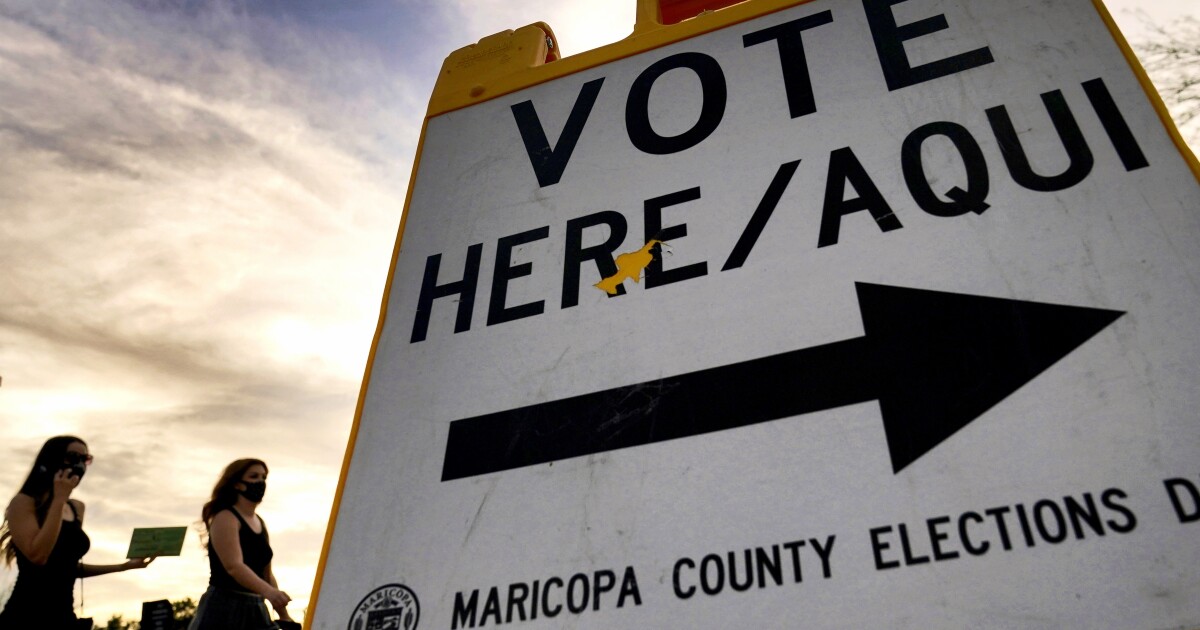
A review of how some noncitizens were allowed to register to vote in Arizona confirms an ABC15 Investigators report that uncovered incompatibilities between state laws for obtaining driver licenses and registering to vote.
Arizona is the only state in the nation to require proof of citizenship to register to vote. About 218,000 voters may not have provided proof due to systemic database issues stretching back 20 years. The problems became public in September, shortly before the 2024 election.
Gov. Katie Hobbs on Friday released a bipartisan audit she ordered in the fall after the issues came to light. It recommends closer coordination between the Motor Vehicle Division, which issues driver licenses, and the Secretary of State’s Office, which maintains voter rolls, as well as county recorders.
“Finding regular time to share information and build relationships between the MVD and election officials will help eliminate issues in the future,” the report states.
ABC15 is committed to finding the answers you need and holding those accountable.
Submit your news tip to Investigators@abc15.com
The MVD and voter roll systems have been reprogrammed, but the audit also notes that state law could still allow some U.S. nationals who are not citizens to register to vote. Arizona law accepts passports as proof of citizenship, but passports are issued to some people who are not citizens, such as U.S. nationals from American Samoa and Swains Island.
The MVD does not know how many people this could affect but believes the number is very small, according to the audit.
Audit cites ABC15 reporting from 2016 on noncitizen who registered to vote
The audit details how the problems affecting Arizona’s voter rolls persisted for decades and confirms ABC15 reporting that the database issues could have been identified and fixed years ago.
In September, then-Maricopa County Recorder Stephen Richer and Secretary of State Adrian Fontes announced they had found a data coding error in Arizona’s driver’s license database that allowed at least one non-citizen to register to vote.
Initial estimates found the data errors affected about 218,000 people, 5% of all Arizona voters, who may not have provided documentary proof of citizenship to register as required by Proposition 200, which became law in 2004. These voters were initially issued a driver’s license prior to 1996, before state law required proof of citizenship for licenses.
In October 2016, ABC15 reported on how a non-citizen was able to register to vote in Maricopa County. At the time, Alan Faygenblat described his actions as an attempt to see “if the system really worked” in preventing voter fraud.
“I didn’t want to get in trouble,” he told ABC15 then.
Faygenblat was criminally charged with false voter registration and pleaded guilty in 2017.
According to court records, Faygenblat was an Israeli citizen who was legally in the United States, but he falsely checked a box saying he was a citizen on the Service Arizona website. He received a voter registration card in the mail.
The Maricopa County Recorder’s Office in 2016 described his registration as a loophole.
“Any person who got a driver’s license after 1996 had to prove citizenship to the MVD. (The individual) had gotten a driver’s license in 1994 so he did not need to prove citizenship. However, for some reason after 1996, he had to get a new license reissued to him and he was never scanned for citizenship at that point,” a recorder’s spokesperson had told ABC15.
Then-Recorder Helen Purcell dismissed the idea this could lead to widespread fraud.
“I think we check it thoroughly enough that’s not the case,” she told ABC15.
Neither the secretary of state nor other election officials asked for changes after the ABC15 story, the audit says.
The same loophole was again discovered in 2024 – eight years later – with a new noncitizen who registered to vote in Maricopa County.
According to an internal report from December, Secretary of State’s Office staffers also discovered the miscoding in two separate instances in 2017 and 2020.
Hobbs, who was secretary of state in 2020, sent current Secretary of State Adrian Fontes a letter critical of that report’s findings, saying the review appeared to be focused on finding someone to blame.
The governor in her letter indicated that the Maricopa County Recorder’s Office, which Fontes headed in 2020, had been made aware of the incident.
The voters affected by the miscoding were allowed to cast a full ballot in November. But county recorders still need to contact those voters for proper documentation of citizenship before the next election.
State and county elections officials also need to decide what to do about a list of approximately 7,000 voters who have an inactive MVD record, according to the governor-ordered audit.



Believe it or not, the 2026 All-Star Game voting process has already begun, as of Wednesday. Fans who want to see their favorite members of the Arizona Diamondbacks take the field in the midsummer classic this season can begin voting for their stars.
There are certainly some deserving players on this Diamondbacks club, which is currently 32-28 and occupying the third Wild Card sport in the National League.
Here’s how and where you can vote for your hometown heroes:
How to vote for Diamondbacks players to make All-Star Game
Fans can utilize the following link to vote for members of their team on dbacks.com. Fans are permitted to fill out and submit as many as five ballots per day, selecting as many or as few players as they choose.
This period of the fan vote constitutes Phase 1 of All-Star voting, which will run from Wednesday, June 3 through Thursday, June 25 at 9:00 a.m. Arizona time (12:00 p.m. Eastern time).
Following Phase 1, the two overall top vote-getters will receive automatic berths into the All-Star lineups. If those two are not Shohei Ohtani and Aaron Judge once again, that would be an upset.
When and where is the 2026 All-Star Game?
The 2026 All-Star Game will take place at Citizens Bank Park, home of the Phillies in Philadelphia. All-Star week begins on June 10, with a full slate of activities, before the game is played on Tuesday, July 14 at 8:00 p.m. Eastern time (5:00 p.m. Arizona time).
The full schedule of events are as follows:
- Friday, July 10: HBCU Swingman Classic
- Saturday, July 11: 2026 MLB Draft
- Sunday, July 12: All-Star Sunday, MLB Futures Game, MLBx All-Star 3-on-3
- Monday, July 13: T-Mobile Home Run Derby (8:00 p.m. ET)
- Tuesday, July 14: All-Star Red Carpet, All-Star Game
Which Diamondbacks are deserving All-Stars?
| Mark J. Rebilas-Imagn Images
So, who should Diamondbacks fans vote for? Obviously, you may fill out the ballot however you choose. That can include a full roster of Diamondbacks, regardless of their stats or notoriety this season.
Still, here are some of the top performing D-backs who might have a leg up on an All-Star berth:
OF Corbin Carroll
Corbin Carroll is having another All-Star worthy season. He’s hitting .289/.380/.545 with a .925 OPS and eight home runs, while playing good right field defense. He has the eighth-most bWAR (2.7) among position players, fifth-most in the National League, and third-most among all pure outfielders.
2B Ketel Marte
If Marte wins the NL second base fan vote, it will be his third straight season starting the All-Star game. Despite such a slow start to the year, that feels possible again. Marte is hitting .259/.315/.456 with 10 homers and is playing the best defense of his career.
3B Nolan Arenado
Nolan Arenado is quietly putting together one of his better seasons of the 2020s, slashing .269/.351/.467 with eight homers and flashing his elite third base glove at nearly as good a pace as ever. His name still carries a lot of weight in third base conversations; he’ll get some votes, no matter what.
1B Ildemaro Vargas
Vargas’ bat has cooled down quite a bit since his historic start to 2026. He’s still hitting a sturdy .290/.318/.454, but feels more likely to be considered as a reserve selection than a leading vote-getter.
Honorable Mention: LHP Eduardo Rodriguez
Pitchers are not selected by the fan vote. They are selected by player ballots and the All-Star Game managers. The National League’s manager will be Dave Roberts of the Dodgers, again.
The National League has quite a few talented pitchers, but Eduardo Rodriguez currently holds the fifth-best starting pitcher ERA (2.24) among NL hurlers. It’s going to be difficult to dethrone Christopher Sanchez or Jacob Misiorowski, but Rodriguez could find his way into the pitching pool, especially after his WBC heroics for Team Venezuela.
 Add us as a preferred source on Google
Follow

Arizona State has added Michael White to its coaching staff for the upcoming 2026-2027 season. White will join the program as an assistant coach and recruiting coordinator.
“I am incredibly honored to return to my home state and join this elite program,” White said. “I’m proud to say that I am coming home. I can’t thank Coach Herbie enough for the opportunity to join his incredible staff and help these young athletes grow and develop into the best individuals they can be. There are so many friends and mentors who have left their mark on this program, and I’m excited for the opportunity to leave mine and help take this program to new heights. Go Devils!”
White arrives with the Sun Devils after most recently spending the last three seasons with Alabama as an assistant. The Alabama women finished 11th at the 2026 NCAA Championships while the men were 24th.
Prior to arriving at Alabama, White spent the 2022-2023 season as a volunteer assistant at Wisconsin. He primarily coached the freestyle, breaststroke and distance groups for the Badgers. In addition to coaching the Badgers, he also was an assistant senior coach with the Madison Aquatics Club for the year. He began his coaching career at Juniata College in Pennsylvania as a volunteer assistant from 2019-2021.
White spent his collegiate career at St. Bonaventure in New York. There he was a 7x individual Atlantic-10 champion and swam to three school records as a senior with a 1:47.30 200 IM, 3:52.18 400 IM, and a 1:47.70 200 fly. He also was team captain for two season and helped the team capture the 2014 A-10 team title.
The Scottsdale, Arizona native will return to his home state. He was a 2012 AIA Division I state champion in the 100 breast and 200 IM as a senior for Dobson High School.
White joins the coaching staff led by head coach Herbie Behm, who is already known to be an innovative coach. Behm spoke of White’s innovation as well saying, “Mike is one of the best young coaches in the NCAA. His interview blew me away with the innovative ideas he presented. I can’t wait to start implementing those ideas and continue our growth at ASU.”
Arizona State swept the 2026 Big 12 team titles, and the men went on to finish 4th at 2026 NCAAs while the women were 37th. Rising senior Ilya Kharun captured the NCAA title in the 200 fly with a 1:37.66.
-

 Washington, D.C4 minutes ago
Washington archbishop removes priest as exorcist after comments on UFOs and demons
-

 Cleveland, OH7 minutes ago
Male dead after running from crash scene and shooting another in Cleveland’s Slavic Village neighborhood, police say
-

 Austin, TX12 minutes ago
Austin, TX venue Emo’s on the move again, AEG to take over the building
-

 Alabama19 minutes ago
Alabama Baseball Host St Johns For A Trip To The World Series
-

 Alaska22 minutes ago
First Alaska mule deer harvest follows years of fleeting appearances in the state
-

 Arizona27 minutes ago
Arizona’s dry heat may be deadlier than we thought
-

 Arkansas34 minutes ago
Texas bee swarm hospitalizes 3; Arkansas doctors explain warning signs of severe reactions
-

 California37 minutes ago
California man charged with bringing explosives to Sacramento airport after repeatedly calling FBI tip line | CNN

