Arizona
Data centers are good for Arizona. Here’s why | Opinion


Data centers have gotten a bad rap lately, but here’s why we think they are actually good for Arizona. It starts with jobs.

Chandler City Council votes no on AI data center
Chandler becomes one of the first Phoenix-area cities to reject a data center, despite months of lobbying by former U.S. Sen. Kyrsten Sinema.
Arizona data centers have generated a lot of political heat in recent weeks.
At her State of the State address, Gov. Katie Hobbs questioned the social benefit of data centers and signaled an interest in reinstating a sales tax on data center equipment purchases. Neal Carter, a Republican state legislator, agrees with Hobbs. So too might Republican state legislator Leo Biasiucci.
A month ago, the Chandler City Council unanimously rejected a proposed data center despite the lobbying efforts of former U.S. Sen. Kyrsten Sinema. Hundreds of Chandler residents filled the auditorium for the vote, and 256 residents submitted online comments opposing the data center.
In Tucson, the city council unanimously rejected connecting a large data center (Project Blue) to the city’s water system. Attorney General Kris Mayes is now looking deeper into Project Blue, Tucson Electric Power and the Arizona Corporation Commission.
Here at The Arizona Republic, the opinion section published an editorial on Jan. 20 (Arizona data centers bring hidden water risks), and the news section printed an article on Jan. 18 (Gas power plant for data center project stirs concerns in Surprise), both of which cast data centers in a less-than-flattering light.
And earlier this week, handfuls of speakers at the Corporation Commission blamed data centers for proposed APS rate hikes.
Each situation has its own complexities and justifications (and I’ll get into some of them in future weeks). Some opposition is more factually substantiated than others. But they’re all rooted in a suspicion that these large warehouses of computer servers that power the modern world are no longer great things for Arizona.
Arizona data center benefits starts with jobs
If we may be so bold, and to set the stage for future articles here at the Republic, here are a few reasons why Arizona should celebrate our position as a top 10 state for data centers:
- Jobs. It’s not just the people employed by data centers (many of which are high-paying jobs), but the ancillary jobs needed by data centers: contracted electricians, carpenters, pipefitters, HVAC technicians, etc. PricewaterhouseCoopers (“PwC”) found that data centers accounted for 81,000 jobs in Arizona as of 2023.
- Taxes. It’s the start of the state legislative season and, sadly, this is going to be one of those years in which we hear lots about the things we can’t afford. But data centers help that equation. According to the same PwC report, data centers generated $2.3 billion in state and local tax revenue from 2017 to 2021. That means money for schools and roads. Or lower state income taxes (as happened).
- Tech center. It’s a truism that tech begets other tech. We’ve said this as we’ve celebrated the massive expansions of TSMC and Intel. It’s also true of data centers. And if proprietors of data centers – companies like Amazon and Microsoft – are happy with Arizona as a data center home, they’ll likely consider Arizona a home for other tech investments.
- Buying unwanted power. Normal businesses use power during the day (8 am-5 pm). Homes use power during the evening (5-11 pm). But few users demand power overnight (11 pm-8 am). This means we often have to dump unsold power. But data centers need power around the clock, and they can buy that overnight power, generating revenue for Arizona utility companies that then doesn’t have to be generated from Arizona households.
Those are the benefits.
Detractors focus on power, water and land. They’re all important, but solvable.
On power, public utilities can, and should, ensure data centers pay for all the power they use–not the public. The Salt River Project (SRP) website states this explicitly on its website. APS announced a proposed 45% increase on data center electricity costs to “make sure that (data centers) will continue to pay their fair share.” The recent agreement between Tucson Electric Power and Project Blue intends to do the same. And some data centers are even looking at generating their own power.
Data centers aren’t our biggest water worry
Regarding water, data centers have gotten so efficient at water use that, in some cases, they would use less water than vacant warehouses (of which there are, sadly, many). The Project Blue data center before Tucson City Council promised to be water-positive for the city, and other cities, such as Chandler have proposed caps on water usage by data centers. These caps are the same that apply to other businesses; data centers don’t get a special water deal. And, really, if you’re looking to pin water woes on any industry, it’s not chip-manufacturing, and it’s not data centers. It’s farming (over 70% of Arizona’s water supply goes to agriculture).
Lastly, regarding land, of course people don’t want to have neighborhoods disrupted by massive warehouses. And nobody should feel like they got into a bidding war with a data center for a home in a cute, quiet neighborhood. That’s why we have noise ordinances and zoning laws. Arizona still has plenty of space. The smart people in city planning can figure it out. And unlike big box stores, data centers don’t have 18-wheelers constantly delivering supplies.
Arizona is a state known for growth. We’ve grown massively in residents. We’ve grown massively in housing (and need to do more). We’ve grown massively in tourism. We’ve grown massively in healthcare. We’ve grown massively in education. And we’ve recently grown massively in semiconductors.
There’s no reason we can’t keep growing in data centers.
Stephen Richer is the CEO of Republic Affairs, a fellow at the Cato Institute, and a former Maricopa County Recorder. Josh Heywood is operations manager at Republic Affairs.



Cardinals’ Burch shares what he learned as a rookie in 2025
Arizona Cardinals second-year player Jordan Burch says his defensive line teammates have formed a bond heading into the 2026 NFL season.
Last year in early July, Cardinals edge rusher Jordan Burch was a rookie third-round draft pick out of Oregon who was looking forward to his first NFL training camp and eventual first season.
That rookie year is behind him now, and Burch has identified what he needs to improve on heading into his second season. He said he now knows what to expect and look for, and after talking with outside linebackers coach Matt Feeney, Burch built an offseason plan with which he was comfortable.
“I don’t think anything was like a surprise,” Burch said on Thursday, July 9, at the Cardinals’ Tempe headquarters. “I kind of know what to prep for, so this offseason I can look at my old plays, and then I can call my coach and tell him, from last year to this year, what does he want to see on the field.”
Burch seeks to improve his pass rush. He played in all 17 games last season and had five solo tackles with a sack, and also broke up three passes.
Much of his position was dropping into pass coverage, so Burch looks to recognize pass catchers’ routes better in 2026. He gets help from veteran Josh Sweat, who is there to answer questions about the position they share.
“Every week, every game going against somebody good,” Burch said about takeaways from last season. “The talent of the quarterbacks. We’re playing the Rams, how quickly they get the ball out.”
Burch looks forward to building a stronger bond with his teammates, having invited some of them for dinner or to watch TV. He said he was happy with his progress as a player throughout last season.
The Cardinals open training camp Wednesday, July 22, at State Farm Stadium. It’s a week earlier than most teams because Arizona plays the Carolina Panthers in the Aug. 6 Hall of Fame Game in Canton, Ohio.
Cardinals legend Larry Fitzgerald will be among those inducted into the Pro Football Hall of Fame Aug. 8.

A new study has ranked Arizona as one of the worst states to move to for two years in a row, largely due to what it calls a poor quality of life.
The study conducted by Consumer Affairs analyzed the best states to move to in the United States, putting Arizona at the bottom of the list.
Before Arizonans get too defensive about the Grand Canyon State, Consumer Affairs used factors such as affordability, safety, economic strength and education to measure each state, leaving out factors like entertainment, retirement benefits and other considerations that may be important to people living here.
Popular states such as California and New York also landed at the bottom of the list due to their lack of affordability, even though they both have some of the best health care and education in the nation, Consumer Affairs noted.
Here’s why the study says you shouldn’t move to Arizona. Do you agree?
Why you shouldn’t move to Arizona
Arizona ranked No. 10 out of the worst states to move to, scoring especially poorly in quality of life.
Quality of life was measured by the state’s Social Progress Index, average air quality, weather, environmental protection and number of national parks. Due to Arizona’s extreme summers and Phoenix’s consistently poor air quality, it’s easy to see why Arizona ranked No. 44 in quality of life out of 50 states, even though the Grand Canyon is one of the most popular national parks in the nation.
However, Arizona also ranked poorly in other categories, sitting at No. 42 in health care and education, No. 41 in safety and No. 34 in affordability out of 50 states.
There was one category Arizona did impressively well in, ranking No. 5 in economic strength even as one of the youngest states in the country. Still, Arizona’s economic power wasn’t enough to boost its ranking.
Top 10 worst states to move to
Arizona wasn’t alone; some of the biggest states in the country were also considered the worst states to move to in 2026.
- New Mexico
- Louisiana
- California
- Arkansas
- Oklahoma
- Nevada
- Alaska
- Mississippi
- Oregon
- Arizona
Top 10 best states to move to
- Utah
- New Hampshire
- Idaho
- Minnesota
- Massachusetts
- Maine
- North Dakota
- Pennsylvania
- Iowa
- South Dakota
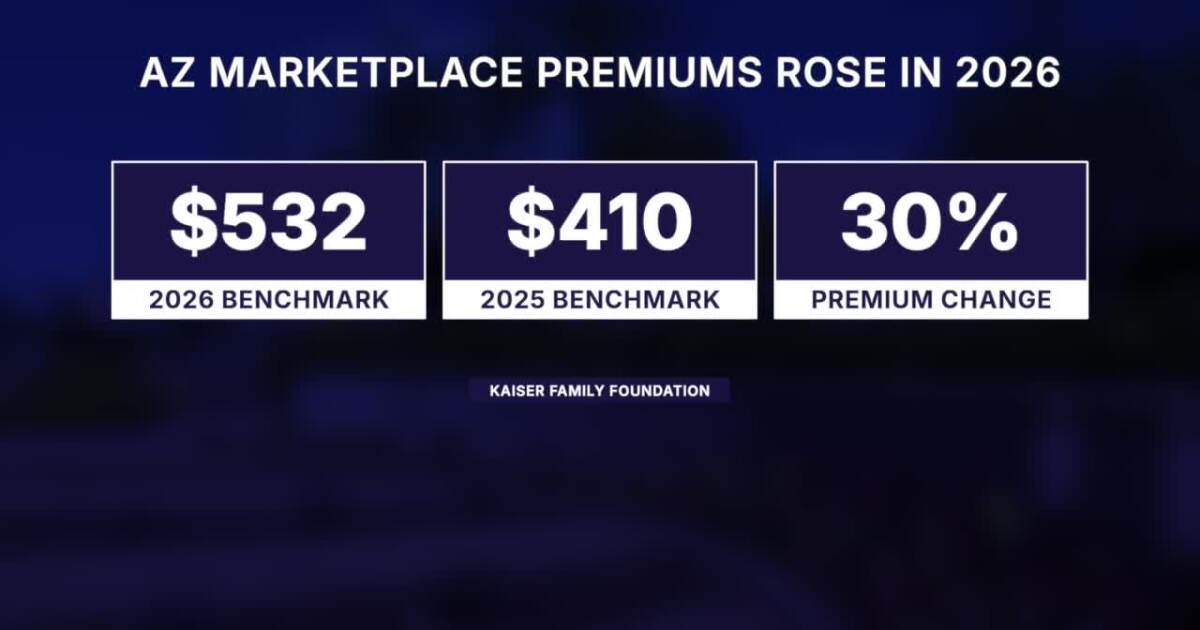
PHOENIX — Arizona’s ACA marketplace enrollment fell from 363,000 to just over 255,000 in a single year — a nearly 30% decline and the third-largest annual drop in the country.
Rising premiums and expired tax credits are driving the trend, with the average benchmark plan premium in Arizona now at $532 — up 30% from 2025.
In the player above, ABC15 Data Analyst Garrett Archer takes a look inside the numbers on how healthcare premiums are impacting health insurance enrollment.
This story was reported on-air by a journalist and has been converted to this platform with the assistance of AI. Our editorial team verifies all reporting on all platforms for fairness and accuracy.
Want more news in your community? Add ABC15 as a preferred source on Google below:

-
 Nevada6 minutes ago
Nevada bystanders pull crash victim from burning motorhome on I-15 near Mesquite
-

 New Hampshire9 minutes ago
Townsend man arrested in connection with two armed robberies in New Hampshire and New Jersey, authorities say – The Boston Globe
-

 New Jersey14 minutes ago
Are all Freedom Fuel locations $3.47? Not anymore
-

 New Mexico21 minutes ago
New Mexico’s ban on liquor ‘minis’ yields mixed results five years later
-

 North Carolina24 minutes ago
NC state budget includes $27M for Madison County’s new public service complex
-

 North Dakota29 minutes ago
The Women’s College Fan Guide To 2026 Junior Nationals – FloWrestling
-

 Ohio36 minutes ago
Ohio reports nearly 200 cases of ‘explosive diarrhea’ illness
-

 Oklahoma39 minutes ago
Every Oklahoma State Cowboys’ College Football 27 Preseason Player Rating

