The latest headlines from our reporters across the US sent straight to your inbox each weekday
Your briefing on the latest headlines from across the US
A man who filmed himself torturing two Alaska Native women and was heard saying that in his movies “everybody always dies,” was sentenced Friday to 226 years in prison.
Brian Steven Smith received 99-year sentences each for the deaths of Kathleen Henry, 30, and Veronica Abouchuk, who was 52 when her family reported her missing in February 2019, seven months after they last saw her.
The remaining 28 years were for other charges, including sexual assault and tampering with evidence. Alaska does not have the death penalty.
Smith, a native of South Africa who became a naturalized US citizen shortly before torturing and killing Henry at an Anchorage hotel in September 2019, showed no emotion during sentencing. He also displayed no emotion when a jury deliberated for less than two hours and found him guilty after a three-week trial in February.
Advertisement
Smith was arrested in 2019 when a sex worker stole his cellphone from his truck and found the gruesome footage of Henry’s torture and murder. The images were eventually copied onto a memory card, and she turned it over to police.
Brian Steven Smith was sentenced to 226 years in prison for the deaths of Kathleen Henry, 30, and Veronica Abouchuk, 52 (AP)
Videos from a memory card were shown to the jury but hidden from the gallery. Smith’s face was never seen in the videos, but his distinctive South African accent — which police eventually recognized from previous encounters — was heard narrating as if there were an audience. On the tape, he repeatedly urged Henry to die as he beat and strangled her.
“In my movies, everybody always dies,” the voice says on one video. “What are my followers going to think of me? People need to know when they are being serial-killed.”
During the trial, the victims were not identified by name, only initials. Saxby said during sentencing that their names would be used in order to restore their personhood.
Smith eventually confessed to killing Henry and Abouchuk, whose body had been found earlier but was misidentified.
“Both were treated about as horribly as a person can be treated,” Alaska Superior Court Judge Kevin Saxby said when imposing the sentence.
Advertisement
“It’s the stuff of nightmares,” he added.
Both Alaska Native women were from small villages in western Alaska and experienced homelessness when living in Anchorage.
Rena Sapp, outside a courtroom October 21, 2019, in Anchorage, Alaska, shows a photo of her sister, Veronica Abouchuk, taken during a day out shopping in 2013 (Copyright 2019 The Associated Press. All rights reserved.)
Authorities identified Henry as the victim whose death was recorded at TownePlace Suites by Marriott in midtown Anchorage.
Smith, who worked at the hotel, was registered to stay there from September 2-4, 2019.
The first images from the card showed Henry’s body and were time-stamped about 1am on September 4, police said.
The last image, dated early September 6, showed Henry’s body in the back of black pickup. Charging documents said location data showed Smith’s phone in the same rural area south of Anchorage where Henry’s body was found a few weeks later.
Advertisement
Anchorage Police were seen investigating the scene where human remains were found on the Seward Highway in Anchorage, Alaska, 2 October 2019 (Bill Roth/Anchorage Daily News via AP)
During the eight-hour videotaped police interrogation, Smith confessed to killing Abouchuk after picking her up in Anchorage when his wife was out of town. He took her to his home, and she refused when he asked her to shower because of an odor.
Smith said he became upset, retrieved a pistol from the garage and shot her in the head, dumping her body north of Anchorage.
He told police the location, where authorities later found a skull with a bullet wound in it.
Abouchuk’s daughter, Kristy Grimaldi, gave the only victim impact statement during the sentencing, according to the Anchorage Daily News, saying Smith would “rot in prison.”
The first Jesuit missionaries in Alaska sailed up the Yukon River in 1887. By the turn of the 20th century, the religious order of the Catholic Church had as many as 50 Jesuits in the state.
Now, only two remain. And by the end of June, there will be none.
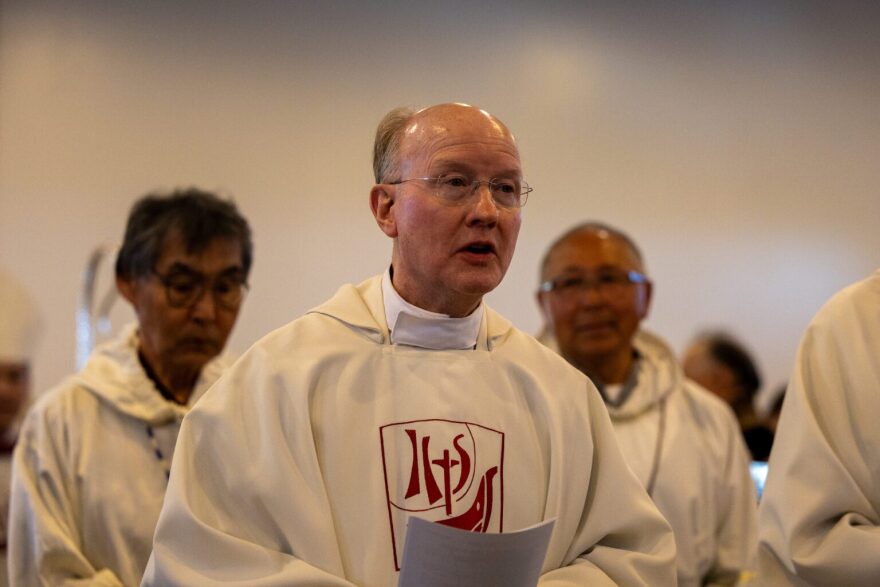
The Jesuits’ nearly 140 years in the state was honored at an event at Bethel’s Immaculate Conception Church on June 16. A procession of priests wearing long white gowns with red hems walked down the aisle to open the event. The Bishop of the Diocese of Fairbanks, Stephen Maekawa, thumped the ground with a shimmering silver staff known as a clozier as he approached the altar.
Bishop of the Diocese of Fairbanks, Steven Maekawa, walks toward the altar at the Immaculate Conception Church in Bethel.
“My brothers and sisters, we gather together to celebrate this wonderful and blessed occasion to acknowledge the love of God and the work of God through the 139 year mission of the Society of Jesus of the Jesuit fathers,” Maekawa said to open the event.
Advertisement
A traditional Catholic mass followed, with readings in both English and Yup’ik. During the sermon, Maekawa acknowledged the vastness of the Fairbanks diocese, and the tremendous amount of work done by the Jesuits to establish it.
“All of the 46 churches of the Diocese of Fairbanks that we currently have were established by either the Jesuit fathers or by direction of a Jesuit bishop,” Maekawa said. “We have a long history of the Society of Jesus’ presence and ministry here in all of Alaska.”
The Jesuits are an order within the Catholic Church, akin to the Dominicans or Franciscans. They have a reputation for taking on some of the Catholic Church’s most remote assignments.
That missionary spirit brought the Jesuits to the Yukon River in 1887, where they built churches, schools, and ministries. Without their work, Catholicism may not have taken root in huge swaths of Alaska, particularly among Alaska Native communities.
The Immaculate Conception Church in Bethel.
But the Jesuits leave a complicated legacy. Their methods of converting Native people to the religion, particularly in the first half of the 20th century, created generational traumas still felt to this day.
Advertisement
Fr. Sean Carroll is the provincial of the Jesuits West Province, which oversees Alaska and nine other states.
Fr. Sean Carroll, provincial of the Jesuits West Province, speaks at an event recognizing nearly 140 years of Jesuit service in Alaska.
“Thank you for all that you have taught us about who Jesus is and how to love and serve Him wholeheartedly,” Carroll said. “I also thank you for your patience with us. For there have been times when we have sinned and when we have hurt you.”
Missionaries, including the Jesuits, forcefully converted and assimilated Alaska Native people into Western culture and religion. Students at Jesuit-run boarding schools were forced to abandon their Native languages and physically punished when caught speaking languages other than English. Native dancing and drumming were also banned.
The Jesuits West Province maintains a list of 150 Jesuits with credible claims of sexual abuse against minors or vulnerable adults. A quarter of the accused Jesuits served in Alaska at some point in time.
“I ask for your forgiveness for all that we have done that was not rooted in Christ and love for Him, and for when we did not value your culture nor recognize the presence of God in you,” Carroll said.
Advertisement
Carroll gave the order to withdraw from the state last spring. A big issue was the recruitment of Jesuits willing to travel and serve in remote villages. He told the congregation that the Jesuits’ work would continue, just without a permanent presence.
Fr. Rich Magner, one of the two remaining Jesuit priests in Alaska, attends a ceremony in Bethel.
Fr. Rich Magner is one of the two remaining Jesuit priests in Alaska. His last day serving Chevak, Hooper Bay, and Scammon Bay is June 30.
“We all always knew coming in, or should have known, that we’re not going to be here forever. It’s going to be mission accomplished at some point,” Magner said. “And then we hand it off to the diocese that we’ve helped create, and so that’s a good feeling.”
Magner’s next stop is a Clinical Pastoral Education residency in Tacoma, Washington.
The other remaining priest, Fr. Tom Provinsal, first came to Alaska in 1968 to teach. A fond memory, he said, was meeting Elders that practiced traditional subsistence lifestyles.
Advertisement
“Some of the grandmothers, their fingers were just all bent with arthritis and stuff like that, you know, their whole lives they’ve been working out in the cold and the wet, doing food, sewing, all that kind of stuff,” Provinsal said. “I’d say I just feel very privileged to have come when I did come and to see that.”
Provinsal returned in 1975 as a priest and has served in the region ever since. After moving away, he plans to take a five month sabbatical. What happens next, he said, is in God’s hands.
Two lines formed in the aisle for communion at the end of the mass. After taking communion, Bethel’s Parish Administrator Susan Murphy gave a final thank you.
“It’s difficult to say goodbye to people who have been a part of our lives for so long,” Murphy said. “We know that you have done what was yours to do, and have taught us to do what is ours to do. We are grateful.”
Jesuit priests form a row along the altar of Bethel’s Immaculate Conception Church as members of the congregation lift their arms and pray.
Dominic Hunt, a Yup’ik deacon that flew in from Emmonak for the event, led the congregation through a final prayer.
Advertisement
“Bless them with your wisdom, that they may be a word of hope, a world in need. We ask this through Christ, our Lord. Amen,” Hunt said.
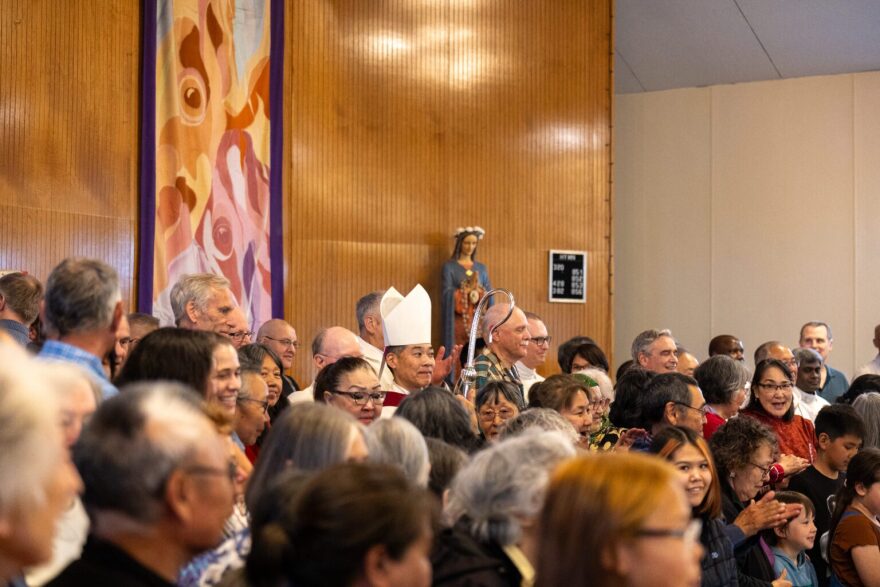
About 70 people posed for a photo on the altar – priests, deacons, parishioners, Elders and children — many of them smiling, some standing quietly.
The photo doesn’t tell the whole story. But it’s a moment when gratitude, grief, and memory all shared the same room.
Bishop of the Diocese of Fairbanks, Steven Maekawa, stands in the middle of a crowd waiting to take a photo at Bethel’s Immaculate Conception Church.
JUNEAU, Alaska (KTUU) – The Supreme Court of Alaska will be taking up the case of the State of Alaska, Division of Elections v. Daniel J. Sullivan, Jr.
The oral arguments will be held Monday at 10 a.m. via Zoom, according to an order and opening notice.
The document also specifies that a decision is expected to be made before noon on Tuesday.
According to documents from the Division of Elections, the state must start printing ballots at noon on the same day.
Advertisement
This comes after an Anchorage Superior Court Judge ordered Dan J. Sullivan on to the ballot Friday.
See a spelling or grammar error? Report it to web@ktuu.com