Alaska’s Supreme Court issued a decision Thursday that will allow a question regarding repeal of the state’s controversial ranked choice voting system to appear on the November ballot.
The state’s high court upheld a lower court ruling that would allow the ballot measure to come to a popular vote.
“Having considered the record, the parties’ briefs, and the parties’ arguments, we affirm the superior court’s summary judgment order,” the judges said in their ruling.
“An opinion explaining this decision will be issued at a later date.”
Advertisement
The case came about after three Alaska residents, led by Elizabeth Medicine Crow, sought to disqualify the measure based on allegedly defective petitions.
RANKED-CHOICE VOTING RANKLES ELECTION SEASON AS SUPPORTERS, OPPONENTS TRANSCEND PARTY LINES IN KEY STATES
Anchorage, Alaska’s skyline(Zihao Chen via Getty Images)
Alaska’s Division of Elections certified in March that enough signatures had been collected to qualify the repeal initiative after the agency allowed petitioners to fix notarized errors in their paperwork.
In 2020, Alaska voters narrowly approved the original ballot measure — with a 50.55% majority recorded — that instituted ranked choice voting there.
Advertisement
The practice, praised as a way to help moderate candidates, changes the election tabulation system from a simple majority framework to one that holds multiple rounds of counting.
In the first round, totals for each candidate are tabulated, and the candidate with the fewest “first votes” is eliminated. The “second votes” of that candidate’s supporters are added to the totals of the remaining candidates, round after round, until a winner is decided.
Alaska Republicans, in particular, criticized the practice in 2022 after Rep. Mary Peltola, D-Alaska, won in an otherwise shocking upset in the red state to succeed six-decade GOP lawmaker Don Young, who died that spring at 88.
The two leading GOP candidates under the new system, former Gov. Sarah Palin and Nick Begich III, the conservative scion of a noted Democratic political family in the state, collectively garnered more votes than Peltola in the first round of tabulation but still lost.
IN THE ONLY STATE BORDERING RUSSIA, ALASKA GOVERNOR SAYS DEFENSES ARE STRONG
Advertisement
Rep. Mary Peltola, D-Alaska, speaks to supporters.(Getty Images )
Kelly Tshibaka, a fellow Republican who lost to Sen. Lisa Murkowski in 2022, previously called it “deceptive how they sell [ranked-choice voting] to the public” as a “moderating force” when it is not in her view.
She pointed to the failed candidacy of Al Gross, a Democrat turned Independent who, at times, led in the primary but dropped out, leaving Peltola, on his left, to remain.
Meanwhile, proponents argue the practice helps take partisanship out of elections.
In Alaska specifically, many have pointed to the fact both conservative Gov. Mike Dunleavy and moderate Murkowski emerged victorious in 2022.
Advertisement
New York Mayor Bill de Blasio also sung its praises after the “biggest ranked choice voting election in America” in his city in 2021, and states like Maine have also adopted it.
Ranked choice voting however, has also been criticized by Alaska conservative activists like Judy Eledge, a former schoolteacher in Barrow, which is now known as Utqiagvik.
“You basically don’t get your first choice of who you want to win, and it enables people that otherwise would never win anything,” Eledge said in a recent Fox News Digital interview.
CLICK HERE TO GET THE FOX NEWS APP
American flags and vote buttons (Kurt “CyberGuy” Knutsson)
Advertisement
“It gives them enough to win and basically just destroys the party system within the state when it comes to elections.”
Some on the right do support the system, including former Virginia State Delegate Chris Saxman, now executive director of Virginia Free, an organization that provides objective, nonpartisan political information to the business community.
In a recent interview with Fox News Digital, the former Staunton lawmaker noted Virginia Republicans utilized ranked choice voting in their 2021 convention candidate selection process and ultimately won back the governorship after a decade out of power.
Saxman spoke of a run-in with a Republican consultant at a party function who decried the use of the system because the right wing could have “gone after [the more moderate Republican] Youngkin harder, but we couldn’t afford to alienate his voters.”
“I was like, ‘So, it’s a problem not to attack a fellow Republican?’” Saxman countered.
Advertisement
The 2024 general election in Alaska will still be operated under ranked choice voting.
Fox News Digital reached out to Peltola, Murkowski, Dunleavy and Sen. Dan Sullivan, R-Alaska, for comment.
Charles Creitz is a reporter for Fox News Digital.
He joined Fox News in 2013 as a writer and production assistant.
Advertisement
Charles covers media, politics and culture for Fox News Digital.
Charles is a Pennsylvania native and graduated from Temple University with a B.A. in Broadcast Journalism. Story tips can be sent to charles.creitz@fox.com.
The first Jesuit missionaries in Alaska sailed up the Yukon River in 1887. By the turn of the 20th century, the religious order of the Catholic Church had as many as 50 Jesuits in the state.
Now, only two remain. And by the end of June, there will be none.
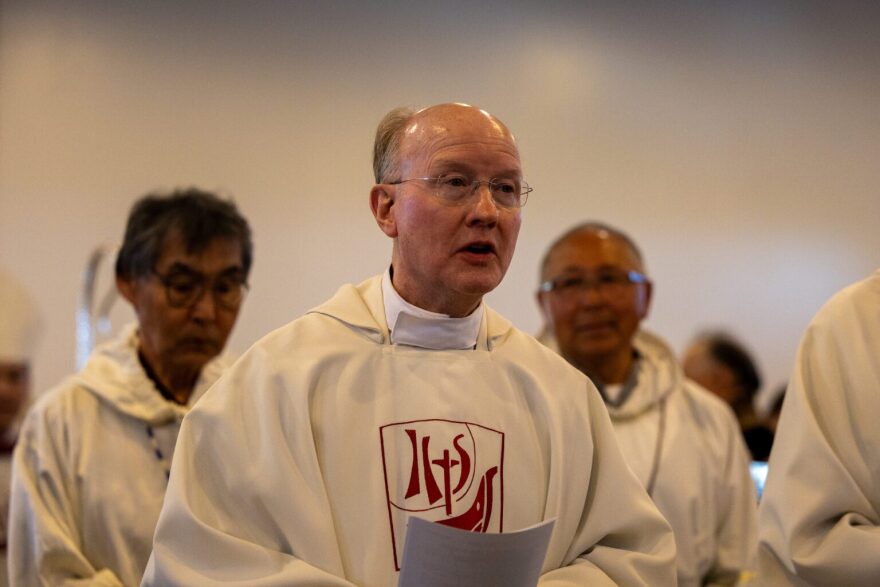
The Jesuits’ nearly 140 years in the state was honored at an event at Bethel’s Immaculate Conception Church on June 16. A procession of priests wearing long white gowns with red hems walked down the aisle to open the event. The Bishop of the Diocese of Fairbanks, Stephen Maekawa, thumped the ground with a shimmering silver staff known as a clozier as he approached the altar.
Bishop of the Diocese of Fairbanks, Steven Maekawa, walks toward the altar at the Immaculate Conception Church in Bethel.
“My brothers and sisters, we gather together to celebrate this wonderful and blessed occasion to acknowledge the love of God and the work of God through the 139 year mission of the Society of Jesus of the Jesuit fathers,” Maekawa said to open the event.
Advertisement
A traditional Catholic mass followed, with readings in both English and Yup’ik. During the sermon, Maekawa acknowledged the vastness of the Fairbanks diocese, and the tremendous amount of work done by the Jesuits to establish it.
“All of the 46 churches of the Diocese of Fairbanks that we currently have were established by either the Jesuit fathers or by direction of a Jesuit bishop,” Maekawa said. “We have a long history of the Society of Jesus’ presence and ministry here in all of Alaska.”
The Jesuits are an order within the Catholic Church, akin to the Dominicans or Franciscans. They have a reputation for taking on some of the Catholic Church’s most remote assignments.
That missionary spirit brought the Jesuits to the Yukon River in 1887, where they built churches, schools, and ministries. Without their work, Catholicism may not have taken root in huge swaths of Alaska, particularly among Alaska Native communities.
The Immaculate Conception Church in Bethel.
But the Jesuits leave a complicated legacy. Their methods of converting Native people to the religion, particularly in the first half of the 20th century, created generational traumas still felt to this day.
Advertisement
Fr. Sean Carroll is the provincial of the Jesuits West Province, which oversees Alaska and nine other states.
Fr. Sean Carroll, provincial of the Jesuits West Province, speaks at an event recognizing nearly 140 years of Jesuit service in Alaska.
“Thank you for all that you have taught us about who Jesus is and how to love and serve Him wholeheartedly,” Carroll said. “I also thank you for your patience with us. For there have been times when we have sinned and when we have hurt you.”
Missionaries, including the Jesuits, forcefully converted and assimilated Alaska Native people into Western culture and religion. Students at Jesuit-run boarding schools were forced to abandon their Native languages and physically punished when caught speaking languages other than English. Native dancing and drumming were also banned.
The Jesuits West Province maintains a list of 150 Jesuits with credible claims of sexual abuse against minors or vulnerable adults. A quarter of the accused Jesuits served in Alaska at some point in time.
“I ask for your forgiveness for all that we have done that was not rooted in Christ and love for Him, and for when we did not value your culture nor recognize the presence of God in you,” Carroll said.
Advertisement
Carroll gave the order to withdraw from the state last spring. A big issue was the recruitment of Jesuits willing to travel and serve in remote villages. He told the congregation that the Jesuits’ work would continue, just without a permanent presence.
Fr. Rich Magner, one of the two remaining Jesuit priests in Alaska, attends a ceremony in Bethel.
Fr. Rich Magner is one of the two remaining Jesuit priests in Alaska. His last day serving Chevak, Hooper Bay, and Scammon Bay is June 30.
“We all always knew coming in, or should have known, that we’re not going to be here forever. It’s going to be mission accomplished at some point,” Magner said. “And then we hand it off to the diocese that we’ve helped create, and so that’s a good feeling.”
Magner’s next stop is a Clinical Pastoral Education residency in Tacoma, Washington.
The other remaining priest, Fr. Tom Provinsal, first came to Alaska in 1968 to teach. A fond memory, he said, was meeting Elders that practiced traditional subsistence lifestyles.
Advertisement
“Some of the grandmothers, their fingers were just all bent with arthritis and stuff like that, you know, their whole lives they’ve been working out in the cold and the wet, doing food, sewing, all that kind of stuff,” Provinsal said. “I’d say I just feel very privileged to have come when I did come and to see that.”
Provinsal returned in 1975 as a priest and has served in the region ever since. After moving away, he plans to take a five month sabbatical. What happens next, he said, is in God’s hands.
Two lines formed in the aisle for communion at the end of the mass. After taking communion, Bethel’s Parish Administrator Susan Murphy gave a final thank you.
“It’s difficult to say goodbye to people who have been a part of our lives for so long,” Murphy said. “We know that you have done what was yours to do, and have taught us to do what is ours to do. We are grateful.”
Jesuit priests form a row along the altar of Bethel’s Immaculate Conception Church as members of the congregation lift their arms and pray.
Dominic Hunt, a Yup’ik deacon that flew in from Emmonak for the event, led the congregation through a final prayer.
Advertisement
“Bless them with your wisdom, that they may be a word of hope, a world in need. We ask this through Christ, our Lord. Amen,” Hunt said.
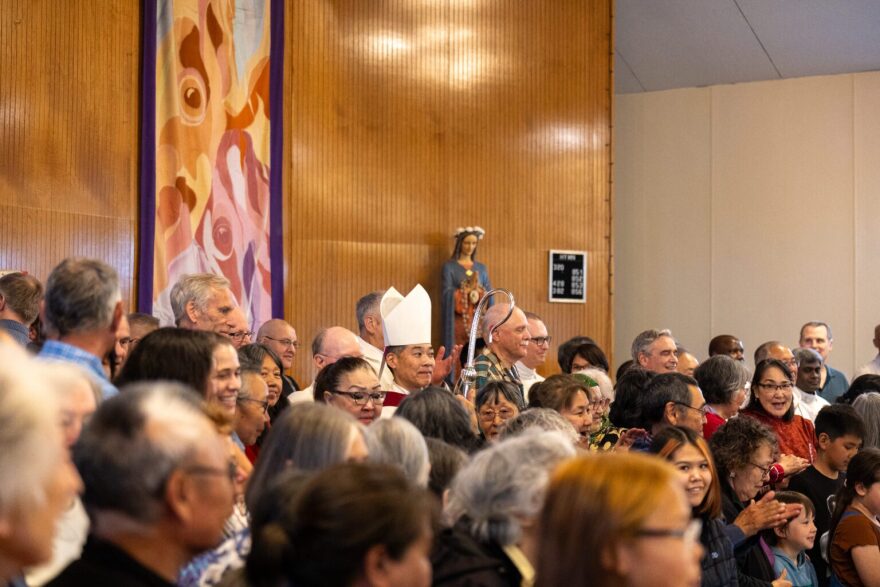
About 70 people posed for a photo on the altar – priests, deacons, parishioners, Elders and children — many of them smiling, some standing quietly.
The photo doesn’t tell the whole story. But it’s a moment when gratitude, grief, and memory all shared the same room.
Bishop of the Diocese of Fairbanks, Steven Maekawa, stands in the middle of a crowd waiting to take a photo at Bethel’s Immaculate Conception Church.
JUNEAU, Alaska (KTUU) – The Supreme Court of Alaska will be taking up the case of the State of Alaska, Division of Elections v. Daniel J. Sullivan, Jr.
The oral arguments will be held Monday at 10 a.m. via Zoom, according to an order and opening notice.
The document also specifies that a decision is expected to be made before noon on Tuesday.
According to documents from the Division of Elections, the state must start printing ballots at noon on the same day.
Advertisement
This comes after an Anchorage Superior Court Judge ordered Dan J. Sullivan on to the ballot Friday.
See a spelling or grammar error? Report it to web@ktuu.com