Alaska
Alaska bike journey rolls along


MANLEY HOT SPRINGS — It’s so quiet in these spruce hills and tamarack swamps that 27 hours and 50 miles passed between when Forest Wagner and I said goodbye to one human being at Old Minto and hello to the next near Baker.
Space is in ample supply here on these pressed-in snow trails between towns and villages of Interior Alaska.
Forest and I are out riding these ephemeral ribbons of blue-white, moving westward with a goal of reaching Nome.
Last Saturday, when it warmed to minus 12 degrees Fahrenheit, I lurched my loaded fat bike out of my home in Fairbanks. Saying goodbye to my wife and dogs, I rumbled eastward on a boot-packed trail that after a mile led to a plowed bike path. I then rolled through the familiar University of Alaska Fairbanks campus and onward 8 miles to Forest’s cabin.
He handed me a mug of coffee and an egg sandwich. Then we started pedaling our fat bikes down Chena Pump Road until we reached the Tanana River.
Forest Wagner, left, and Ned Rozell pause in front of the tripod on the ice of the Tanana River at the town of Nenana. When the river ice breaks up and the tripod pulls a cable attached to shore, the person who guessed the time will win the Nenana Ice Classic.
We found a trail groomed for a multisport winter race, turned right, and headed downstream on our home river, which was half a mile wide. It was a day when the weather finally nodded toward spring. Fair-a-dise showed up with bluebird skies as the day warmed to 8 degrees Fahrenheit.
After a month of pillowy snows and crazy cold temperatures and retelling people our new takeoff days to semi-suppressed eye rolls, we were finally unstuck from the glue of town.
If an object wasn’t hanging off our bikes, we didn’t need it. No more fiddling with the load or obsessing on the seven-day weather forecast. Just big ol’ tires humming on dry snow.
Now, five days and 145 miles later, Forest and I are digesting French toast and bacon our friend Steve O’Brien cooked for us as we wait on the dryer in the Manley washeteria. When we get a few dollar bills, we will take showers.
It’s a good life here on the trail, just-add-water living at its finest. Eat everything in front of you, apply some sunblock, and keep mashing on the pedals.
O’Brien is one of the many people helping us move westward. In one of the most clutch moments, my wife Kristen and our friend Jen Wenrick appeared wearing headlamps on the packed snow ramp off the Tanana River in Nenana. They handed us burgers and fries from the Monderosa.
After a surprise tough day due to soft trail that had us working real hard, those burgers and Cokes were like oxygen.
There have been many other acts of kindness from Jenna and David Jonas, Steve Ketzler, Forest’s dad Joe Wagner and others. Tonic for the body and soul.
We will meet more excellent people, including some old friends, as we ratchet toward Nome.
When my satellite tracker is on, you can see our arrow creeping across the landscape here: https://share.garmin.com/NedRozell.
Since the late 1970s, the University of Alaska Fairbanks’ Geophysical Institute has provided this column free in cooperation with the UAF research community. Ned Rozell is a science writer for the Geophysical Institute.


Winds and fire activity decreased Friday as U.S. Wildland Fire Service personnel and aircraft made progress toward containing the Kopshesut Fire (#137), burning about a mile west of Ambler.
Water dropping aircraft and smokejumpers made solid progress on the eastern side of the fire and are reporting about 20% containment. Satellite images show the fire’s perimeter now covers nearly 1,500 acres. Especially because this is an early‑season fire, it is not burning all the vegetation within that area. Hardwoods, willows, and alders usually don’t carry fire well this time of year. Instead, the fire has mainly spread through black spruce — the dominant tree across much of the area — and is not burning into deeper ground layers, making the flames easier to extinguish. The fire has reached the edge of the Kobuk River about a mile southwest of Ambler.
On Thursday, wind gusts up to 30 mph pushed the flames from their starting point at the nearby landfill, carrying the fire through black spruce to the southeast toward the Kobuk River rather than directly toward Ambler. Those winds decreased to 15 mph on Friday. The fast‑moving fire did burn a nearby Native allotment.
Water, whether coming from hoses used by smokejumpers on the ground or dropped from helicopters and airplanes, is having a noticeable impact on calming the flames. Two single‑engine water scoopers delivered more than 100,000 gallons on Thursday and Friday, with 70,200 gallons dropped on Friday alone. Each AT‑802F aircraft can scoop up to 800 gallons in about 15 seconds by skimming across a waterbody at roughly 75 mph. With favorable conditions — such as a clear, debris‑free stretch of the Kobuk River at least 2,200 feet long — the aircraft have been able to increase the number of drops per fuel cycle to 27, resulting in a higher volume of water delivered before needing to refuel.
The USWFS Midnight Sun Hotshots arrived in Ambler on Friday and will take over work on the eastern edge while smokejumpers shift to the western side. The North Star Fire Crew — the USWFS Alaska training crew — is shuttling to Ambler today and will join smokejumpers on the west edge of the fire Sunday. Each federal firefighting hand crew has just over 20 firefighters.
PREDICTED WEATHER — Cooler temperatures are expected Saturday, with a small chance of afternoon showers. Minimum humidity should stay around 45% through the start of the week. Winds will come from the south to southwest at about 10 mph. Another weather system is expected Sunday afternoon and evening, bringing more widespread showers and a better chance of meaningful rainfall, with totals between 0.05 and 0.15 inches through Sunday night.
AIR QUALITY — There is considerable concern about the noxious smoke produced by the burning material in the landfill where the fire began. Both wildfire smoke and smoke from burning trash contain fine particles and other pollutants that can be very harmful to people’s health. These particles can irritate the eyes and lungs and are especially dangerous for Elders, young children, and people with heart or respiratory conditions. Even short‑term exposure can worsen breathing problems. At this time, smoke from the Kopshesut Fire has not significantly drifted into Ambler, but residents should stay alert to changing conditions and take steps to protect their health if smoke moves into the community.
Contact Public Affairs Specialist Beth Ipsen at Elizabeth_ipsen@ios.doi.gov or (907)356-5510 for more information.
Read all Kopshesut Fire updates.
 100vw, 700px”/><figcaption class=) Map showing the Kopshesut Fire’s perimeter near Ambler on June 6, 2026. Click on map for PDF version to download or click here for an interactive map of the area.
Map showing the Kopshesut Fire’s perimeter near Ambler on June 6, 2026. Click on map for PDF version to download or click here for an interactive map of the area.-USWFS-
U.S. Wildland Fire Service, P.O. Box 35005 1541 Gaffney Road, Fort Wainwright, Ak 99703
Need public domain imagery to complement news coverage of the USWFS in Alaska? Visit our Flickr channel!
Learn more online, and on Facebook and Twitter.
Categories: AK Fire Info, US Wildland Fire Service
Alaska
The prisoner & his mom: How are candidates who’ve never visited Alaska able to run for the state’s federal seats?

ANCHORAGE, Alaska (KTUU) – A federal prisoner serving 20 years in a New York prison and his South Dakota mother are both on Alaska’s August primary ballot — and neither have ever set foot in the state.
They are two of several candidates running for Alaska’s federal seats from Lower 48 addresses, raising questions about whether non-residents should appear on the ballot.
“I’ve flown over it,” said Carol Hafner, the South Dakota resident and Alaska Senate candidate. “As far as boots on the ground, that’s in my future.”
Her son Eric Hafner, a federal inmate who has also not visited Alaska, is again on the ballot as a Democrat. He last ran for Alaska’s U.S. House seat in 2024 and is now seeking the same seat in 2026.
Eric Hafner was convicted in 2022 of threatening to kill judges, police officers and others, as well as making false bomb threats. He was sentenced to serve 20 years in federal prison and is currently serving out his sentence in a New York federal prison.
His 2024 run prompted Alaska Democrats to sue the state elections division in an attempt to remove him from the ballot.
MORE: Full 2026 election coverage in Alaska
The Alaska Supreme Court ruled in a 4-1 decision that Hafner could remain on Alaska’s U.S. House ballot. He was able to make it past the primary contest to the final ballot but received less than 1% of the vote in the general election.
“The state cannot put in higher requirements than what the federal constitution and federal laws have to say on this issue,” Sen. Bill Wielechowski, D-Anchorage, told Alaska’s News Source Thursday.
The Alaska State Constitution does have a residency requirement for state positions, like positions in the legislature or governor, but congressional seats are contingent on the U.S. Constitution, which requires candidates to “inhabit” the state they run for. The Alaska Supreme Court determined Hafner could run for office but could not take office.
It isn’t the first run for either Hafner. Carol said she has previously run for federal office in Alaska — she ran in the 2018 Democratic primary for Alaska’s U.S. House seat — and her campaign website shows a run in Wyoming as well.
The Hafners are not the only non-residents on the ballot. Five other out-of-state candidates are running for Alaska’s two federal seats.
In the U.S. House race: Yaquelin Reynoso, a Democrat with a Lawrence, Massachusetts address; John Foddrill Sr., a Libertarian with a San Antonio, Texas address; and Melanie Salazar, a nonpartisan with a San Francisco, California address.
In the U.S. Senate race: Richard Grayson, a Green Party member with an Arizona address, and Richard Mayers, a Republican with a Chicago address.
MORE: Alaska’s 2026 primary ballot is set – here’s who is on it
The Hafners will appear on the Aug. 18 primary ballot. The top four candidates will advance to the November election.
The race for U.S. Senate has garnered headlines as former congresswoman Mary Peltola challenges two-term incumbent Republican Sen. Dan Sullivan for his seat.
Sullivan has accused Peltola of recruiting a Petersburg man who shares his name to appear on the primary ballot and confuse voters — an allegation the Peltola campaign denies. National Republicans have filed a formal complaint with the Lt. Governor seeking the Petersburg candidate’s removal from the ballot.
See a spelling or grammar error? Report it to web@ktuu.com
Copyright 2026 KTUU. All rights reserved.
Alaska
Best solution to Alaska’s PFD ‘gorilla’ is to end the program with $10K payout, Walker argues

Former Gov. Bill Walker, running to again be Alaska’s top elected official, would like to end the Permanent Fund dividend program with a one-time $10,000 payment to each eligible Alaskan.
“We are in this to solve significant issues,” Walker said in a phone interview Friday. “Business as usual just isn’t going to work.”
Alaska has faced a structural deficit — that is, more expenses than revenue — for years. A sharp decline in oil prices in the mid-2010s, during Walker’s first term in office, led him to take the unprecedented step of vetoing part of the Permanent Fund dividend in 2016. Ever since, lawmakers have spent much of their energy each year wrangling over the amount of the dividend.
Though Gov. Mike Dunleavy proposed a dividend in line with a 1980s statute in each of his annual budget proposals, lawmakers consistently approved far smaller payouts — $1,000 last year, and $1,200 this year — with legislators on both sides of the aisle saying the dividend formula is no longer realistic.
“The dividend discussion has been the 600-pound gorilla in the room,” said Randy Hoffbeck, Walker’s former revenue commissioner and running mate.
With the existing formula calling for “financially impossible” dividends, there are two choices, Hoffbeck said.
“We can cage the gorilla with a new formula that better reflects our current economic situation and our fiscal situation, or we can actually remove the gorilla from the room,” he said.
Walker envisions asking Alaskans to endorse the idea with a question on the application for the 2027 Permanent Fund dividend, he said.
“If it’s overwhelmingly, ‘Yes, we like it,’ then we would proceed to the Legislature with legislation,” Walker said. “If it’s not, then we will continue with, probably, looking at a formulaic modification in some way that reflects our current fiscal situation.”
Alaskans would be free to spread the payment over multiple years to avoid a large tax bill, Walker said. And it would be a one-time offer in an effort to avoid people moving to Alaska on a short-term basis to cash in.
“If we paid it out in 2027, people would already have to be here to be eligible,” Hoffbeck said.
Ending the dividend with a one-time $10,000 payment would certainly “stress” the fund, he said. With more than 618,000 applicants for the 2025 dividend, the plan would cost about $6.2 billion.
That’s roughly what would be left in the Permanent Fund’s earnings reserve account, which can be spent with a majority vote of the Legislature and the consent of the governor, after transfers for dividends, government services and inflation-proofing this year and next year, according to figures from the Alaska Permanent Fund Corp., which manages the state’s $89 billion nest egg.
“The $10,000 isn’t a random number,” Hoffbeck said. “It’s a calculated number on what is possible with the current earnings reserve balance.”
But it would go a long way toward erasing the structural deficit, Hoffbeck said. He estimated that beginning in 2028, ending the deficit would free up about $1 billion in revenue.
“Even though it has a depressing effect on the (annual 5% draw), it’s more than offset from the benefits of not having to pay the dividend,” Hoffbeck said.
Walker’s proposal drew criticism from some of his competitors in the governor’s race. Democrat Tom Begich called the plan “fiscally irresponsible” and “fantastical,” comparing it to Dunleavy’s unfulfilled campaign promise to deliver full dividends. It’s the Legislature, not the governor, that sets the maximum amount of the dividend each year, Begich said.
“We may have underfunded education in this state, but Alaskans aren’t stupid,” Begich said.
Walker and Hoffbeck rejected the criticism, insisting the key difference is that their proposal would provide a one-time payment. They said they’d work with the Legislature to push the proposal through if elected.
-
 Business21 seconds ago
Earwormy Kars4Kids jingle is back as charity appeals in California court
-
 Entertainment7 minutes ago
Review: A family braces for the worst, unsentimentally and with nuanced charm, in ‘Renoir’
-
 Lifestyle10 minutes ago
At 100, Route 66 still beckons as a cross-country caravan takes off from Santa Monica
-
 Politics15 minutes ago
Judge pauses USDA plan to tie SNAP benefits to Trump’s gender, immigration ideology
-
 Science22 minutes ago
A flesh-eating worm from the 1960s is re-invading the U.S. Are CA cattle at risk?
-
 Sports25 minutes ago
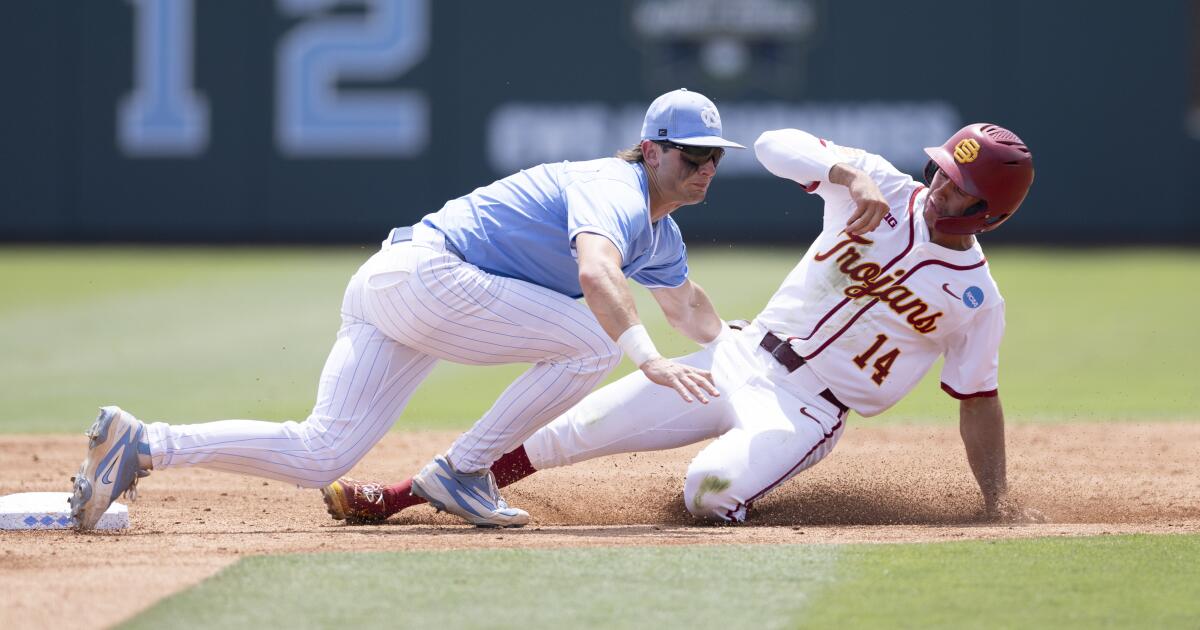
North Carolina’s Jason DeCaro shuts out USC baseball to force decisive Game 3
-

 World37 minutes ago
D-Day 82nd anniversary honoured in France
-
 News1 hour ago
Despite a competitive market, finding a summer job is highly beneficial for teens

