Sports
What's fueling the rise in arm injuries across MLB? A dangerous 'cocktail' of causes


Matt Blake texted Cleveland Guardians pitcher Shane Bieber a conciliatory message over the weekend. As a member of the Cleveland player-development system in the 2010s, Blake aided Bieber’s rise from college walk-on to unanimous American League Cy Young Award winner in 2020. For a time, Bieber represented the modern model for the manufacturing of a big-league ace, a player who added strength to his frame, velocity to his fastball and spin to his offspeed pitches as he ascended the ranks.
By the time Blake sent his text, though, Bieber had become part of a growing, more troubling demographic: talented young pitchers who will spend this season as spectators. Two days after the Miami Marlins announced 20-year-old phenom Eury Pérez would undergo Tommy John surgery, the Guardians disclosed Bieber, 28, would need the same procedure. A recent examination of 25-year-old Atlanta Braves starter Spencer Strider revealed damage to his elbow’s ulnar collateral ligament, which could result in his second Tommy John surgery. In New York, where Blake is now the Yankees pitching coach, the team has lost its ace, Gerrit Cole, until June with elbow inflammation and one of its top relievers, Jonathan Loaisiga, to year-ending elbow surgery.
“As a pitching coach trying to get through nine innings worth of pitching every night over 162 games,” Blake said, “I’m pretty worried.”
Pitching has always been hazardous for its practitioners. There is reason to believe it is only getting more challenging to keep them healthy. The opening days of the 2024 season have demonstrated the inherent fragility of the position. A recent story by The Ringer cited research from former MLB trainer Stan Conte that tallied 263 UCL surgeries in 2023, a steady uptick from 111 procedures performed in 2011. Of the 166 players who began the season on the injured list, as the New York Post reported, 132 were pitchers. If these trends continue, 2024 will be another banner year for arm injuries — and cause for alarm around the game.
The subject prompted sniping between Major League Baseball and the MLBPA on Saturday, as the two sides argued through press releases about the effect of the pitch clock, which was introduced in 2023 and shortened for 2024. MLBPA chief Tony Clark painted the league’s insistence on cutting time off the clock before the 2024 season against the wishes of players as “an unprecedented threat to our game.” MLB countered by citing unpublished analysis from Johns Hopkins University that found no link between the introduction of the clock and the surge of injuries.
The clock, however, was just one area of concern among players, coaches and managers surveyed by The Athletic this weekend. Those conversations presented a tapestry of additional reasons for the injury problem, including the industry’s relentless push for optimization, the encouragement of players to chase maximum velocity and spin, and the usage of training methods that encourage year-round, full-throttle workouts. To some, the explanations are interwoven and intractable. Untangling the knot may require years of research and re-evaluation.
“To protect these guys’ arms is paramount,” Dodgers manager Dave Roberts said. “And clearly we haven’t nailed it.”
This season began with baseball’s most heralded pitchers on the shelf. Los Angeles Dodgers starter Clayton Kershaw underwent shoulder surgery last October. Texas Rangers pitcher Max Scherzer is recovering from back surgery, while his teammate Jacob deGrom is rehabbing from a second Tommy John surgery. Houston Astros ace Justin Verlander experienced shoulder soreness in spring training. All those pitchers are 35 and older, the sort of age where the body no longer cooperates with the rigors of the big-league schedule.
Not long ago, Eury Pérez and Sandy Alcántara were on their way to becoming twin aces for the Marlins. Now both will spend 2024 rehabbing from surgery. (Megan Briggs / Getty Images)
For MLB, the more pressing concern is the fleet of arms breaking down soon after reaching prominence. Miami Marlins starter Sandy Alcántara, the unanimous winner of the 2022 National League Cy Young Award, underwent elbow reconstruction last season. So did Tampa Bay Rays pitcher Shane McClanahan, a little more than a year after starting the All-Star Game. Milwaukee Brewers pitcher Brandon Woodruff will miss this season because of shoulder surgery. Same story for Kansas City Royals pitcher Kyle Wright, a 21-game winner for Atlanta in 2022.
“Our sport deserves our best pitchers to be on the mound,” Detroit Tigers manager A.J. Hinch said. “Regardless of the era you’re in, the starting pitcher matchup is the first thing you look at every day. You want the big boys out there. You want the guys that are elite, and more and more are getting hurt.”
To research the problem, MLB commissioned a study last October, which has sprawled to include conversations with 100 people around the game, including medical officials. When the study is completed, the league intends to create a task force and provide recommendations to clubs about how to keep pitchers healthy.
The sport has grappled with the problem since its inception. In another era, pitchers were believed to get hurt by overuse. Teams altered how they used pitchers in hopes of preserving them. Gone are the days of the exhausted starter, pushed to the brink at 125 pitches or more, trying to finish the seventh or eighth inning. The new archetype asks the pitcher not to ease into outings but explode at the outset. Go as hard as you can for as long as you can, is the new mantra. An influx of data about the shape and movement of pitches offered teams granular ways to make pitchers better. The data did not, however, offer an answer for how to keep them healthier.
“I’ve heard through my years managing that we ask less out of starting pitchers because we don’t leave them in the game long enough and they don’t throw 100 pitches as much anymore,” Hinch said. “Yet we ask them for max velo, max shape, max everything, and virtually train year-round.”
Hinch pointed to Tarik Skubal, a 27-year-old Tigers lefty who underwent Tommy John surgery in college and flexor tendon surgery in 2022. Skubal trained this past winter so that when he arrived at spring training, he touched 99 mph in his first session of live batting practice. “Go to Tarik Skubal and tell him, ‘Hey, ease it off and throw 92 mph,’ and see how that works out for you,” Hinch said. “No. Because we’re asking our athletes to compete at the highest level.”
To some retired players, the quest for elevated velocity and spin has put pitchers at risk. Dan Haren, a 13-year veteran who now works as a pitching strategist for the Arizona Diamondbacks, posted on X about his Instagram feed providing footage of “guys throwing weighted balls at max effort against a wall, with a crow hop, with his bros cheering him on.” Added Roberts, “The body is designed, in my opinion, to only take so much force and velocity before it gives way.”

Shane Bieber hadn’t allowed a run over two outings this season when it was announced he would undergo elbow surgery. (Jason Miller / Getty Images)
Some, like Chicago Cubs manager Craig Counsell, suggested pitchers will always try to throw harder. “I don’t think the pursuit of velocity is ever going to end,” Counsell said. “Because it’s something that makes pitchers better. I don’t think we should demonize the pursuit of velocity.”
Yet the industry has championed this trend by shortening the outings of starting pitchers and encouraging them to maximize their output. Not only do pitchers throw their fastballs as hard as possible, they throw offspeed pitches with utmost force, in hopes of generating unique movement and missing bats. “The types of deliveries that create the outlier shapes are probably more stressful in some ways,” Blake said. “I think the maximization of force to create the shapes probably doesn’t help. When you’re chasing 20 inches of break or 20 inches of ride or the high velo, I think there is some level of physical cost.”
Despite protestations from MLB officials, players will continue to complain about the clock. The innovation trimmed 24 minutes off the average game last season. The timer in 2023 granted pitchers 15 seconds to act with the bases empty and 20 with runners aboard. MLB’s 11-man competition committee voted to shave two seconds off the 20-second clock for 2024 despite objections from the players.
Los Angeles Angels pitcher Tyler Anderson suggested pitchers might place more stress on their arm rather than their legs because of the clock. But he doubted any study could show a correlation between decreased time between pitches and increased injuries. The act of pitching was already unhealthy enough. “Rob Manfred knows it’s really hard to prove, would be my guess,” Anderson said.
The union sees the clock as a bogeyman. The commissioner’s office sees their complaint as a straw man. For coaches like Blake, who must navigate the season as injuries continue, the clock is only part of the problem, along with the perilous chase of velocity and spin.
“I don’t think any of them are the most responsible,” Blake said. “But the cocktail of them all is hard to get by.”
The Athletic’s Fabian Ardaya, Sam Blum, Patrick Mooney, Cody Stavenhagen contributed reporting.

GO DEEPER
Rosenthal: Pitching injury crisis has no easy fix, but baseball’s leaders better get to work on one
(Top photo of Strider: Justin K. Aller / Getty Images)



Sports
London descends into disorder as Morocco fans flood streets after World Cup elimination by France

NEWYou can now listen to Fox News articles!
Public unrest began in parts of London late Thursday night, and it appears Morocco’s exit from the 2026 FIFA World Cup at the hands of France is the reason.
France took down Morocco 2-0, eliminating the African country for the second consecutive tournament, this time in a quarterfinal match.
As a result, many feared Paris would erupt into riots, especially after the chaos that followed Paris Saint-Germain’s UEFA Champions League victory over Arsenal in May.
Instead, images and videos from Edgware Road in northwest London showed police clashing with large crowds as smoke billowed through the streets and debris littered the roadway.
A police vehicle is parked in a road as people from pro-Palestinian activist groups gather near the Edgware United Synagogue during a demonstration against the “Great Israeli Real Estate Event” organized by real-estate agency My Home in Israel, which markets property in Israeli settlements in the occupied West Bank, in London, Britain, June 14, 2026. (Toby Shepheard)
Riot police, equipped with shields and body armor, tried to contain the crowds as they clashed with people launching fireworks and throwing debris. One video also appeared to show an officer down.
KYLIAN MBAPPÉ, OUSMANE DEMBÉLÉ FIRE FRANCE INTO WORLD CUP SEMIFINALS WITH WIN OVER MOROCCO
It’s unknown what happened to the officer who was down on the asphalt or how he was injured.
Fans waved Moroccan flags in the middle of the streets, which held up traffic. Some even jumped on top of vehicles trying to get through the area.
Moroccan fans in the stands before a FIFA World Cup 2026 quarterfinal match between France and Morocco at Boston Stadium July 9, 2026, in Foxborough, Mass. (Richard Sellers/SportsphotoAllstar)
Similar scenes unfolded after Egypt’s World Cup exit, when Argentina rallied for a controversial 3-2 victory that featured several disputed officiating decisions.
Paris, on the other hand, looked more like a city celebrating than one on the brink of a riot. Supporters of both France and Morocco flooded the streets, slowing traffic in several parts of the city.
One video showed horns blasting from cars with French and Moroccan flags out the windows on the L’avenue des Champs-Élysées in Paris. Supporters on the side of the road, waving their own flags, joined in on the celebration.
France’s Kylian Mbappé scored his eighth goal of this World Cup, which ties him for the most with Argentina’s Lionel Messi. Ousmane Dembélé also scored in the second half for France in the 2-0 win over Morocco.
It’s the third straight semifinal appearance for France, while Morocco still made World Cup history despite the loss. After becoming the first African country to reach the quarterfinals and semifinals in World Cup history in 2022, Morocco added to that by becoming the first-ever African nation to reach more than one quarterfinal.
Moroccan fans react while attending a watch party for the World Cup round of 8 match between France and Morocco in Boston, Massachusetts, on July 9, 2026. (Joseph Prezioso/AFP)
CLICK HERE TO DOWNLOAD THE FOX NEWS APP
Morocco’s exit means there are no more African nations alive in the World Cup. France will be taking on the winner of Spain and Belgium, while England and Norway and Argentina and Switzerland face off in the quarterfinals.
Follow Fox News Digital’s sports coverage on X and subscribe to the Fox News Sports Huddle newsletter.
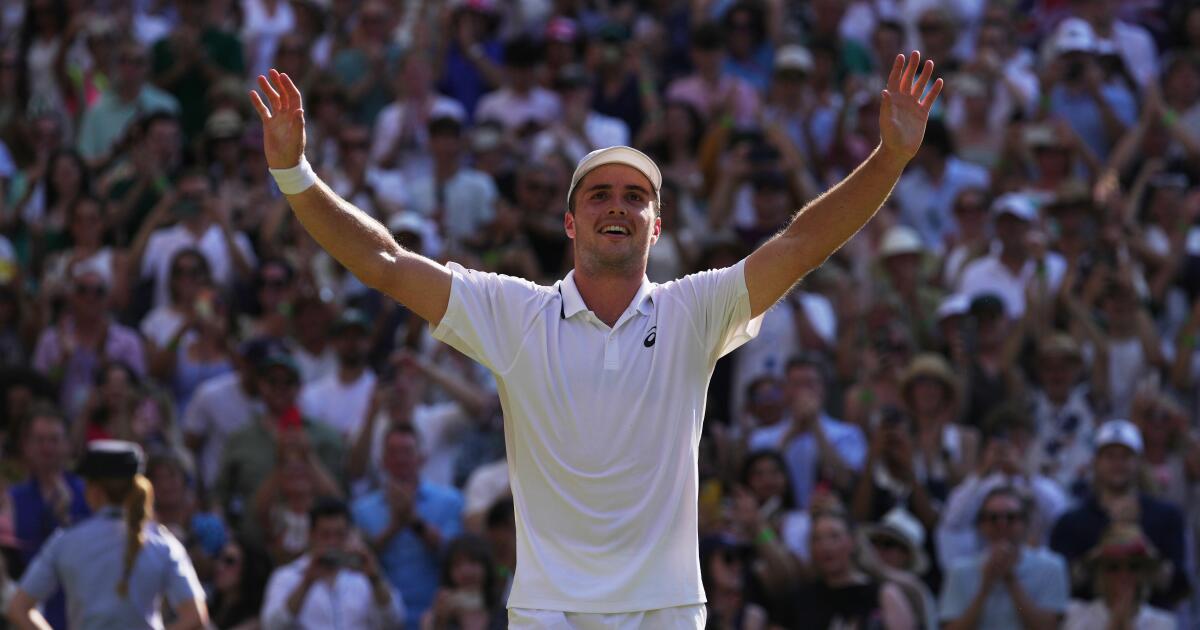
LONDON — A local boy sleeps in his own bed, plays in front of a king and queen and makes a Cinderella run to the Wimbledon semifinals. Sounds like a Hollywood script that might never see the silver screen.
But it’s no fairy tale — it’s Arthur Fery’s out-of-nowhere performance over the last 10 days.
Fery, a virtually unknown British wild card with a triple-digit ranking, has become the emotional heartbeat of Wimbledon while legitimately diverting some national attention from England’s World Cup quest.
The royal treatment at his matches across the All England Club has come in more ways than one.
Fery, who grew up five minutes from Wimbledon and is staying at home during the tournament, first played before grass-court king Roger Federer, Wimbledon’s eight-time singles champion, during Monday’s fourth-round victory. Two days later, he beat No. 9 seed and French Open runner-up Flavio Cobolli of Italy in the quarterfinals 6-4, 7-6 (4), 6-0 in front of Queen Camilla.
Ranked 114th, Fery had never reached the semifinals of an ATP Tour event, let alone a major, before his brief chat with the queen following the match.
“She just said, ‘Congratulations, keep going,’” 23-year-old Fery told reporters later. “I told her it was my birthday on Sunday, so it would be great to play the Wimbledon final on my birthday.”
That’s still a match away. To get there, Fery will have to get past one of the hottest players on tour: No. 2 seed Alexander Zverev, who is fresh off his first Grand Slam title at the French Open. Looming on the other side of the draw is a highly anticipated showdown between defending champion Jannik Sinner against 24-time major winner Novak Djokovic.
If Fery can continue his magical run to the end, he would become the first British wild card to win a Wimbledon title.
Arthur Fery reacts after defeating Flavio Cobolli in the Wimbledon quarterfinals on Wednesday.
(Maja Smiejkowska / Associated Press)
Born in France, Fery’s family moved to Wimbledon when he was an infant. His mother played professional tennis. He was a top British junior but chose to sharpen his game for three years in the U.S. collegiate system at Stanford, as many of his compatriots have done.
“I came out with a lot of hunger coming out of that, and I was ready to attack the pro circuit,” Fery said.
After struggling with bone bruising in his arm that limited him to playing mostly on the lower-tier Challenger circuit in recent years, Fery is finally healthy and playing consistently.
His path to the last four in London has been a masterclass in clutch come-from-behind performances. The Brit has stared down near-certain elimination in multiple matches, repeatedly breaking his opponents’ momentum with Houdini-like on-court acts.
At 5-foot-9, Fery possesses a skill set perfectly suited for low-bounding grass.
His compact strokes, low center of gravity, and elite movement allow him to hug the baseline, take time away from opponents, and confidently execute delicate volleys at the net, according to ESPN analyst Chris Eubanks.
“He defends well,” said Eubanks, a 2023 Wimbledon quarterfinalist. “He can scrap. He can claw. He can dig his way back into points. And when he ventures forward, he’s very, very comfortable at the net. This is a picture-perfect example of someone whose game is built for the surface.”
Still, it’s hard to fathom the multitude of milestones for Fery, who briefly reached the No. 1 ranking in college and earned 2023 Pac-12 Singles Player of the Year honors before leaving early to pursue a pro career.
He arrived at Wimbledon with just one main-draw victory at a major, a losing record as a professional, and only one previous ATP quarterfinal, at Queen’s Club last month. He’s now 11-8, won his first two five-set matches, and is the first British wild card to reach the Wimbledon men’s semifinals in the Open Era. The only other men’s wild-card semifinalist was Goran Ivanisevic, who won the title as a wild card in 2001.
Fery, who started the season ranked No. 185 and will climb to at least No. 36 after the tournament, said there were a “lot of first times” as he reflected on his unprecedented run. “First five-setter, longest match that I’ve ever played, first time breaking into the top 100, first second week in a slam, all at home, five minutes from where I grew up. It’s a great story for me,” he said.
The gap with his fellow semifinalists is understandably massive.
Entering Wimbledon, Djokovic, Sinner and Zverev’s combined records include 29 Grand Slam titles, 2,088 match wins and 155 tour-level titles. Fery was 6-8 in tour-level matches with zero titles.
But he has singlehandedly lifted the tournament for locals. With top hopes Jack Draper and Emma Raducanu withdrawing before the tournament and the rest of Britain’s singles prospects falling one by one — 18 men and women were eliminated by the third round — Fery became the nation’s last knight standing.
If his first name inevitably evokes Arthurian legend, Fery’s march through the draw gave Britain reason to believe again. No sword, no Round Table, just world-class shot-making, a lion’s heart and a Centre Court crowd thrilled to rally behind him.
“This is really quite something to see on home soil,” said Russell Fuller, the BBC’s tennis correspondent, who compared it with Raducanu’s stunning U.S. Open win in 2021 as a qualifier.
Fery earned every bit of it.
In the first round against Damir Dzumhur, Fery dropped the opening set and trailed by a break in the second before surging back. Against Zizou Bergs in the third round, he faced a 4-1 deficit with a double break in the fourth set, and again fell behind 4-1 in the fifth, before somehow surviving.
Then, stepping onto Centre Court for the first time against former top-10 stalwart Grigor Dimitrov of Bulgaria in the fourth round, Fery clawed out of a 2-sets-to-1 hole and a break down in the fourth set to clinch the victory in a fifth-set tiebreak.
“He carries himself with humility, but he’s a fierce competitor, and he’s got a ton of belief in himself,” said Stanford men’s coach and former top-60 player Paul Goldstein, who flew to England Tuesday to see his former charge compete against Cobolli.
While Fery attempts to outmaneuver Zverev on Friday, the other semifinal features a 2025 Wimbledon semifinal rematch between seven-time Wimbledon winner Djokovic and top-ranked Sinner, who defeated the Serb in straight sets on his way to the title. It’s also their second Grand Slam semifinal meeting in 2026. At January’s Australian Open on hard courts, Djokovic bested 24-year-old Sinner in five sets before falling to now-injured Carlos Alcaraz in the Melbourne final.

Arthur Fery hits a return during his Wimbledon quarterfinal win over Flavio Cobolli on Wednesday.
(Clive Brunskill / Getty Images)
Djokovic, 39, enters the match after surviving a grueling five-set, 5-hour-plus quarterfinal slugfest against No. 3 Félix Auger-Aliassime that concluded just minutes before Wimbledon’s 11 p.m. curfew. But the seventh-seeded Serb has a way of defying Father Time and he has had two days to recover on a surface where points are shorter and generally less taxing on the body.
Italy’s Sinner, who defeated Alcaraz in last year’s Wimbledon final, has been efficient if not at the level that saw him capture five consecutive titles before crashing out in the second round at the French Open. After a first-round scare here, the four-time Grand Slam champion has dominated opponents behind his improving serve, winning 80% of his first-serve points. He hasn’t dropped a set since the opening round. Sinner leads the head-to-head with Djokovic 6-5.
According to Eubanks, Djokovic must disrupt Sinner’s movement to break his rhythm, and take his chances.
“He’s got to play similar to how he played in Australia, where it was just all-out aggression,” Eubanks said.
For Sinner, he added: “His serve can be a neutralizing force for what Novak is going to try to do.”
On the other side of the ledger, Fery’s poise under pressure and deft use of the home crowd will be paramount to continue his surprise run against Germany’s Zverev, whom he called a “step up again” from his last five matches. Zverev, 29, is seeking his fifth major final and first at Wimbledon.
“I’m ready for it,” Fery said. “I have nothing to lose. I’m just going to go out there and … put my game on the court, do what I’ve done, believe in myself. We’ll see where that takes me.”
Home has never been closer to Centre Court. Nor has Arthur Fery ever been closer to tennis history.
Sports
Pirates star pitcher makes unfortunate history after being taken out in middle of perfect game bid

NEWYou can now listen to Fox News articles!
Jared Jones was flirting with Major League Baseball history on Wednesday night — he got it, but it was not what he originally envisioned.
The Pittsburgh Pirates pitcher retired the first 18 batters he faced, but he was taken out in the middle of his perfect game bid after six innings.
Now, the Pirates certainly have their reasons — the 24-year-old Jones hasn’t thrown more than 81 pitches in eight starts since returning May 20 after missing all of last season while undergoing ulnar collateral ligament internal brace surgery on May 21, 2025. He was yanked with 77 pitches and likely would have needed more than 100 pitches to record the 25th perfect game in MLB history.
Jared Jones of the Pittsburgh Pirates pitches during the first inning against the Atlanta Braves at PNC Park on July 8, 2026, in Pittsburgh, Pennsylvania. (Photo by Joe Sargent/Getty Images)
However, Jones left the game after getting zero run support, so when the Atlanta Braves tacked on three runs late for a 3-0 victory, Jones instead found himself in the wrong chapter of the history books.
According to Opta Stats, Jones became the first pitcher in the modern era (since 1920) to pitch at least six perfect innings and not record a win.
“It does suck. Something’s cool coming on, but I’m on what? My eighth start off of surgery? I completely understand it, and it is what it is,” Jones told reporters after the game.
Pittsburgh Pirates starting pitcher Jared Jones (17) makes his way to the field to warm up before pitching against the Atlanta Braves at PNC Park. (Charles LeClaire/Imagn Images)
JUSTIN VERLANDER ANNOUNCES HE WILL RETIRE AFTER THIS SEASON: ‘I’VE REALIZED THAT TIME HAS COME’
Jones said he didn’t entertain attempting to complete the perfect game.
“Not with the pitch count,” he said. “Not really ever expecting to go nine right now, so that was never in my head.”
Joey Bart, traded to the Braves from the Pirates on June 18, followed a double by Mike Yastrzemski with a 422-foot, two-run homer to left-center field off a slider from Dennis Santana. Drake Baldwin added an RBI single to center in the ninth for good measure.
It was the second time in less than a week that a pitcher was taken out of the game with a perfect bid through six innings — the Miami Marlins took Eury Perez out after seven innings in which he had 92 pitches. Perez, too, is in the midst of returning from injury and has surprisingly found himself right in the postseason mix.
He was pulled for Lake Bachar to start the eighth, and the Marlins allowed eight runs to the Athletics in the final two innings, but held on to win 9-8.
Jared Jones (17) of the Pittsburgh Pirates delivers a pitch during a MLB game against the Cincinnati Reds on June 27, 2026, at PNC Park in Pittsburgh, Pennsylvania. (Joe Robbins/Icon Sportswire via Getty Images)
CLICK HERE TO DOWNLOAD THE FOX NEWS APP
The Pirates are 4.0 games out of the final wild card spot, which is held by the Marlins.
The Associated Press contributed to this report.
Follow Fox News Digital’s sports coverage on X, and subscribe to the Fox News Sports Huddle newsletter.
-

 Indiana2 minutes ago
Kelsey Mitchell winner completes Fever comeback against Mercury, without Caitlin Clark
-

 Iowa7 minutes ago
McKeever’s 7′3″ frame made Iowa the ‘obvious choice’ in the transfer portal
-
 Kansas14 minutes ago
Kansas City to reduce bus transit frequency, extended hours after World Cup matches end
-

 Kentucky16 minutes ago
Public Health Student Hollie Hagan found her calling in rural Kentucky
-

 Louisiana22 minutes ago
Inside the lab at the heart of Louisiana’s mosquito-borne disease prevention network
-
 Maine29 minutes ago
Meet 16 obscure Maine Democrats shaping Graham Platner’s replacement
-

 Maryland31 minutes ago
Justice Department sues Maryland over immigration policies
-

 Michigan37 minutes ago
How two Michigan stamping plants power Stellantis turnaround plan

