Sports
What did NFL learn about S2 after CJ Stroud? 'People in our league can't help themselves'


The truth is C.J. Stroud never let it get to him, even as draft day neared and the questions started coming and the conversation around him shifted.
“Look at my perspective,” he’d say later. “I’m about to get drafted regardless of that dang test.”
He was right — Stroud, the Ohio State quarterback who was among the top prospects in last year’s NFL Draft, still went second to the Houston Texans, and in a matter of months, the 22-year-old would put together one of the most prolific seasons by a rookie quarterback in league history, lifting a franchise from the league cellar to the divisional round of the playoffs.
But his ascent was less assured last April, when Stroud’s on-field intelligence was being debated, even doubted. Most of this stemmed from his leaked score on the S2, a pre-draft cognition test that has quickly gained credence around the NFL for its ability to measure a quarterback’s mental capacity and, some believe, forecast his chances of future success.
Ten months later, it’s hard to tell the story of Stroud’s record-setting rookie season without at least addressing the reliability of that dang test and what the ensuing firestorm says about the draft process and the veracity of the information that trickles out along the way. Too often, according to several high-ranking league executives granted anonymity by The Athletic so they could discuss Stroud and the test without tampering charges, vital context is missing. Stroud’s case, they believe, is a prime example.
For starters, one exec wondered, why was his score leaked to the media in the first place? And by whom?
“I think it was thrown out there by a team that had their own goals and wanted to use it to put him down and gloat on what they wanted seen,” said one general manager whose team was not in the running for a top quarterback in last year’s draft.
“It was complete B.S. that it was leaked,” offered another GM, “but people in our league can’t help themselves.”
Last spring, Stroud was fresh off two stellar seasons as the Buckeyes’ starter and among the most polished passers in a QB-heavy draft. Along with Alabama Heisman Trophy winner Bryce Young, he was in the running to be the first overall selection, owned by the Carolina Panthers. The Texans had the second pick. Both teams desperately needed QBs.
Then, six days before the draft, a red flag: GoLong.com’s Bob McGinn, a veteran NFL reporter and former contributor to The Athletic who speaks annually with league executives before the draft, published the S2 results of several quarterbacks, including Stroud and Young. The difference between the two scores, per McGinn’s reporting, was jarring. Young scored in the 98th percentile. Stroud scored in the 18th.
“That’s like a red alert, red alert, you can’t take a guy like that,” McGinn quoted a league executive saying. “That’s why I have Stroud as a bust. That in conjunction with the fact that, name one Ohio State quarterback that’s ever done it in the league.”
Earlier this month, Stroud earned 48 of a possible 50 votes for Offensive Rookie of the Year. McGinn did not respond when asked about his reporting on the S2 test last year.
GO DEEPER
What C.J. Stroud and his parents saw early, the world is seeing now
The S2 cognition test was first used by NFL teams before the 2016 draft; the Nashville-based company founded by two neuroscientists and former college athletes is currently under contract with half of the league’s 32 teams, two in each division, who effectively pay for the exclusivity of the results.
The test has risen in prominence in recent years, touted for its ability to measure a player’s cognitive ability — specifically, in quarterbacks.
A striking example, detailed last year in The Athletic, was that of Brock Purdy, the overlooked, undersized final pick of the 2022 draft who stepped in for an injured Jimmy Garoppolo halfway through his rookie season and led the San Francisco 49ers to eight straight wins and a berth in the NFC Championship Game. This year, Purdy went 12-4 as a starter, was one of five finalists for MVP and led the 49ers to Super Bowl LVIII.
When The Athletic revealed that Purdy had aced the S2, it further validated the test’s credibility. And it didn’t hurt that two of the best quarterbacks in the league, the Chiefs’ Patrick Mahomes and the Bengals’ Joe Burrow, were also reported to have scored extremely well. (Indeed, Burrow disclosed his own score as being in the 97th percentile.)
The S2 is a nine-part battery of tests that, unlike its Wonderlic predecessor, doesn’t set out to measure an athlete’s intelligence. Instead, its goals are quantifying processing speed, reaction time and the ability to digest information and respond under duress.
“Historically, the NFL has been using different IQ tests to assess how ‘smart’ a player is,” one exec said. “But to be honest, whether or not you can solve a trigonometry question or if you know how many presidents we’ve had … that doesn’t equate to football.”
The S2 lasts around 45 minutes, completed using a specially designed gaming laptop and response pad that tracks pattern recognition and impulse control. In theory, it can reliably forecast how quickly a quarterback’s mind can tick through his progressions, or predict if the game will ever feel “too fast,” a phrase frequently used by coaches and evaluators.
“I did my homework on it, and I think the science behind it is really sound,” said one league executive. “It gives you a snapshot of how quickly an individual can process information, and I don’t think there’s a better tool on the market for that. I feel really comfortable with the data we get back from S2.
“Is it foolproof? Absolutely not. Nothing’s foolproof. But it does give you a sense of how quickly a player can make split-second decisions.”
Every executive contacted for this story stressed that the S2 is merely one tool among many used throughout the draft process. Actual game tape is far more important, they said, as are in-person interviews.
“It’s not the ultimate decision-maker,” one exec said of the S2. “It allows you to confirm what you see on film, or it tells you to ask more questions.”
“You’re not sitting there saying, ‘Oh, tell me what his S2 is,’ then putting him in the second round,” another said. “There’s some positions where I don’t even look at their score at all.”
Houston coach DeMeco Ryans downplayed the S2’s weight in the Texans’ decision-making process last spring. “You don’t pick a guy based on a test,” Ryans said in October. “It’s silly to say, ‘Take one metric,’ when there are so many different variables that go into drafting a guy.”

In his rookie season, Stroud led the Texans to a 10-7 record, an AFC South crown and a wild-card playoff win. (Carmen Mandato / Getty Images)
The luster the S2 enjoyed as a fresh, innovative new tool in the all-important quarterback evaluation has rubbed off largely due to Stroud’s leaked score, the subsequent season and the questions that followed. “They Created a Test to Identify Star QBs,” a recent Wall Street Journal headline read. “How Did It Miss the Best One in Years?”
The league executives contacted for this story made it clear they didn’t put much stock in Stroud’s result last spring, believing from the beginning that the score was suspect. Several confirmed that S2 flagged the result after it came in and that teams were informed it was “unreliable.” (As part of its confidentiality agreement with teams, S2 does not publicly release scores and would not comment on Stroud’s result for this story.)
“From my understanding, the S2 people had a lot of questions when his score came back in,” one exec said. “It got leaked by a club, and they wanted to know why.”
The sense around the league: Stroud didn’t give full effort. It’s more plausible than it sounds. For top prospects like Stroud, the draft process is a day-in, day-out grind — four long months filled with on-field training, physical tests, written tests, a media gauntlet, the Senior Bowl in Mobile, the scouting combine in Indianapolis, private workouts with teams and top-30 visits.
Players sometimes end up taking the S2 at the end of 12- or 14-hour days, the execs pointed out. Others simply don’t test well or don’t believe it’s all that important.
“If you only give 80 percent on this test, you’ll bomb it,” one league source pointed out, “Period.”
“If I were to bet dollars to donuts, I would be stunned if Stroud gave 100 percent on the assessment,” said another. “When he took it, was he tired? Was he choosing not to give it his best? Was he nervous? Had he taken a million other tests that day? There’s a whole host of factors.”
Another exec said the same questions were asked in the draft room he sat in last April.
“It made us all say, ‘Wait a minute, what?’ You watch his tape, and his tape is awesome. He’s processing. He’s playing fast. He’s making good decisions. Maybe this is just an anomaly? Maybe he didn’t try?
“When it’s an outlier like this, you ask yourself, when and where did he take it? Was it his fourth test that day and he’d just had enough? Then you call the agent and say, ‘Hey, he scored really low on this. Can we get him to take it again?’”
It’s unclear if Stroud retook the test last spring, and only the quarterback himself knows if he gave full effort. But during an interview with The Athletic last fall, he seemed to indicate the test was not a top priority during the draft process.
“Some things I apply myself to, some things I don’t,” Stroud said, asked specifically about the S2. “Look, I can show you my high school report card — I’m not a dumb kid. I’m not gonna lie, in school, I was lazy. I would get what I could get so I could play football. And I always had a 3.0 (GPA). That was the standard in my household. That was my mom’s rule.”
After the leak, the conversation around him shifted dramatically. Few — and almost no one in media — stopped to consider if the score was accurate or not.
“Because people don’t care,” Stroud said. “People like negativity these days … but I’m not mad at those (S2) people. It is what it is. I got down to how (the leak) happened, so I got some heads to bust in the offseason.”
With that, Stroud laughed. Asked to clarify what he’d learned about the leak, he shook his head. He was fine letting his play do the talking.
The fallout angered plenty around the league. It still does.
“It paints the picture of the kid that’s a false narrative,” one exec said.
In Indianapolis, Colts general manager Chris Ballard went on a post-draft rant on the subject. Ballard’s Colts had the fourth pick, and he studied Stroud extensively, working out both him and Young privately in California. (With Young and Stroud off the board, the Colts took Florida quarterback Anthony Richardson.)
“I’m gonna go off on a sidebar here,” Ballard said on draft weekend. “All the crap that comes out about these kids … it’s bullsh–. I’m sorry, but it’s bullsh–. Like, people leak these stories, these negative stories on kids, and I don’t agree with it. It’s bullsh–.
“They work their ass off to where they need to be, and then all week you gotta read (this) and they gotta answer questions on it. They’re good kids, and I thought (Stroud) had to take a beating he didn’t have to take.”
Earlier this month, The Athletic reported that at least one agency, Athletes First, which represents nearly 30 draft-eligible prospects — including a handful of projected first-round picks — has advised its players against taking any form of cognitive exam ahead of this year’s draft, a clear response to the situation Stroud found himself in last spring.

GO DEEPER
Sports agency directing NFL Draft prospects to skip cognitive tests
After picking Young first overall, the Panthers maintained he was their preference all along. Former general manager Scott Fitterer said Young’s S2 score played a small role in the evaluation.
“It’s a nice piece,” Fitterer said on draft night. “It reaffirms things.”
But Young, and his 98th percentile, staggered through a disappointing rookie season. The talent-thin Panthers finished a league-worst 2-15. The top pick threw just 11 touchdowns.
Including two playoff starts, Stroud finished with 4,557 passing yards, second-most in NFL history for a rookie passer — and 1,680 more than Young. He opened the season with 192 consecutive pass attempts without an interception, the most ever by a player to begin a career.
He also led the league in passing yards per game (273.9) and touchdown-to-interception ratio (4.6). Only Joe Montana and Tom Brady have had seasons in which they finished first in both categories.
Any doubt that Stroud couldn’t see the field, or couldn’t process at the NFL level, was put to rest quickly and definitively. Perhaps it never should have been a question in the first place.
(Illustration: Daniel Goldfarb / The Athletic; photo: Michael Owens / Associated Press)



Sports
UConn’s Braylon Mullins hits game-winning 3-pointer to shock Duke, advance to men’s Final Four

NEWYou can now listen to Fox News articles!
The UConn Huskies needed to dig themselves out of a hole in the second half against the Duke Blue Devils, and behind Braylon Mullins’ clutch 3-pointer and Tarris Reed Jr.’s high-percentage scoring, they were able to pull off an incredible comeback victory to advance to the Final Four.
The Huskies were able to effectively pressure the Blue Devils into a turnover with less than seven seconds left. Caden Boozer had his pass deflected and the ball got into Mullins’ hands.
UConn guard Braylon Mullins (24) celebrates after a basket against Duke during the second half in the Elite Eight of the NCAA college basketball tournament, Sunday, March 29, 2026, in Washington. (AP Photo/Stephanie Scarbrough)
UConn guard Braylon Mullins, right, celebrates his game winning basket with guard Malachi Smith (0) during the second half in the Elite Eight of the NCAA college basketball tournament against Duke, Sunday, March 29, 2026, in Washington. (AP Photo/Stephanie Scarbrough)
The freshman was well beyond the 3-point line when he chucked up the ball. His prayer was answered as the ball went through the back of the net. UConn’s 19-point comeback was complete as the Huskies’ bench jumped in jubilation.
UConn was able to get the ball into Reed many times over the course of the game and for nearly half of the second half, the Huskies were in the bonus. Reed finished with 26 points on 10-of-16 from the field with nine rebounds. He was 6-of-9 from the free-throw line.
MICHIGAN ROUTS TENNESSEE TO WIN REGIONAL FINAL, ENTER NCAA MEN’S FINAL FOUR
Duke guard Dame Sarr celebrates a basket against UConn during the first half in the Elite Eight of the NCAA college basketball tournament, Sunday, March 29, 2026, in Washington. (AP Photo/Stephanie Scarbrough)
Duke was up three points with 28 seconds to go. UConn guard Silas Demary Jr. was fouled and went to the free-throw line for two shots. He missed the first and made the second. The second free throw enabled UConn to set up its press defense and force the turnover in the end.
The Huskies outscored the Blue Devils 44-28 in the second half after being down 44-29 in the first half.
Cameron Boozer led Duke with 27 points and grabbed eight rebounds.
UConn forward Tarris Reed Jr. (5) dunks during the second half against Duke in the Elite Eight of the NCAA college basketball tournament, Sunday, March 29, 2026, in Washington. (AP Photo/Abbie Parr)
CLICK HERE TO DOWNLOAD THE FOX NEWS APP
UConn is back in the Final Four for the third time in three years. The Huskies will be looking to get back to the national championship after winning two titles in the last three years. UConn will take on Illinois and Michigan will go up against Arizona in the Final Four.
Follow Fox News Digital’s sports coverage on X and subscribe to the Fox News Sports Huddle newsletter.

SACRAMENTO — The team that can’t stop dancing won’t stop dancing.
The top-seeded UCLA women’s basketball team beat Duke 70-58 in the Elite Eight. It wasn’t balletic, but beautiful.
Sunday’s game at Golden 1 Center in Sacramento wasn’t a fun, free-flowing joy ride that so many of the Bruins’ wins have been this season.
It was a rattling, teeth-gritting, heart-thumping roller-coaster ride — weeeeee!
The Bruins weren’t having fun, exactly. They were having the time of their lives.
And in the end, they shoved their way to the front of the stage — and back to the Final Four.
Now the TikTok countdown is on before final exams in Phoenix, where redemption and legacy and a rematch await with either winner of the No. 1 Texas vs. No. 2 Michigan tussle in the Fort Worth Regional final.
And any questions — ahem, mine — about how the barely-battled-tested boogie-down Bruins respond to a significant stress test were answered.
The Bruins are built for this.
They’re not just talented. And they’re not just talented dancers (and postgame, Lauren Betts, Charlisse Leger-Walker and Gabriela Jaquez reprised the routine that went viral when they did it with the UCLA Dance Team during halftime of a men’s game this season).
They’re tough. And they’re locked in.
And unlike last season, when their program’s Final Four debut ended in a 85-51 national semifinal blowout loss to eventual champion Connecticut, they’re ready for what comes next.
They let us know in the second half Sunday.
Duke came floating in, still buzzing from Friday’s buzzer-beater in the Sweet 16. That slow-motion-in-real-time three-pointer by Ashlon Jackson that rolled around and around the rim as though the basketball gods needed just a little more time to determine UCLA’s opponent Sunday.
UCLA’s Lauren Betts, left, Gabriela Jaquez celebrate after the Bruins defeated Duke on Sunday to advance to the Final Four.
(Eric Thayer / Los Angeles Times)
It was to be Duke, who proved a dangerous No. 3 seed. The Bruins weren’t prepared for the Blue Devils to be so prepared for them, trailing at the break for just the second time this season. The first time was in November against Texas, when the Bruins — now a program-record 35-1 — suffered their only loss this season.
Still their only loss.
Even a fool could read the determination on the Bruins’ faces as they roared back from a 39-31 halftime deficit; they’d come so far together, but they so badly wanted to go further.
No one was ready to get off the ride, not least the six seniors who played the entirety of the second half, seizing momentum and the moment and hitting the Blue Devils (27-9) with a white-knuckled flurry of activity.
“Compliment them,” Duke coach Kara Lawson said, “for turning up their defensive intensity.”
There were 50-50 balls in name only, because UCLA seemed to be winning 100% of them.
UCLA players were ripping away passes. They were diving all over the floor and were all over the boards. They ratcheted up the intensity so much it spread into the stands, where the largely pro-Bruins crowd of 9,627 cheered deliriously.
Shots started falling. Turnovers stopped cascading. UCLA found its rhythm.
And UCLA’s 6-foot-7 star center Betts did what she does, with 15 points, eight rebounds and two blocks in the second half, of which she played all 20 minutes.
“I was just pretty mad,” she said. “You know, my senior season is on the line, so I kind of got to wake up a little bit.”
Angela Dugalic continued to be the matchup nightmare she has been all March; the 6-4 sixth woman scored 15 timely points to take some pressure off Betts.
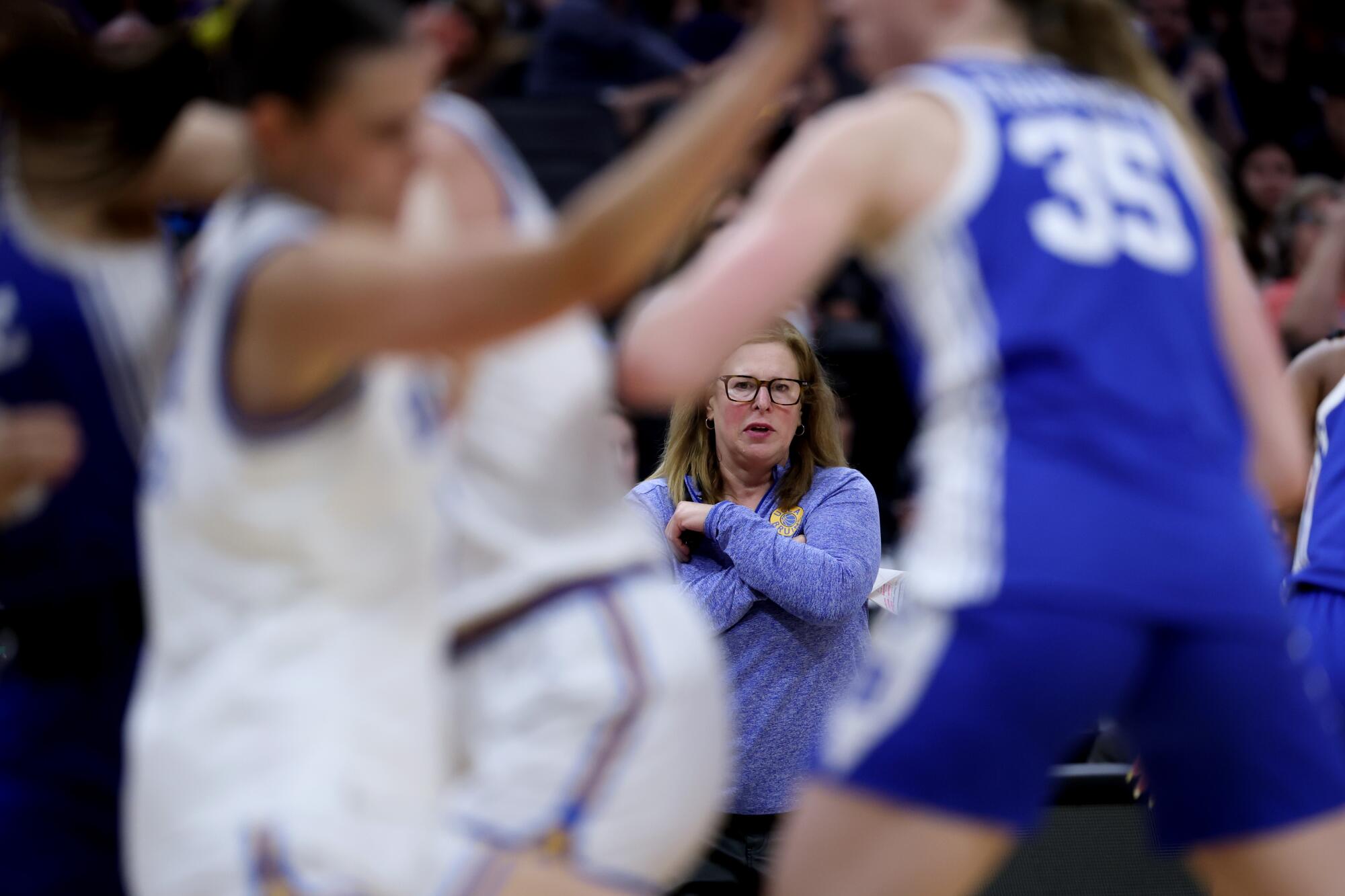
UCLA coach Cori Close watches play during the Bruins’ win over Duke on Sunday.
(Eric Thayer/Los Angeles Times)
“I’m just so proud of her,” Betts said. “The confidence and her poise … you could get in your head in moments when we’re down … but she did all the right things and what we needed at the time.”
It was an entertaining Elite Eight clash that was brought to you by two coaches who staged, like up-and-coming chefs, under two of the greatest leaders the sports world has known.
UCLA coach Cori Close and Lawson committed to making sure we won’t lose John Wooden’s and Pat Summitt’s recipes — never mind all the seismic, disorienting shifts happening in college sports.
A former Tennessee star, Lawson brings Summitt’s brand crackling intensity to Duke, a mindset that she’s said calls for supreme confidence, chasing excellence and holding oneself to an all-around standard of success.
UCLA’s bench was uplifted all season by Close’s warm intentionality, learned from years of mentorship from Wooden. The main ingredients, she’ll tell you, requiring a dollop of growth, gratitude, of giving and not taking.
“[Our] team culture is not this nebulous thing or phrases on a wall,” Close said. “It’s a group of people that are willing to be committed to the hard, right behaviors over and over again. I cannot tell you how many times throughout that game we referred to our values, who we are, what our identity was, what we had to get back to.
“… I’m just really humbled and thankful to be a part of a team and staff that cares about things from the inside out. What you saw on the court is a reflection and a byproduct of what’s happened on the inside.”

NEWYou can now listen to Fox News articles!
Max Verstappen snatched the torch from Lewis Hamilton and became one of the most unstoppable Formula 1 drivers in the sport from 2021 to 2024.
The 2025 and 2026 seasons have been a struggle for the Red Bull racer. He finished second to McLaren’s Lando Norris in the drivers’ standings last season, ending his streak of world championships, and has yet to finish in the top five this year.
Red Bull driver Max Verstappen of the Netherlands steers his car during the Japanese Formula One Grand Prix at Suzuka in central Japan, Sunday, March 29, 2026. (AP Photo/Hiro Komae)
After finishing eighth in the Japanese Grand Prix, Verstappen suggested he was contemplating retirement at the age of 28.
“Privately I’m very happy,” Verstappen told the BBC. “You also wait for 24 races. This time it’s 22. But normally 24. And then you just think about is it worth it? Or do I enjoy being more at home with my family? Seeing my friends more when you’re not enjoying your sport?”
He made clear he was suggesting that 2026 could be his final season.
“I want to be here to have fun and have a great time and enjoy myself. At the moment that’s not really the case,” he said. “Of course I do enjoy certain aspects. I enjoy working with my team. It’s like a second family. But once I sit in the car it’s not the most enjoyable unfortunately. I’m trying. I keep telling myself every day to try and enjoy it. It’s just very hard.”
ISRAELI RACING STAR ‘NERVOUS’ AS FAMILY DEALS WITH IRAN’S RETALIATORY STRIKES, EXPRESSES HOPE FOR REGION
Red Bull driver Max Verstappen, right, of the Netherlands and Mercedes driver Kimi Antonelli of Italy talk during the drivers parade ahead of the Japanese Formula One Grand Prix at Suzuka in central Japan, Sunday, March 29, 2026. (AP Photo/Eugene Hoshiko)
Part of the struggles for Verstappen has been trying to get acclimated to the regulation changes.
“I can easily accept to be in P7 or P8 where I am,” he said. “Because I also know that you can’t be dominating or be first or second or whatever, fighting for a podium every time. I’m very realistic in that and I’ve been there before. I’ve not only been winning in F1.
“But at the same time when you are in P7 or P8 and you are not enjoying the whole formula behind it, it doesn’t feel natural to a racing driver,” he continued. “Of course I try to adapt to it, but it’s not nice the way you have to race. It’s really anti-driving. Then at one point, yeah, it’s just not what I want to do.”
Maybe a break in the schedule will help clear Verstappen’s head.
Formula 1 will have a few weeks off as two races that were set for April in Bahrain and Saudi Arabia were canceled because of military operations in Iran.
Red Bull driver Max Verstappen of the Netherlands leaves during the qualifying session of the Japanese Formula One Grand Prix at the Suzuka Circuit in Suzuka, Japan, Saturday, March 28, 2026. (Franck Robichon/Pool Photo via AP)
CLICK HERE TO DOWNLOAD THE FOX NEWS APP
The next race is set for May 3 in Miami.
The Associated Press contributed to this report.
Follow Fox News Digital’s sports coverage on X and subscribe to the Fox News Sports Huddle newsletter.

A New Homelessness Strategy is Sweeping California – edhat

Colorado’s Biggest Priorities After Losing Bangot Dak

Food workers at CT service plazas secure landmark union contract

Man’s body discovered off Route 40 in New Castle, Delaware

Florida man ‘purposely walked’ onto tracks before being hit by train

Florida High School Football Rankings: Top 25 teams – Oct. 21

How old is Bo Nix? What to know about Oregon quarterback ahead of 2024 NFL Draft

Cleary's 21 help Le Moyne down Central Connecticut State 69-64 in OT

99th annual Pony Swim held in Virginia

Indiana Members Credit Union announced as new anchor tenant at Bottleworks District

Video: Iran to Allow More Oil Ships Through Strait of Hormuz, Trump Says

Dem senator warns deportation could let Virginia woman’s illegal immigrant killer ‘escape accountability’

Newsletter: G7 ministers to hold talks on war’s economic fallout

ICE officers could remain at airports after TSA workers are paid

Scathing report claims nation’s oldest labor union ‘betrayed’ MAGA members through ‘shocking’ spending
-

 Sports1 week ago
IOC addresses execution of 19-year-old Iranian wrestler Saleh Mohammadi
-

 Miami, FL4 days ago
Jannik Sinner’s Girlfriend Laila Hasanovic Stuns in Ab-Revealing Post Amid Miami Open
-

 New Mexico1 week ago
Clovis shooting leaves one dead, four injured
-

 Politics1 week ago
Schumer gambit fails as DHS shutdown hits 36 days and airport lines grow
-

 Tennessee7 days ago
Tennessee Police Investigating Alleged Assault Involving ‘Reacher’ Star Alan Ritchson
-

 Minneapolis, MN4 days ago
Boy who shielded classmate during school shooting receives Medal of Honor
-

 Science1 week ago
Record Heat Meets a Major Snow Drought Across the West
-

 Politics1 week ago
Trump gives Iran 48-hour ultimatum to reopen Strait of Hormuz or face strikes on power plants