Sports
'Uncharted territory': Is Mookie Betts at shortstop a sustainable solution for the Dodgers?

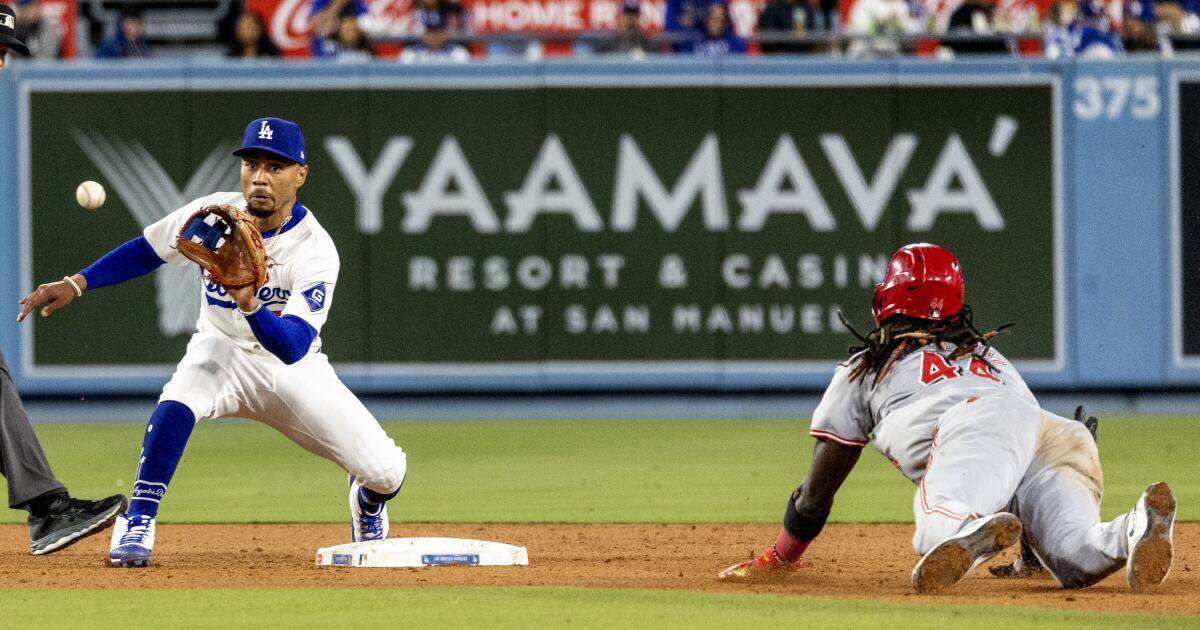
Three months in, the amazement has yet to dissipate.
Every day, the Dodgers watch Mookie Betts take the field hours before first pitch, field dozens of ground balls in pregame infield drills, and endure the toil of perfecting the shortstop position.
Every day, since the former Gold Glove right fielder made the unprecedented switch two weeks before the start of this season, the team marvels at the progress Betts has been able to so quickly make.
“There’s no perfect player,” Dodgers manager Dave Roberts said recently. “But if there is as close to a perfect player, it’s Mookie Betts. It really is.”
Indeed, in what was a virtually unprecedented defensive gamble this year, Betts’ move to shortstop hasn’t blown up in the Dodgers’ face.
As the season nears the halfway mark, Betts has led the Dodgers to a 41-26 record entering Tuesday’s game, providing a spark with his bat (he is hitting .309 with 10 home runs) and his glove (starting at shortstop in 55 of 67 games) to help the team surge to a 7½-game lead in the National League West.
Betts is far from a perfect shortstop. Playing the position regularly for the first time as a professional — and the first time at all since his days as a high school player growing up in Tennessee — there have been learning curves and growing pains, including a team-high nine errors and poor .957 fielding percentage (third-worst among 24 qualified MLB shortstops this season).
Such struggles, however, were inevitable for Betts this season. After replacing defensively scuffling teammate Gavin Lux at shortstop this spring, failure was the only way for Betts to learn a new, intricate, demanding position.
“I take a lot of pride in it, how I’ve come a long way,” Betts said this weekend, reflecting on the process while from a visiting locker at Yankee Stadium last weekend. “Starting from as low as I was, you go up pretty quick.”
What comes next, however, is much more unclear.
Between now and October — if not, more urgently, the July 30 trade deadline — the Dodgers will have to make several determinations regarding both Betts and their shortstop position:
- Whether Betts can truly hone the role by the end of the year — and be trusted to play shortstop regularly in the playoffs.
- Whether the process of getting there can be sustained without Betts overexerting himself physically, given the extensive pregame routine he has relied on for continued improvement.
- And, whether keeping Betts at shortstop — or, potentially sliding him over to second base — makes the most sense in the long haul for this year’s Dodgers team.
Right now, “everything is on the table,” said one person with knowledge of the situation who wasn’t authorized to speak publicly.
Which is why, for as astonishing as Betts’ acclimation to shortstop has been, the process still feels stuck in an almost experimental phase — looming as one of the most important variables for a club with lofty World Series ambitions.
“I was talking to Lux,” Betts said after a recent game, “and I was like, ‘This is the hardest thing I’ve ever had to do.’ … Not looking for any sympathy. But, you know, it’s tough. So I gotta get it done.”
During his first four years in the major leagues, Honus Wagner — or, as he is described on his Baseball Hall of Fame plaque, the “greatest shortstop of all time” — didn’t actually play a single game at the position.
Instead, after making 232 appearances in the outfield from 1897 to 1900, the Pittsburgh Pirates legend only started playing shortstop in 1901, and didn’t move there permanently until 1904.
Over the following 120 years, no player is believed to have recorded more outfield appearances before switching to shortstop on a full-time basis. Few ever dared such an ambitious defensive change.
That is, until this season came around.
Until Betts, the six-time Gold Glover who played a whopping 1,130 career games in the outfield before ever appearing at shortstop (five times more than Wagner did before making his switch), accepted the challenge with the Dodgers this spring, making a major career change at age 31.
“I’m doing something that is uncharted territory,” Betts said. “I can’t go ask someone. I can’t go talk to anybody. Nobody can lead me through this, because nobody has done this. So, it’s really like [being] a pioneer, trying to figure this whole thing out.”
Betts did have some familiarity with shortstop from his high school days. He was already preparing for a full-time switch to the infield this season, as well, set to become an everyday second baseman after playing there regularly in 2023.
Going straight to shortstop, though, was a monumentally taller task — like asking a teenager to take a driver’s test before they’d hardly even begun the learning permit phase.
Dodgers manager Dave Roberts, right, has been effusive in his praise of Mookie Betts as he’s taken on the starting shortstop position.
(Robert Gauthier /Los Angeles Times)
Shortstop requires more range, more split-second instincts and a fundamental feel for making myriad types of throws across the diamond. There is less time to think, react or set your feet. And only through extensive practice — and obligatory failure — can the correct habits be developed.
“For me, it’s something I know I can do,” Betts said. “But I know that it’s gonna take time. There’s no way to go play shortstop — elite shortstop — in a month, with zero practice.”
Three months in, it remains a quixotic quest.
Dodgers officials, however, have been profuse in their praise of Betts since the start of the season.
“I don’t think it’s being talked about enough just how selfless Mookie is,” president of baseball operations Andrew Friedman said. “Most superstar players wouldn’t put themselves in the position of being as vulnerable as he is. And the way he has attacked it, the improvement we have seen day over day, week over week, it’s been astonishing.”
Teammates have lauded the tireless effort that has gone into his transition — most notably the extensive routine of infield drills Betts will take under the guidance of longtime third base coach Dino Ebel and experienced shortstop teammate Miguel Rojas before almost every game.
“Everything he does, he’s trying to be the best at it,” first baseman Freddie Freeman said. “So, because he hasn’t done this before, he’s overloading the work. Trying to do everything he can to put himself, and us, in the best situation.”
Despite all that, publicly available defensive metrics paint a much bleaker picture of Betts’ shortstop performance.
His nine errors so far are fourth-most at the position. His .957 fielding percentage is better than only Cincinnati’s Elly De La Cruz and Pittsburgh’s Oneil Cruz. He does rank 10th among qualified shortstops in “defensive runs saved,” and has helped turn 26 double plays, 12th-most among the group.
But, according to Baseball Savant’s all-encompassing “outs above average” metric, Betts has been the worst overall shortstop in the majors.
And on multiple occasions in recent weeks, he has aired frustrations with himself about miscues in the field.
“I gotta clean up a lot of things,” Betts said after committing two errors in Pittsburgh last week. “There’s no excuses. But the fact is, this is all new to me, man. This is all new. And it’s going to take more than two months to get.”
The good news for the Dodgers is that Betts has looked increasingly smoother with his shortstop play. He is better at going to his right and fielding grounders on his backhand. After “cutting” his throws too much early in the year, as Freeman described it, with the ball tailing too low and to the left, Betts has gotten more consistent and accurate with his tosses of late.
“It’s Mookie Betts,” Freeman said. “Everyone knows he will master it.”
The question, however, is how long such mastery will take to achieve — and how well Betts will hold up physically in the meantime.
“You can plateau pretty quick,” Betts said of his progression of learning shortstop defensively. “So I don’t know where I’m at. I just know I’m trying to get better each day, and see what happens.”
Roberts called it a “lazy” narrative. But that doesn’t mean it contains no truth.
After winning NL player of the month in April, and emerging as an early most valuable player front-runner by mid-May, Betts’ offensive production has started to slide in recent weeks. Since May 16, he is batting just .226, with a pedestrian .381 slugging percentage over his last 21 games.
“It’s not that good,” Betts said of his recent production. “But I’m grinding. I’m working. You know me. I’m always working to get better. It’s just not happening.”
While any number of factors could be causing such struggles, one point of speculation has centered on Betts’ defensive workload — and whether all of his efforts to learn shortstop are hampering him in any way at the plate.
Both Betts and Dodgers personnel scoffed at that theory last week.
Betts said that, thanks to changes in his diet and daily routine (even as simple as morning walks with his family, to keep his body moving), this year is actually “the best I’ve felt since I was probably 21 or 22 years old.”
Ebel, who directly oversees the Dodgers’ infield defense, said the club’s training staff has offered similar evaluations, especially as Betts has started streamlining his daily regime of infield drills in recent weeks (where Betts once took five reps of each specific ground ball type, for example, he now takes only three).
“It’s a long season,” Ebel said. “But we’re watching him daily, and he says ‘I’ve never felt better.’”
Nonetheless, until Betts maintains dominance at the plate and in the field, there will be calls from some corners of the fanbase for the team to make a defensive lineup change.
The simplest solution could come internally. Rojas, who was the Dodgers’ primary shortstop last season, is not only among the most sure-handed players in the sport at the position, but is also having a resurgent season at the plate, batting .283 with 11 extra-base hits.
Right now, Rojas is playing mainly at second and third base — clearing the way for Betts to get as many reps as possible at shortstop, where the Dodgers hope he can continue his steady defensive improvements.
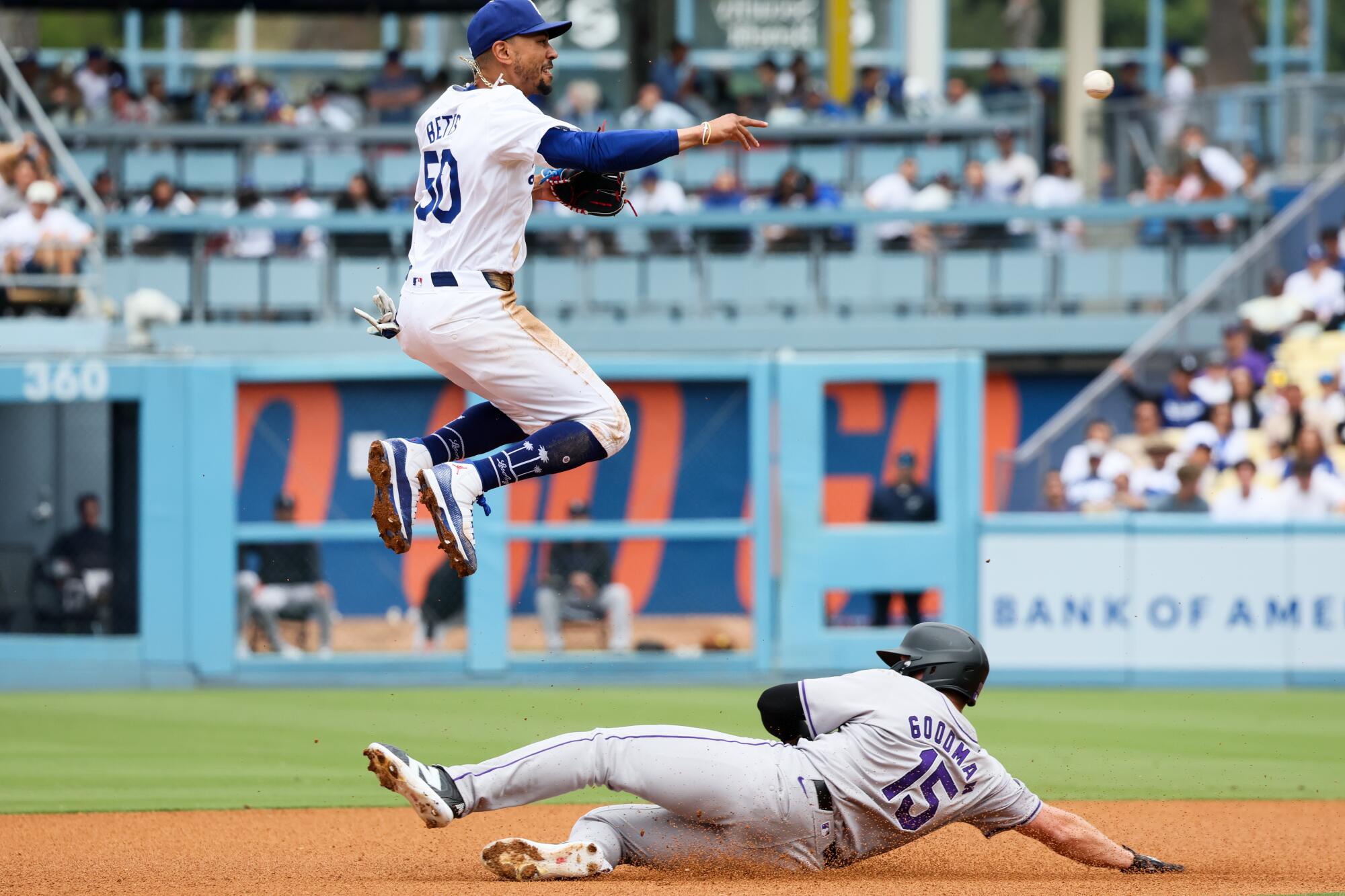
Dodgers shortstop Mookie Betts leaps over the Rockies’ Hunter Goodman after throwing to first base during a game at Dodger Stadium on June 2.
(Robert Gauthier / Los Angeles Times)
Rojas is also battling some leg soreness that has prevented him from playing on an everyday basis the past two weeks.
But, come the stretch run of the season, the Dodgers could always opt to reinsert Rojas as their primary shortstop and slide Betts over to second base (a return to right field, people around the organization believe, is unlikely at this stage of Betts’ season).
The trade deadline will offer other potential opportunities, too.
It’s worth remembering, the Dodgers have had past interest in Milwaukee shortstop Willy Adames (though he seems destined to stay with a surprise Brewers team currently leading the NL Central).
They could also be a fit for someone like Toronto star Bo Bichette, but only in the unlikely event that the Blue Jays opt for a midseason fire sale.
The rest of the trade market looks light on top shortstop targets, though smaller names, such as Paul DeJong of the Chicago White Sox, should be available.
All of this is to say: There will be more traditional shortstops than Betts, both inside the organization and not, for the Dodgers to consider before they reach October.
And if the team ultimately does go in a different direction, Betts said last weekend that he would understand.
“I don’t care,” he said. “I just want to win. If I’m not serviceable enough and they need to move off [playing me at shortstop], I ain’t got no pride when it comes to this. I just want to win. I genuinely don’t care about anything else.”
For now, though, the Dodgers don’t appear to be rushing down that path.
They remain mesmerized by all he has accomplished as a shortstop thus far. They’ve seen enough to not yet give up on the possibility of him cementing himself there for the rest of the season.
“No one wants to be uncomfortable and put in a position to fail, let alone a superstar,” Roberts said. “He could’ve stayed in right field and been a Hall of Famer. Or gone to second base and rode his ticket to the Hall of Fame. But now, he’s putting himself out there to play short.”
And he’s giving the club much to consider in the process.


NEWYou can now listen to Fox News articles!
The ESPYS brought some of the biggest names in sports and entertainment to New York City on Wednesday night, a day that typically ranks among the slowest on the sports calendar.
But this year’s ceremony was preceded by a World Cup semifinal match in Atlanta that was already being described as an instant classic. Lionel Messi and Argentina punched their ticket to a second straight World Cup final with a win over England. The defending champions will meet Spain on Saturday in nearby New Jersey, just a short trip across the Hudson River from where comedian Marcello Hernández opened the ESPYS.
The “Saturday Night Live” star wasted little time taking a few jabs at Jake Paul, Tiger Woods and other sports figures.
ESPN’S JOHN BUCCIGROSS NAMES HIS MOUNT RUSHMORE OF ALL-TIME SPORTSCENTER ANCHORS
Marcello Hernández speaks onstage during the 2026 ESPY Awards at David H. Koch Theater at Lincoln Center in New York City. (Mike Coppola/Getty Images)
“Mike Tyson ripped my watch off. Welcome to the ESPYS!” Hernández joked after making a boxing-style entrance in a robe with Tyson as part of his entourage.
“I must say, it’s an honor to be here among so many great athletes, and Jake Paul,” Hernández began in his roughly 10-minute monologue.
Paul appeared to take the joke in stride, laughing and applauding as cameras cut to him in the crowd. Hernández then stayed on the YouTube star-turned-boxer, needling him over his history of fighting older opponents.
“Jake, that’s just a joke. Don’t fight me,” Hernández continued. “My dad and my stepdad are both here. They’re over 50, and I know that’s how you like them. So, fight them instead.”
Paul kept laughing as Hernández’s bit played out, eventually closing with the comedian shifting attention to his father and stepfather, who were shown in the audience.
Atmosphere at the 2026 ESPYS at the David H. Koch Theater at Lincoln Square on July 15, 2026, in New York, New York. (Gilbert Flores/Variety via Getty Images)
Hernández later used Caleb Williams’ “Madden 27” cover as a lead into Woods.
CLICK HERE FOR MORE SPORTS COVERAGE ON FOXNEWS.COM
“I want to congratulate Caleb Williams, the quarterback for the Chicago Bears, who will be on the cover of the new Madden video game. Congratulations to Caleb,” Hernández said, before adding, “And Tiger Woods will be on the cover of Grand Theft Auto.”
Woods was arrested in Florida in March on charges of DUI after a car crash. The arrest report said a deputy found pain pills in his pocket and observed signs of impairment at the scene. Woods later announced he would take time away from golf to seek treatment.
Hernández also worked North Carolina football coach Bill Belichick into the monologue, using the 74-year-old’s relationship with Jordon Hudson as part of a joke about the New York Knicks’ title drought.
“The Knicks won their first championship since 1973. And to put into perceptive how long ago that was, in 1973 hockey players didn’t wear helmets, basketball had no three point line. And in 1973, Bill Belichick was the age his girlfriend is now.”
The Knicks later took home the ESPY for Best Team.
Jalen Brunson, Karl-Anthony Towns, OG Anunoby and other members of the 2025-26 Knicks championship team took the stage to accept the award, but Josh Hart was noticeably absent. Brunson drew laughs when he joked, “I want to say thank you to the ESPYS for pulling Josh Hart’s invite.”
Earlier in the night Brunson also received the “Best Championship Performance” award.
Jalen Brunson accepts the Best Championship Performance award onstage during the 2026 ESPY Awards at David H. Koch Theater at Lincoln Center in New York City on July 15, 2026. (Kevin Mazur/Getty Images for W+P)
Former NBA player Jason Collins, who died in May at age 47 following a battle with Stage 4 glioblastoma, posthumously received the Arthur Ashe Award for Courage. Former MLB pitcher Jim Abbott received the Jimmy V Award for Perseverance, while Scott Ruskan was honored with the Pat Tillman Award for Service.
CLICK HERE TO DOWNLOAD THE FOX NEWS APP
The ESPYS are held every summer, bringing together top athletes and other stars to celebrate the best moments from the past year in sports while honoring figures recognized for courage, service and impact. In past years, the ceremony has been held in Los Angeles, but shifted to New York this year.
Follow Fox News Digital’s sports coverage on X, and subscribe to the Fox News Sports Huddle newsletter.

ATLANTA — The jury is still out on whether Lionel Messi is the greatest soccer player ever. But there should be no doubt he’s the greatest to ever play in a World Cup.
And you don’t need the records, the wins or the goals to prove that — although he certainly has enough of those. You just need to see Messi at his most magical, as he was Wednesday, setting up a pair of game-changing goals in a seven-minute span to lift Argentina to a 2-1 win over England and into Sunday’s World Cup final with Spain.
“It’s really hard to speak right now, but I’m going to try not to cry,” Lautaro Martínez, who scored the winning goal two minutes into stoppage time, said in Spanish. “I’m already overwhelmed inside. It’s incredible. Everything we’ve achieved is just incredible.”
Like their 13-game World Cup unbeaten streak, dating to the opening game of the 2022 tournament in Qatar. Or back-to-back trips to the final, which gives them a chance to become the first repeat champion in the men’s tournament since Brazil in 1962.
Argentina’s Lautaro Martinez scores his team’s second goal in front of England goalkeeper Jordan Pickford (1) and fellow England players Ezri Konsa (2) and John Stones (5) during a World Cup semifinal in Atlanta on Wednesday.
(Erik S. Lesser / Associated Press)
But it hasn’t been easy. Eleven of Argentina’s 19 goals — including both scores in Wednesday’s semifinal — have come after the 75th minute. They trailed in the 80th minute or later in two of their last three knockout games, only to rally both times.
And Messi has either scored or assisted on three of the four goals that rescued Argentina.
“This group, in the face of adversity, keeps going, keeps going, and never gets tired,” Martínez said. “And we have the best in the world as our example.”
On Wednesday that meant heartache for England, which was as close to a World Cup final as it has been in six decades, leading 1-0 on Anthony Gordon’s second-half goal with just five minutes left in normal time.
But after taking the lead, England turned strangely conservative, dropping all 11 players behind the ball at times, daring Argentina to score. Eventually it did, with Enzo Fernández curling a right-footed shot from about 20 yards past England keeper Jordan Pickford and in at the left post to tie the game.
It was a pass from Messi that found Fernández in space at the top of the box, earning the Argentine captain his record 11th World Cup assist.
“The opponent doubted themselves,” Argentine coach Lionel Scaloni said. “We smelt blood and went for it. We all felt it. “
The tie didn’t last for long though, with Messi threading a perfect cross from the right wing to Martínez, who found space between English defenders John Stones and Ezri Konsa at the far post. Messi’s pass just cleared the leaping Stones, then dipped to Martínez, who nodded it home.

England’s Harry Kane and England’s Jude Bellingham are dejected after losing to Argentina during a World Cup semifinal on Wednesday in Atlanta.
(Jeff Roberson / Associated Press)
When the ball hit the net, the sellout crowd at Atlanta’s massive Mercedes-Benz Stadium erupted.
“Once again, despite falling behind, we managed to turn the game around in stoppage time. That speaks volumes about this group, about this team that never settles, always wants more, always strives for more,” Martínez said.
It also gives Messi a chance to strive for more in Sunday’s final. He has already played in more World Cup games, scored more World Cup goals and had more World Cup assists than any man in history. With a win over Spain, he can join another elite group of men: those who have won back-to-back World Cup titles.
History will eventually decide if it was Messi’s brillance or the tactical surrender of England coach Thomas Tuchel that truly turned the game around. Tuchel, however, said he had no regrets.
“We played the matches how they were,” he said. “We overcame every obstacle. We were very, very close today. It’s not a moment now to analyze the full tournament because we lost a crucial match.”
His captain, Harry Kane, who lost in the semifinal of a World Cup for the second time in three tournament, was also not interested in second-guessing.

Argentina’s Lionel Messi sits on the shoulders of a teammate and celebrates after beating England in a World Cup semifinal on Wednesday in Atlanta.
(Rebecca Blackwell / Associated Press)
“We had a lot of good moments in this tournament, a lot of good games,” he said. “We talked about knocking on the door. We’re close, we just have to find that missing piece in the final stage of the tournament.”
They may be closer than they think: England is the only team this century to score the first goal in a World Cup semifinal but not reach the final, according to the OptaJoe statistical service.
Argentina’s team, meanwhile, is missing nothing — except maybe a second title,
“The people of Argentina should celebrate being in a final,” Scaloni said. “This group of players is difficult to describe in words. They are so special. I’m getting emotional. They fight for everything.
“We’re going to try to win the final. But what else does this team need to do? There isn’t much else to say. I’m eternally grateful to this group of players.”
Sports editor Iliana Limón Romero contributed to this report.

NEWYou can now listen to Fox News articles!
After five years out of the Octagon, Conor McGregor’s return barely lasted one minute.
McGregor opened his Saturday fight against Max Holloway aggressively, attempting a running kick before throwing a head kick moments later. However, he slipped both times because it was apparent he had suffered a knee injury.
He tried to power through it, but nearly two minutes into the fight, he grabbed at his right leg again, and referee Mike Beltran called the fight after just 69 seconds.
Conor McGregor reacts after losing to Max Holloway in a welterweight fight at UFC 329 on Saturday, July 11, 2026, in Las Vegas. (John Locher/AP)
In his first post on Instagram since the bout, McGregor vowed to return from the injury.
“We’ll be back,” McGregor said after showing off his new energy drink.
Prior to that, McGregor showed off the “Mac” drink, enjoying it alongside his wife. McGregor then shared his faith.
Conor McGregor of Ireland reacts after an injury stoppage in a welterweight fight during UFC 329 at T-Mobile Arena in Las Vegas, Nev., on July 11, 2026. (Chris Unger/Zuffa LLC)
WWE’S PAUL HEYMAN TAKES SWIPE AT CONOR MCGREGOR INJURY ON ‘MONDAY NIGHT RAW’
“In the name of the Father, the Son, and the Holy Spirit. Amen. We’ll be back. Let’s go.”
McGregor made an emotional post the day after the fight, saying his “head gasket is gone.”
“Destroyed. I had no injury / injuries going into the fight. I was throwing kicks, planted and jumping, all throughout camp as well as backstage before the fight. This came out of nowhere. I am beyond dark here. I can only describe it as hell,” he said on X.
UFC president Dana White said he assumed McGregor suffered a “blown ACL.”
Conor McGregor kicks Max Holloway in a welterweight fight at UFC 329 on Saturday in Las Vegas. (John Locher/AP)
CLICK HERE TO DOWNLOAD THE FOX NEWS APP
McGregor was participating in his first bout since July 2021 when he lost to Dustin Poirier due to a devastating leg injury. He’s only won one fight since 2020.
Fox News’ Ryan Gaydos, Chantz Martin, and The Associated Press contributed to this report.
Follow Fox News Digital’s sports coverage on X, and subscribe to the Fox News Sports Huddle newsletter.
-

 Health32 seconds ago
Is lettuce still safe to eat amid Taco Bell illness probe? Doctors answer
-

 Sports7 minutes ago
Marcello Hernández roasts Jake Paul, Tiger Woods and Bill Belichick in ESPYS monologue
-

 Technology13 minutes ago
You paid for it. So why is your device showing ads?
-
 Business19 minutes ago
Paramount shareholder lawsuit accuses Ellisons of corruption
-
 Entertainment25 minutes ago
‘You’re scaring my people.’ Shia LaBeouf’s alleged stalker arrested after posting viral video
-
 Politics37 minutes ago
Californians back Becerra and reject AI data centers by big margins, poll finds
-
 Science43 minutes ago
How to eat safely amid outbreak of diarrhea-causing cyclosporiasis
-
Sports49 minutes ago
Magical Lionel Messi leads Argentina past England for trip back to World Cup final

