Sports
Total Eclipse of the Park: The Guardians' home opener coincides with a rare solar eclipse


CLEVELAND — Befuddled birds will start chirping. Drivers trapped in a boundless traffic snarl will halt their honking. The temperature will plunge. Sluggers swatting batting practice tosses at Progressive Field will pause for a cosmic intermission.
At 3:13 p.m. ET on April 8, the springtime sky above downtown Cleveland will host a total solar eclipse, as the moon’s shadow sweeps across the middle of the country and eclipse chasers scramble to locate the perfect spot to witness the spectacle.
The orbits of the sun, the Earth and the moon will align so that the moon blocks out the full disc of the sun, casting darkness along a path that will extend from Mexico to Dallas to Little Rock to Indianapolis to Cleveland to Buffalo to Caribou, Maine. The phenomenon occurs every 18-24 months, but usually over vast oceans or uninhabited regions like Antarctica.
This one is headed for the spotlight, and it’s also on a collision course with the Cleveland Guardians’ home opener.
For two years, Cleveland officials have planned for an event in which the ensemble carries out its performance millions of miles from the front-row seats on Lake Erie’s shore. The showcase is expected to attract visitors to Cleveland from Canada, France, Ireland and Zimbabwe, plus states near and far. The city won’t land in the path of totality again until 2444.
To grant the Guardians an extension for their ongoing ballpark renovations, the league booked them a three-city, 11-day trip through Oakland, Seattle and Minneapolis to start the regular season. They’re one of three teams, along with the Boston Red Sox and Toronto Blue Jays, following that sequence, but they’re the only one with celestial complications.
The Guardians are now faced with a decision: Do they host their home opener that day, or that night, or shortly after the three-minute, 49-second phase of totality when day masquerades as night?
“Everybody talks about where they were when the Cavs won the championship,” said Chris Hartenstine, an education coordinator at NASA’s Glenn Research Center. “Everybody can say, ‘I was in the arena,’ ‘I was at the watch party,’ ‘I was watching with friends.’ This is one of those moments. It’s in science, not necessarily sports. The cool thing about the Guardians is you can get a little bit of both. ‘I was there on Opening Day when the eclipse happened.’”
The preparation for April 8, 2024, for many, began on Aug. 21, 2017, the date of the last total solar eclipse visible from the U.S. That’s when Cleveland restaurant owner Sam McNulty first entered a reminder on his phone’s calendar. Now, he’s fast-tracking the completion of a rooftop bar at Market Garden Brewery to accommodate the out-of-towners who have reserved tables for April 8.
For some, it started a bit earlier.
“I’ve been thinking about 2024 since I was a kid,” said Mike Kentrianakis, who has witnessed 14 total solar eclipses since 1979 from Indonesia, Chile, Gabon, Australia, China, Russia, Greece, Aruba, Canada, and — while over the Scotia Sea — north of the Antarctic Peninsula.
He watched the 2017 eclipse from Carbondale, Ill., and at the end of March, he’ll hop in a rental car in Queens, N.Y., and start his 15-hour trek to the same site, the rare city to fall in the path of totality in both 2017 and 2024.
“I’ll do anything for an eclipse,” Kentrianakis said.
Hartenstine anchored NASA’s public presentation from the path of totality seven years ago in a tent on the grassy area in front of the state capitol building in Jefferson City, Mo. He wasn’t sure what to expect. Hartenstine went from sweating buckets in Jefferson City’s 90-degree summer heat to needing a sweatshirt. As darkness descended in the middle of the day, crickets and cicadas and birds chirped in confusion. Shadows sharpened to what Hartenstine described as “video game” levels as the moon impeded the sun’s effect, before it all returned to normal with disappointing speed.
“Four minutes is a song on the radio,” Hartenstine said. “You can totally miss the experience. You have to know ahead of time to know what you’re looking for and then you can really embrace it.”
While some embrace it, others have to plan around it. The eclipse coincides with the NCAA Women’s Final Four at Rocket Mortgage FieldHouse and the Cleveland International Film Festival at Playhouse Square. And, of course, the Guardians’ home opener – which, in at least some capacity, will have to surrender to the quirks of science for a once-in-a-lifetime total eclipse at the park.
Over the past few months, the Guardians have consulted with everyone from local authorities to NASA scientists as they tried to determine the best Opening Day approach. The Guardians have slated seven of their last eight home openers (in which fans were permitted) for 4:10 p.m. ET, but that time will fall in the partial eclipse window, and trying to barrel a 90 mph slider while sporting solar-filtered glasses is a tall order. If they choose a late-afternoon start time, fans could potentially view the eclipse from ballpark seats that have a view of the midday sun. Even if they opt for a night game, there will still be traffic-related challenges to sort through.
Few baseball teams have had to consider such questions before, but there is at least one example — and they leaned hard into the eclipse festivities.
In 2017, the Bowling Green Hot Rods, the Low A affiliate of the Rays, faced a similar quandary. Bowling Green, Ky., resided in the path of totality, and when an astronomy professor at nearby Western Kentucky University placed it on their radar a year in advance, the Hot Rods started their planning.
They settled on a brunch-timed first pitch, officially 10:34 a.m., as league rules prohibited them from starting much earlier. The teams, clad in black “moon” and white “sun” jerseys, breezed through the first eight innings, but just as the Hot Rods’ broadcaster expressed relief about the pace of play, the West Michigan Whitecaps pieced together a five-run ninth and the sunlight started to dim.
In 2017, the Bowling Green Hot Rods made an eclipse into a fully themed event, with special uniforms and a viewing party. (Steve Roberts / Bowling Green Hot Rods)
Had the game dragged on any longer than the two hours, 38 minutes it took, the teams would have paused the action. Instead, moments after the final out, players and fans sprawled out on the outfield grass as professors explained the science unfolding overhead.
The Hot Rods attracted a crowd of 6,006, one of the largest in the ballpark’s history, and certainly the largest for a Monday morning first pitch.
The Guardians have sold out every home opener since 1994, and it’s fair to expect that Progressive Field will again sell out its roughly 35,000 seats, eclipse or not. In a normal year, that might qualify as a major event downtown; this year, it’s got a lot of competition.
This is the first total solar eclipse over Cleveland since 1809, nearly a century before the city’s baseball outfit became a charter member of the American League. Destination Cleveland, an organization charged with bringing tourism to the city, estimates that 200,000 visitors will trek downtown that day. Most hotels in the city are already sold out.
“People are going to descend on Cleveland like we’ve never seen,” said Scott Vollmer, VP of education and exhibits for the Great Lakes Science Center.
NASA will broadcast the day’s events from outside the Great Lakes Science Center, where an expected crowd of 50,000 will gather for the grand finale of a three-day festival at the North Coast Harbor.
“It’s literally once-in-a-lifetime,” Vollmer said, “and all you have to do is look up to see it.”
Downtown Cleveland isn’t the only place expecting to be overrun with eclipse tourists. The suburb of Avon Lake, Ohio, about a half-hour west of downtown Cleveland, sits directly on the center line of totality, hence the town’s new slogan, “Totality’s best seat.”
Erin Fach, Avon Lake’s director of parks and recreation, has studied Hopkinsville, a small town in southwest Kentucky that welcomed visitors from 48 states for the 2017 eclipse. Fach and his team even dined at Ferrell’s, a Hopkinsville burger joint with one stove and a dozen barstools that, five years after the landmark event, still featured on its menu an eclipse burger — a double cheeseburger with bacon and a sunny-side-up egg.
Fach expects the town’s population of 30,000 to double or triple on April 8. He has prepared the city’s planners by describing the day as their annual July 4 fireworks show coinciding with the biggest high school football game they’ve ever hosted while another milestone event unfolds at the primary community park.
Now organizers and eclipse tourists alike are simply hoping the weather holds up and everyone can see the show. Cloud cover is a concern in Cleveland, but Hartenstine relayed cautious optimism that the temperature of Lake Erie will create a barrier of cold air that pushes a stagnant, overcast sky away from the waterfront. Colleagues at the Johnson Space Center in Houston have asked Hartenstine why eclipse chasers would venture to Cleveland on April 8 instead of Dallas or another city with a more accommodating spring forecast. Hartenstine pointed out that Cleveland has had clear skies on that date the last two years.
“The pinnacle (is) the totality,” Hartenstine said. “The last little glimmer of sunlight disappears behind the moon and then you have to take your eclipse glasses off or you won’t see anything. When you take those glasses off, you can see the corona of the sun radiating across the sky.
“That was the moment for me in 2017. I still didn’t get it. But once you take the glasses off and see the show, it becomes however long you have in that path of totality, whether it’s 20 seconds, or 3 minutes, 50 seconds, like Cleveland has. You have to take it in.
“That’s four minutes of visual phenomenon, amazement — and then it’s gone.”
The Guardians are expected to decide on their start time in the next few weeks. Whether they build the eclipse into the home opener or try to work around it, it will be a baseball experience with little precedent.
Kentrianakis plans to wait until 18-24 hours before the climax of the event to determine whether he’ll stay in Carbondale or hightail it to Cleveland. The city with the clearer forecast will win out. It’s the last total solar eclipse that will be visible in the contiguous U.S. until August 2044.
“It’s an indescribable experience,” he said. “It’s unlike anything you could imagine.
“Everyone’s gonna say, ‘That was the coolest thing I’ve ever seen.’”
(Top image: Eamonn Dalton / The Athletic; Photos: Bill Ingalls courtesy of NASA; Tim Clayton / Corbis via Getty Images)



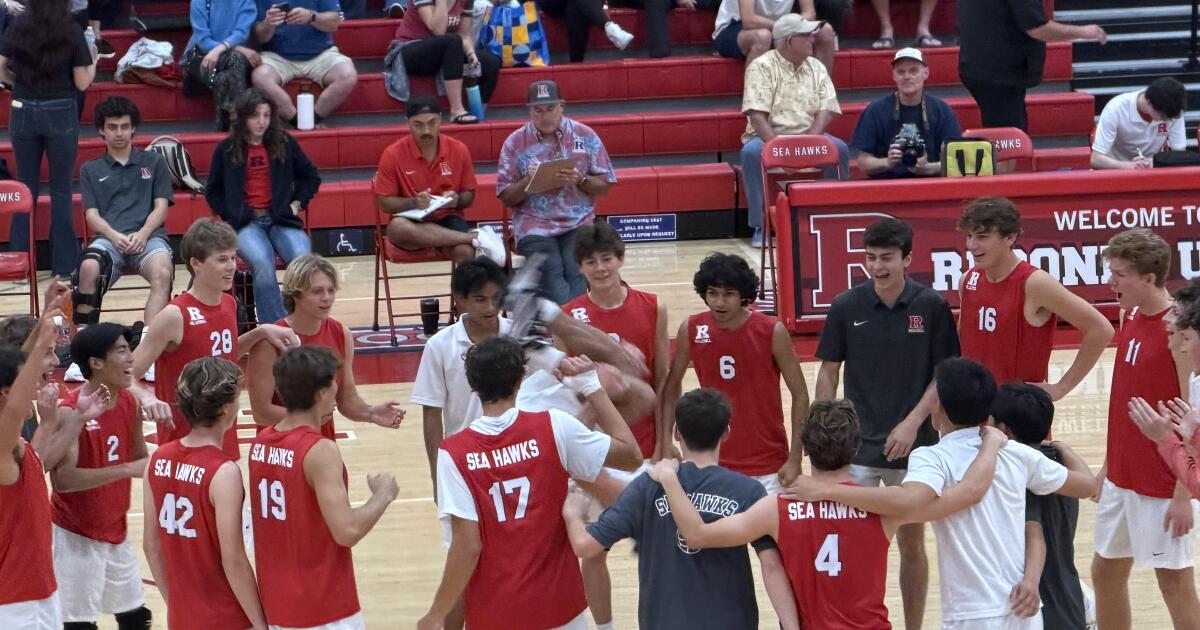
Redondo Union didn’t care that Mira Costa’s volleyball team was ranked No. 1 in California. This was their South Bay rival coming to their gym Thursday night, and anything can happen when a team digs deep and doesn’t fear losing.
The Sea Hawks (14-2) were aggressive from the outset and came away with a 27-25, 21-25, 25-22, 21-25, 15-13 victory.
“Chemistry,” setter Tommy Spalding said about the Sea Hawks’ triumph. He’s one of three players headed to MIT, and all three had big matches.
At one point on back-to-back plays, Carter Mirabal had a block and Vaughan Flaherty followed with a kill off an assist from Spalding. Chemistry.
JR Boice, a Long Beach State commit, was delivering kills, and Cash Essert’s serving and all-around play kept Mira Costa’s Mateo Fuerbringer looking frustrated. The Sea Hawks’ focus was on Fuerbringer, who came alive in the fifth set with six kills, but Redondo was able to come back from an 11-9 deficit.
It was only Mira Costa’s second loss in 25 matches. Redondo Union took over first place in the Bay League.
Baseball
Orange Lutheran 3, Jacksonville (Fla.) Trinity Christian 2: The Lancers advanced to the semifinals of the National High School Invitational in Cary, N.C., behind a walk-off single in the eighth inning by Andrew Felizzari. Brady Murrietta had tied the score with a squeeze bunt in the bottom of the seventh. CJ Weinstein had two doubles for the Lancers.
Venice (Fla.) 12, Harvard-Westlake 0: The Wolverines were limited to three hits at the National High School Invitational in Cary, N.C.
Casteel (Queen Creek, Ariz.) 3, St. John Bosco 2: The Braves suffered their first defeat in North Carolina. Jack Champlin threw five innings and also had two RBIs.
Chatsworth 6, Taft 3: Tony Del Rio Nava threw six innings and had two RBIs in the West Valley League win.
Granada Hills 4, El Camino Real 3: A two-run single by Nicholas Penaranda in the seventh inning keyed a three-run inning for the Highlanders in their West Valley League upset. JJ Saffie had three hits for ECR.
Cleveland 4, Birmingham 3: The Cavaliers pushed across a run in the top of the 10th inning to break a 3-3 tie in the West Valley League win. Joshua Pearlstein finished with three hits, including a home run.
Sun Valley Poly 4, San Fernando 2: Fabian Bravo gave up four hits in 6 2/3 innings for the Parrots, who are tied with Sylmar for first place in the Valley Mission League. Ray Pelayo struck out eight for San Fernando.
Verdugo Hills 15, Kennedy 1: Cutlor Fannon had two doubles and four RBIs in the five-inning win. Anthony Velasquez added two singles and four RBIs.
Westlake 9, Agoura 4: Jaxson Neckien hit a three-run home run to power the Warriors.
Thousand Oaks 7, Calabasas 5: Gavin Berigan, Jeff Adams and Cru Hopkins each had two hits for the Lancers.
Oaks Christian 11, Newbury Park 2: Dane Disney contributed three hits in the Marmonte League win. Carson Sheffer had two doubles and three RBIs.
Santa Monica 12, Simi Valley 4: Ryan Breslo and Johnny Recendez had two RBIs and a triple for Santa Monica. Ravi Chernack had three RBIs.
Dana Hills 7, Corona Santiago 0: Gavin Giese finished with eight strikeouts over six innings and gave up one hit for Dana Hills.
Softball
Sherman Oaks Notre Dame 10, Sierra Canyon 0: Kelsey Luderer contributed three hits and two RBIs while freshman Ainsley Jenkins threw five scoreless innings.
Chaminade 15, Louisville 2: Norah Pettersen had two hits and four RBIs.
Carson 10, San Pedro 0: Atiana Rodriguez finished with three hits, including a double and triple, and three RBIs.
Huntington Beach 6, El Modena 2: Willow Kellen had three hits for the Oilers.
Murrieta Mesa 15, Chaparral 0: It’s a 16-0 start for the Rams. Tatum Wolff hit two home runs.

NEWYou can now listen to Fox News articles!
The fiancée of Buffalo Sabres star Rasmus Dahlin received a roaring welcome home in her first appearance of the season Wednesday night, months after undergoing a lifesaving transplant after she suffered heart failure during a vacation in France.
Carolina Matovac, 25, was shown on the jumbotron during Wednesday’s game against the Boston Bruins. Fans cheered as she waved, and Dahlin, who was also shown on the screen in a split, cracked a smile at the crowd’s reaction.
Carolina Matovac and Rasmus Dahlin of the Buffalo Sabres pose on the red carpet at the Metro Toronto Convention Centre in Toronto, Ontario, Canada, Feb. 1, 2024. (Nicole Osborne/NHLI via Getty Images)
“Welcome home to Carolina Matovac, the fiancée of our captain Rasmus Dahlin,” the arena announcer said. “She is back with us, attending her first game of the season. The Sabrehood loves you, Carolina.”
In an open letter to fans in September, Dahlin shared that Matovac had been feeling ill for several days during their trip, which led to her experiencing “major heart failure.”
“Fortunately, she received CPR on multiple occasions, and up to a couple of hours at a time to keep her alive, which ultimately saved her life. Without her receiving lifesaving CPR, the result would have been unimaginable. It is hard to even think about the worst-case scenario,” he wrote at the time.
Rasmus Dahlin (of the Buffalo Sabres prepares for a faceoff during a game against the New York Rangers at KeyBank Center in Buffalo, N.Y., Oct. 9, 2025. (Bill Wippert/NHLI via Getty Images)
Matovac remained on life support for weeks before receiving the transplant in France.
JACOB WINTERTON, FORMER OHL PLAYER AND BROTHER OF NHL’S RYAN WINTERTON, DEAD AT 25 AFTER CANCER BATTLE
In January, Matovac revealed she was pregnant when her heart failed, adding that her unborn child was the reason she went to the hospital initially.
“You will always hold a special place in our hearts as our first baby, even though we never had the chance to meet. Our love for you is endless,” she wrote in a post on Instagram on what was supposed to be her due date.
“Though you didn’t get to experience this world, you played a vital role in ensuring that I could continue to be a part of it.”
Buffalo Sabres defenseman Rasmus Dahlin follows the puck in the first period against the Ottawa Senators at the Canadian Tire Centre in Ottawa, Ontario, Canada, on April 1, 2025. (Marc DesRosiers/Imagn Images)
CLICK HERE TO DOWNLOAD THE FOX NEWS APP
Despite taking some time to be with Matovac as she recovered in their native Sweden, Dahlin is second on the team with 65 points, and the Sabres are on the cusp of ending an NHL-record 14-season playoff drought.
The Associated Press contributed to this report.
Follow Fox News Digital’s sports coverage on X, and subscribe to the Fox News Sports Huddle newsletter.

Transgender women athletes will be excluded from the Olympics beginning with the 2028 Los Angeles Games after the International Olympic Committee implemented a new eligibility policy on Thursday.
Eligibility for women’s competition will be determined by a one-time, mandatory genetics test, according to the IOC. The test requires screening through saliva, a cheek swab or a blood sample.
No woman who transitioned from being born male competed at the 2024 Paris Summer Games, and it is unclear if any transgender women currently compete at an Olympic level. The new policy, however, aligns with President Trump’s executive order banning transgender athletes from participating in women’s or girls’ sporting events in the United States.
The eligibility policy approved by the IOC is not retroactive and does not apply to recreational sports programs.
The IOC said in a statement that it “protects fairness, safety and integrity in the female category.
“Eligibility for any female category event at the Olympic Games or any other IOC event, including individual and team sports, is now limited to biological females.”
Until now, individual sports federations determined whether transgender women were allowed to compete in women’s categories, with the IOC providing only recommendations. Sports that placed restrictions on transgender athletes included track and field, boxing, swimming and rugby.
The IOC Executive Board approved the new policy after 18 months of study. It mirrors the guidelines approved by the World Athletics Council in June, determining eligibility for the female category through screening for the absence or presence of the SRY gene.
The IOC policy leans on scientific research that considers the presence of the SRY gene fixed for life and represents evidence that an athlete has experienced male sex development. Athletes who screen negative for the SRY gene will be eligible to compete in women’s sports.
SRY (which stands for sex-determining region Y gene) is found on the Y chromosome. In the cell, it binds to other DNA, leading to testis formation, according to the National Library of Medicine. Even men who lack Y chromosomes still have a copy of the SRY region on one of their X chromosomes, which accounts for their maleness.
Jane Thornton, the IOC medical and scientific director, last year presented to the executive board findings that transgender athletes born with male sexual markers retained physical advantages, even those that had received treatment to reduce testosterone.
Kirsty Coventry, a former gold-medal Olympics swimmer from Zimbabwe, was elected a year ago as the first woman president of the IOC. She campaigned on the importance of protecting the women’s category.
“At the Olympic Games, even the smallest margins can be the difference between victory and defeat,” Coventry said Thursday in a statement. “So, it is absolutely clear that it would not be fair for biological males to compete in the female category.”

FKA twigs sues ex-boyfriend Shia LaBeouf over ‘unlawful’ NDA
LAPD chief backed cops who shot at author, Weezer bassist’s ex; commission overruled him

What European Luxury Can Learn From American Fashion

Bill Maher on getting the Mark Twain Prize for humor: ‘Like an Emmy, except I win’
Prep sports roundup: Redondo Union takes down No. 1 Mira Costa in boys volleyball

Florida High School Football Rankings: Top 25 teams – Oct. 21

How old is Bo Nix? What to know about Oregon quarterback ahead of 2024 NFL Draft

Cleary's 21 help Le Moyne down Central Connecticut State 69-64 in OT

99th annual Pony Swim held in Virginia

Indiana Members Credit Union announced as new anchor tenant at Bottleworks District

Rubio joins crucial G7 talks as Iran war set to dominate second day

A surprise resignation could open the door for an independent to win a Montana Senate seat

Video: Savannah Guthrie Says She Believes Her Mother Was Taken for Ransom

Stefanik grills University of Michigan leader on lack of audit after string of Chinese national arrests

Photos: More than one million displaced by Israel’s evacuations in Lebanon
-

 Detroit, MI1 week ago
Drummer Brian Pastoria, longtime Detroit music advocate, dies at 68
-

 Science1 week ago
How a Melting Glacier in Antarctica Could Affect Tens of Millions Around the Globe
-

 Movie Reviews1 week ago
‘Youth’ Twitter review: Ken Karunaas impresses audiences; Suraj Venjaramoodu adds charm; music wins praise | – The Times of India
-
 Science1 week ago
I had to man up and get a mammogram
-

 Sports6 days ago
IOC addresses execution of 19-year-old Iranian wrestler Saleh Mohammadi
-

 New Mexico4 days ago
Clovis shooting leaves one dead, four injured
-

 Texas7 days ago
How to buy Houston vs. Texas A&M 2026 March Madness tickets
-

 Tennessee3 days ago
Tennessee Police Investigating Alleged Assault Involving ‘Reacher’ Star Alan Ritchson