Sports
The art of scanning in football


Earlier in the season, Frank Lampard spent some time with Rodri at Manchester City, breaking down the Ballon d’Or winner’s game as part of a “midfield masterclass” that he was filming.
“I did about a 50-second run of him against Aston Villa where he was scanning through the pitch,” former Chelsea and England midfielder Lampard tells The Athletic. “He kind of went deep, got the ball, checked his shoulder five times, did it again and ended up putting (Ilkay) Gundogan through on goal. So he’s a scanner.”
Lampard was a scanner too. When Geir Jordet, a professor at the Norwegian School of Sport Sciences, carried out a study a decade or so ago, after getting his hands on a pile of Premier League ‘Player Cam’ DVDs, he discovered that Lampard scanned more frequently than any of the other 117 footballers he watched.
“He scanned, if I may get a little technical, at a rate of 6.2 scans in the last 10 seconds before he got the ball, which is still high,” Jordet says. “It’s the top percentile level.”
Jordet has been publishing research on scanning since 1997, running all sorts of experiments at club level as well as working closely with some of the top players in the world, and that makes him as qualified as anyone to explain exactly what we’re talking about here.
“Scanning is looking away from the ball with the intention to gather information that can then be used when I later engage with the ball,” Jordet says. “Either I get the ball when we are in possession, or I’m trying to defend, so I’m engaging with a player who will get the ball on the opposing team.
“So, essentially, looking away from the ball – and you can see that when we measure it. Or you can see it just watching TV, or watching your son and daughter playing on the pitch when their face is directed away from the ball and the seconds leading up to them ultimately getting the ball – that would be a scan.”
A 16-second clip of Lampard in action for Chelsea in 2009 provides a perfect illustration. The footage won’t feature on the now Coventry City manager’s career highlights and it doesn’t lead to one of his 177 Premier League goals, but it regularly surfaces on social media as an example of what scanning looks like at the highest level. Lampard’s head is constantly turning one way and then the other, surveying everything around him – team-mates, opponents, space.
The best football players have great awareness of their surroundings, even before receiving the ball. I started studying SCANNING in 1997. Since then, we have filmed & analyzed more than 250 professional players and 200 elite youth players. What have we learned? Thread 1/15. pic.twitter.com/sO3AugCmP9
— Geir Jordet (@GeirJordet) October 14, 2021
It makes you wonder what Lampard thinks when he watches that video now.
“What I think is that it’s almost completely subconscious,” he replies. “I was probably slightly aware, but I was never aware of doing it to the extent that I did. That’s the surprising thing. It became like something that was a bit… built-in, I guess.
“Looking back on my game now – and sometimes it’s easier to reflect when you’re finished because you watch modern players and you see clips like you’ve just shown me there – I do understand that the things that I was probably quite good at as a midfield player… I wasn’t an amazing-in-tight-areas-get-myself-out-of-trouble kind of player. But I did have that understanding of what was around me, so it would help to know where pressure was coming, how much pressure was coming, where my team-mates were, where the opposition were. You’re forever creating a picture in your head. And I did do a lot of that.”
“Pictures” is the word that Lampard’s father, Frank Snr, a former player and then coach at West Ham United, repeatedly used when his son was a schoolboy. Some of the terminology, and certainly the technology (we’ll come on to footballers wearing virtual reality headsets to “prime their mind” later), has changed over time, but the idea of encouraging players to develop their awareness on the pitch has been around for as long as anyone can remember.
When Ron Greenwood was in charge at West Ham in the 1960s, he occasionally blew his whistle during training sessions and told everyone to stand still and close their eyes. Greenwood, who later went on to manage England’s national team, would then ask the players to name where all their team-mates were positioned on the pitch.
Some footballers seem to know that kind of thing instinctively.
Jamie O’Hara told a story to UK newspaper The Guardian years ago about a training session at Tottenham Hotspur when he was bellowing at striker Dimitar Berbatov to pass to him. Midfielder O’Hara assumed that Berbatov, who had his back to play and was positioned on the other side of the pitch, hadn’t seen him – until a ball dropped perfectly into his stride seconds later. Afterwards, Berbatov had a word with O’Hara. “He said to me, ‘I know where you are. You don’t have to shout’.”
Lionel Messi could play with the game on mute. He never misses a trick – a clip was doing the rounds on social media a little while ago showing him scanning during a kickabout at a child’s birthday party.
Scouring the pitch for information in actual matches, Messi can often be seen flicking his eyes one way and then the other (Jordet calls this micro-scanning). On other occasions, such as before setting up Argentina’s opening goal against the Netherlands in the 2022 World Cup quarter-finals, Messi looks like a pedestrian about to cross a road as he turns his head fully to the left and then to the right while slowly walking towards where the play is developing. When he explodes into life seconds later, everything seems to be mapped out in his mind.
Look at Leo Messi scanning before receiving the ball.🥶🐐 pic.twitter.com/2f7faC31oY
— ArgentineCuler (@FCB_Argentine) December 9, 2023
It’s a bit like a sixth sense for elite players. Manchester City’s Kevin De Bruyne, for example, receiving a pass between the lines before playing a killer through ball that nobody else has seen. Martin Odegaard of Arsenal taking possession on the half-turn in a tight area and spinning away from pressure. Or how about Sergio Busquets and Xavi, two former Barcelona midfielders, who played the game like they had eyes in the back of their head.
“I was nicknamed, ‘The girl from The Exorcist’,” Xavi told So Foot, the French sports magazine, in 2018. “I don’t turn my head 360 degrees like her, but there are games where I’ve rotated it more than 500 times. It’s like an obsession. When I entered this room, I analysed how the chairs, the tables, were placed. I always want to sit where I can see the whole room. It’s a reflex.”
(David Ramos/Getty Images)
Not everyone is like Xavi, though.
Picture the midfielder who makes a robotic first-time backward pass for your team when there is an opportunity to turn and play forward. Or the player who lets the ball run across their body with no idea that an opponent is closing them down on that side. It’s a bit like a driver pulling out at a busy junction, only looking one way, and colliding with another vehicle – Christian Eriksen’s part in FC Twente’s equaliser against his Manchester United side in the Europa League in September being football’s equivalent. “Scan!” screamed social media (and my boss in a WhatsApp message).

Three days later, another midfielder playing as if wearing blinkers was identified. “That Newcastle player didn’t scan!” my teenage daughter said during the second half of their Premier League game against Manchester City, prompting me to look up from the laptop, reach for the TV remote and hit rewind.
“That Newcastle player” turned out to be Joelinton, who received possession with his back to goal just inside the City half and with no idea that opponent Bernardo Silva was coming up behind him.
Seven minutes later, Joelinton had his pocket picked again, this time by Savinho.
An unfortunate coincidence? Or could the fact that Joelinton was converted from a striker into a midfielder in recent seasons, and the players up front typically scan less than any other position (midfielders, centre-backs, wingers, full-backs, strikers, is Jordet’s full running order), have something to do with it?
Either way, the fact my daughter, who has only a passing interest in football, now talks about scanning is a worrying sign of how much this subject has consumed me, going back to a remarkable conversation last year with Rafferty Bolshaw, who was aged 12 at the time yet spoke like Pep Guardiola.
“I don’t know if you’ve seen it, but zone 14, in that area of the pitch (the advanced central position outside the penalty area), that’s where it’s most overloaded and that’s where I find myself a lot,” Bolshaw, who is now a player in Liverpool’s academy, explained. “In that area, you might have to adapt and maybe do a shorter scan – you don’t necessarily have to take in all the intricate information.”
Bolshaw, of course, will need to master much more than scanning if he is to fulfil his dream of becoming a professional footballer.
In his seminars, Jordet talks about the importance of tactical knowledge, technical skill and decision-making, as well as the part that body orientation plays before receiving possession. But the art of scanning is an important cog in the wheel and, in Jordet’s view, a part of the game that “should get more attention”.
“In the Premier League now, it’s so important,” Declan Rice says. “If you’re not scanning, you’ve got no chance.”
The England and Arsenal midfielder was speaking to The Athletic in April, when we analysed every aspect of his game with him.
“You hear the manager (Mikel Arteta, himself a former midfielder) saying all the time, ‘Check your shoulder’, and wanting us to pass forward. Passing forward is massive,” Rice says. “The worst thing is (poor) body reception – standing there, you want to play one way but your body faces the other.”

(Michael Regan/Getty Images)
Interestingly, Arsene Wenger was preaching exactly the same stuff to midfielder Cesc Fabregas when he was Arsenal manager 20 years ago. “He would insist on playing forward from midfield and would drill into me the idea that adopting the correct posture – opening your body to receive – was key,” Fabregas told The Coaches’ Voice last year.
Body orientation and scanning should go hand in hand, otherwise all that information gathering, to borrow Jordet’s expression, is futile. “You’re scanning for a reason: to understand what you want to do next,” Lampard adds. “So you can move your body shape at the last moment depending on what you’ve seen and where the pressure’s coming from.”
It’s why players such as Liverpool’s Ryan Gravenberch or Bayern Munich’s Jamal Musiala, are exceptional at taking the ball on the half-turn – an underrated skill that allows players to escape pressure and open up space to drive forward in possession.
“Obviously, if he (the opponent) is on my left shoulder, I’ll turn off the right side. If he’s straight behind me, then I can go left or right or try to keep it,” Musiala told me in June. “But I always try to get into a position where he (the opponent) is on a shoulder, then I can mostly turn.”
For 2010 World Cup winner Fabregas, the single most important thing in football is for a player to know their next pass. Scanning is critical in that respect – but being on the same wavelength as a team-mate, whether through a rehearsed movement pattern or just a mutual understanding, helps too.
In one phase of play against Brighton last season, Rice scanned six times in the space of eight seconds in between exchanging passes with Oleksandr Zinchenko. Rice then opened his body and launched a diagonal to Bukayo Saka on the opposite side of the pitch – exactly the sort of pass that Lampard says he remembers hitting almost without thinking for Chelsea at Stamford Bridge.
“The more looks (scans) the better, because then you can see the time you’ve got,” Rice explains. “But also I probably knew before that ball was played (from Zinchenko) that Saka was free. In my head, I’m thinking, ‘If this ball comes back to me, I know Saka is on.’ I’m playing the passages of play a few steps ahead, just like you said (about a snooker player working out the shot after next).”
Rice’s last glance away from the ball (highlighted below) is what Jordet describes as the ‘critical scan’. It’s the final one before receiving and ideally takes place when the ball is travelling towards the player, rather than when it’s still at their team-mate’s feet, so as to get the most up-to-date picture. In theory, that should lead to better decision-making.
When this particular aspect of scanning came up during a wide-ranging, off-the-record discussion with a manager in League One, England’s third tier, he smiled at the suggestion that some football fans might hopefully find it interesting to read about the importance of the timing of that critical scan. “I don’t think the midfielders here (at his club) would know that,” the manager said.
The Critical Scan is one of the hardest skills in football. But for those who master it, it can be incredibly powerful. Here’s why. A Thread 1/10 🧵 pic.twitter.com/xvbZ1Wyovl
— Be Your Best (@BeYourBest_pro) January 11, 2023
Anecdotally, the amount of information top players can process during the ‘critical scan’ stage is remarkable. Recalling his meeting with Rodri, Lampard says the Spain international talked him through another passage of play in that match against Villa where he ended up shooting with the inside of the foot as the ball came across him.
“I said, ‘What made you choose that technique?’,” Lampard recalls. “The interesting thing in his explanation was he gave me about six different thought processes that he had, from the moment Zinchenko passed it to what he did.”
It’s on, it’s on, my goodness it’s on! 🙌#ManCity pic.twitter.com/GMl7iGluXX
— Manchester City (@ManCity) May 22, 2022
That story brings to mind something Jordet said during one of his seminars, when he spoke about how his eye-tracking studies at Rosenborg showed the majority of the Norwegian club’s players scanned for less than half a second. “It’s super-brief — just a glance and that’s it,” Jordet said. “So quick that you can even question how much information they are able to pick up when they conduct scans. I’ll leave that question hanging.”
Jordet’s smile as he made that last comment felt telling. Presumably, the answer was far more information than most people would imagine.
“Oh definitely!” Jordet says, laughing, when we catch up a few months later. “I have several answers to that question, though. One of them is that I do think that from a single scan you’re not typically – this is what our research indicates – picking up the whole pitch. You’re seeing probably more what I would call proximal information. So just information immediately around you.”
Like if you took a photo? “Yes. But it’s a blurry photo. So maybe you’re seeing shadows moving around. You’ll probably pick up colours, a team-mate, an opponent, and you’ll definitely see someone there, so an opening here (one side) but a block there (the other side). But then, of course, these players don’t do just one scan; they typically do more scans, so they see pictures seaming together. So they get a bigger feel for what’s happening around them.
“One of the more fascinating players I’ve looked at when it comes to scanning is Zinedine Zidane. They made a movie about him – he was playing for Real Madrid against Villarreal and they had 20 cameras only focusing on Zidane. And in it there are several moments where he is picking up the ball, and from between the passes being hit to him and him receiving the ball, I count sometimes three, four (critical) scans, which is an insane number. It feels to me that he knows everything about you (the opponent) when he gets the ball.

(Denis Doyle/Getty Images)
“The other thing I want to say is about my experience in conversations with elite players – these are players who are now, or were in the past, at the highest level in Europe, that I speak with every week as a personal psychology consultant but also about tactical work and cognitive perceptual work. And these players are thinking.
“We have this feeling that players are on the pitch and there’s not that much going through their heads. But I have exactly the same impression that you cite Rodri as saying (to Lampard), that we can go through a situation on video and the players that I’ve been working with, they will tell me what they’re thinking when the ball is in the air, and there are two, three, four different options that they’re considering. And then they end up saying, ‘No, I’m not gonna do those three because the fourth option feels the best.’
“Now, some of this could be after-the-fact reconstruction of a memory, which we know is a bias. But in my experience, there’s so much more cognitive work going on than what we realise.”
But where does that cognitive work, or that football intelligence, come from? Is it nature or nurture?
“I think it’s something that comes naturally to some people and others have to work on it,” former Everton manager Lampard says. “It’s something that I always talked about a lot with younger players, and I remember actually speaking to (Belgium international midfielder Amadou) Onana about it at Everton when he first came (to the club in summer 2022), because I could see that he had a really good talent for receiving and kept his first and his second touch close. But my feeling was: is he definitely aware of what the picture is, to be making the best possible pass? And I think the best players make the best pass and, generally, the best pass is forward.
“So when you can make those quick decisions and understand that if Rodri wants to find De Bruyne in a pocket, if he can’t get that pass away quickly enough, he loses that opportunity and then it becomes a sideways or a backwards pass. So the idea of scanning, and the football intelligence, is as critical probably as the execution of the pass, because without the scan and the idea where you’re going to play it, then you’re not even going to get that.”
Name: Rafferty Bolshaw
Occupation: Secondary school pupil and Liverpool academy player
Chosen specialised subject: scanning.
It doesn’t take long in Bolshaw’s company to realise that he is no ordinary 13-year-old. There are times during the interview when you have to stop and remind yourself you are listening to a child. Polite, bright and wonderfully engaging, he is a future Mastermind contestant in the making.
“In lockdown, I read an article called The Art of Scanning and there were three main points that I took from it,” he explains. “The first one was that they said it separated the good players from the great players. It also mentioned that the people with the highest scan frequency were players that I already admired – for example, Xavi. And then it also said that scouts in Europe were now using scanning to measure the potential of players. So I wanted to look into it more.
“I’d heard about this lady called Sherylle Calder from my dad, because he loves rugby and she was part of the 2003 (England’s men) rugby (union) World Cup-winning team. And she had a platform called EyeGym. So I really wanted to train my scanning, so I started using it and straight away I saw that I was improving and getting quite high scores. I stopped using that after I beat Bryan Habana’s score.”

Rafferty Bolshaw signing for Liverpool (Liverpool FC)
Bolshaw makes that last comment in such an unassuming way he could be talking about getting good marks for his science homework. Habana, for the record, is a former rugby union World Cup winner with over 100 caps for South Africa and one of the greatest players of his generation. Bolshaw was a primary-school pupil at the time.
Nick, his father, says that his son’s interest in scanning is totally “self-led”. By his own admission, Bolshaw Snr “doesn’t understand most of it” because cricket and rugby were his thing rather than football. His son, in contrast, gives the impression that he could present on the topic as part of the UEFA Pro Licence coaching course.
“Obviously, scanning helps you with your game,” Bolshaw adds. “But if you’re just swinging your head around, it’s not really going to help anyone. It’s more important you can show that the scanning is helping with your decision-making on the pitch.”
Some people will probably wonder if Bolshaw is a bit young for all of this, and if he should just enjoy playing football at his age and not think too much about concepts such as “scan symmetry” – a term he uses at one point to explain the importance of looking to your left and your right side. But the experiences of some of the world’s top players say otherwise.
When Bolshaw attended a football seminar in Manchester (he persuaded his dad to take him after seeing the event advertised on Instagram), he ended up talking to Jordet, who told him a story about Odegaard practising scanning in his living room from the age of eight.
Total number of scans: 493
Odegaard is definitely one of the top scanners in the game. This number was the total observed by us when Odegaard was in view. 2/14 pic.twitter.com/wJv7PIJg1Z
— Be Your Best (@BeYourBest_pro) March 14, 2023
“After that conversation (with Jordet), I was really inspired,” Bolshaw says. “So I went to see Geir again, in Oslo, and he spoke all about creating scanning as a habit. Geir showed me this really cool video on YouTube with Martin, where the ball was played to him and he had a man behind him, tight on him, and he moved to one direction. When Martin watched the replay, he was like, ‘Oh, I did scan there’ – he didn’t even know he’d done it because he’d been doing it his whole life, creating a habit.”
While in Oslo, Bolshaw also tried something new to help with his scanning: a virtual reality headset. The equipment, developed by a company called Be Your Best, enables players to practise their scanning in scenarios recreated from professional games, and also to move freely around the pitch and make their own decisions via a “MatchPlay” feature that is driven by artificial intelligence.
“The usage is typically around priming, so priming five to 10 minutes before a training session, or five to 10 minutes before a game, so that they are primed for that scanning behaviour,” explains Andreas Olsen, the Be Your Best CEO.
Olsen talks about “pre-living games”, which is exactly what Aurelien Tchouameni did last season when he was asked to fill in for Real Madrid at centre-back. A midfielder by trade, Tchouameni posted footage of himself on TikTok wearing a VR headset at home before a match against Osasuna, when he was able to simulate situations that he might find himself in when operating as an auxiliary defender.
@aurelientchm Embrace the 🆕 #realmadrid
♬ original sound – Aurelien Tchouameni
For others, the technology is used more routinely.
“You have a lot of different, let’s say, modes you can play, but what I use it for is the scenarios,” explains the Norway international midfielder Kristian Thorstvedt, who plays his club football for Sassuolo in Italy. “You get put in scenarios that can happen on the pitch in your position, you choose the game speed, and then you will get the ball and it’s about making the right choice. You get points for how much you scan, how well you scan, and the timing of the scanning.
“I like to use it mostly before games, to kind of get in the rhythm of scanning, to have my head clear to know that if I get in these situations, I know what choice to make. So I always bring it with me when we go on away trips. Or the day before a game, I use it here at home.”
Thorstvedt is a good case study for another reason too. He remembers being 10 or 11 years old at Stavanger’s Viking, the Norwegian club where he started his football journey, and listening to a coach present on scanning. Some footage of Lampard was shown during the meeting and everyone was told how much scanning could help their game. Thorstvedt didn’t think much more about it at the time but, as he got older and grew more familiar with playing in midfield, he came to realise that mastering scanning gave him the best chance of competing with boys who were physically more powerful than him.
“I wasn’t very quick,” he explains. “I wasn’t the strongest guy when I was younger, so I had to complement it with other stuff. So that’s why I found the importance of scanning.”
That story feeds into a broader discussion at youth level around scanning and players who are late developers physically. Is it possible that children who aren’t able to rely on attributes such as strength and pace in their younger years are more likely to pick up and master scanning skills?
Jordet nods.
“It’s that old idiom, isn’t it – necessity is the mother of invention. So when you need to do something to survive, then you’re more likely to develop it. Not everyone will, but some will,” he says.
“For example, I heard about Xavi from someone who had spoken directly with him about this, that when he was a young player he was scared of all the physically superior players around him, and the way to make sure that they couldn’t touch him was to always know where they were coming from, which, again, is so logical.”
It’s natural with scanning to think about the team in possession. But defensive scanning can be every bit as important, if not more. A study of the 2020 European Championship showed that 38 per cent of the 133 open-play goals conceded at that tournament were down to either a closed-body position or a lack of scanning. Ball-watching, in other words.
“That doesn’t surprise me,” Lampard says. “I’m not trying to patronise players here because I was one. But if you come away from those basics – defensive body shape and understanding that – you can forget them. So I don’t think you can repetitively train those things enough.”
But how often do coaches put on training exercises designed to work on scanning both with and without the ball? Do they even speak to players about scanning?
Wenger certainly did at Arsenal. The Frenchman was fascinated by the subject and even allowed Jordet and his team of researchers to install cameras at the club’s Emirates Stadium during the 2017-18 season to study his players. Not all of the footage made for enjoyable viewing – Jordet shows a clip in his seminar of Arsenal forward Alexis Sanchez ball-watching before Manchester United score a counter-attacking goal – but it was instructive.

Arsene Wenger (Ryan Pierse/Getty Images)
“If football can be summed up as ball reception, decision making, and the quality of performance, we realised that the thing that makes the difference between players is the ability to take in information,” Wenger wrote in his autobiography. “In the Premier League, the good players take in four to six pieces of information in the 10 seconds prior to receiving the ball, and the very good players take in eight to 10 pieces. It is therefore important to develop exercises that help increase this gathering of information.”
Jordet’s study at Arsenal found a robust link between scanning and performance but, unlike Wenger, he “can’t go that far to say that it is the difference-maker”. Instead, he says that scanning is “definitely something that contributes” to performance. When it comes to Wenger’s thoughts on training exercises, though, he is in total agreement.
In one of his seminars, Jordet shows a clip of an unopposed passing drill at a German Bundesliga club – two groups of players facing each other – and asks the audience to count the number of scans.
“Did anyone count any?,” Jordet says afterwards. “Of course not. And why would they (scan)? This is an exercise that doesn’t invite scanning, because all the information you need is in front of you. And think about that, because what these players then get is a lot of training on receiving the ball while they look at the ball.”
Thorstvedt gives the impression that scanning is overlooked once players turn professional. He’s 25 years old and says he hasn’t ever had a coach at senior level talk about it in a group meeting. “I think most coaches think scanning is part of when you grow up when you’re young and you have to learn this by yourself,” he adds. “But I wish there was more focus on it.”
Lampard listens to that comment with interest. “I haven’t done it in a general team meeting. It’s a good point. Sometimes maybe your focus is on other things. But with scanning, I’ve probably generally done it with midfield players more, as I’ve spoken about (with Onana). But I would say it absolutely should be something that’s part of coaching with professional players.”
One of the best ways to do that, Lampard explains, is to show a player footage of themselves scanning well, to highlight how that helped them to pass forward or make a good decision, and then show another clip where they failed to “check their shoulder” and the negative impact that had on their next action.
“Then, when I would train with players – and this is just a simple example – you could arrange a drill where you have a ball being fired into a midfield player and they’re either receiving fake pressure from a coach who is giving them space, or the coach is going tight and they need to pop it off quickly. I think doing those sort of basic things, and getting the player’s buy-in as to why you’re doing it, are the building blocks.”
In Jordet’s experience, that kind of one-to-one work isn’t done nearly enough: “One of the things that has surprised me – I would almost say shocked me – working in football over the past decade or so is how little these players get feedback from their manager, but also their coaching staff in general, about their individual development. All the focus is on team tactics. That’s their world, that’s what they care about.
“And then if they don’t even focus on individual development, then to focus on scanning, which is just a little part of that…. maybe it’s not their role either, but someone at the club should have that role, and it’s not happening as much as we might think, or want.”
In reality, scanning drills should be position-specific too and not just generic. Forwards, for example, scan in a very different way to centre-backs and, typically, a lot less than midfielders – something that Jordet partly puts down to the lack of space around them, which means that the speed of perception needs to change too.
There are, of course, always exceptions to the rule. Jordet’s research shows that Erling Haaland, Robert Lewandowski and Kylian Mbappe all scan “significantly more” than the average (three scans in the final 10 seconds before receiving) for players in their position. “Their super-strength is in their heads and how quickly they think,” Jordet says.
That comes back to something Lampard said earlier in our interview about how much of football is played in the brain. If that is the case, should scanning be considered a talent?
Lampard was never sure about that idea as a player and he still wrestles with the question now. “I think it possibly is a talent,” he says. “But it’s a strange thing: my dad saying that I had ‘pictures’; it’s a really easy statement – just swivel your head, that’s not hard to do. And it doesn’t necessarily feel like a talent, does it?
“But I think that the talent is, probably, understanding what you’re looking for and understanding what you want out of that.”
(Top photos: Getty Images; design: Eamonn Dalton)



NEWYou can now listen to Fox News articles!
CM Punk appeared on “Friday Night SmackDown” ready to take on any challenger that was ready to step to him after winning the Undisputed WWE Championship against Sami Zayn.
Punk entered the ring in Oklahoma City and called back to the “Monday Night Raw” after WrestleMania 42 when he told Cody Rhodes he’d be ready to deliver if a championship opportunity fell “out of the sky.”
COMPLETE PRO WRESTLING COVERAGE ON FOX NEWS DIGITAL
Cody Rhodes and CM Punk face off during SmackDown at Paycom Center in Oklahoma City, Okla. (Craig Ambrosio/WWE via Getty Images)
“When championship opportunities fall out of the sky, CM Punk catches them,” he said.
Punk named potential SmackDown superstars he’d think might come for the title, including Gunther, Finn Balor, Royce Keys, Damian Priest and Trick Williams. He even said that Zayn could come back around and get his rematch if he wanted. He didn’t mention Rhodes’ name, but the “American Nightmare” came out uncalled and marched his way down to the ring.
“I don’t think you and I can run away from each other anymore,” Punk told Rhodes.
Cody Rhodes looks on during SmackDown at Paycom Center in Oklahoma City, Okla., on July 10, 2026. (Craig Ambrosio/WWE via Getty Images)
Rhodes agreed and mentioned that Punk would want a match with him, just “say when.” It was a quick retort from Punk, who said, “when.” SmackDown general manager Nick Aldis, who was in the ring for the segment, booked the match for SummerSlam.
Punk will defend the Undisputed WWE Championship at SummerSlam, which takes place Aug. 1 and 2 at U.S. Bank Stadium in Minneapolis.
First, however, Punk and Rhodes will be involved in a tag team match at Saturday Night’s Main Event in New York City next week. Aldis made the match after Gunther demanded that Aldis put him in a match against Punk. Gunther was hoping it would be for the championship. Instead, Gunther will tag with Zayn.
Gunther didn’t take too kindly to that and attacked Aldis. Rhodes came back out to break up the calamity. He wanted to take on Gunther after the show went off air but Gunther walked away.
Gunther makes his entrance during SmackDown at Paycom Center in Oklahoma City, Okla., on July 10, 2026. (Rich Wade/WWE via Getty Images)
CLICK HERE TO DOWNLOAD THE FOX NEWS APP
Punk definitely has his hands full as he moves to SmackDown to become a fighting champion.
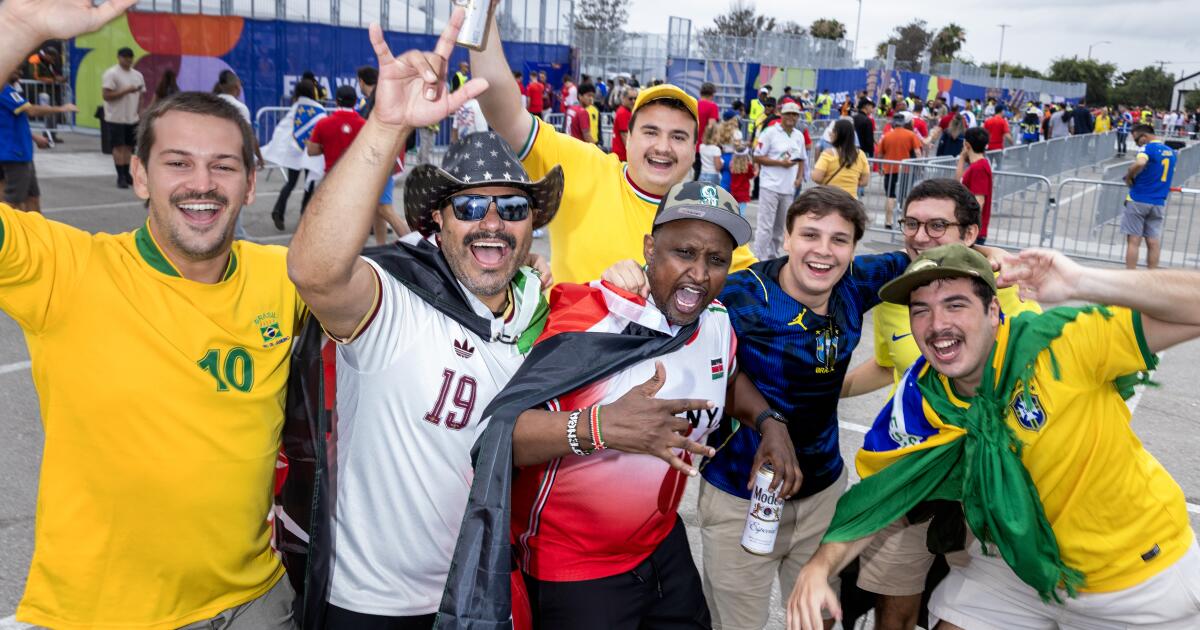
World Cup tourists are coming to L.A. for the soccer, but they’re staying for the $21 smoothies and Double-Doubles.
As the last Los Angeles FIFA World Cup event ended Friday, soccer fans were eating like locals and famous chains from the region were cashing in.
In the weeks that L.A. has hosted the World Cup, international soccer enthusiasts have flocked to big brands from the area, often in large groups wearing their countries’ jerseys.
It is a phenomenon seen at many of the host cities. In Dallas, giant gas station Buc-ee’s is the main attraction. For people visiting New Jersey, deli shops have been a hot ticket. In L.A., the place to be between matches was Erewhon.
Thirsty international sports fans gathered for pictures outside different Erewhons, wandered their aisles smiling, and, of course, picked up pricey smoothies.
While Erewhon would not comment on its business, mobility data company Arity, which uses phone data to track consumers, said Erewhon visits at the outlets around SoFi Stadium were quadruple what they were a week earlier on June 12, the day of the U.S. national soccer team’s opening match there.
Arity looked at what stores people visited within a 10-mile radius of SoFi that day and also found surges in visitors to nearby El Pollo Loco and Trader Joe’s.
Locals have spotted groups of people in Korea jerseys huddled together, trying to decide what to order at In-N-Out.
Some complained on social media that international tourists at Trader Joe’s were buying up all the mini canvas tote bags.
Soon after the Belgium vs. Spain quarterfinal ended Friday, the In-N-Out near SoFi had a long line of soccer fans stretching out the door in bright red and yellow and black jerseys and matching striped hats and scarves.
One of the workers said he had to explain “spread” and “animal style” to foreign football fans.
“I didn’t know this place existed,” a fan from Romania said while waiting in line.
Los Angeles and other cities and states that have hosted the event need the soccer fans to spend money to make the event worth all the time, effort and money it requires.
A rosy 2024 report projected the World Cup could bring more than $800 million to the L.A. region as 180,000 people converge on the area to sleep, eat and spend.
There were early concerns people weren’t turning up for the event because of the high ticket prices and the difficulty of obtaining visas for citizens of some countries.
However, at least for some L.A. hotels, there was a surge of last-minute visitors which pushed up occupancy and room rates.
While sports fans are not in the region to shop, they do make time for it.
World Cup customer spending is also apparent in beer sales. Andrew Heritage, the chief economist at the Beer Institute said beer purchases at entertainment and attractions in L.A. – outside of World Cup spaces – were up around 10% from normal.
“That tells me that fans in the L.A. area have decided to extend their stay and take in all the other things that the area has to offer, rather than just the match itself,” he said.
On social media, the purpose of these shoppers is clear: grab a quick souvenir or local specialty and take a selfie.
The data from Arity suggests that fans are very efficient when they spend at local spots, diving in, getting what they want and getting out as soon as possible, said Jeff Schlitt, a director at the company.
“Normally you’re there for an hour. They’re going to be there for 15, 18 minutes,” he said. “Why is that? Because they were purpose-driven shoppers.”
For some travelers, the more popular American chains aren’t unfamiliar. But some of the native L.A. fare still comes as a surprise.
As one Belgium-Spain matchgoer from the Netherlands stood taking a picture of the In-N-Out sign after the game, he said he’d never had a burger like the one he’d just tried.
“We only have McDonald’s and Burger King,” he said. “It’s way better.”

NEWYou can now listen to Fox News articles!
The face of baseball will not be at Tuesday’s All-Star Game.
Shohei Ohtani was scratched from his start on Friday as the Los Angeles Dodgers said he will also miss the Midsummer Classic with what the team called left knee irritation.
Ohtani, for obvious reasons, has become an All-Star Game fixture. He has earned the honor in each of the past five seasons and made his first start in 2021.
Starting pitcher Shohei Ohtani #17 of the Los Angeles Dodgers warms up before the MLB game against the Arizona Diamondbacks at Chase Field on June 03, 2026 in Phoenix, Arizona. (Photo by Christian Petersen/Getty Images) (Christian Petersen/Getty Images)
The two-way phenom is on his way to winning his fifth MVP award in his last six seasons as he is hitting .290 with a .939 OPS and pitching to a minuscule 1.79 ERA, the second-lowest in the sport among pitchers with 80-plus innings. His OPS is also the seventh-best mark in the league.
The Dodgers said Ohtani will be the team’s designated hitter up until the break, but he will “have some interventions on his knee to put him in the best position for the second half of the season.”
Ohtani dealt with knee issues earlier in the season.
It is certainly a big hit for the game as the other face of the sport, Aaron Judge, will miss the game due to a fractured rib that has kept him out since late May.
Shohei Ohtani #17 of the Los Angeles Dodgers gets ready in the on deck circle against the Arizona Diamondbacks at Chase Field on June 01, 2026 in Phoenix, Arizona. (Photo by Norm Hall/Getty Images) (Norm Hall/Getty Images)
DODGERS WILL AGAIN VISIT WHITE HOUSE TO CELEBRATE WORLD SERIES CHAMPIONSHIP, OFFICIAL SAYS
Ohtani hit 99 home runs combined in 2024 and 2025, leading the National League with a 1.025 OPS in that span. Ohtani did not pitch in 2024 after elbow surgery but returned to the bump last year and owned a 2.87 ERA and 11.9 K/9, a figure he also put up in 2022 that led the American League.
The “Japanese Babe Ruth” is the only player in MLB history to have 300-plus plate appearances and 40-plus innings in six separate seasons (Ruth only did it twice and never stole 50 bases), and he has more than excelled at both.
Shohei Ohtani pitches for the Los Angeles Dodgers against the San Francisco Giants at Dodger Stadium in Los Angeles, California, on May 13, 2026. (Gary A. Vasquez/Imagn Images)
CLICK HERE TO DOWNLOAD THE FOX NEWS APP
Ohtani is not hitting like he has in the past, but certainly the best pitching performance of his career will make up for it. He “only” has 20 homers and 56 RBI this season.
Follow Fox News Digital’s sports coverage on X, and subscribe to the Fox News Sports Huddle newsletter.
-

 Colorado4 minutes ago
Colorado mountains could see near-record temperatures as heat dome develops over the West
-
Connecticut11 minutes ago
I moved from Connecticut to the South chasing a cheaper, simpler life. It wasn’t at all what I expected, so I moved back.
-

 Delaware12 minutes ago
New information on “sophisticated cybercriminal attack” against Delaware County
-

 Florida19 minutes ago
NW Florida authorities make two more arrests in murder case
-

 Georgia26 minutes ago
How Georgia football can make sure they are the defining program of the 2020s
-

 Hawaii29 minutes ago
Filipino dignitaries embrace RIMPAC hospitality amid outside protests – Hawaii Tribune-Herald
-

 Idaho34 minutes ago
Follow the clues and find $15,000 in East Idaho's biggest treasure hunt yet
-

 Illinois41 minutes ago
Real estate sales in Peoria, Tazewell, Woodford counties for July 11, 2026


