Sports
Swimming has a diversity problem. Can this generation of Olympians change that?

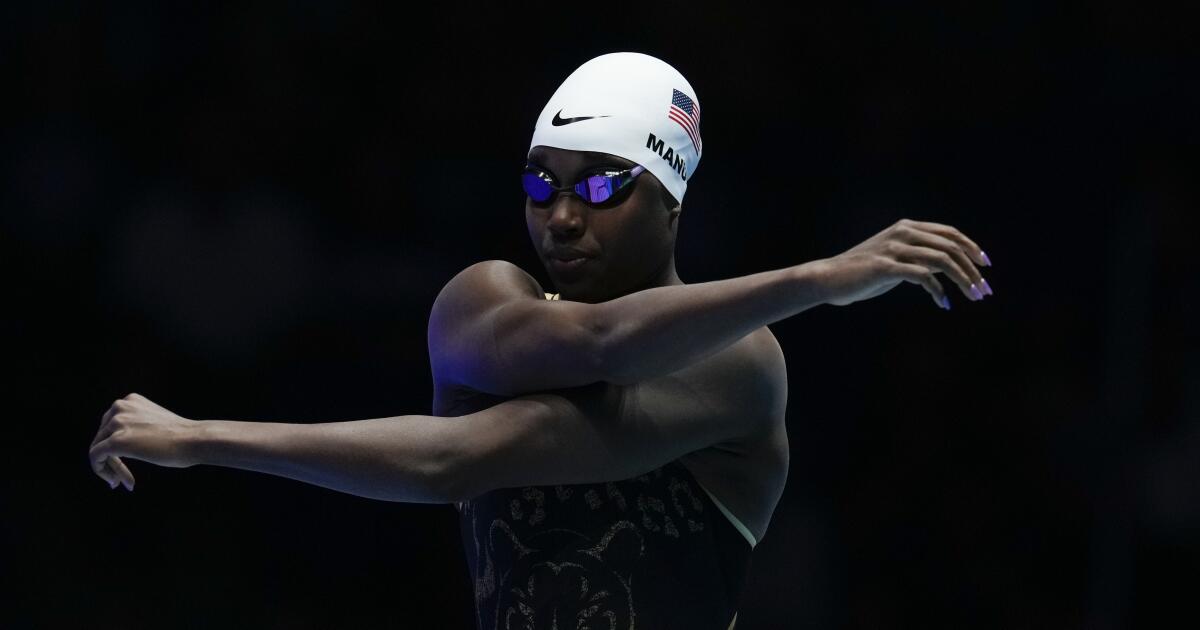
When Maritza Correia McClendon started swimming in Puerto Rico, she stood out because of her talent, not the color of her skin.
“There’s a lot of diversity in Puerto Rico,” said McClendon, who is Black and Latino, as are one in five people on the island.
Then her Guyanese-born parents moved to Florida when she was 8. Though she had become even faster in the pool, that was no longer the first thing people noticed about her.
“I remember a parent telling me, ‘What are you doing here? You should go do track or you should go on a basketball court,’” she said. “They were almost shaming me for being that outcast on that pool deck.
“That is definitely traumatizing. It’s still hard for me. I do definitely still struggle with that confidence factor.”
McClendon overcame that to become the first Puerto Rican of African descent to make the U.S. Olympic swimming team, the first Black female to win an Olympic medal for the U.S. and the first Black American swimmer to hold a world record.
2024 Paris Summer Olympic Games
In an effort to get others to follow her lead, McClendon is now among a growing number of former swimmers, coaches, officials and administrators working to make the sport more accessible and welcoming for people of color, from the grassroots level, where she was once shunned, to the Olympic team, where she shined.
The Paris Games has the opportunity to provide a big boost in those efforts when the swimming competition begins Saturday. Although only two of the 46 pool swimmers who will compete for the U.S. in Paris are Black — and none are Latino — those two, Shaine Casas, a three-time world champion, and Simone Manuel, a two-time Olympic champion and five-time Olympic medalist, have a chance to inspire a generation.
“If you’re not seeing somebody that you can relate to as a swimmer, then who’s going to be your role model?” said Steve Roush, executive director of Southern California Swimming, the grassroots affiliate of USA Swimming and the largest of the nation’s 59 local swim committees. “When you’ve seen over the last few years people like Simone Manuel, interests in the Black population say, ‘Hey, I guess we can swim. I guess there are spots for us.’ If they’ve never seen a Black on an Olympic or national team, then it’s really hard for them to think, ‘That’s what I want to do.’”
USA Swimming says less than 5% of the athletes registered with the federation are Black or Latino. Those groups account for 31% of the U.S. population. The level of representation on the Olympic team is no better. The reason for that has little to do with talent.
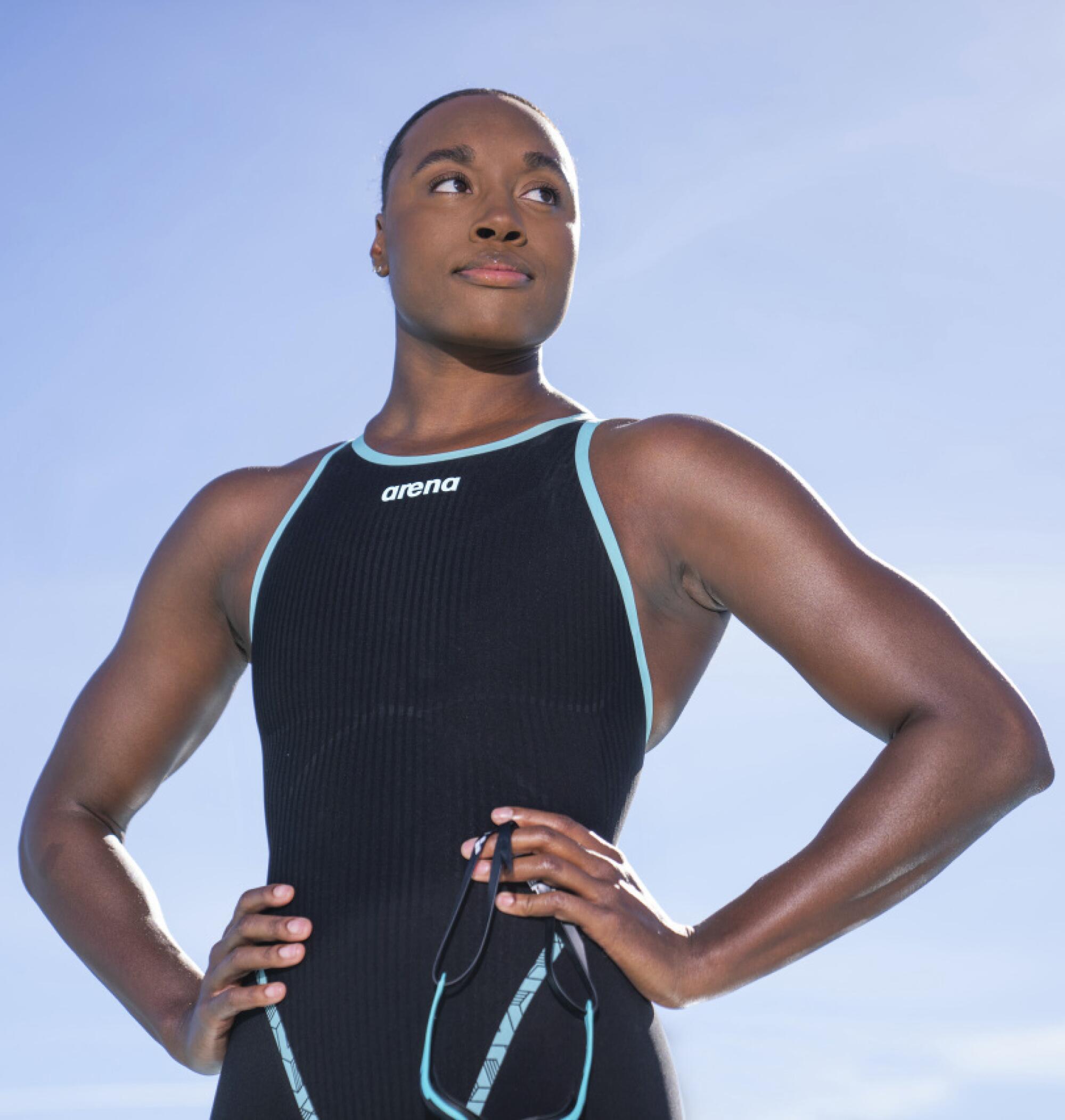
Simone Manuel will be competing in the women’s 50-meter freestyle at the Paris Games.
(Jack Spitzer / Associated Press)
“It’s not an athletic thing,” said Nic Askew, coach of the swim team at Howard University, the only HBCU to compete in the sport. “Anyone of any race and culture can be an amazing athlete in anything. But when you look at the history and the neglect, it absolutely is more social and socioeconomic.”
Until the last half of the 20th century, Black people and Latinos were commonly prohibited from using public pools and beaches. When those bans were lifted, the lack of swim facilities in inner-city neighborhoods became a new impediment to the sport.
“It’s very, very expensive,” McClendon said. “Not only for the person to learn how to swim, but also for the community to keep a pool open. The cost of the water, the chemicals, lifeguards. Every part of it tends to be very expensive.
“That’s a big hurdle. Another one is generational trauma. When our parents were growing up in segregation, they weren’t even allowed to go to the pool. So there became a fear of going to the water.”
That lack of access has had consequences that stretch beyond making an Olympic team. According to a 2021 study conducted by the USA Swimming Foundation and the University of Memphis, more than two-thirds of Black children do not know how to swim. The number is 45% for Latino children. As a result, the Centers for Disease Control and Prevention found the rate of drowning deaths among Black children aged 10-14 is 7.6% higher than whites of the same age while the rate for Latinos rose 25% between 2019 and 2022.
“Swimming,” McClendon said, “is the only sport that is also a life-saving skill.”
Yet as long as children of color don’t see themselves represented there, they will continue to believe swimming is not for them. That makes the Olympics — and especially the presence of athletes such as Casas, Manuel and Cullen Jones, the first Black American swimmer to break a world record — so important.
Casas, 24, a former world champion in the backstroke, will swim the 200 individual medley in Paris. That event begins Aug. 1. Manuel, who turns 28 next week, will swim the 4×100 freestyle relay Saturday and the individual 50 freestyle next week. She won gold medals in the 100 freestyle and the relay in Rio de Janeiro in 2016 and won a relay bronze in Tokyo three years ago.
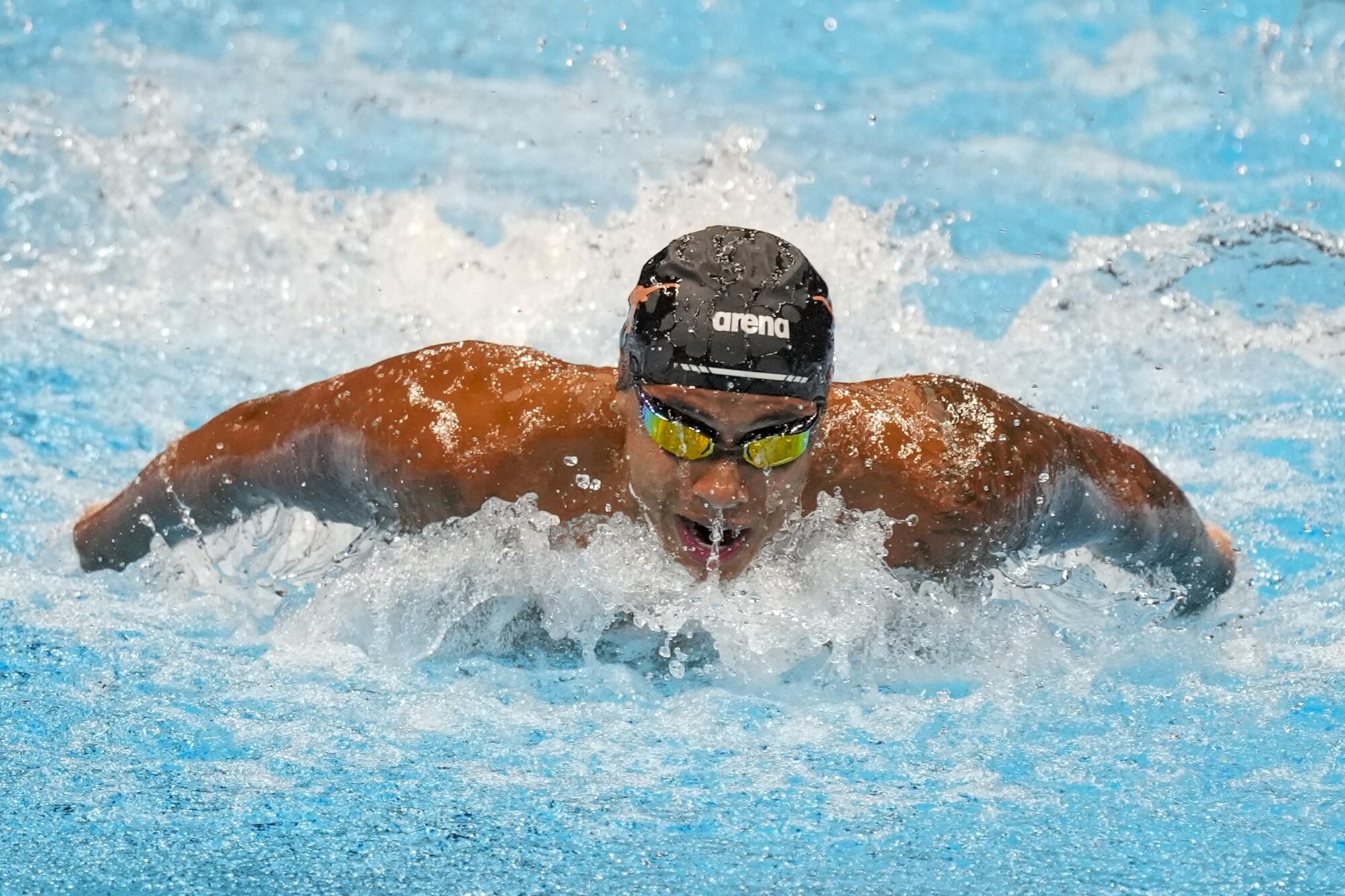
Shaine Casas swims during the men’s 200 individual medley preliminaries at the U.S. Olympic swimming trials in June.
(Michael Conroy / Associated Press)
If both can repeat their success in France, it could provide a big boost to make swimming more diverse in the U.S.
Progress is being made on other fronts as well. In Paris another barrier will fall — and another example will be created — when Anthony Nesty, a former gold medalist for Suriname and the coach at the University of Florida, becomes the first Black head coach of a U.S. Olympic men’s swim team. At the grassroots level, Roush said nearly a fifth of Southern California Swimming’s 20,000 athletes are Latino, a record for the region.
“The participation’s there,” he said. “I think we are reflective of the diverse ethnicity within Southern California. But these numbers aren’t reflective of what’s out there on the national scene.”
Making those numbers reflective of the population at large is important for a number of reasons, said Richard Lapchick, president of the Institute for Diversity and Ethics in Sport at the University of Central Florida.
Tennis, for example, shed its country club image when Serena and Venus Williams began to dominate the sport. That has not only brought more fans and more revenue to the sport, it has brought more and diverse participants as well, with the number of people playing the sport in the U.S. increasing by 33% between 2020 and 2023.
Not surprisingly that growth was most dramatic among people of color with the number of Latino players growing by 90% over that three-year period while Black participation increased by 46%.
“In any area, if you’re not raising a population that is representative of the entire country, you’re excluding [many] that could have been [great],” Lapchick said.
“Part of the reason why it would be helpful if [swimming] was more diverse, there are people who won’t pay attention to swimming because they look at it as a sport that’s exclusive rather than inclusive.”
Without the Williams sisters, we might never have gotten Coco Gauff. And without Black Olympic gymnastics champion Gabby Douglas, we might never have gotten Simone Biles. Over the next nine days, Casas and Manuel have a chance to do the same for Black and Latino swimmers. That opportunity is a fleeting one that only comes around once every four years.
“The one time historically that swimming is at the top of the media or a topic of conversation is during the Olympics,” Askew said. “But the Olympic cycle is every four years. So to be able to see athletes like Shaine and Simone now, it’s phenomenal.
“This is a space that a Black person can be at this elite level.”

Sports
Bryce Harper hits for cycle, Kyle Schwarber blasts three homers in Phillies blowout win over Mets

NEWYou can now listen to Fox News articles!
The Phillies’ turnaround following the dismissal of manager Rob Thomson reached a new milestone when two of the franchise’s biggest stars delivered a historic performance.
Kyle Schwarber launched three home runs, including two in the third inning, while Bryce Harper completed the cycle to add yet another achievement to his accomplished career.
The offensive explosion powered Philadelphia to a 15-3 rout of the New York Mets on Saturday, as the Phillies continued their surge and received a signature performance from two of the game’s most recognizable stars.
Philadelphia Phillies’ Kyle Schwarber celebrates his home run with Bryce Harper during the third inning against the New York Mets in Philadelphia, Pennsylvania on June 20, 2026. (Chris Szagola/AP)
Schwarber’s first home run traveled 456 feet, while his second blast of the third inning measured 457 feet off Mets reliever Cionel Pérez.
He capped his night with a two-run homer in the seventh inning. Schwarber’s major league-leading home run total climbed to 28, and the performance marked the fifth three-homer game of his career.
Cristopher Sanchez allowed one earned run in six innings to lower his ERA to 1.80.
It’s his 23rd straight start at Citizens Bank Park in which he allowed two earned runs or fewer, the second-most such starts by a pitcher at the same ballpark in MLB history since 1913, trailing only Jacob deGrom’s 24 at Citi Field for the Mets from Sept. 9, 2019 to Aug. 31, 2022.
ZERO BS. JUST DAKICH. TAKE THE DON’T @ ME PODCAST ON THE ROAD. DOWNLOAD NOW!
Bryce Harper and Kyle Schwarber of the Philadelphia Phillies leave the field after defeating the New York Mets at Citizens Bank Park in Philadelphia, Pennsylvania, on June 20, 2026. (Rob Tringali/MLB Photos via Getty Images)
Schwarber is the 67th player in major league history and second this season with multiple home runs in an inning, joining Houston’s Yordan Alvarez on June 12.
Schwarber is the fourth Phillies player to hit two home runs in an inning, along with Trea Turner (Aug. 19, 2023), Von Hayes (June 11, 1985) and Andy Seminick (June 2, 1949).
Philadelphia Phillies designated hitter Kyle Schwarber hits a solo home run in the bottom of the third inning against the New York Mets at Citizens Bank Park in Philadelphia, Pennsylvania on June 20, 2026. (Mitchell Leff/Getty Images)
Meanwhile, Harper hit a solo home run in the first inning, his 16th of the year. He doubled and singled in the third, then hit a two-run triple to the gap in left-center field in the fifth for his first career cycle and the 11th in Phillies history.
CLICK HERE TO DOWNLOAD THE FOX NEWS APP
The Phillies and Mets will wrap up their three-game series Sunday night, with first pitch set for 7:20 p.m. ET.
The Associated Press contributed to this report.

The 2026 FIFA World Cup is well into the second run of group play, with every team still eager to post wins and most looking to secure a place in the knockout stage.
Here’s everything you need to know about matches being played Sunday, Monday and Tuesday in the 48-team tournament across the U.S., Mexico and Canada (all times Pacific). Tuesday’s matches will conclude the first two games of group play for every team at the World Cup.
Sunday’s Group G matchups:
Belgium vs. Iran

Belgium’s Romelu Lukaku, right, is challenged by Egypt’s Ramy Rabia during a World Cup Group G match on June 15.
(Alex Grimm / Getty Images)
Where: SoFi Stadium
Time: noon
TV: FS1, Telemundo
The buzz: Iran twice rallied from deficits to draw with New Zealand in its first game, while Belgium, outplayed by Egypt in its opener, was lucky to escape with a point on an own goal early in the second half. Belgium’s aging golden generation of Romelu Lukaku, Kevin De Bruyne, Thibaut Courtois, Thomas Meunier and Axel Witsel is going to need to do much better if they hope to avoid another early World Cup exit.
New Zealand vs. Egypt

New Zealand’s Callan Elliot, left, and Iran’s Mehdi Ghayedi battle for the ball during a World Cup Group G match on June 15.
(Andre Penner / Associated Press)
Where: BC Place, Vancouver
Time: 6 p.m.
TV: FS1, Telemundo
The buzz: One of these teams could make history since neither has ever won a World Cup game. New Zealand earned its first point in the World Cup since 2010 with a draw against Iran. The winner likely advances to the next round.

Sunday’s Group H matchups:
Spain vs. Saudi Arabia

Spain’s Mikel Oyarzabal, top, challenges for the ball during a draw with Cape Verde on June 15.
(Mattia Ozbot / Getty Images)
Where: Mercedes-Benz Stadium, Atlanta
Time: 9 a.m.
TV: Fox, Telemundo
The buzz: Both teams opened the World Cup with surprising results. Second-ranked Spain was unable to score in a draw with No. 67 Cape Verde. Saudi Arabia was 10 minutes away from upsetting Uruguay, only to settle for a tie. Spain desperately needs a win to get its World Cup back on track, while another good performance from Saudi Arabia — unbeaten in its last three games — would have the Arabian Falcons in position to reach the knockout stage.
Uruguay vs. Cape Verde

Cape Verde goalkeeper Vozinha holds the nation’s flag after a draw with Spain on June 15.
(Buda Mendes / Getty Images)
Where: Hard Rock Stadium, Miami Gardens, Fla.
Time: 3 p.m.
TV: FS1, Telemundo
The buzz: With all four teams playing to draws in their openers, the group is wide open. That creates a rare opportunity for tournament debutant Cape Verde, the second-smallest country to qualify for a World Cup. Vozinha, Cape Verde’s goalkeeper, made seven saves to shut out Spain. If he can frustrate Uruguay the same way, Cape Verde could be through to the round of 32.

Monday’s Group J matchups:
Argentina vs. Austria

Argentina’s Lionel Messi reacts after scoring his third goal against Algeria at the World Cup on June 16.
(Charlie Riedel / Associated Press)
Where: AT&T Stadium, Arlington, Texas
Time: 10 a.m.
TV: Fox, Telemundo
The buzz: Argentina opened its World Cup title defense with a 3-0 win over Algeria on a hat trick from Lionel Messi. The Argentina captain, playing in his record sixth World Cup, is tied with Germany’s Miroslav Klose for the most career World Cup goals (16). Austria, meanwhile, would all but assure itself of a spot in the knockout round with a point.
Jordan vs. Algeria

Algeria’s Zineddine Belaïd kicks the ball during a World Cup loss to Argentina on June 16.
(Michael Steele / Getty Images)
Where: Levi’s Stadium, Santa Clara, Calif.
Time: 8 p.m.
TV: FS1, Telemundo
The buzz: Little was expected of Jordan, making its first appearance in the World Cup. And it delivered little in a 3-1 loss to Austria. But Algeria, ranked 28th in the world, entered the tournament with high hopes and one of African soccer’s most potent attacks. However, it had only one shot on goal in its loss to Argentina and needs a big rebound to avoid an early trip home.

Monday’s Group I matches:
France vs. Iraq

France’s Kylian Mbappé celebrates after scoring against Senegal on June 16.
(Adam Hunger / Ap Photo/adam Hunger)
Where: Lincoln Financial Field, Philadelphia
Time: 2 p.m.
TV: Fox, Telemundo
The buzz: Kylian Mbappé proved his fitness with a brace in France’s opening win over Senegal, giving him 14 World Cup goals, tied for fourth on the all-time list. He has a great chance to pad that total against an Iraq team that gave up four goals to Norway. Iraq still is looking for its first-ever World Cup point.
Norway vs. Senegal

Norway’s Erling Haaland celebrates after scoring against Iraq on June 16.
(Justin Setterfield / Getty Images)
Where: MetLife Stadium, East Rutherford, N.J.
Time: 5 p.m.
TV: Fox, Telemundo
The buzz: Norway, playing in its first World Cup this century, made up for lost time with a 4-1 win in its opener, getting two goals from Erling Haaland. Norway probably will move on to the next round no matter what happens, but a point would lock down a spot. Senegal and Sadio Mané, on the other hand, desperately need a win.

Tuesday’s Group K matchups:
Portugal vs. Uzbekistan

Portugal’s Cristiano Ronaldo walks on the field during a match against the Democratic Republic of the Congo on June 17.
(Molly Darlington / Getty Images)
Where: NRG Stadium, Houston
Time: 10 a.m.
TV: Fox, Telemundo
The buzz: Cristiano Ronaldo entered this World Cup with visions of winning his first title. But he’ll go home early and empty-handed unless fifth-ranked Portugal improves on the listless performance it had in a draw with the Democratic Republic of the Congo. Uzbekistan, playing in its first World Cup, was not intimidated by the big stage, weathering a withering Colombia attack in a 3-1 loss. Expect it to bunker in again against Portugal.
Colombia vs. DR Congo

Yoane Wissa, left, celebrates with teammates after scoring for the Democratic Republic of the Congo against Portugal on June 17.
(Karen Warren / Associated Press)
Where: Estadio Akron, Zapopan, Mexico
Time: 7 p.m.
TV: FS1, Telemundo
The buzz: The Democratic Republic of the Congo’s only other World Cup appearance came in 1974, when the country was known as Zaire; it lost all three games and didn’t score a goal. It’s already done better with Yoane Wissa’s score in first-half stoppage time giving the team a point against Portugal. A win here and it’s through to the knockout phase. The same is true of Colombia, which got a 65th-minute goal from Luis Díaz and another from substitute Jáminton Campaz deep in stoppage time to beat stubborn Uzbekistan.

Tuesday’s Group L matchups:
England vs. Ghana

England’s Harry Kane celebrates after scoring against Croatia on June 17.
(Tony Gutierrez / Associated Press)
Where: Gillette Stadium, Foxborough, Mass.
Time: 1 p.m.
TV: Fox, Telemundo
The buzz: England opened its World Cup with a surprisingly comfortable win over Croatia behind two goals from captain Harry Kane. But the Three Lions are only equal atop the table with Ghana, which got a goal deep in stoppage time from Caleb Yirenkyi to beat Panama. If there’s a winner here, it probably will decide the group. A point likely sends both teams through.
Panama vs. Croatia
Where: BMO Stadium, Toronto
Time: 4 p.m.
TV: Fox, Telemundo

Panama’s Ismael Díaz attempts a shot against Ghana on June 17.
(Kevin C. Cox / Getty Images)
The buzz: Croatia has played in two straight World Cup semifinals, but that streak is in jeopardy after a 4-2 loss to England. Panama outshot, outpassed and outpossessed Ghana in its first game but came away with nothing after conceding a goal in stoppage time, leaving the Central Americans still looking for their first World Cup win.




Sports
Jazz Chisholm explains why he still won’t wear a cup after fouling a pitch into his own groin

NEWYou can now listen to Fox News articles!
Men around the country are still wincing from the sight of New York Yankees second baseman Jazz Chisholm Jr. fouling a pitch straight into his own groin.
It was bad enough that Chisholm had to leave the game, and it left many wondering why he wasn’t wearing a cup to protect himself.
Well, now we have an answer.
ZERO BS. JUST DAKICH. TAKE THE DON’T @ ME PODCAST ON THE ROAD. DOWNLOAD NOW!
New York Yankees second baseman Jazz Chisholm Jr. took a brutal shot to the groin on Thursday night. (Wendell Cruz-Imagn Images)
Yankees beat writer Gary Philips shared some quotes from Chisholm explaining why he wasn’t a cup guy before taking a foul ball to the cojones, and why he isn’t going to be a cup guy moving forward.
WEEKS AFTER BULLFIGHTER SUFFERED PERFORATED RECTUM, ANOTHER WAS GORED IN GROIN AND REQUIRED EMERGENCY SURGERY
Chisholm said that the pain level was a “million,” and that, “If you ever got hit in the testicles, you would know.”
Most males reading this just nodded at that statement.
But Chisholm revealed that despite cups being mandatory in the minor leagues, he still skipped them and will continue to because he trusts his own defensive abilities.
“I’ve never worn a cup,” he said. “I’ve never been hit in the balls. That was just unlucky.”
Now, there are times when I wonder why men don’t wear cups all the time just for some peace of mind (I feel that way about helmets too). You wouldn’t regret not wearing a cup until the moment you’re at a cookout and a rogue volleyball puts you in shambles.
But I also like that Chisholm trusts himself to react and protect the boys. I’ve always said that a fairly significant part of a man’s life is devoted to protecting his lower anatomy.
You’re ever vigilant, trying to steer clear of anything that could leave you doubled over on the ground, and spouting off every expletive you know and several others you didn’t realize you knew.
Jazz Chisholm Jr. says he’ll rely on his defensive abilities instead of wearing a cup moving forward. (David Richard-Imagn Images)
Waist-high branches, table corners, projectiles, bicycle seats, even a pet jumping in your lap when you’re not ready.
CLICK HERE TO DOWNLOAD THE FOX NEWS APP
Chisholm is self-aware enough to know where his self-preservation reflexes stand, and I respect that.
But if he takes another foul ball to the lower area of his body, he might want to start rethinking that stance on cups.
-

 World11 minutes ago
Mourners gather to remember Lebanese conservationist killed by Israel
-
 News34 minutes ago
Trump claims vandals damaged D.C. Reflecting Pool, and says it will be drained again
-

 Los Angeles, Ca2 hours ago
31st annual Rodeo Drive Concours d’Elegance provides perfect Father’s Day activity
-

 Detroit, MI2 hours ago
3 Isaiah Stewart Trade Packages That Would Make Sense for Detroit Pistons
-

 San Francisco, CA2 hours ago
Giants Reach Franchise Milestone Never Before Seen in San Francisco
-

 Dallas, TX2 hours ago
Mavericks’ Potential 2026 NBA Draft Trade Down Target Revealed
-

 Miami, FL3 hours ago
Could the Heat bring Duncan Robinson back in a Deal for Giannis Antetokounmpo?
-

 Boston, MA3 hours ago
Volunteer rescuer seriously injured Friday helping unresponsive teenage hiker in NH – The Boston Globe

