Sports
Morning after the night before: In the cold light of day, a tennis match at 3am is ridiculous


Follow live coverage of day 10 at the 2024 French Open today
You know those nights when you tell yourself that you’re going to be sensible and not stay out too late — but you kind of know deep down that you will?
That’s pretty much how tennis’ Grand Slams feel about ludicrously late finishes.
After the Australian Open’s 4:05am finish last year (and its 3:40am one this time), and the U.S. Open’s 2:50am in September 2022, Roland Garros said, ‘Hold my biere’ in the early hours of Sunday as it recorded its latest ever finish to a day’s play — 3:06am. The French Open, which didn’t even have a night session until 2021 (and no floodlights until a year earlier), shattered its latest-ever-finish record by almost two hours when Novak Djokovic beat Lorenzo Musetti, 7-5, 6-7(6), 2-6, 6-3, 6-0, as though it felt left out from this ludicrous club.
Wimbledon, with its 11pm curfew, is the only outlier among the four Grand Slams. Tennis officials say that they are learning, that they are aware that these are farcical finish times. And yet they continue.
Despite the silliness of the situation, it’s not something that the French Open deliberately engineered. These finishes are a consequence of dysfunction in tennis, but nobody actually thinks they are a good idea, even if the Australian and U.S. Opens have for a long while appeared to treat late finishes as a badge of honour, rather than a serious risk to players’ welfare.
GO DEEPER
How the fight to improve the tennis calendar risks destroying its soul
The events of Saturday night and Sunday morning came about because of the rain that blighted the first week at Roland Garros. Grigor Dimitrov and Zizou Bergs had already seen their third-round match postponed by a day, and needed to get it done ahead of the winner playing again on Sunday.
With rain still falling, the schedulers tried to squeeze it in ahead of Djokovic-Musetti. Dimitrov was two sets up, but Bergs stole the third, and it ran longer than hoped for before Dimitrov triumphed.
Djokovic and Musetti didn’t take to the court until around 10:30pm, having been scheduled for 8:15pm. There was no move possible, because it would have deprived night-session spectators of the match they’d come, and specifically paid, to see. So Djokovic and Musetti waited and waited, the match when it came was an epic, and there we all were at 3am, wondering how tennis found itself in this position, which is so damaging to players.

Musetti and Djokovic’s incredible match came at a cost. (Clive Brunskill/Getty Images)
That kind of finish can mean anything up to a 7am bedtime once a player has completed their post-match commitments.
And it wasn’t just Djokovic and Musetti who finished late on Saturday/Sunday — Casper Ruud and Tomas Martin Etcheverry didn’t get off court until close to 1am, while Taylor Fritz and Thanasi Kokkinakis were done about an hour earlier.
Playing until that late affects players’ circadian rhythms, and can leave them feeling disorientated for days after. There is a reason why sleep deprivation is used as a form of torture. Lack of sleep compromises the ability to think, the immune system, and attention span and reaction time, which are vital for athletes.
Dr Robby Sikka is the medical director for the Professional Tennis Player Association (PTPA) — the organization Djokovic co-founded in 2020 to address, among other issues, working conditions for arguably the most important people in the sport — and takes the view that muscle recovery is only part of the problem.
“There will be neurological consequences too. Neurological recovery takes longer the more you put a player through, and another five-set match would be very tough,” Dr Sikka said.
Those post-match commitments that can go on until sunrise don’t just entail media duty.
“You lose a complete night of sleep and sleeping is part of the recovery, one of the biggest parts. The food, everything we do, treatments, ice baths. All this stuff, and you don’t sleep,” said current men’s world No 18 Karen Khachanov after Russian compatriot Medvedev’s 3.40am finish at the Australian Open back in January.

Emil Ruusuvori leaves the court after his loss to Medvedev at the Australian Open. (Anthony Wallace / AFP)
Medvedev had a series of long matches and late finishes in Melbourne before, perhaps inevitably, running out of steam in the final against Jannik Sinner from two sets up.

GO DEEPER
Medvedev’s 3.40am finish is latest absurd example of why tennis has to change
“I definitely think it’s not healthy,” said women’s world No 3 Coco Gauff on Sunday. “It may be not fair for those who have to play late, because it does ruin your schedule. “For the health and safety of the players, it would be in the sport’s best interest to try to avoid those matches starting after a certain time. Obviously, you can’t control when they finish.”
The current Wimbledon men’s champion Carlos Alcaraz, who was the winner of that U.S. Open match that finished just shy of 3am two years ago, also against Sinner, expressed his dislike too; women’s world No 9 Ons Jabeur called it “unhealthy”.
But this is about more than just the players. There is a whole ecosystem involved in running a tennis match: the unpaid ball kids, security personnel, umpires, and myriad other staff involved all have to stay that late, too.
As do the fans.
Women’s world No 1 Iga Swiatek expressed sympathy for everyone who has to go to work after a match, and said matter-of-factly that the reason she asks not to play night matches is because, “I just like to sleep normally.”

Gauff playing an eerie night session in Paris in 2020. (Martin Bureau / AFP via Getty Images)
Djokovic resisted giving his views on the situation, but 17-year-old Russian Mirra Andreeva was not so diplomatic.
Her second-round match against Victoria Azarenka started at around 10:30pm on Thursday, and didn’t finish until after 1am on Friday. “It’s so depressing,” said Andreeva, who was playing on tiny Court 12, in front of barely any fans. “No one is watching, and it’s cold. You are playing, fighting, and no one is there.”
Dr Sikka emphasised his belief that not only is tennis an outlier, but other sports are outliers because they view this kind of situation as ridiculous. “We are watching one of the best athletes at recovering (Djokovic) for 20 years — in any sport, but you would never do that to Tom Brady (in American football) or LeBron James (basketball).”
The implication, and it’s hard to argue, is that it makes tennis feel like a novelty act rather than a serious sport.
Recognising the absurdity of these situations, the ATP and WTA have taken steps to try to redress the balance.
At the start of the year, they announced that matches would not start later than 11pm.
That first reform came after Sinner had to pull out of the Paris Masters in November, after he won a match that started after midnight and finished at nearly 3am. In Acapulco, Mexico, two years ago, Alexander Zverev beat the American Jenson Brooksby at 4:55am — the latest ever finish to a professional tennis match.
Women’s world No 4 Elena Rybakina, who revealed on Saturday that she has struggled to sleep of late, finished a match at the Rogers Cup in August just before 3am. Rybakina said she was “destroyed” by the experience, and drew a pretty straight line from that finish to an injury she suffered the following week in Cincinnati, retiring hurt from her second-round match against Italy’s Jasmine Paolini despite having won the first set.

Rybakina serving during that late match against Daria Kastakina. (Minas Panagiotakis / Getty Images)
“It was horrible,” Rybakina said shortly afterwards. “It’s not easy because they (the injuries) are not even because of tennis. It’s really tough to recover when you go to sleep at 5am.”
Rybakina also called out the WTA: “I think it’s a bit unprofessional. The leadership is a little bit weak for now. But hopefully something is going to change.”
The Grand Slams make their own rules, and despite attempts to reform, the Australian Open endured the same old problems this year. Tennis Australia hoped that a Sunday start to the tournament would ease the scheduling burden, and hoped that reducing the number of matches in the day sessions from three to two would mean less chance of the evening matches starting late.
It didn’t work, because tennis matches have gotten so long that these kinds of schedules are no longer fit for purpose.
Research by The Athletic last year showed that men’s matches at Grand Slam level increased by around 25 per cent over a 24-year period. At the 2022 U.S. Open, three hours was almost the average length of a match, rather than the novelty it used to be. Within that context, a four-and-a-half-hour match like the one on Saturday/Sunday is well within the normal range.
A similar length match, for Djokovic’s first-round win over Dino Prizmic at the Australian Open, meant the women’s defending champion Aryna Sabalenka didn’t even get on court for the first match of her title defence until after 11.30pm — comfortably beyond the ATP and WTA cutoff.
Curfews and start time cut-offs feel like the most obvious solutions. And if tennis actually wants to address the root of the problem, it should give serious consideration to making the first weeks of Grand Slams best-of-three rather than best-of-five sets for men’s matches.
Baseball and cricket are evidence that sports can evolve and modernise, even if the Slams can always point to how well-attended their events are as evidence that there’s no real need for them to reform.
Tennis players know that they risk looking entitled by complaining about these sorts of issues. But they are also aware of the risks to themselves and to the sport of allowing the situation to continue.
Speaking in August, seven months on from his initial fury at being made to play tennis at 4am against Thanasi Kokkinakis in Melbourne, Andy Murray said: “Often when the players complain about that stuff, you hear, ‘Oh, shut up and get on with it. Try working in a warehouse from nine to five’.

Murray on his way to finishing after 4am. (William West / AFP)
“I get that. I know I’m fortunate to be playing tennis. It’s just… tennis is also entertainment. I don’t think it helps the sport that much when everyone’s leaving because they have to go and get public transport home and you finish a match in front of 10 per cent of the crowd. You don’t see it in other sports, so it’s clearly wrong.”
In football/soccer, global players’ union FIFpro warned the sport’s world governing body, FIFA, that players would take “matters into their own hands” if nothing was done to address their growing workload. It even suggested that strike action is possible.
But football, as well as other sports such as baseball, has reformed. In the English Premier League, for example, teams can no longer play in the 12:30pm Saturday slot if they’ve played away in continental Europe on the Wednesday night.
The Djokovic-led PTPA will keep making its case to the sport’s governing bodies, which consist of seven different organisations empowered to enact their own rules with little input from active players.
The morning after the night — and morning — before, the vibe at Roland Garros on Sunday was bleary-eyed.
The spectacle of the match had faded, into both tiredness and a kind of disbelief that this is still allowed to happen.
In the cold light of day, it seemed unnecessary for an event that is supposed to be about fun and entertainment to feel compromised like this.
Never again. Until the next time.
(Top photo of Novak Djokovic: Emmanuel Dunand / AFP via Getty Images)



Sports
Golf star records lowest round in LPGA major history with astounding performance at Evian Championship

NEWYou can now listen to Fox News articles!
There are good days on the golf course, and then there is what Haeran Ryu just did on Saturday.
Ryu, 25, recorded the lowest round in LPGA major history on Saturday with an 11-under 60 at the Evian Championship. With the South Korean golfer’s historic round, she holds a three-stroke lead.
Ryu’s round comes just two weeks after winning her first major at the Women’s PGA Championship. On the 18th hole, Ryu left a 30-foot eagle putt a few inches short, and instead settled for a birdie.
CLICK HERE FOR MORE SPORTS COVERAGE ON FOXNEWS.COM
Haeran Ryu of South Korea reacts on the 18th green after the third round of The Amundi Evian Championship at Evian Resort Golf Club in Evian-les-Bains, France, on July 11, 2026. (Stuart Franklin/Getty Images)
She said after the round that she had no idea what she had done until she counted up her scorecard.
“But after the putt and I counted my score with my caddie,” she said. “Oh my God, it’s 11-under par today. It was so amazing. My caddie says, ‘Yep.’ I’m so happy right now.”
If Ryu had made the eagle putt on the 18th hole, she would have been just the second player to shoot a 59 in LPGA history.
ZERO BS. JUST DAKICH. TAKE THE DON’T @ ME PODCAST ON THE ROAD. DOWNLOAD NOW!
Haeran Ryu of South Korea celebrates a birdie on the 15th green during the third round of The Amundi Evian Championship at Evian Resort Golf Club on July 11, 2026, in Evian-les-Bains, France. (Stuart Franklin/Getty Images)
Her 60 broke the record for the lowest round in an LPGA major by one shot. Leona Maguire and Jeungeun Lee6 in 2021, and Hyo Joo Kim in 2014, each shot 61 at the Evian Championship, which was designated as an LPGA major in 2013.
The lowest round in a men’s major is 62, which is shared by four players — Branden Grace at Royal Birkdale in the 2017 British Open, Xander Schauffele and Rickie Fowler in the 2023 U.S. Open at Los Angeles Country Club, and Schauffele and Shane Lowry in the 2024 PGA Championship at Valhalla.
CLICK HERE TO DOWNLOAD THE FOX NEWS APP
Haeran Ryu of South Korea and Lottie Woad of England interact after their round on the 18th green during the third round of the Amundi Evian Championship at Evian Resort Golf Club in Evian-les-Bains, France, on July 11, 2026. (Stuart Franklin/Getty Images)
Ryu hopes her historic third round can help propel her to a second major win in three weeks.
“That is amazing, amazing dream,” Ryu said. “So I just want that one to come true, but we have one more day.”
The Associated Press contributed to this report.
Follow Fox News Digital’s sports coverage on X, and subscribe to the Fox News Sports Huddle newsletter.
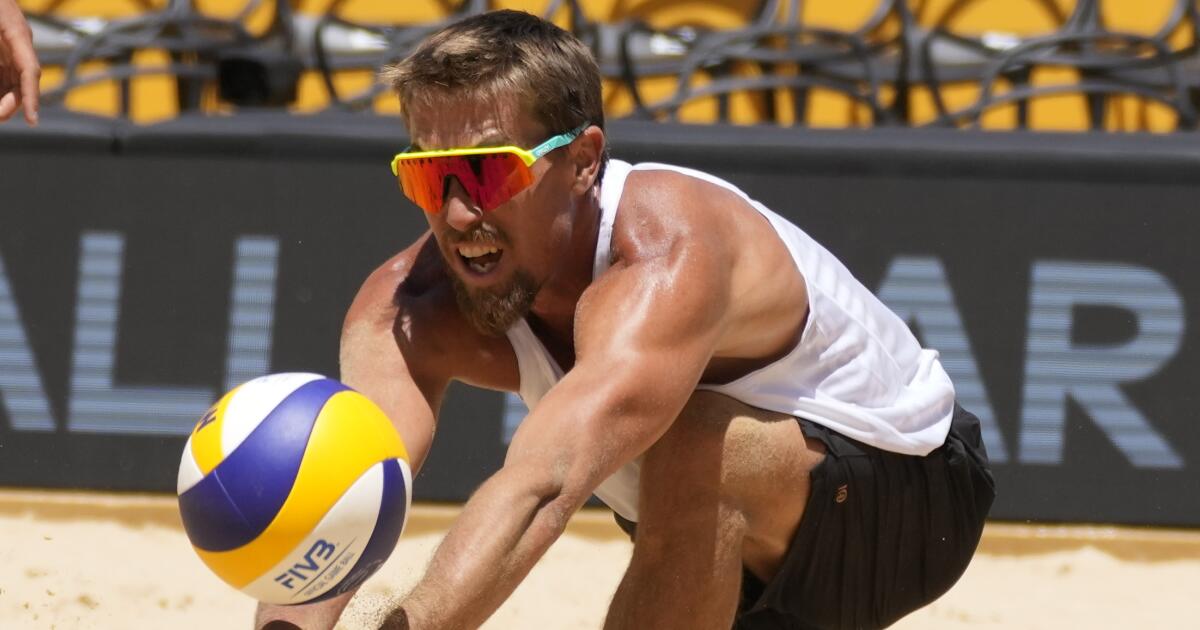
Taylor Crabb is no stranger to South California beaches. The Long Beach State alum returns home this weekend to compete in AVP League matches.
It marks the first time AVP will compete in Long Beach since 2020 and allows players to compete at the 2028 Olympics beach volleyball venue.
Crabb, 34, made his AVP debut in 2013 with his brother, Trevor, and advanced from the qualifier in Manhattan Beach before finishing 25th in his first tournament.
After years of competing with various different partners, Taylor Crabb and Andy Benesh have delivered the top performances this AVP season.
The following interview with Crabb has been edited for clarity and length.
Are you excited to compete in this weekend’s event at Long Beach?
Crabb: Very excited. A lot of my college teammates and part of the school have reached out, saying that they’re gonna come. So I’m excited to get a chance to play in front of them again.
When was the last time you were in Long Beach?
Crabb: I always try to go down there for alumni events or any big games they have. I went to UCLA against Long Beach last year, when it was No. 1 versus No. 2, so I always try to get down there and support them.
You missed out on the chance to compete in the 2020 Olympics because of COVID-19 restrictions and chose not to pursue a spot at the 2024 Olympics. Are you fired up to try to compete in the 2028 Olympics, knowing that Long Beach will host the competition?
Crabb: Yeah, it’s definitely an exciting time having the Olympics in Long Beach, and we kind of get to break it in this weekend. As you said, Tokyo didn’t go the way I wanted, but I’m going full force now. I have a great partner in Andy Benesh, who obviously went to the Paris Olympics, and if it weren’t for the Olympics being in Long Beach, and me getting a partner like Andy, I’m not even sure I’d be going for it, but because of those two things, I want to make the most of it.
You mentioned that if it wasn’t for a partner like Andy, you wouldn’t be going for it. What do you mean by that?
Crabb: I didn’t feel motivated by playing in all the international events, but now, I think, sitting out kind of lit the fire under me, and I’m really motivated now.
You’ve had different partners throughout your time. What other motivation does Andy give you?
Crabb: He’s been, in my mind, the top blocker for the U.S. the last four or five years. Seeing the professionalism he brings every day to practice, on and off the court, while traveling and when showing up to tournaments, it rubs off on you and that’s really motivating to see. And I just want to make him proud.
Why do you love volleyball?
Crabb: A lot of reasons, but it’s just a feeling I have when I’m out there on the court. It feels natural. It feels like home. I was born into a volleyball family. I had a volleyball in my hands my entire life, so I’ve always just enjoyed it.

NEWYou can now listen to Fox News articles!
CM Punk appeared on “Friday Night SmackDown” ready to take on any challenger that was ready to step to him after winning the Undisputed WWE Championship against Sami Zayn.
Punk entered the ring in Oklahoma City and called back to the “Monday Night Raw” after WrestleMania 42 when he told Cody Rhodes he’d be ready to deliver if a championship opportunity fell “out of the sky.”
COMPLETE PRO WRESTLING COVERAGE ON FOX NEWS DIGITAL
Cody Rhodes and CM Punk face off during SmackDown at Paycom Center in Oklahoma City, Okla. (Craig Ambrosio/WWE via Getty Images)
“When championship opportunities fall out of the sky, CM Punk catches them,” he said.
Punk named potential SmackDown superstars he’d think might come for the title, including Gunther, Finn Balor, Royce Keys, Damian Priest and Trick Williams. He even said that Zayn could come back around and get his rematch if he wanted. He didn’t mention Rhodes’ name, but the “American Nightmare” came out uncalled and marched his way down to the ring.
“I don’t think you and I can run away from each other anymore,” Punk told Rhodes.
Cody Rhodes looks on during SmackDown at Paycom Center in Oklahoma City, Okla., on July 10, 2026. (Craig Ambrosio/WWE via Getty Images)
Rhodes agreed and mentioned that Punk would want a match with him, just “say when.” It was a quick retort from Punk, who said, “when.” SmackDown general manager Nick Aldis, who was in the ring for the segment, booked the match for SummerSlam.
Punk will defend the Undisputed WWE Championship at SummerSlam, which takes place Aug. 1 and 2 at U.S. Bank Stadium in Minneapolis.
First, however, Punk and Rhodes will be involved in a tag team match at Saturday Night’s Main Event in New York City next week. Aldis made the match after Gunther demanded that Aldis put him in a match against Punk. Gunther was hoping it would be for the championship. Instead, Gunther will tag with Zayn.
Gunther didn’t take too kindly to that and attacked Aldis. Rhodes came back out to break up the calamity. He wanted to take on Gunther after the show went off air but Gunther walked away.
Gunther makes his entrance during SmackDown at Paycom Center in Oklahoma City, Okla., on July 10, 2026. (Rich Wade/WWE via Getty Images)
CLICK HERE TO DOWNLOAD THE FOX NEWS APP
Punk definitely has his hands full as he moves to SmackDown to become a fighting champion.
-
 Cleveland, OH27 seconds ago
Wanted sex offender arrested at home where Tennessee woman’s body found
-

 Austin, TX6 minutes ago
Man shot and killed by police after pointing gun at people in Austin, Texas
-

 Alabama13 minutes ago
Alabama has Talent returns with local connection
-

 Alaska16 minutes ago
Alaska Sports Scoreboard: July 11, 2026
-

 Arizona21 minutes ago
Cardinals Mailbag: Latest on Jacoby Brissett, Carson Beck, and Arizona’s QB Future
-

 Arkansas28 minutes ago
Arkansas tips its hat to blues pioneer Larry “Totsie” Davis in England dedication
-

 California31 minutes ago
‘Explosive diarrhea’ parasite surfaces in California as health officials fear statewide surge
-

 Colorado36 minutes ago
This Quiet Colorado Town Is An Underrated Gem For Nature Lovers

