Sports
MLB wants Japan to cheer for more than the Dodgers and Ohtani. The prize could be billions


TOKYO — During the early innings of a nighttime exhibition between the Los Angeles Dodgers and Yomiuri Giants, Nori Kawana walked through the concourse of the Tokyo Dome in disbelief. As the head of Fanatics’ East Asia operation, Kawana leads MLB’s merchandising in Japan, and the day had already set his company’s sales record in Asia. He was willing to bet no other sports retailer had ever had a better day in the region, either.
Seemingly every other fan at the Dome wore national hero Shohei Ohtani’s No. 17 jersey. Some 20 minutes after Kawana stopped to talk to a reporter, Ohtani ripped a home run to right field, and the frenzy continued. Just outside the Dome, fans streamed through a 31,000-foot MLB retail store, even as it grew late on a Saturday. Fanatics and MLB clocked an average of 1,100 transactions every hour across 140 registers.
The much-anticipated centerpiece of MLB’s week in Japan, the regular-season games between the Dodgers and Cubs, were still three days away.
“The Tokyo series is going to be the biggest standalone international event in the history of Major League Baseball,” league commissioner Rob Manfred said.
If MLB has its way, the series will also serve as a beginning. The league sees a trove of fan interest and cash to be unlocked in Japan, a country long obsessed with baseball that has grown infatuated with the defending World Series champion Dodgers and their expat star, Ohtani. The mission at baseball’s central office is to broaden the appeal of the whole league here, and success would not be trivial.
“We do believe there are payoffs in the B’s: billions,” Manfred said.
Manfred expects this Opening Series will set records across the board among league special events, including in viewership and revenue, the latter pegged by Manfred at $35 million. The only comparison he sees is to the league’s annual All-Star Game, an analogy that both flatters and undersells the moment: The midsummer classic is MLB’s premier standalone event, but also never produces the kind of fervor Japan has shown this week.
To Manfred, MLB has the benefit of both years of work in Japan — the first Opening Series was 25 years ago this month — as well as the lightning-in-a-bottle stardom of Ohtani. Last season, he became the first player in MLB history to hit 50 home runs and steal 50 bases in one year.
“We have really stayed after Japan, but it takes time for something like this to grow,” Manfred said. “Ohtani is like the accelerator. I mean, every once in a while, even we need to get lucky, right?”
MLB has multiple avenues for growth, and more games abroad is an obvious starting point. National teams from MLB and Japan will participate in another World Baseball Classic, the sport’s recurring international tournament, next year. But Manfred also expects to propose “more regular activity” in Japan and Korea in future negotiations with the MLB players’ union. Japan wants to see an event like the Opening Series every three years, he said.
But the greatest windfall lies with media rights: in the telecasts of stateside MLB games in Japan, including Ohtani’s Dodgers.
“Because media unlocks everything else,” said Dodgers president Stan Kasten, who has also run an NBA and NHL team. “What the NBA learned was the importance of exposure. The NBA got their finals in 200 countries around the world on television.”
MLB’s international TV deals expire following the 2028 season, at the same time the league’s national contracts in the U.S. conclude. When negotiating the next iterations, Manfred intends to dangle the possibility of bundling both together, hoping to entice the major streaming companies that seek audiences both in the U.S. and abroad.
“The explosion in popularity in Korea and Japan is going to create an opportunity to fundamentally change the way we sell our media rights,” Manfred said. “We’ve traditionally sold them in (individual) countries, and I think in 2028 they will be sold as part of an international package that will help us drive our media revenue in general.”
A powerful advertising agency, Dentsu, has brokered MLB’s TV rights in Japan since 1990, sublicensing to major broadcasters like NHK. Another company, Eclat, sells MLB’s streaming rights in the country. Overall, MLB has 10 TV partners in Japan today.
“Particularly in a digital space, we’re going to sell the rights where we get the best deal,” Manfred said.
But ultimately, how much MLB can grow in Japan likely depends on a few questions: How well can MLB tailor itself to the Japanese customer? And is the outcome really in MLB’s hands, or does the league’s fate rest with star players and their individual teams?
“Thinking about MLB entering the Japanese market, do people watch baseball because of the MLB teams? I don’t think so,” said Mariko Sakakibara, a professor at the University of California, Los Angeles who teaches international business courses and previously served as the deputy director of Japan’s Ministry of International Trade and Industry. “People watch MLB games because those teams have familiar players, right? And so it’s player-driven.”
In the last five years, Ohtani merchandise has accounted for 57 percent of Fanatics’ sales in Japan, Kawana said. Ohtani is so ubiquitous that it makes for a game: Try to wander around Tokyo for a few minutes and not catch a glimpse of him.
He appears not only on a multi-story New Balance display near the city’s famed Shibuya Crossing, but on smaller Seiko watch ads along the moving walkways at Haneda airport — a greeting for visitors who might have just landed on a Japan Airlines plane wrapped in his image. He is on both bottles and boxes of Ito En green tea in the convenience chain Family Mart, and on the banner above one’s head when entering the store. In a taxi ride at the end of one’s day, Ohtani might recommend a mattress on the passenger’s video monitor.
In Japan, Ohtani’s face is everywhere. (Tomohiro Ohsumi / Getty Images)
MLB believes there’s a halo effect to be had from that omnipresence. But there’s a competing theory that essentially places MLB at the mercy of its individual clubs.
“If you really want to grow MLB, it’s by attracting more NPB players to a more diverse set of major-league teams,” said player agent Joel Wolfe, who represents Ohtani’s Dodgers teammates Yoshinobu Yamamoto and Roki Sasaki, both Japanese. “MLB can’t do that. It’s on the individual teams that are truly interested to take the time to research and find the right people to expand their presence individually as organizations in Japan. Because MLB has been at the forefront of the minds of NPB players and fans for decades.”
At the team level, recruitment is an uneven playing field. What the Dodgers have done in landing all three of Ohtani, Yamamoto and Sasaki would be hard to replicate. It was hardly an accident.
“We saw this day coming,” Kasten said.
Kasten rattled off all the groundwork the Dodgers laid: attempts to sign Ohtani a decade ago and again seven years ago when he landed with the Angels, then preparing for his free agency years in advance. They signed Sasaki this winter when his Japanese team made him available, but the team had been ready for that possibility for at least a couple years, separating itself from the pack.
“It was like the Powerball got to $1.5 billion and all of a sudden the entire league wanted to drive down to the corner store and buy a lottery ticket. But they soon realized that it didn’t work that way for this kid, and most Japanese players,” Wolfe said of the Sasaki sweepstakes. “There’s a handful of teams that have spent an enormous amount of time, energy and manpower building a ground game in Japan and learning about Japanese culture. The ones that just showed up out of nowhere really didn’t have much of a chance to separate themselves.”
It is inevitable that more Japanese stars will play in the U.S. But if the rate of defection spikes, complexities or even conflict could follow. The nation already has its own professional league, Nippon Professional Baseball, where all three of the Dodgers’ stars once played.
Recently, top Japanese talents have started pursuing MLB careers at a younger age, bucking an expectation that players remain in their home country for much of their prime. NPB official historian Nobby Ito said that “of course, it is not positive” to lose the best players, but added “it is not necessarily negative” either, because MLB helps expose Japanese kids to baseball and spurs NPB teams to grow.
“You don’t want to do damage,” Manfred said, “and you’ve got to be a little careful about that.”

Ohtani jerseys are everywhere in Japan. (Mary DeCicco / MLB Photos via Getty Images)
Japanese teams, often resistant to change, have some leverage. They are party to the posting agreement that allows for NPB teams to put their players up for bidding, and any party can seek revision to the agreement, or even terminate it.
“It’s good for the business for there to be players performing at a very high level in Major League Baseball because it sort of validates the quality of play in Japan, right?” Manfred said. “In a perfect world with no other consideration, we’d have every one of the best players in the world playing Major League Baseball. But the fact of the matter is we also recognize we can’t play every day in Japan, and we want a thriving domestic product in Japan.”
After a meeting with NPB commissioner Sadayuki Sakakibara on Sunday in Tokyo, Manfred said he does not expect NPB will push for change in the near future.
“Deference and humility go a long way in this country,” said Ulrike Schaede, professor of Japanese business at the University of California, San Diego. “The commissioner’s right. I would tread very carefully about this.”
While the Dodgers guard their strategies for recruiting top Japanese players, they will gladly tell other teams how to then make money off them.
MLB clubs share best off-the-field practices, and the Dodgers are piloting a program in Japan that has been successful in European soccer: a paid fan club, which is a joint venture between MLB and the team. There are different annual membership fees for four levels, starting at $45 or so and ranging up to $500. Exclusive opportunities come along, from special events to offers for bobbleheads and tickets.
“MLB hasn’t done this with an individual team before, and maybe the time will come that all teams will do that based on what we learn,” Kasten said. “Remember, Premier League and La Liga teams have hundreds of millions of signed-up fans around the world. Hundreds of millions. And so far, we don’t have any because we haven’t started those programs.”
The profits of the fan club are considered international revenue, which means they are shared equally among the 30 MLB teams. The same is true for the money MLB makes from international TV deals. It isn’t clear what percentage of the league’s overall revenue the international bucket accounts for, but “it’s a significant number that can grow significantly bigger,” Kasten said.
“It’s not a small rounding error,” he said.
Most companies trying to grow in Japan have a steep learning curve. But MLB has an advantage in that its product is already entrenched.
Baseball is Japan’s top sport. In the last few years, research revealed accounts of its arrival here in 1871, a year earlier than previously understood. Babe Ruth, Lou Gehrig, Jimmie Foxx and other Hall of Famers famously came to Japan on tour in 1934.
“I appreciate the fact that if you show up in Japan on day one as ‘New Company X,’ there are challenges,” Manfred said. “The relationship between American baseball and Japanese baseball, I mean hell, it goes back to Babe Ruth for God’s sake,” said Manfred. “That’s not an issue for us.”
But customers in Japan do have nuances compared to those in the U.S. — “You don’t want to come in and say, ‘we have the better way,’” Schaede said — and the league will benefit from partnerships with companies that want to grow in Japan alongside it.

Nori Kawana of Fanatics. (Evan Drellich / The Athletic)
Kawana of Fanatics noted that Japanese fans do not wear sports jerseys day to day nearly as often as their U.S. counterparts. His mission is to convince them it’s cool to do so. The company collaborated with the artist Takashi Murakami on limited-edition merchandise for the Opening Series that sold out almost within an hour.
Japanese fans also expect a high level of service, and one of Kawana’s first undertakings at Fanatics was to reduce shipping times. “We’ve got to make sure the customers are treated with care in a much more granular way than I think anywhere else,” he said.
Both Fanatics and New Balance pointed to the different tastes in graphic T-shirts fans in Japan have. Illustration can be key. Japan is “one of the most fashion-forward countries in the world,” said Evan Zeder, New Balance’s head of baseball marketing. New Balance sponsors Ohtani, but the sneaker brand had a presence in the country well before that long-term deal was struck in 2023.
Topps, which has a multi-level installation in Tokyo during the Opening Series not far from New Balance’s, has seen an explosion in sales here, but still considers the country something of a nascent market. The Fanatics-owned brand said it totaled $22.6 million last year in Japan, up from $1.5 million in 2021.
“There’s definitely demand here for high-end $10,000 boxes,” said David Leiner, Topps’ president of trading cards. “But we think ultimately, to be most successful and to really grow the market and to introduce new collectors, we’ve got to have some lower-level price points to get people to try it.”
The best way for MLB to connect in Japan might be to take up efforts that read less like marketing at all. Sakakibara of UCLA suggested MLB focus on projects that benefit Japanese baseball and the country more broadly, such as arranging more games between MLB and NPB teams, and educational and community efforts.
On Monday, Manfred and a host of retired MLB stars, including CC Sabathia and Adam Jones, visited a school in Tokyo to hold a baseball skills event.
“It hasn’t changed since I was over there,” said Trey Hillman, a consultant to NPB’s Nippon Ham Fighters who has been a manager in MLB, NPB and Korea’s top league as well. “If they know that you’re in and that it’s genuine and sincere, and you really want to build a business relationship, it’s got to start at the grassroots. They’re not as quick to make changes as we are here in the United States.”
Nothing, of course, might be more grassroots than the homegrown role model who hits home runs every other night. In 2023, Ohtani said he would donate roughly 60,000 New Balance baseball gloves across schools in Japan.
“I don’t believe there’s ever been an athlete with this much demand in baseball,” said Zeder of New Balance, which manufactured the gloves. “I think people want to connect to an athlete, and I think people want to connect to someone who has achieved the greatness that he has.”
(Illustration: Will Tullos / The Athletic; Photos: Robert Gauthier, Kiyosha Ota, Yuki Taguchi, Yuichi Yamazaki, Gene Wang, Harry How / Getty Images)



NEWYou can now listen to Fox News articles!
In just his second season at the helm, Curt Cignetti led Indiana to its first national championship.
During the Hoosiers’ title run, Cignetti became known for his demanding coaching style. Indiana opened spring practice Thursday, and incoming transfer wide receiver Nick Marsh got a crash course in what it means to play for Cignetti.
Marsh, who transferred from Michigan State, arrived at practice in gold cleats. After noting Marsh’s productive two-year stint in East Lansing, Cignetti pivoted to the wideout’s footwear.
Nick Marsh (6) of the Michigan State Spartans runs the ball up the field during the first quarter of a game against the Maryland Terrapins at Ford Field Nov. 29, 2025, in Detroit. (Mike Mulholland/Getty Images)
“I didn’t love those gold shoes he came out in today,” Cignetti said. “He learned what getting your a– ripped is all about. I don’t know if that happened to him very often at Michigan State. That was before practice started.”
INDIANA’S CURT CIGNETTI SHUTS DOWN NFL COACHING SPECULATION: ‘I’VE ALWAYS BEEN MORE OF A COLLEGE FOOTBALL GUY’
Marsh totaled 1,311 receiving yards and nine touchdowns at Michigan State. TCU quarterback Josh Hoover also headlines Indiana’s transfer additions.
An Indiana Hoosiers helmet during a game against the Ball State Cardinals at Lucas Oil Stadium Aug. 31, 2019, in Indianapolis. (Michael Hickey/Getty Images)
Cignetti added that the coaching staff has “more work to do with this group than the first two teams,” noting the group is still learning more about players the team will likely rely on next season.
Indiana Hoosiers head coach Curt Cignetti during the second quarter against the Miami Hurricanes in the 2026 College Football Playoff national championship at Hard Rock Stadium Jan. 19, 2026, in Miami Gardens, Fla. (Alex Slitz/Getty Images)
Indiana went 16-0 en route to a thrilling win over Miami in the College Football Playoff national championship in January.
Cignetti framed his callout of Marsh’s cleats as an early message about expectations.
“That was a wake-up call,” Cignetti said of the receiver’s pre-practice cleats. “But he’s really worked hard, done a great job for us.”
Follow Fox News Digital’s sports coverage on X, and subscribe to the Fox News Sports Huddle newsletter.
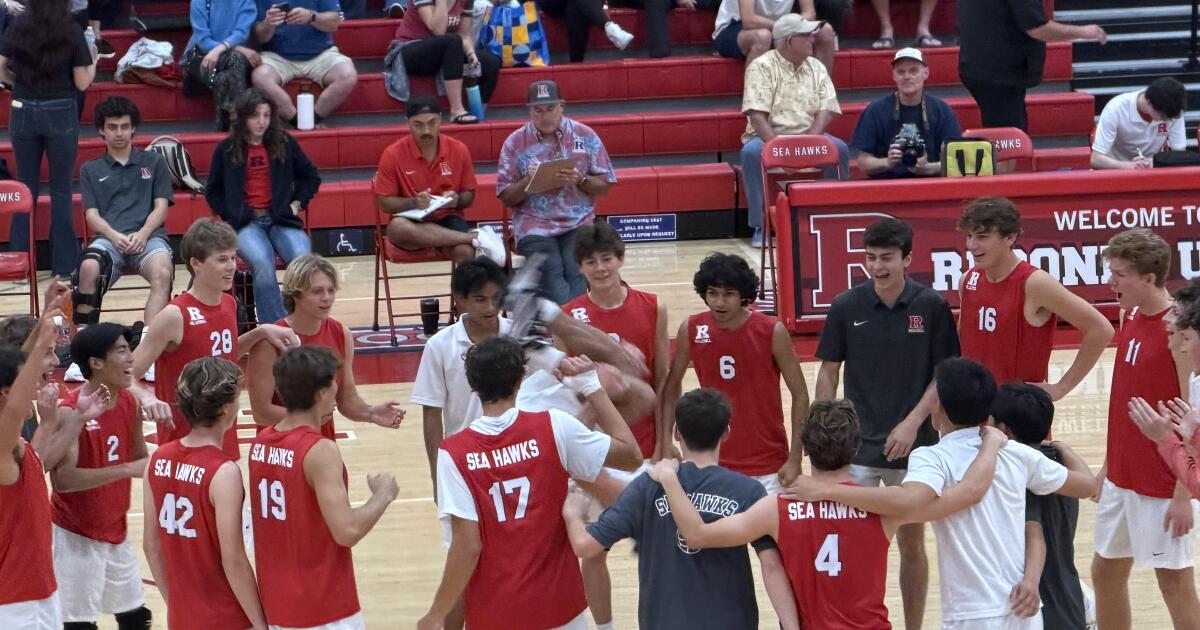
Redondo Union didn’t care that Mira Costa’s volleyball team was ranked No. 1 in California. This was their South Bay rival coming to their gym Thursday night, and anything can happen when a team digs deep and doesn’t fear losing.
The Sea Hawks (14-2) were aggressive from the outset and came away with a 27-25, 21-25, 25-22, 21-25, 15-13 victory.
“Chemistry,” setter Tommy Spalding said about the Sea Hawks’ triumph. He’s one of three players headed to MIT, and all three had big matches.
At one point on back-to-back plays, Carter Mirabal had a block and Vaughan Flaherty followed with a kill off an assist from Spalding. Chemistry.
JR Boice, a Long Beach State commit, was delivering kills, and Cash Essert’s serving and all-around play kept Mira Costa’s Mateo Fuerbringer looking frustrated. The Sea Hawks’ focus was on Fuerbringer, who came alive in the fifth set with six kills, but Redondo was able to come back from an 11-9 deficit.
It was only Mira Costa’s second loss in 25 matches. Redondo Union took over first place in the Bay League.
Baseball
Orange Lutheran 3, Jacksonville (Fla.) Trinity Christian 2: The Lancers advanced to the semifinals of the National High School Invitational in Cary, N.C., behind a walk-off single in the eighth inning by Andrew Felizzari. Brady Murrietta had tied the score with a squeeze bunt in the bottom of the seventh. CJ Weinstein had two doubles for the Lancers.
Venice (Fla.) 12, Harvard-Westlake 0: The Wolverines were limited to three hits at the National High School Invitational in Cary, N.C.
Casteel (Queen Creek, Ariz.) 3, St. John Bosco 2: The Braves suffered their first defeat in North Carolina. Jack Champlin threw five innings and also had two RBIs.
Chatsworth 6, Taft 3: Tony Del Rio Nava threw six innings and had two RBIs in the West Valley League win.
Granada Hills 4, El Camino Real 3: A two-run single by Nicholas Penaranda in the seventh inning keyed a three-run inning for the Highlanders in their West Valley League upset. JJ Saffie had three hits for ECR.
Cleveland 4, Birmingham 3: The Cavaliers pushed across a run in the top of the 10th inning to break a 3-3 tie in the West Valley League win. Joshua Pearlstein finished with three hits, including a home run.
Sun Valley Poly 4, San Fernando 2: Fabian Bravo gave up four hits in 6 2/3 innings for the Parrots, who are tied with Sylmar for first place in the Valley Mission League. Ray Pelayo struck out eight for San Fernando.
Verdugo Hills 15, Kennedy 1: Cutlor Fannon had two doubles and four RBIs in the five-inning win. Anthony Velasquez added two singles and four RBIs.
Westlake 9, Agoura 4: Jaxson Neckien hit a three-run home run to power the Warriors.
Thousand Oaks 7, Calabasas 5: Gavin Berigan, Jeff Adams and Cru Hopkins each had two hits for the Lancers.
Oaks Christian 11, Newbury Park 2: Dane Disney contributed three hits in the Marmonte League win. Carson Sheffer had two doubles and three RBIs.
Santa Monica 12, Simi Valley 4: Ryan Breslo and Johnny Recendez had two RBIs and a triple for Santa Monica. Ravi Chernack had three RBIs.
Dana Hills 7, Corona Santiago 0: Gavin Giese finished with eight strikeouts over six innings and gave up one hit for Dana Hills.
Softball
Sherman Oaks Notre Dame 10, Sierra Canyon 0: Kelsey Luderer contributed three hits and two RBIs while freshman Ainsley Jenkins threw five scoreless innings.
Chaminade 15, Louisville 2: Norah Pettersen had two hits and four RBIs.
Carson 10, San Pedro 0: Atiana Rodriguez finished with three hits, including a double and triple, and three RBIs.
Huntington Beach 6, El Modena 2: Willow Kellen had three hits for the Oilers.
Murrieta Mesa 15, Chaparral 0: It’s a 16-0 start for the Rams. Tatum Wolff hit two home runs.

NEWYou can now listen to Fox News articles!
The fiancée of Buffalo Sabres star Rasmus Dahlin received a roaring welcome home in her first appearance of the season Wednesday night, months after undergoing a lifesaving transplant after she suffered heart failure during a vacation in France.
Carolina Matovac, 25, was shown on the jumbotron during Wednesday’s game against the Boston Bruins. Fans cheered as she waved, and Dahlin, who was also shown on the screen in a split, cracked a smile at the crowd’s reaction.
Carolina Matovac and Rasmus Dahlin of the Buffalo Sabres pose on the red carpet at the Metro Toronto Convention Centre in Toronto, Ontario, Canada, Feb. 1, 2024. (Nicole Osborne/NHLI via Getty Images)
“Welcome home to Carolina Matovac, the fiancée of our captain Rasmus Dahlin,” the arena announcer said. “She is back with us, attending her first game of the season. The Sabrehood loves you, Carolina.”
In an open letter to fans in September, Dahlin shared that Matovac had been feeling ill for several days during their trip, which led to her experiencing “major heart failure.”
“Fortunately, she received CPR on multiple occasions, and up to a couple of hours at a time to keep her alive, which ultimately saved her life. Without her receiving lifesaving CPR, the result would have been unimaginable. It is hard to even think about the worst-case scenario,” he wrote at the time.
Rasmus Dahlin (of the Buffalo Sabres prepares for a faceoff during a game against the New York Rangers at KeyBank Center in Buffalo, N.Y., Oct. 9, 2025. (Bill Wippert/NHLI via Getty Images)
Matovac remained on life support for weeks before receiving the transplant in France.
JACOB WINTERTON, FORMER OHL PLAYER AND BROTHER OF NHL’S RYAN WINTERTON, DEAD AT 25 AFTER CANCER BATTLE
In January, Matovac revealed she was pregnant when her heart failed, adding that her unborn child was the reason she went to the hospital initially.
“You will always hold a special place in our hearts as our first baby, even though we never had the chance to meet. Our love for you is endless,” she wrote in a post on Instagram on what was supposed to be her due date.
“Though you didn’t get to experience this world, you played a vital role in ensuring that I could continue to be a part of it.”
Buffalo Sabres defenseman Rasmus Dahlin follows the puck in the first period against the Ottawa Senators at the Canadian Tire Centre in Ottawa, Ontario, Canada, on April 1, 2025. (Marc DesRosiers/Imagn Images)
CLICK HERE TO DOWNLOAD THE FOX NEWS APP
Despite taking some time to be with Matovac as she recovered in their native Sweden, Dahlin is second on the team with 65 points, and the Sabres are on the cusp of ending an NHL-record 14-season playoff drought.
The Associated Press contributed to this report.
Follow Fox News Digital’s sports coverage on X, and subscribe to the Fox News Sports Huddle newsletter.

Iran-linked hackers have breached FBI Director Kash Patel’s personal emails | CNN Politics

Retired Detroit sergeant faces new sexual assault charge involving 14-year-old victim from 2002

Trump floats sending federal agents to San Francisco to tackle crime

Dallas ISD will offer free pre-K starting next school year

Norwegian Cruise Line offers a first look at Luna, new cruise ship setting sail from PortMiami – WSVN 7News | Miami News, Weather, Sports | Fort Lauderdale

Florida High School Football Rankings: Top 25 teams – Oct. 21

How old is Bo Nix? What to know about Oregon quarterback ahead of 2024 NFL Draft

Cleary's 21 help Le Moyne down Central Connecticut State 69-64 in OT

99th annual Pony Swim held in Virginia

Indiana Members Credit Union announced as new anchor tenant at Bottleworks District
Iran-linked hackers have breached FBI Director Kash Patel’s personal emails | CNN Politics

Live: CPAC 2026 Day 2

Video: Will ICE Change Under Its New Leader?

DHS shutdown breakthrough comes at cost for Republicans as funding fights nears end

Rubio joins crucial G7 talks as Iran war set to dominate second day
-

 Detroit, MI1 week ago
Drummer Brian Pastoria, longtime Detroit music advocate, dies at 68
-

 Science1 week ago
How a Melting Glacier in Antarctica Could Affect Tens of Millions Around the Globe
-

 Movie Reviews1 week ago
‘Youth’ Twitter review: Ken Karunaas impresses audiences; Suraj Venjaramoodu adds charm; music wins praise | – The Times of India
-

 Sports6 days ago
IOC addresses execution of 19-year-old Iranian wrestler Saleh Mohammadi
-

 New Mexico5 days ago
Clovis shooting leaves one dead, four injured
-
 Business1 week ago
Disney’s new CEO says his focus is on storytelling and creativity
-

 Technology5 days ago
YouTube job scam text: How to spot it fast
-

 Tennessee4 days ago
Tennessee Police Investigating Alleged Assault Involving ‘Reacher’ Star Alan Ritchson