Sports
Juraj Slafkovský and the weight of a nation


When the Montreal Canadiens were considering whether they should use the No. 1 pick in the 2022 NHL Draft on Slovak winger Juraj Slafkovský, we were given a glimpse at their draft meetings through the team’s annual behind-the-scenes draft video.
In one of those meetings, Canadiens co-director of amateur scouting Nick Bobrov made his pitch for the hulking winger who was a late riser on draft lists that year.
The first of the two most important points made by Bobrov was about Slafkovský’s personality.
“He just has that personality to want to take the bull by the horns,” Bobrov said. “He wants to own the moment, the situation. … He’s doing it with that drive, desire, owning the moment, and it’s a personality trait. It’s more than just a skill, a hockey skill. He just has that personality trait to want to own the stage.”
GO DEEPER
NHL season previews 2024-25: Projecting each team from worst to first
The second point was about the pressure Slafkovský had already been living under in his native Slovakia, a country that saw him as the next great hockey hope to follow in the footsteps of Peter Bondra, Žigmund Pálffy, Marián Hossa, Marián Gáborík, Zdeno Chára and many others, and how that environment would prepare him well for the pressure-cooker that is the Montreal hockey market.
“Lastly, a country of five million has been talking about this kid for, what, three years now? Four years now? The pressure on him is a country, and so far he’s handled it unbelievably well,” Bobrov said. “So to gauge how this kid can handle pressure, I think, there’s evidence, and the proof is in the pudding — not only through the tournaments but through a period of time of maybe two and half years to three years where he’s been the next one — and he kept getting better while under the pressure of that five-million population.”
Two years later, Slafkovský is sitting on the verge of NHL stardom, and his second half of last season gave hope the Canadiens were correct in banking on his personality and his ability to handle pressure to take the risk of making the unpopular decision to draft him at No. 1.
But what is that personality? Where does it come from? And what is that Slovak fishbowl Slafkovský has lived in since he was 14? How did it prepare him for what he is now experiencing in Montreal?
We went to the source in search of answers, spending 40 minutes talking to Slafkovský last week to get to the bottom of these two questions. Because those questions are, in many ways, the origin story of why Slafkovský is poised to become a central part of the Canadiens rebuild.
And it begins in Slovakia.
The fishbowl
Slafkovský was not the only Slovak player to be drafted in the first round of the 2022 draft. Šimon Nemec went No. 2 to the New Jersey Devils and Filip Mešár went at No. 26 to the Canadiens. Adam Sýkora went in the second round to the New York Rangers, and two more Slovaks followed in the sixth and seventh rounds that year.
Having four players from Slovakia go in the first two rounds in 2022 matched the country’s total of drafted players from the previous three drafts combined.
But despite having so much company that year, being drafted No. 1 — something no Slovak player had ever done — put Slafkovský into another stratosphere in terms of his celebrity status at home.
“Slovakia is not a big country, so everyone knows him since the day he got drafted first overall,” Mešár said of his good friend. “Obviously everywhere he goes, everything he does, it’s already on the internet every day. Like, the next day. So he has to be smart with the things he does off the ice. I would say everyone’s watching him. He’s the biggest superstar there. So, it’s not easy for him, but he can handle it.”
The highest-drafted Slovak player before Slafkovský was Marián Gáborík, who went No. 3 to the Minnesota Wild in 2000, a draft spot Nemec also surpassed when he was picked second. When Nemec goes home, he too feels the glare of that fishbowl.
But not like Slafkovský.
“I have a little bit of trouble, and he’s got really big trouble,” Nemec said. “That’s the difference.”

Slovak countrymen Šimon Nemec, left, Juraj Slafkovský, center, and Filip Mešár pose at the 2022 NHL Draft in Montreal. (Bruce Bennett / Getty Images)
It is the type of celebrity status that is difficult to understand, even in Montreal where Canadiens players are treated like gods. But it’s not the same.
“I can’t remember (seeing) that popular of a guy in Slovakia,” Nemec said. “I think he has a good mind and he’s doing really good now. I think he doesn’t feel the pressure of the Slovak people. … The pressure is hard, but I think he can do it.”
For Slafkovský, however, it is not as easy as he makes it seem to his good friends Mešár and Nemec. It is a constant grind. When he goes out to eat with his friends, he visits restaurants owned by his friends’ parents, comes in through the back door and dines in a private room. He will not go to a bar and grab a drink with friends. He avoids doing groceries or shopping with his little sister because the excursion turns into an extended photo shoot. Photos of his home get published in the media. Photos of his mother’s gym get published in the local media. Any morsel of information on him, no matter how banal, is fodder for a story.
And so when Slafkovský goes home, he hides. He doesn’t have to hide in Montreal.
“No, Montreal is way better. I do everything. Montreal, I can go shopping. Like, if I go grocery shopping back home, I probably take 25 pictures. Here it’s more diverse, different types of people from different parts of the world, so not everyone knows you. In Slovakia, everyone knows you. In a store, the girl that sells you stuff knows you, if you go clean a suit they know you there, if you go buy a book, she knows you. It’s not like that here,” Slafkovský said.
“I never had this happen here. Everyone is always saying, oh, the Montreal media. I never had anything like this happening here. You focus on hockey, and if I made 17 bad passes, you’re probably going to say 23, but I get that. That’s completely fine with me. But don’t take pictures of my house. I have kids ringing my bell every day (in Slovakia). I don’t live in downtown Košice, I live outside the city, but now everyone knows where I live because it was in the media.
“I’ve learned how to live with it, but it just pisses me off inside. I’ll say it. But there’s nothing I can do about it.”
Slafkovský has refused to give interviews with several Slovak journalists. One of them is Štefan Bugan, of the media outlet Denník N, whose life has been turned upside down trying to report on Slafkovský.
The history of Slovak hockey is important to understand when trying to make sense of the infatuation people there have with Slafkovský, the context of what creates this hysteria that surrounds him at all times.
It goes back to the dissolution of the former Czechoslovakia, Bugan says. When Slovakia became its own country, the hockey program was dropped into the third tier of international hockey. It was slowly built up to the point where Slovakia won the silver medal at the 2000 world championships and two years later, won the gold medal. It was a watershed moment in the country, contributing to a sense of identity the country was seeking ever since the dissolution in 1993.
“It’s one of the biggest things that ever happened in this country,” Bugan said of the world championships gold. “Not sports things, but overall. It was kind of a unifying moment for the country.”
That was a golden era of Slovak hockey, but then a lull hit, and Slafkovský is seen as the face of the end of that lull. Which explains the media coverage he gets at home.
This is why Bugan spent the last two seasons, as long as Slafkovský was healthy, living a bizarre life in Slovakia.
“When you wake up in Slovakia you have a lot of articles about how Slovak players played. Not just Juraj, other players too, but he’s the main story when he’s playing,” Bugan said. “The usual coverage is the journalist wakes up at maybe 5 a.m., which in Montreal is about 11 p.m. after the game, and he just watches the highlights and reads some tweets and he writes a story. When he has no points, it’s that Slafkovský played terrible, something negative. I don’t like it because it’s not the real thing. So last season, I watched every shift of Slafkovský. Every one.
“I was living in Slovakia on Canadian time.”
But Slafkovský does not see it the same way, even if he understands the source of that media coverage is how much his country loves him. He sees it as toxic — something that affects not only his quality of life, but that of his family as well.
Still, his status as Slovakia’s next big star is something Slafkovský fully embraces.
“Oh, I love it,” he said. “Like I said, I want to be the best and I always wanted to be the best. So obviously I want to be the best Slovakian player. I’m fine with that. I just hate what comes with it because I see other countries and I see other players that don’t have this, even though they’re better players than me.”
And that line — how he’s always wanted to be the best — is where the personality comes in.
The personality
When asked what he means by wanting to be the best, whether he means the best in the world or the best version of himself, Slafkovský pauses briefly to think.
“I would say the best version of myself,” he said. “But I think if I’m the best version of myself, I can be one of the best in the world. Obviously you have special players in this world, and I don’t know if I can be on the level of a (Connor) McDavid or a (Nathan) MacKinnon or a (Auston) Matthews, but I can bring something. And to me, the answer to this is how many rings you have at the end of your career.”
Then he pauses again, to look at his hand, with no rings on it.
“If you can look at your hand like this and you have at least two,” he continues, “then you can say you were pretty good.”
Slafkovský has lived with that level of scrutiny in Slovakia since he was roughly 14 years old, and the Canadiens assumed this scrutiny shaped his personality. But it dates back much further than that. So much so that Slafkovský doesn’t remember a time he wasn’t this way.
“I think it’s just that I always wanted to be the best, in everything I did, even outside hockey. Any competition, I wanted to be the best,” he said. “And I never cared. I don’t think I ever cared. I only cared what my coach said, but I never really cared what people had to say. It probably was bad when I was a kid in school and stuff, but I think I was the same way. Someone would tell me something, and I would be like, ‘Nah.’ I would have my own truth in my head. It’s kind of bad when you’re a kid, but then when you grow up, I feel like that kind of helps me.”
There’s more to it than that. When he took some time to think about it, Slafkovský was able to figure out where this comes from.
His mother, Gabriela.
She is headstrong. She doesn’t care what anyone else thinks.
“My mom never had that many friends because she was always honest with everyone and she always said what she thought. If it was bad or good, she would say it. If she was thinking something bad about someone, tell them right away,” Slafkovský said. “I’m the same way…So I think it’s because of my mom and the way she is. I’m pretty much just like her.
“I think it was always there because of her. Because of what I saw.”
And to understand just how headstrong Slafkovský is at age 20, you only need to get him back talking about Slovakia and the state of the game in his home country.
“I can say so much s–t about Slovakia right now that I want to change,” he began. “But I won’t.”
And then he did. Because Slafkovský doesn’t care what anyone else thinks.
“The Slovak hockey federation, a couple of things have to change there for us to be successful again,” he said. “Because I feel we got the Olympic (bronze) medal (in 2022), and people get satisfied by these things, but that was lucky because there was no NHL players. Let’s be honest, we wouldn’t have won that medal if everyone had their full squad. But we get satisfied by these little things. … We think we’re doing things the right way, but we’re not. We’re just pretending. And we are trying to sell it to the people that we’re doing things the right way by pushing these fake results.
“Obviously it’s the greatest thing that ever happened to me that I won the Olympic medal, but be honest about it.”

Juraj Slafkovský celebrates after scoring for Slovakia in the bronze-medal game at the 2022 Olympics in Beijing. (Gabriel Bouys / AFP via Getty Images)
Slafkovský said he thinks hockey in Slovakia needs wholesale changes, that there are not enough quality coaches and that decisions are too often made for the wrong reasons, because of who a player’s father is or whom he knows instead of how well he can play. When he was 12, Slafkovský’s father got together with a group of other parents and formed an elite select team that traveled to the Québec City peewee tournament and other North American events. Eight players who participated in that program were drafted in 2022 or 2023, and another was signed as an undrafted free agent.
There was one player drafted out of Slovakia in 2024.
“Let’s just say all these players that got drafted went through that team,” Slafkovský said. “So that shows something, no?”
The reason the fathers put that select team together, Slafkovský said, was to get their kids out of the hockey system and the nepotism that defines it. One example he cited is the U16 and U17 national programs that run camps in the summer refuse to invite players who are playing overseas in North America because, he said, “the people running it are scared that their own kid won’t play, or he knows this guy’s father and his kid needs to play.”
“It’s all about connections in Slovakia,” he said. “I see it, and everyone is scared to talk about it.”
So, what were Slafkovský’s connections?
“Me? Yeah, I could play hockey, that was my connection,” he said. “There was no option for them because I knew how to play, actually.”
The solution, Slafkovský believes, is to “freshen up” the Slovak hockey federation.
“Probably we need more people to work for the federation, but no one wants to work for that,” he said. “You think Hossa wants to work for the federation? No. Gáborík? No. It’s because of some people that are already there, they do it their own way, so they benefit from it, and not Slovak hockey.
“That’s my opinion.”
This is a lot for a 20-year-old to have on his plate: the state of hockey in his home country, the constant media attention in his home country and managing those two realities of his life at home.
In the middle of all that, being a vital part of the Canadiens rebuild seems relatively minor. But it’s not.
As Slafkovský said, he will measure his career based on the number of rings on his fingers, and in order to achieve that, this rebuild will need to be successful. He has always measured his success through team success because he has evidence of that being true. Many felt he was stifled playing in Finland for TPS Turku, but he disagrees because he played in the Liiga finals in his draft year. The fact Slovakia won that Olympic bronze medal, regardless of the level of competition, allowed Slafkovský to play more games and eventually be named MVP of the tournament.
And now, with everything his life at home has taught him and his inherently independent convictions, Slafkovský is ready to use all his baggage to take that same step with the Canadiens.
“People always want to have winners on their teams,” he said. “I’d rather have a winner that scores five less goals than some loser that just focuses on scoring 40 goals.”
It’s safe to say the Canadiens share his opinion on that.
(Top photo: Bruce Bennett / Getty Images)



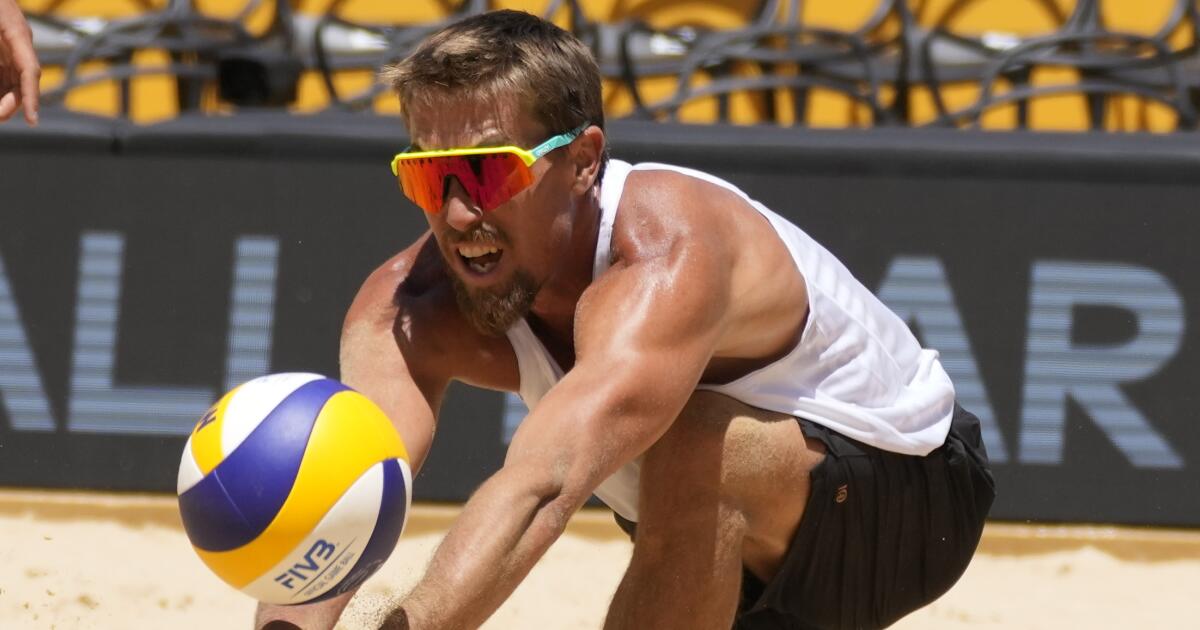
Taylor Crabb is no stranger to South California beaches. The Long Beach State alum returns home this weekend to compete in AVP League matches.
It marks the first time AVP will compete in Long Beach since 2020 and allows players to compete at the 2028 Olympics beach volleyball venue.
Crabb, 34, made his AVP debut in 2013 with his brother, Trevor, and advanced from the qualifier in Manhattan Beach before finishing 25th in his first tournament.
After years of competing with various different partners, Taylor Crabb and Andy Benesh have delivered the top performances this AVP season.
The following interview with Crabb has been edited for clarity and length.
Are you excited to compete in this weekend’s event at Long Beach?
Crabb: Very excited. A lot of my college teammates and part of the school have reached out, saying that they’re gonna come. So I’m excited to get a chance to play in front of them again.
When was the last time you were in Long Beach?
Crabb: I always try to go down there for alumni events or any big games they have. I went to UCLA against Long Beach last year, when it was No. 1 versus No. 2, so I always try to get down there and support them.
You missed out on the chance to compete in the 2020 Olympics because of COVID-19 restrictions and chose not to pursue a spot at the 2024 Olympics. Are you fired up to try to compete in the 2028 Olympics, knowing that Long Beach will host the competition?
Crabb: Yeah, it’s definitely an exciting time having the Olympics in Long Beach, and we kind of get to break it in this weekend. As you said, Tokyo didn’t go the way I wanted, but I’m going full force now. I have a great partner in Andy Benesh, who obviously went to the Paris Olympics, and if it weren’t for the Olympics being in Long Beach, and me getting a partner like Andy, I’m not even sure I’d be going for it, but because of those two things, I want to make the most of it.
You mentioned that if it wasn’t for a partner like Andy, you wouldn’t be going for it. What do you mean by that?
Crabb: I didn’t feel motivated by playing in all the international events, but now, I think, sitting out kind of lit the fire under me, and I’m really motivated now.
You’ve had different partners throughout your time. What other motivation does Andy give you?
Crabb: He’s been, in my mind, the top blocker for the U.S. the last four or five years. Seeing the professionalism he brings every day to practice, on and off the court, while traveling and when showing up to tournaments, it rubs off on you and that’s really motivating to see. And I just want to make him proud.
Why do you love volleyball?
Crabb: A lot of reasons, but it’s just a feeling I have when I’m out there on the court. It feels natural. It feels like home. I was born into a volleyball family. I had a volleyball in my hands my entire life, so I’ve always just enjoyed it.

NEWYou can now listen to Fox News articles!
CM Punk appeared on “Friday Night SmackDown” ready to take on any challenger that was ready to step to him after winning the Undisputed WWE Championship against Sami Zayn.
Punk entered the ring in Oklahoma City and called back to the “Monday Night Raw” after WrestleMania 42 when he told Cody Rhodes he’d be ready to deliver if a championship opportunity fell “out of the sky.”
COMPLETE PRO WRESTLING COVERAGE ON FOX NEWS DIGITAL
Cody Rhodes and CM Punk face off during SmackDown at Paycom Center in Oklahoma City, Okla. (Craig Ambrosio/WWE via Getty Images)
“When championship opportunities fall out of the sky, CM Punk catches them,” he said.
Punk named potential SmackDown superstars he’d think might come for the title, including Gunther, Finn Balor, Royce Keys, Damian Priest and Trick Williams. He even said that Zayn could come back around and get his rematch if he wanted. He didn’t mention Rhodes’ name, but the “American Nightmare” came out uncalled and marched his way down to the ring.
“I don’t think you and I can run away from each other anymore,” Punk told Rhodes.
Cody Rhodes looks on during SmackDown at Paycom Center in Oklahoma City, Okla., on July 10, 2026. (Craig Ambrosio/WWE via Getty Images)
Rhodes agreed and mentioned that Punk would want a match with him, just “say when.” It was a quick retort from Punk, who said, “when.” SmackDown general manager Nick Aldis, who was in the ring for the segment, booked the match for SummerSlam.
Punk will defend the Undisputed WWE Championship at SummerSlam, which takes place Aug. 1 and 2 at U.S. Bank Stadium in Minneapolis.
First, however, Punk and Rhodes will be involved in a tag team match at Saturday Night’s Main Event in New York City next week. Aldis made the match after Gunther demanded that Aldis put him in a match against Punk. Gunther was hoping it would be for the championship. Instead, Gunther will tag with Zayn.
Gunther didn’t take too kindly to that and attacked Aldis. Rhodes came back out to break up the calamity. He wanted to take on Gunther after the show went off air but Gunther walked away.
Gunther makes his entrance during SmackDown at Paycom Center in Oklahoma City, Okla., on July 10, 2026. (Rich Wade/WWE via Getty Images)
CLICK HERE TO DOWNLOAD THE FOX NEWS APP
Punk definitely has his hands full as he moves to SmackDown to become a fighting champion.
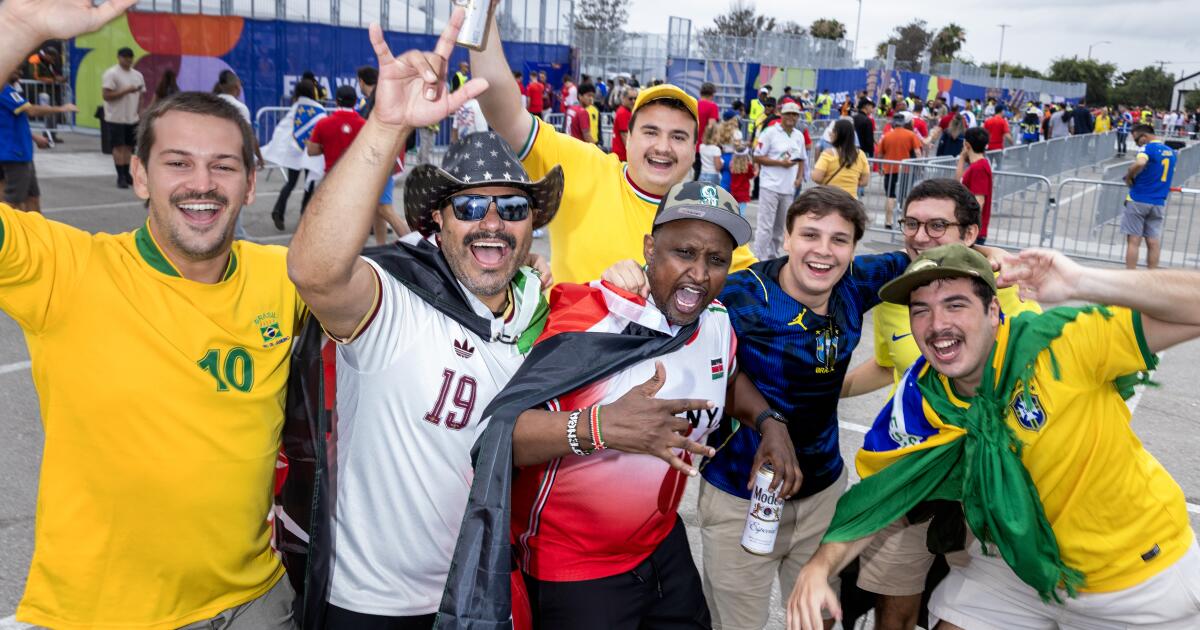
World Cup tourists are coming to L.A. for the soccer, but they’re staying for the $21 smoothies and Double-Doubles.
As the last Los Angeles FIFA World Cup event ended Friday, soccer fans were eating like locals and famous chains from the region were cashing in.
In the weeks that L.A. has hosted the World Cup, international soccer enthusiasts have flocked to big brands from the area, often in large groups wearing their countries’ jerseys.
It is a phenomenon seen at many of the host cities. In Dallas, giant gas station Buc-ee’s is the main attraction. For people visiting New Jersey, deli shops have been a hot ticket. In L.A., the place to be between matches was Erewhon.
Thirsty international sports fans gathered for pictures outside different Erewhons, wandered their aisles smiling, and, of course, picked up pricey smoothies.
While Erewhon would not comment on its business, mobility data company Arity, which uses phone data to track consumers, said Erewhon visits at the outlets around SoFi Stadium were quadruple what they were a week earlier on June 12, the day of the U.S. national soccer team’s opening match there.
Arity looked at what stores people visited within a 10-mile radius of SoFi that day and also found surges in visitors to nearby El Pollo Loco and Trader Joe’s.
Locals have spotted groups of people in Korea jerseys huddled together, trying to decide what to order at In-N-Out.
Some complained on social media that international tourists at Trader Joe’s were buying up all the mini canvas tote bags.
Soon after the Belgium vs. Spain quarterfinal ended Friday, the In-N-Out near SoFi had a long line of soccer fans stretching out the door in bright red and yellow and black jerseys and matching striped hats and scarves.
One of the workers said he had to explain “spread” and “animal style” to foreign football fans.
“I didn’t know this place existed,” a fan from Romania said while waiting in line.
Los Angeles and other cities and states that have hosted the event need the soccer fans to spend money to make the event worth all the time, effort and money it requires.
A rosy 2024 report projected the World Cup could bring more than $800 million to the L.A. region as 180,000 people converge on the area to sleep, eat and spend.
There were early concerns people weren’t turning up for the event because of the high ticket prices and the difficulty of obtaining visas for citizens of some countries.
However, at least for some L.A. hotels, there was a surge of last-minute visitors which pushed up occupancy and room rates.
While sports fans are not in the region to shop, they do make time for it.
World Cup customer spending is also apparent in beer sales. Andrew Heritage, the chief economist at the Beer Institute said beer purchases at entertainment and attractions in L.A. – outside of World Cup spaces – were up around 10% from normal.
“That tells me that fans in the L.A. area have decided to extend their stay and take in all the other things that the area has to offer, rather than just the match itself,” he said.
On social media, the purpose of these shoppers is clear: grab a quick souvenir or local specialty and take a selfie.
The data from Arity suggests that fans are very efficient when they spend at local spots, diving in, getting what they want and getting out as soon as possible, said Jeff Schlitt, a director at the company.
“Normally you’re there for an hour. They’re going to be there for 15, 18 minutes,” he said. “Why is that? Because they were purpose-driven shoppers.”
For some travelers, the more popular American chains aren’t unfamiliar. But some of the native L.A. fare still comes as a surprise.
As one Belgium-Spain matchgoer from the Netherlands stood taking a picture of the In-N-Out sign after the game, he said he’d never had a burger like the one he’d just tried.
“We only have McDonald’s and Burger King,” he said. “It’s way better.”
-
Sports5 seconds ago
Q&A: Partner, chance to play in Long Beach reignited AVP star Taylor Crabb’s Olympic fire
-

 World10 minutes ago
Moldova president nominates pro-European businessman Tofan for PM
-

 News37 minutes ago
US congressman says he was detained by armed Israeli settlers in occupied West Bank
-

 Los Angeles, Ca2 hours ago
New details emerge in fatal stabbing of boy in El Monte
-

 Detroit, MI2 hours ago
1 dead, 1 injured after two-vehicle crash at Collingwood and Belleterre in Detroit
-

 San Francisco, CA2 hours ago
4 arrested, 3 cited after brawl following Giants vs. Rockies game at Oracle Park
-

 Dallas, TX3 hours ago
Mark Cuban takes legal action against Dallas Mavericks ownership over potential new arena deal
-

 Miami, FL3 hours ago
South Florida Dirt: A timeline of the Vacchi vs. Stern legal battle

