Sports
Inside the community creating the golf courses of their dreams — for a video game


They didn’t have much, but they could create. Money was tight for the family, so they built their own board games growing up in Saskatchewan, Canada. One year, Matthew Fehr’s father created his own little golf board game out of huge bristle boards with holes drawn in and different clubs tapered off. They rolled dice to see where the ball went, with sand traps and water hazards and trees along the way.
It lit a spark in Matthew. Sure, he liked golf as a game, but there was more pulling him in — he could create new worlds this way. Soon he was 7 years old drawing up golf courses on sheets of paper. In high school he discovered the website Golf Club Atlas and practically lived on what he called the “greatest resource ever.” He scoured through photo profiles of courses around the world, places he couldn’t go, and read through discussion boards on the best golf architects.
The world of golf architecture is exclusive. And expensive. One does not simply just jump into designing golf courses. So that was a dream Fehr had to put aside, settling for old-school computer games like Sid Meier’s SimGolf as he pursued a career as a chef.
“There has to be something out there that will allow me to build golf courses,” he thought.
Then, seven or so years ago, Fehr found an independent game called “The Golf Club.” It wasn’t very popular outside of the niche gaming world. It didn’t have licensing deals at the time like EA Sports did. But it did have a remarkably in-depth course designer tool.
He wasn’t a gamer nor was he particularly tech savvy, but this was his calling. He taught himself how to do the one thing he always wanted to do. The kid playing bristle board dice golf was designing golf courses. “It just blew my mind,” he said.
The game grew in popularity and was bought by gaming goliath 2K, which just released a new version — “PGA Tour 2K25”. Fehr — he’s better known by his tag, MattyfromCanada — is one of the most respected designers in an international community, so much so he’s been contracted by 2K to design official courses for each new version of the game. He is, no matter how you want to define it, a professional golf course architect, his courses put alongside Pebble Beach, Royal Portrush and Oakmont in the game.
“I’ve told my boss at work,” Fehr said, “my dream, if there’s ever even a chance I could ever design a golf course for real life, I will run out of the building and you will never see me again.”
He’s just one member of a fascinating world of obsession, a group of creatives that range from 15-year-old high schoolers to 70-year-old retirees spending their lives on message boards, Discord chats and YouTube streams to interact, create and discover the best courses in the game. Some can build a course in 10-20 hours. Others will sweat it out for more than 200 hours to create their masterpiece. Some courses are hyper realistic, forming homages to their favorite golden age architects. Others are fantastical, only possible in a video game world.
But over the last decade, these people have created a community. This summer, Fehr and a few others will fly to Scotland for a golf trip to play St. Andrews and North Berwick. Others meet up each year, taking turns hosting the others. Some were die-hard gamers. Some don’t touch a single other video game. Some turned this passion into jobs at golf architecture firms. Others got hired by gaming studios. But the story of this design world isn’t about any of that. It’s about getting to be who they always thought they were.
The montage launches with five minutes of clips of every course you wish you could play. There are heathland style tracks, and some sandbelt beauties. There are absurdist gems in the mountains with rocky creeks and tee shots into cliffs. There are stadium courses that look like TPC Sawgrass on steroids and parkland courses inspired by Augusta National.
Then the Twitch stream begins, and a soft-spoken Englishman in his 30s begins to speak. His name is Ben Page. Others know him as b101. Either way, “everybody wants to be like Ben,” one fellow designer said.
Today is the group stage draw for the World Cup of Design 2025. The average person will have no clue this ever happened. But for the 300 people who did watch, this is their Super Bowl. Forty of the best designers in the PGA 2K world will be drawn into eight groups to compete through a knockout style format to crown the best course of the year. That opening montage? Those were the previous six winners.
Page then welcomes his co-host for the draw.
“If you don’t recognize Andre, he once designed golf courses,” Page says in a dry tone.
“Once,” quips Andre Quenneville, another 30-something man with glasses and a light beard.
Quenneville, or CrazyCanuck, is something of the godfather of this community. He’s the Velvet Underground of 2K course design. Maybe not that many people actually watched his videos, but everyone who did felt compelled to become a designer.
But he’s more of a background figure now. Part of that is having children and a family. Much of it is becoming disillusioned or disappointed with recent editions of the game and its design tool. But the executives at HB Studios, the creators of “The Golf Club” that 2K Sports acquired in 2021, were smart enough to know that to get people back on board and excited with this newest game, they needed CrazyCanuck on board. They looped him in early to preview the new design tool, and suddenly he’s back. His excitement has others excited too.
Quenneville was far from the first to launch this community, but he ended up being the whole who brought in new audiences. He’s a teacher by trade, teaching high school math and science. Yeah, he golfed, but not too intensely. He didn’t know the design world. He’s not a huge gamer, either. But like Fehr and so many others, he had a fascination with courses and drew them out as a kid.
Then, in 2014, the first edition of “The Golf Club” came out. That game is a story of its own for another day. It was cool and new and anti-establishment, with gameplay that felt like golf — as frustrating as it was rewarding. But the big sell was the “Greg Norman Golf Course Designer,” a partnership with Norman’s design company that allowed the firm to render course proposals for potential clients. The tech initially was not very good, but improved quickly.
Quenneville’s first courses were “absolute garbage,” and there was nobody making videos explaining how to use it. They were all on their own.
But he had an idea. He went into forums and said, “Hey, if you post your courses here I’ll review them on YouTube.” Quenneville was far worse than the guys he was critiquing, but by reviewing these courses he could hone in and figure out how these people were making them. How’d they do that bunker lip? How’d they plant it that way? This was a decade ago, so the tools were far behind. “It was like the dark ages,” he joked, so the best designers were the ones discovering tricks to create visuals.
Quenneville becoming the primary “reviewer” coincided with the creation of a niche website called TGC Tours. See, the original games didn’t have any career mode or tour system, so a group of buddies created their own online league where people played the same courses and submitted their scores to the website. It grew and grew to where there are now thousands of members, with dozens of different tiers and tours and competitions. TGC Tours became as important as “The Golf Club” itself, enough so that later versions of the game have added an “online societies” mode where these created online tours were actually inside the game.
But possibly the most lasting element of TGC Tours is that it became the primary hub for designers to meet in the forums and talk. That’s where they shared courses, gave notes and tried to create ones good enough to be picked for the next TGC Tour season. It created community.
Quenneville got better at making his own courses. Much better. “Then I went on my teaching knowledge and said, ‘There’s an opportunity here for me to make some really simplistic, easy-to-start tutorials because there’s a massive hole in that.’”
Those videos gained popularity around 2019 as “The Golf Club” was on its third edition, but the COVID-19 pandemic unleashed a new wave. Suddenly everyone in the world was stuck at home, and wanted a hobby. Some of them found this game, and then they found Quenneville’s videos.
One of the people constantly commenting in those early streams was Page. He didn’t even have the game yet. A CrazyCanuck video popped into his feed and he was hooked, because unlike Quenneville, Page is a true golf architecture nerd through and through. In the description of his newest club, Ferncliff, he cites Myopia, Sleepy Hollow, Boston GC, Essex, Beau Desert and Ohoopee as inspirations.
But like Quenneville, Page is also an educator, teaching high school French and German in England’s midlands. He thinks that’s why he was able to pick it up so quickly. Within weeks, he was one of the better designers. The natural, if you will. By the time 2K Sports bought HB Studios and created “PGA Tour 2K21”, they were hiring Page as a designer.
“You’ll see a lot of people where they have command of the tools and can make everything look very pretty, but the golf is not very interesting, one dimensional,” Page said. “Or there’s the reverse where the golf is great but the visuals aren’t. Or, because it’s a video game, you have people almost trying to do too much and throw everything at one course because you can. It’s all about finding a balance.”
But the beauty of the community is the variance inside it, though it remains mostly male. What was once 10 top designers has become closer to 70.
There’s Page (@b101tgc), perhaps the top dog nowadays. He has a combination of visuals and architecture know-how many are trying to catch up to. And the teacher found his own niche creating tutorials that focus on taking designers from good to great.
There’s Adam Benjamin (@articfury1). He’s the elusive artist, hardly ever talking in the community but popping in out of nowhere to release a new course with spectacular, jaw-dropping visuals.
There’s Tanner Bronson (@DTannerBronson), a younger designer who turned his hobby into a job working at a golf architecture firm.
There’s Christian Andrade (@SleepyPanda_7), a former golf pro who found Quenneville’s videos, got really good at design and got hired by HB Studios as a senior level editor. He gets a lot of credit for taking the criticism of 2K23, looping in the design community and creating a design tool for 2K25 that has them all giddy.
But the cool part is the ways the designers have created their own world inside a world. They’ll have contests where you have to make a course as a specific designer. Or a certain era or region. Many have gotten in the habit of sending each other plots of land to adapt to and create inspiration.
Quenneville was on the first trip to Myrtle Beach organized by the TGC Tours founder. Now most of them go on a different trip each year. Quenneville has become so close with one designer that their wives hang out. Some people don’t even design courses anymore but still go on the trips as friends.
“Every time you’re just like, oh my god, is there any axe murderer in here? Who are these random guys?” Quenneville said. “But you’re so comfortable with them.”
“They are genuine friends,” Fehr said.
“You’re all golf geeks that have an extremely niche interest inside of an extremely niche interest,” Page said. “So people tend to want to chat about the same things.”
Yes, there is sometimes tension in the forums. Sometimes the fantastical designers and the realists disagree on judging results. Sometimes players don’t take criticism well, because it’s not exactly fun being told something you just spent 100 hours on isn’t very good. Sometimes the elite players and the elite designers go at it.
But overall, it’s a group of people who just want to create.
“Not too many people in the community are into it for how many plays you got,” Quenneville said. “It’s just the process, or being picked to host a tournament on TGC Tours is a cool experience, but for the most part people like sharing it with people in their community.”
There’s a question they all get asked most often, though. One this reporter of course asked as well. How long does it take to design a course?
None of them quite have their answer down, because it depends. Quenneville is the first to say he’s not the most detail obsessed, so in his prime he could make a pretty good course in 20 to 40 hours. Page’s simplest courses take that long, or he could take 200 hours. Fehr, yeah he’s going to be around 100 to 200 hours without a doubt. He’s hit 300 hours before over several months. He might spend a whole night mastering one bunker.
And all these guys have day jobs. At the peak of his obsession, Quenneville would be at the dinner table thinking about what hole he was going to work on, or wonder if he could take off work to finish a course. Now, he’s much more likely to put his kids to bed and spend an hour or two planing grass while listening to a podcast.
But Fehr took exception when asked about how much time he takes living in this community. Sure, he makes time to see his family. And yes, he does go see his friends in Saskatoon when he can. But there was something about the suggestion that his design world was him running away from the real world that didn’t sit right with him. Was his design life not as valid? Was living out some version of his dream not as substantial? He wasn’t avoiding his friends.
“These are my friends.”
(Illustration: Demetrius Robinson / The Athletic; Photos: Courtesy 2K)



CHICAGO — Dodgers superstar Shohei Ohtani was out of the lineup Friday against the White Sox after exiting the game before with discomfort in the back of his left knee.
Manager Dave Roberts said Ohtani had imaging done on the knee and showed “the normal wear and tear.”
“He feels fine-ish,” said Roberts, who hopes Ohtani will be back in the lineup this weekend. Ohtani remains in line to make his next pitching start on Wednesday against the Tampa Bay Rays at Dodger Stadium.
Especially at this point in the season, the Dodgers have incentive to play it safe with Ohtani’s recovery. Pushing him to return early and exacerbating the injury would be a larger blow to a team seeking its third straight World Series championship.
With Ohtani out, left fielder Alex Call was in the leadoff spot, and Santiago Espinal served as the designated hitter.

NEWYou can now listen to Fox News articles!
With the largest World Cup field in the history of the tournament, 32 of the 48 teams will be fighting for a spot in the knockout stage.
66.6% of nations will advance out of the group stage this summer, which is a massive upgrade from 50% in past World Cups. Because of this, sportsbooks have adjusted with less favorable odds.
Prior to the start of the tournament, Spain, Argentina, Brazil, England, and Germany entered with the strongest odds to advance from the group stage, supported by recent major-tournament success and talent-rich rosters.
All five nations are heavily favored at -10000 to advance to the knockout round.
The Spaniards are the defending European Champions while the Argentinians are looking to win back-to-back titles. Germany has not made it out of the group stage in the last two World Cups, but has always been a perennial contender— having won four titles in its history. And then of course there’s Brazil, which has more titles than any country with five.
Now, after the conclusion of the first day of the World Cup, Mexico has joined the group at the top. El Tri has surged to -10000 to advance to the knockout stage after initially being just -1400. Mexico’s huge leap up the oddsboard is a direct result of its dominating 2-0 win over South Africa.
With that in mind, let’s dive into the odds for each team to advance to the knockout stage of the 2026 FIFA World Cup as of June 12.
This page may contain affiliate links to legal sports betting partners. If you sign up or place a wager, FOX Sports may be compensated. Read more about Sports Betting on FOX Sports.
Odds to Advance to Knockout Stage
Spain: -10000 (bet $10 to win $10.10 total)
Argentina: -10000 (bet $10 to win $10.10 total)
Brazil: -10000 (bet $10 to win $10.10 total)
England: -10000 (bet $10 to win $10.10 total)
Mexico: -10000 (bet $10 to win $10.10 total)
Germany: -10000 (bet $10 to win $10.10 total)
Portugal: -5000 (bet $10 to win $10.20 total)
France: -5000 (bet $10 to win $10.20 total)
Belgium:-3500 (bet $10 to win $10.29 total)
South Korea: -2500 (bet $10 to win $10.40 total)
Switzerland: -1800 (bet $10 to win $10.56 total)
Netherlands: -1400 (bet $10 to win $10.71 total)
Morocco: -1000 (bet $10 to win $11 total)
Colombia: -1000 (bet $10 to win $11 total)
Uruguay: -1000 (bet $10 to win $11 total)
Canada: -1000 (bet $10 to win $11 total)
Ecuador: -900 (bet $10 to win $11.11 total)
Norway: -900 (bet $10 to win $11.11 total)
United States: -750 (bet $10 to win $11.33 total)
The U.S. men’s national team is currently -750 to advance from Group D (Photo by Omar Vega/USSF/Getty Images).
Croatia: -500 (bet $10 to win $12 total)
Austria: -500 (bet $10 to win $12 total)
Türkiye: -500 (bet $10 to win $12 total)
Ivory Coast: -500 (bet $10 to win $12 total)
Japan: -500 (bet $10 to win $12 total)
Egypt: -340 (bet $10 to win $12.94 total)
Algeria: -310 (bet $10 to win $13.23 total)
Scotland: -310 (bet $10 to win $13.23 total)
Senegal: -230 (bet $10 to win $14.35 total)
Sweden: -230 (bet $10 to win $1435 total)
Bosnia and Herzegovina: -220 (bet $10 to win $14.55 total)
Paraguay: -205 (bet $10 to win $14.88 total)
Iran: -200 (bet $10 to win $15 total)
Czechia: -165 (bet $10 to win $16.06 total)
Ghana: -140 (bet $10 to win $17.14 total)
Australia: -110 (bet $10 to win $19.09 total)
DR Congo: +100 (bet $10 to win $20 total)
Raúl Jiménez helped propel Mexico to a 2-0 win over South Africa in the opening match of the 2026 FIFA World Cup (Photo by Yair Gonzalez/Jam Media/Getty Images).
Saudi Arabia: +105 (bet $10 to win $20.50 total)
Tunisia: +140 (bet $10 to win $24 total)
New Zealand: +150 (bet $10 to win $25 total)
Uzbekistan: +180 (bet $10 to win $28 total)
Cape Verde: +200 (bet $10 to win $30 total)
Panama: +200 (bet $10 to win $30 total)
Qatar: +275 (bet $10 to win $37.50 total)
South Africa: +320 (bet $10 to win $42 total)
Jordan +350 (bet $10 to win $45 total)
Iraq: +450 (bet $10 to win $55 total)
Haiti: +800 (bet $10 to win $90 total)
Curaçao: +1000 (bet $10 to win $110 total)
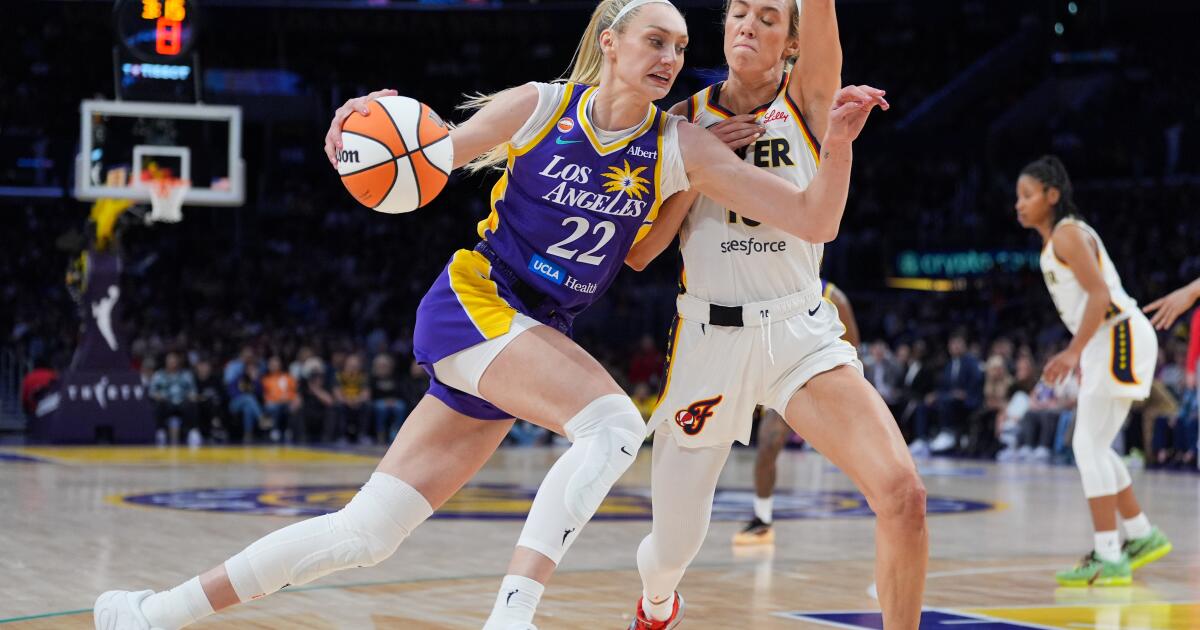
Cameron Brink said she’d appreciate some grace. She really would.
Sparks fans should give her some, because where else is she going to get it?
Certainly not from WNBA refs. Not from opponents with more to play for than ever. Certainly not from the game itself; basketball moves fast, and a bummer can become a bust in a blink.
But Brink, 24, is not on the brink of bust territory, no. Block that thought. Technically, it’s Year 3, but after a torn ACL derailed her as a rookie two summers ago, it’s practically like Year 2 for the former Stanford star. And by design, the WNBA is testing her confidence, her decision-making and her patience as she tries to reestablish herself as one of the WNBA’s best young players.
So, grace.
The recognizable 6-foot-4 forward — she’s the long-blond-haired hooper in the New Balance ads — was the No. 2 overall pick in 2024.
Now she’s her team’s No. 3 option in the post. She’s coming off the bench behind Nneka Ogwumike and Dearica Hamby for the Sparks, who are a modest 6-6 after wins this week over the expansion Portland Fire and the struggling Seattle Storm.
Against the Fire, Brink scored two points and picked up four fouls in nine minutes. Then she went to Seattle and had 15 points in 18 minutes but was pulled with more than five minutes left in the fourth quarter after getting her third, fourth and fifth fouls in 86 seconds. (WNBA players get six fouls before being disqualified.)
For the season, Brink has been called for 49 fouls in 208 minutes. A foul about every four minutes!
They’re silly fouls and they’re phantom calls. Egregious and ticky-tack. Costly and common. A real fouled-up buffet. She sets screens that get scrutinized as if by the most vigilant TSA agent. And sometimes, yes, she’s doing the accidental tripping. Other times, the officials are.
Her reputation precedes her, so everyone gets a superstar’s whistle when being defended by Brink. Opponents bake it into their game plans.
That can’t continue.
All that fouling is hindering Brink’s development because it’s robbing her of important in-game reps — which she needs, foremost, to figure out how to stop fouling.
Sparks forward Cameron Brink, left, blocks the shot of the Tempo’s Laura Juskaite during a game last month.
(Jeff Lewis / Associated Press)
“At the pro level,” said Tara VanDerveer, Brink’s coach at Stanford, “every young player always has a lot of work to do. And I saw her make a three. I see her block shots. She rebounds, she can handle the ball, she’s unselfish, she’s a terrific talent. But there’s always things players need to work on.”
We know what Brink’s thing is.
“She has to be disciplined,” VanDerveer said. “And if you want something so badly, if you want to be an All-Star someday or make the Olympic team, you’ve got to be dependable … and I think anyone can change, if it’s behavior they recognize is not in their best interests or not in their team’s best interests. It’s hard, but it’s something I think people can do.
“That’s what Cam is working on.”
And, VanDerveer added, “I’m really so excited that Nneka is there, because she will give her such great guidance and mentorship.”
And grace. Brink is getting that from Ogwumike — also a former Stanford star, the Sparks legend returned to L.A. this season after two seasons in Seattle — and her other teammates.
“I just do my best to lead by example,” Ogwumike, 35, said. “But then also let [Brink] know that she’s very capable, that she’s more than capable, which is exactly why she’s here with us and it’s exactly why we need her on this team.”

Sparks forward Cameron Brink, wearing a facemask, controls the ball while defended by Sun forward Raegan Beers.
(Joe Buglewicz / Getty Images)
But how long will Brink get grace from the Sparks in the what-have-you-done-for-me-lately business of basketball?
The foul trouble tells us why a win-now team wouldn’t trust her, why the Sparks would give meaningful minutes to two veteran post players ahead of her. Why they wouldn’t prioritize Brink’s development alongside winning as they strive to snap a previously unthinkable five-year playoff drought.
And what about fans? How patient will you all be with a player who was drafted immediately after Caitlin Clark and five spots in front of Angel Reese?
These days, that might depend on what the parlay calls for.
Or, preferably, whether you remember Brink’s first 15 WNBA games. All starts, all signs pointing to stardom. She showed up in 2024 throwing lavish block parties. Her 2.3 blocks per game were message-sending spikes, like what Lisa Leslie used to enthrall Sparks crowds with.
From the jump, she had guys coming to games at Crypto.com Arena wearing her No. 22 jersey and little girls arriving in groups with No. 22 painted on their cheeks and “I love Cam Brink” signs in hand.
And then the torn ACL cost her 25 games of her rookie season and another 25 last season, plus her spot on the United States’ Olympic 3×3 women’s basketball team in Paris in 2024.
She had to start over. Lost a lot of ground. But you see that masked woman stuck on the Sparks’ bench for all but 17 minutes per game?
You can’t miss her. She’s looking uncomfortable in protective facial gear that either hinders her breathing or her peripheral vision, her only options to protect the torn septum she suffered in a victory over the Las Vegas Aces last month.
She’s the one with the 6-8 wingspan who’s averaging 9.2 points, 4.3 rebounds and 1.5 blocks while shooting 52.1% from the field in her limited minutes.
She’s still Cameron Brink. Between fouls, she’s fluid and fast and covers more of the court than almost anyone in the WNBA, able to leap from defending guards to centers in a single bound.
“It’s just looking at every day as a new opportunity to learn and grow and not getting too bogged down when things don’t go exactly as you planned,” Brink told me. “Because more times than not, things are not going to go how you want them to. And that’s life. So I just want to be able to put my best effort out there every single night.
She knows what the Sparks need from her: “To perform, just come on the floor and compete.”
To prove she can stay on the floor to compete.
-
Sports3 minutes ago
Shohei Ohtani held out of starting lineup a day after leaving game with knee inflammation
-

 World13 minutes ago
Pope leaves Spain on plane offered by king after technical glitch
-

 Los Angeles, Ca2 hours ago
MLB to screen Hollywood classic at drive-ins nationwide
-

 Detroit, MI2 hours ago
Detroit at Le Mans: Cadillac favorite, Ford poised for 2027
-

 San Francisco, CA2 hours ago
Hudson Pacific lands SF’s biggest office lease in nearly a decade
-

 Dallas, TX3 hours ago
NFL Brazil tickets are available: Shop Cowboys vs. Ravens NFL Brazil tickets now
-

 Miami, FL3 hours ago
North Miami man accused of stabbing victim 7 times
-

 Boston, MA3 hours ago
Everything you need to know about Sail Boston 2026

