Sports
How Klay Thompson's 13-year run with the Warriors splintered so unceremoniously


SAN FRANCISCO — The tensest of 24-hour stretches in Klay Thompson’s 13th and final season as a Golden State Warrior — ending in an unceremonious divorce that stunned so many this week — came directly before this past All-Star break, during and after a home collapse against the LA Clippers.
The Warriors were on a five-game win streak that opened in Brooklyn a week prior, the same night Steve Kerr opted to close with little-known Gui Santos over Thompson because Santos made a few fourth-quarter hustle plays and Thompson had been slumping.
It worked fine. The Warriors won. Santos had a feel-good moment. But the postgame story shifted to Thompson, who delivered an honest, viral locker room interview about his difficulty grasping this transitional moment of his career, seeming to fight tears while also emphasizing how proud he was of Santos.
The Warriors won the next four games, but Thompson’s struggles continued. They were 26-25, battling back above .500 now that Draymond Green had returned from suspension, but still desperate to climb up the conference standings before it was too late. Kerr was making rotation decisions with increased urgency and less sentimentality.
Fast forward five months and Thompson’s free agency departure for Dallas has so many in the league wondering: Why? How did it get to a point where a 13-year legacy player willingly walked away from a dynasty brand he helped build and an area that adored him so much?
It’s been a layered five-year path to this divorce, splintering last season, sprouting earlier and finalizing in the last couple weeks, where —among the conversations Thompson had, league sources said — was a request of Stephen Curry not to exert his significant organizational influence and up the temperature with management to ensure Thompson’s return. Curry’s measured voice, even if it altered the outcome, wouldn’t change the genuineness of Joe Lacob and the front office’s true desire to have Thompson back.
So there they were against the Clippers, up 12 in the fourth but in constant fear of blowing a large lead because they’d made it a habit. Thompson hit two jumpers to open the quarter, but his night wasn’t going well. Those jumpers made him 4 of 14 overall. He subbed out at the 7:01 mark and it became clear quickly that Kerr didn’t plan to go back to him. So Thompson stewed.
Strip away the quirks, anybody who knows Thompson will tell you that his competitive fire burns as deeply and as ferociously as anyone who has ever played. It’s a killer instinct that has him bound for the Hall of Fame. The franchise won titles and made countless millions, in part, because of that instinct the past decade.
But dense character traits can be attached to flaws in adverse moments. Thompson was never going to smoothly handle a reduced role. During an early December game in Phoenix — the same night Green nailed Jusuf Nurkić and earned an indefinite suspension — Thompson was pulled from the closing lineup for the first time in his career. In a fit of rage after learning the decision, Thompson whacked a cup rack behind the bench to the ground and needed to be pulled back by Curry as he lit up the coaching staff in the huddle.
On this February night against the Clippers, he planted himself on the bench and boiled, staring out at the court as his two legendary teammates, Curry and Green, were out there battling to preserve the dying days of a dynasty with a rookie, Brandin Podziemski, in his spot.
But another problem surfaced: When absorbed in existential thought (as Thompson tends to find himself), the details of the present (like the mechanics of a basketball game) can fade. The Clippers went up six with 48 seconds left. The Warriors called a timeout. Kerr knew they needed a 3. So he called for a cold Thompson, still one of the world’s greatest floor spacers and shooters, to replace Jonathan Kuminga.
The design worked. Thompson drew two off a screen, found a rolling Green, who hit Podziemski in the corner for 3. The Warriors were now only down three with 39.1 seconds left, plenty of time to play out the possession.
“We didn’t want to foul,” Kerr said. “It’s an obvious defend and play it out, get a rebound.”
Thompson didn’t calculate time and score. He committed an intentional foul after the inbound, sending Kerr and the Warriors’ bench into a collective spasm of frustration that’d be replayed quite publicly over the minutes and hours that followed. Some theorized postgame Thompson’s head was elsewhere.
These Warriors reactions to Klay’s late-game foul 😬 pic.twitter.com/3ehLxrrbwl
— Warriors on NBCS (@NBCSWarriors) February 15, 2024
They lost again, a common factor at the core of most growing frustrations in sports. The proud Warriors were failing more often in increasingly bewildering ways, generating a perpetual blame game that was leaning Thompson’s way more than ever before.
This was an embarrassing blunder for him at one of the low points of his season, only compounded the next morning in Salt Lake City when Kerr, on the second night of a back-to-back, informed Thompson he’d be moving to the bench. He’d occupied the Warriors’ starting shooting guard spot for more than a decade, 727 consecutive games when healthy. It was an identity more than just a title.
But it was now being given to Podziemski, who was 8 when Thompson hit the first of his 2,982 3s (playoffs included) for the franchise. That news didn’t land softly. Thompson ripped into Kerr and his staff, team sources said, and spent some of that day grumbling about his inevitable summer departure from the franchise. His impending free agency loomed in the background all season.
But this is where the complexity and dichotomy of Thompson inevitably whipped back. He went out that night and torched the Utah Jazz for 35 points in 28 minutes and then sat down for another of his introspective postgame media sessions, telling the world he “deserved” the demotion, he’d “embraced” the role, he shouldn’t “pout” and then used Manu Ginobili’s career as a reference point.
Thompson and Kerr sat down for several heart-to-hearts over the last few seasons. Thompson detailed a few publicly, thanking Kerr for reminding him he needed to enjoy the final years of a historic career and not anguish over a chase to reclaim what he once was prior to the injuries. In one particular revealing soundbite, Thompson acknowledged the negative energy he’d been spreading and the need to be a better mentor.
“Sometimes I forget just how lucky and successful I’ve been,” Thompson said.
That version of Thompson is the reason so many within the Warriors expected him to circle back around in recent weeks, have all the necessary reconciliation conversations and ultimately decide on a reunion. He’s deeply proud of what he helped build and went into detail about his desire to remain with the Warriors forever prior to last season.
“I was here before banners were hung up,” Thompson said. “So in a way, it’s our baby. You want to ride it out. I’ve just been so lucky to be a part of this franchise. It’d be so hard to envision myself in another uniform.”
Kerr made some sensitive coaching decisions last season that, in retrospect, played a part in nudging Thompson out the door. In Kerr’s exit interview, he mentioned the desire to bring Thompson off the bench again (he won his starting job back by the end of the season) and the need to play him less in general, a soundbite that wouldn’t have helped in any theoretical negotiations with a player most proud of his durability and availability (a team-high 77 games at nearly 30 minutes per night last season) at this advanced stage of his career.
But the substantial relationship fracturing that led to this split points the microscope at upper management. Controlling owner Joe Lacob led a front-office effort to take a cold, mostly uncommunicative approach to Thompson’s next contract in his three summers of extension eligibility, league sources said, which isn’t separate from their norm. Lacob has done similar in the past with Curry, Kerr, Bob Myers, Andre Iguodala and Green, using dwindling time as a weapon but ultimately paying up (he put a substantial offer on the table for Myers) after a staring contest.
But Iguodala’s (in 2017) and Green’s (in 2023) are the two parallel situations that have popped up most in conversation about the split with Thompson that blindsided some Warriors’ executives in recent weeks. Iguodala and Green, both sharp and versed in the corporate world, used leverage to exact a better deal from the Warriors. Iguodala took his decision deep into free agency.
Thompson operates on his own wavelength. The Warriors’ decision-makers were warned that a drawn-out negotiation into July during this free-agent cycle wouldn’t be met the same way. He wasn’t trying to leverage his way back until the bitter end. After a bumpy end to a grumpy year, there was a realistic chance he went searching for a fresh start and more happiness elsewhere, regardless of how rapidly and warmly the Warriors prioritized him.
But his decision, as one source put it, became easy when the Warriors kicked him down the summer pecking order. They paid a record luxury-tax bill last season and didn’t make the playoffs, a cost-versus-benefit that is untenable. So Joe Lacob, Mike Dunleavy, Kirk Lacob and their front office set off this offseason to explore big-picture moves that could vault them into contention and salary-slicing moves that were more reasonable.
There was little communication between Thompson, the Warriors and Thompson’s agent, Greg Lawrence, and ultimately no offer in this cycle. Warriors sources maintained a plan to eventually make a competitive offer in relation to his market once other business was settled. But they never had the chance. Many league sources said Thompson’s decision to depart was unofficially made weeks ago.
Thompson and Stephen Curry celebrate a win in Oklahoma City in November 2023. (Alonzo Adams / USA Today)
Warriors sources will mention the two-year, $48 million offer put on Thompson’s desk back in the preseason, especially considering he is heading to the Dallas Mavericks on a lower per-year three-year and $50 million deal, as an example of their dollars-and-cents intent to keep him around longer term. But the two sides have differing versions of the firmness of the offer and, again, the true desire of the franchise’s lead decision-makers in valuing him as a can’t-lose member of the core, only becoming more complicated when Myers (the ultimate communicator) ceded his high-ranking position in June 2023.
An extension didn’t get done. It bled into the season. Thompson, who led the NBA in made 3s two years prior as the Warriors made the second round, saw a dip in his production. He still made the fourth-most 3s in the NBA, but went from 41.2 percent to 38.7 percent, slowed more defensively and saw a younger crop of Warriors (Podziemski, Moses Moody) begin to bump into his current and future playing time.
The real origin story of their split goes back to 2019. Thompson, at the absolute peak of his prime, tore his ACL on a Game 6 NBA Finals dunk attempt during one of the signature nights of his career. He had 30 points after he hobbled up to the free throw and buried both. Had he not fallen, those within the Warriors believe that series was going back to a Game 7 in Toronto and Thompson was destined for some sensational seasons through his mid-prime.
The Warriors rewarded him that summer with a five-year max deal, knowing he’d miss the following season. Thompson went without a player option on the end of it, a minor detail that now looms larger, considering he could’ve entered the market with Green the previous summer. Some of this is about timing. Despite becoming extension eligible right after the 2022 title like his three teammates, had Thompson been as close as Jordan Poole or Andrew Wiggins or Green to free agency, he’d likely still be around.
After Thompson went 0 of 10 in an elimination Play-In loss in Sacramento in April — his final game in a Warriors uniform — Green, when asked about Thompson’s future, mentioned that the Warriors’ leadership always takes care of its own.
“They did right by me,” Green said. “They’ve done right by Steph. They’ve done right by all of us. Klay tore his ACL and they gave him $160 million dollars.”
At a tense exit interview a few days later, Thompson — not directly at Green’s comment, but the prevailing theory that he owes the Warriors anything for the previous contract — bit back.
“Oh, man,” Thompson said. “Well, 2019, could you imagine if they didn’t pay me after I got hurt? That would have been really bad. Like, ‘Oh, you went to five straight finals, you blew your knee out, yeah, sorry.’ That was very nice of them.”
The Warriors let Thompson rehab his ACL mostly away from the facility during the 2019-20 season. Curry missed almost the entire season with a hand injury. Green missed part of it. They went an NBA-worst 15-50, but felt geared up for another run the following season.
That’s when one of the most consequential days in this run struck. On the same night the Warriors drafted James Wiseman second, Thompson ruptured his Achilles playing pickup basketball in Los Angeles, away from the team’s care and, he’d later admit, with too much weight.
“It might’ve been costly,” Thompson said in a 2021 interview with The Athletic. “I don’t know. I try not to think about it too much. But it just, uh, it’s something I learned from. I’m not in my early 20s anymore.”
Thompson was in the facility and far more committed to head medical decision-maker Rick Celebrini’s plan the second time around. But Thompson ended up missing 941 days and two-and-a-half seasons of his mid-prime, losing an intangible amount of his burst in the process. There were many thorny rehab and post-return interactions as Thompson struggled to fully grasp the best seasons of his basketball career getting ripped away. He did become more temperamental on a daily basis, team sources said.
But Thompson also worked diligently to reclaim every ounce of his former self and then served as a vital member of the 2022 championship run, averaging a team-high 36 minutes, appearing in all 22 playoff games and scoring 19 points per night. He hit eight 3s in closeout games over the Memphis Grizzlies and Mavericks to help secure the team’s sixth Western Conference title in his tenure. Then Thompson played 69 and 77 games and made 301 and 268 3s the next two seasons, respectively, his 12th and 13th in the league, giving him a strong belief that he has a whole lot more great basketball left and should be valued accordingly.
“I try every year I give my best effort,” Thompson said at his exit interview. “And the ownership group has been great. I have nothing but positive things to say about them. They treat us with great respect and do all the little things for us to do our jobs at the highest level … (But the future), it’s up to them.
“At the end of the day, whatever happens, it’s all gravy. It’s been such a freaking special run.”
Required reading
Kawakami: The poetic timing of Klay Thompson’s 13 seasons of splash for the Warriors
The Athletic staff: Klay Thompson to join Mavericks, Warriors get picks
(Illustration: Dan Goldfarb / The Athletic. Photos: Getty; Mike Rasay / NBAE)



Sports
Golden Knights beat Hurricanes in double OT Game 3, one of the wildest Stanley Cup Final games of all-time

NEWYou can now listen to Fox News articles!
The Stanley Cup Final shifted to Las Vegas for Game 3 with the Vegas Golden Knights and Carolina Hurricanes knotted at 1-1 after splitting the opening two games in Raleigh.
And, as you’d expect from the Golden Knights, this one got started with some theatrics, plus a little help from the city’s latest hope at quarterback, who was getting in on the festivities.
That’s right. Who better to put on siren duty than Raiders draft pick and reigning Heisman Trophy winner Fernando Mendoza?
ZERO BS. JUST DAKICH. TAKE THE DON’T @ ME PODCAST ON THE ROAD. DOWNLOAD NOW!
There was a big surprise when the game got underway: Golden Knights defenseman Brayden McNabb — who took a slapshot straight to the face on Thursday in Game 2 — was in the Vegas lineup, albeit with a full cage.
It goes without saying, but hockey players are just built different.
The first period was physical but ultimately scoreless, with Carolina getting more offensive opportunities, leading Vegas in shots 7-2.
Vegas captain Mark Stone found the back of the net just 36 seconds into the second period; however, it was ruled offside after a Carolina challenge.
CLICK HERE FOR MORE SPORTS COVERAGE ON FOXNEWS.COM
A few minutes later, Golden Knights forward Jack Eichel found the back of the net, but Carolina challenged this goal as well after Vegas’ Ivan Barbashev made contact with Canes goalie Frederik Andersen’s head.
It was another cut-and-dried review that kept a Golden Knights tally off the board.
The first penalty of the night was a self-inflicted one, when the Hurricanes were called for too many men, and it didn’t take long for Tomas Hertl to make them pay.
Then, just moments later — 16 seconds to be exact — Mitch Marner was credited with a goal after Carolina defenseman Sean Walker tipped his shot into the back of his own net.
But, hey, those own goals are no fun; Marner wanted to get one the old-fashioned way, which he did.
What’s that, you want more?
Well, Mitch Marner — who is having the playoffs of his life — had more for you.
That’s right, Marner potted a hat trick in just six minutes and 10 seconds. That’s an NHL record.
Although, I bet The Rocket’s first goal of his lightning-quick hatty wasn’t an own goal, but hey, they count the same.
Vegas star Mitch Marner took over in the second period of Game 3 with a natural hat trick in just six minutes and ten seconds. (Photo by David Becker/NHLI via Getty Images)
What a performance. Maybe he was just doing that so that the next time the team puts him on a rally towel it actually looks like him.
After the second intermission, Andersen was pulled in favor of Brand Bussi, who made his Stanley Cup Playoffs debut.
Carolina was in a state of disarray in the third, and after going on a power play, Sebastian Aho slashed Marner, who was headed to the net on a short-handed breakaway.
Marner was awarded a penalty shot, but Bussi didn’t give him much to shoot at, and Marner missed his attempt on the backhand.
While it may have looked bleak after a dominant second for Vegas, in the third, Carolina dropped the fastest three goals in Stanley Cup Final history to make it a game. (Photo by Josh Lavallee/NHLI via Getty Images))
Carolina’s Jordan Martinook got the Hurricanes on the board a little under halfway through the third period to make it 4-1.
Just moments later, Taylor Hall tacked on another one to cut Vegas’ lead to 4-2.
And, while they’re doing goals, how about you just throw a Jordan Staal tally in there?
Carolina scored those three goals in 39 seconds, the fastest three goals by a single team in Stanley Cup Final history, making what looked like a no-doubt Vegas win into a game once again.
Carolina killed off a delay-of-game penalty, which was crucial for staying in the game.
Then, Vegas’ Shea Theodore airmailed a puck into the stands for delay of game, giving Carolina a late power play.
Then — as if it couldn’t get wilder — Andrei Svechnikov tied the game on the power play and with the goalie pulled.
And with that, it was off to overtime for the second game in a row.
In the extra frame, both teams got their share of chances and opportunities to put a pin in this one and hit the craps tables, but the first overtime period didn’t yield a winner.
In the second overtime, we finally got a winner, and as wild as this game was, it was only fitting that the game-winner would be unbelievable.
That’s the same Shea Theodore, by the way, who skied the puck into the stands to set up the tying goal, and he did it after 39 minutes of ice time.
CLICK HERE TO DOWNLOAD THE FOX NEWS APP
Vegas players Brett Howden (21), Shea Theodore (center), and Mitch Marner (93) celebrate the game-winning goal in double overtime. (Lucas Peltier-Imagn Images)
What. A. Game.
I think after this one, Game 4 — which will be on Tuesday in Las Vegas — is officially appointment viewing.
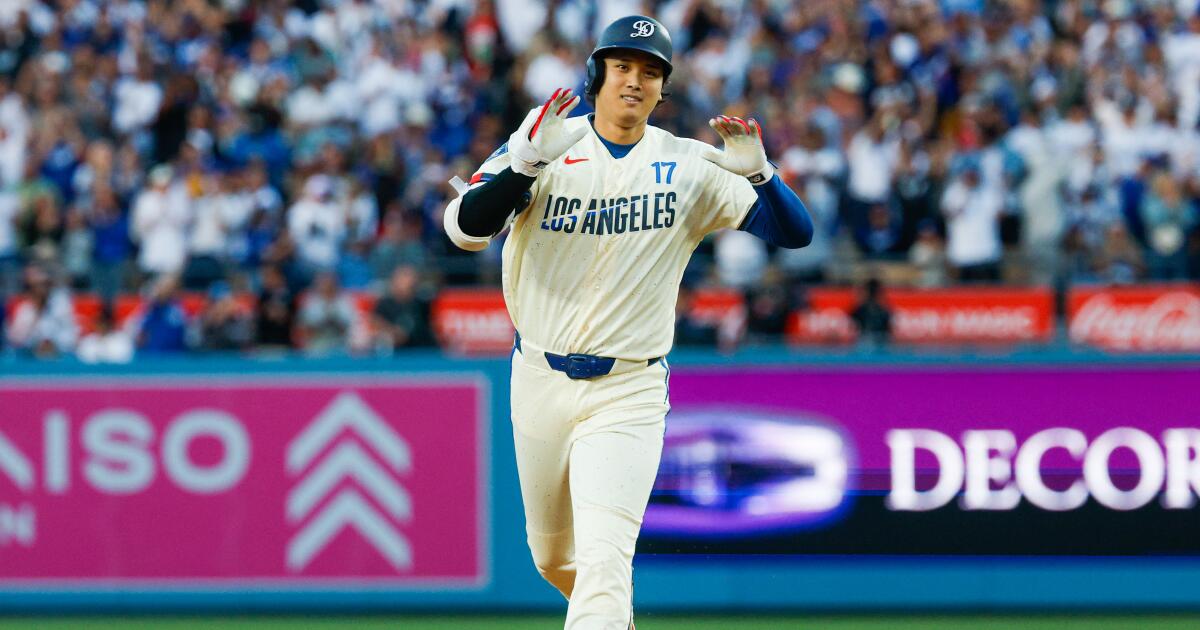
The Dodgers spent so long racking up an insurmountable lead in the first inning that starting pitcher Yoshinobu Yamamoto resorted to throwing a ball against the back of the dugout to stave off rust.
He also went to the batting cages to keep his arm moving, tossing weighted PlyoCare balls.
As he worked, the Dodgers scored all of the runs they would need and more to defeat the Angels 9-2 on Saturday at Dodger Stadium. The chasm between the Freeway Series rivals was on display.
“That’s a lot of fun,” Dodgers rookie Ryan Ward said of the first-inning onslaught. “You can feel them start to speed up a little bit, and we’re starting to calm down and enjoy it. And it’s easy to pass it along when you have a lot of runners on, and then just keep it going.”
The one-run lead the Angels (24-41) had jumped out to in the top of the inning — when a leaping center fielder Andy Pages couldn’t quite reel in Oswald Peraza‘s deep line drive for an RBI triple — was long forgotten after the Dodgers rallied for nine runs in the first.
Andy Pages celebrates with teammates in the dugout after hitting a two-run home run as part of a nine-run first inning for the Dodgers.
(Ronaldo Bolaños / Los Angeles Times)
It was the most runs the Dodgers scored in a single inning in nearly five years, matching their seventh-inning rally against the Nationals on July 2, 2021.
The Dodgers (42-23) helped themselves with a show of power. Pages drove in the first two runs by crushing a center-cut changeup from Angels starting pitcher Jack Kochanowicz over the left-field wall.
Judging by his stroll out of the batter’s box, Pages seemed to know it was a homer on contact.
The ball had so much loft that reliever Blake Treinen parked under it in the bullpen and caught it with his hat. His fellow relievers mobbed him in an impromptu mosh pit.
“The homer by Andy to answer back was big, kind of put to bed any type of momentum they had at the top of the first,” manager Dave Roberts said. “And then after that, just the hits kept coming, just good at-bats.”
Later in the same inning, after the lineup turned over, Shohei Ohtani also notched a two-run homer, for his second hit. In between, rookie Ryan Ward hit a two-run double off the wall.
The Dodgers brought 12 batters to the plate and recorded six hits in a row — seven total.
The Angels’ shoddy defense exacerbated the scoring spree. They had a chance to get out of it just four runs into the rally.
Kochanowicz had faced eight hitters and only recorded one out when Angels manager Kurt Suzuki turned to his bullpen.
Veteran left-hander Brent Suter jogged in with the bases loaded. Immediately, Suter got Alex Freeland to hit a ground ball to shortstop Zach Neto, for what should have been an inning-ending double play.
Instead, Neto’s throw across his body sailed past second and into foul territory on the other side of the diamond. By the time Angels right fielder Jo Adell collected the ball and threw to the cutoff man, three runs had scored.
“We always say, you can’t give good teams extra outs,” Roberts said. “And so, to give us extra outs just makes us really tough to beat.”

Ohtani was up next. And in a two-strike count, he stayed inside a sinker to launch his two-run blast to left-center field.
The Angels’ defense didn’t fare much better in the second, although Suter navigated a pair of misplays — Neto muffed a one-hopper up the middle, which was ruled a single, and third baseman Donovan Walton overthrew first on a chopper — to escape without the Dodgers extending their lead.
Yamamoto retired 22 straight en route to eight innings of two-hit ball.
“I was given a big lead,” Yamamoto said through interpreter Yoshihiro Sonoda. “So what I was trying to do was focus on my execution and also be fine, precise with my location, the height and location of my pitches.”

Dodgers pitcher Yoshinobu Yamamoto delivers against the Angels in the first inning Saturday at Dodger Stadium.
(Ronaldo Bolaños / Los Angeles Times)
The lead also gave him a chance to experiment.
“You get up big like that, you don’t want to get too cute to an extent,” catcher Dalton Rushing said. “But you also want to understand and see what he’s capable of. … For him, it’s so easy, because he has eight pitches that he can throw wherever he wants. Obviously it’s fun to work with him. We tried a few new tricks, and we’ll carry them over into his next one.”
While Yamamoto gave the Dodgers bullpen a rest, Roberts used the early blowout to give first baseman Freddie Freeman some rest.
Freeman, who has played in 62 of the Dodgers’ 65 games, left after the top of the fourth inning, replaced by Miguel Rojas.
The Angels had time to chip away, but they didn’t score again until Neto’s solo homer off Dodgers reliever Jack Dreyer in the ninth inning.
The contrast was glaring.

Rams defensive end Myles Garrett throws out the ceremonial first pitch Saturday at Dodger Stadium.
(Ronaldo Bolaños / Los Angeles Times)
Smith scratched
Dodgers catcher Will Smith was scratched from the lineup because of a stiff neck, Roberts said. The issue “came out of nowhere,” Roberts said, pointing to a “bad night’s sleep or a bad pillow.”
“He was going to play two out of three [against the Angels] regardless,” Roberts said. “So it’s nice that we could kind of tap Dalton on the shoulder and get him in there.”
Roberts said he expects Smith will return to the lineup Sunday.
Injury update
Right-handed reliever Brock Stewart (left foot bone spur) is progressing after a setback a week and a half ago stymied his throwing progression.
The last time Stewart threw live batting practice, he aggravated the injury by running afterward. But throwing to hitters Saturday went better. He’s scheduled to throw one more live BP session before going out on a minor-league rehab assignment, Roberts said.
Roster moves

Dodgers pitcher Tyler Glasnow smiles on the field before the Dodgers’ 9-2 win Saturday against the Angels at Dodger Stadium.
(Ronaldo Bolanos / Los Angeles Times)
The Dodgers added right-hander Nick Frasso to the 40-man roster and transferred right-hander Tyler Glasnow (back spasms) to the 60-day injured list.
The team originally expected Glasnow to avoid the IL altogether, but his back issues have persisted. He remains shut down from throwing after a flare-up.
“He wants to get cranking again,” Roberts said, “but the doctors just aren’t allowing it and the body is not allowing for it right now.”
The Dodgers also traded left-hander Antoine Kelly, whom they signed to a minor-league deal in November to the Cubs.

NEWYou can now listen to Fox News articles!
It’s a two of a kind for Golden Tempo.
The winner of last month’s Kentucky Derby, who sat out the Preakness Stakes, forfeiting a shot at the Triple Crown, took home the victory at the 158th Belmont Stakes in New York on Saturday.
Renegade opened up as the morningline 2-1 favorite, similar to the Derby, followed by Chief Wallabee at 3-1 and Golden Tempo at 9-2.
The racing post is pulled down the front stretch for a race at Saratoga Race Course. (Gregory Fisher/Imagn Images)
Just like the Derby, Golden Tempo was well at the back of the pack but began to make his move at the final turn. At one point, Golden Tempo was neck-and-neck with Commandment, but Golden Tempo was able to get away from the pack in the final stretch.
This was the second consecutive year in which the Derby winner skipped out on the Preakness to tune up for the Belmont. Last year, Sovereignty won the Kentucky Derby before not traveling to Pimlico Race Course and then taking home the Belmont.
Golden Tempo (9) with Jockey Jose Ortiz crosses the finish line to win the 158th running of the Belmont Stakes horse race, Saturday, June 6, 2026, in Saratoga Springs, New York. (AP Photo/Yuki Iwamura)
CHERIE DEVAUX REFLECTS ON MAKING KENTUCKY DERBY HISTORY AS FIRST FEMALE TRAINER TO WIN THE RACE
“We made our decision, he won today, and we’re happy about that,” trainer Cherie DeVaux said after the race.
Saturday’s Belmont Stakes marked the third consecutive, and final, year in which the race took place at Saratoga Race Course in Upstate New York, as Belmont Park finishes up renovations.
Due to the change in course since 2024, the race ran at 1 ¼ miles instead of its usual mile-and-a-half. Saratoga is home to the annual Whitney, Travers, and Jim Dandy Stakes.
A sign at Saratoga Race Course for the 2026 Belmont Stakes. (Will Waldron/Albany Times Union via Getty Images)
This year’s Belmont did not feature any horses from the Preakness Stakes three weeks ago and just four from the Kentucky Derby in early May: Renegade, Commandment, Chief Wallabee, and Golden Tempo.
All four of them finished in the top four.
Follow Fox News Digital’s sports coverage on X, and subscribe to the Fox News Sports Huddle newsletter.
-

 Connecticut2 minutes ago
Rocky Hill water main break closes road
-

 Delaware7 minutes ago
Police investigating shooting in Claymont, Delaware
-

 Georgia17 minutes ago
5 Best Georgia Online Casinos & Sweeps Sites to Try This Weekend (June 2026)
-

 Hawaii22 minutes ago
Driver in Pahoa fatal crash charged with manslaughter – West Hawaii Today
-

 Idaho29 minutes ago
Wagon Days Honored by Idaho State Historical Society
-

 Illinois32 minutes ago
Atlanta Hawks 2026 NBA Draft Profile – Illinois Guard Keaton Wagler
-

 Indiana37 minutes ago
Food Delivery Robots To Launch On Indiana University Campus
-

 Iowa44 minutes ago
Class of 2027 QB Accepting Iowa State Football Challenge

