Sports
How do you fix an NHL arena where the fans don’t cheer? ‘Play in the sandbox’


It was a small moment in the Toronto Maple Leafs season, a late-January footnote that most of the NHL hardly noticed.
But when the team captain remarked how he was disappointed in the home crowd for showing so little enthusiasm for an early-game fight, it set off plenty of commentary in the center of the hockey universe about the Leafs fan base.
Or, to be more specific, the lack of one in the seats.
“I would’ve liked a little more energy from the crowd after that (fight),” Auston Matthews said following a 5-1 loss to the Columbus Blue Jackets, during which the Leafs’ Ryan Reaves dropped the gloves with Mathieu Olivier in the first period. “I thought it was a little quiet tonight, especially after two guys like that go at it.”
“He’s just admitting what everybody knows,” TSN commentator Bryan Hayes later added. “That building on a Wednesday night in January is never loud.”
Criticism of the crowds at Scotiabank Arena is not new in Toronto, where ticket prices have long outpaced the average fan’s means.
The tepid game atmosphere was raised by many of the hundreds of Leafs faithful who responded to our ownership survey last month. It was heavily featured again when we interviewed season-ticket holders about eye-opening price increases for next year’s packages.
Part of the issue in Toronto has to do with the nature of sports attendance in general over the past 20 years. More and more tickets are bought by companies as corporate perks, to the point that sitting in the lower bowl often doubles as attending a business meeting in major markets such as Toronto, New York and Vancouver.
Swanky suites and expensive lounges near the best viewing areas help woo clientele, who then help inflate revenue beyond what anyone could have imagined in earlier eras.
And yet, even with this growing trend across all sports, many organizations have started sinking millions of dollars into improving the atmosphere in their respective arenas. What’s become known as the “event presentation industry” has grown dramatically in that span. The impact has become particularly noticeable over the last decade or so in hockey, as newer markets have pushed the envelope of what’s possible at an NHL game.
According to some in the event presentation industry, the Nashville Predators may have started it all when they erected a band stage above the Zamboni entrance at Bridgestone Arena, embracing their Music City reputation with live performances integrated into the gameday experience. Plenty of other teams have followed suit, between the Tampa Bay Lightning’s outdoor areas and Tesla coil; the Seattle Kraken’s flying fish; and how the Vegas Golden Knights have … well, there’s a lot going on at T-Mobile Arena.
The result? When you travel to non-traditional markets these days, it’s jarring how much better the arena environment can be compared to some of the most venerated hockey cities on Earth.
It’s a contrast that made me wonder about the science behind working the crowd — and whether, perhaps, the NHL’s old guard can learn something from the new.
When Las Vegas landed an NHL expansion franchise in 2016, the soon-to-be Golden Knights heavily invested in the in-game experience. But they didn’t simply airlift in “hockey people” for the roles.
President Kerry Bubolz, who came by way of the NBA’s Cleveland Cavaliers, instead hired two staffers from the WWE to build out their presentation team: Jonny Greco, who became the Golden Knights’ vice president and chief experience officer, and Andrew Abrams, who specialized in video production at the arena level.
Greco and Abrams had worked in the NHL before — Greco with the Columbus Blue Jackets and Abrams with the St. Louis Blues — but their assignment for the Golden Knights was significantly different. In Vegas, they were tasked with combining what they had learned in both hockey and wrestling; applying the lessons to a unique market; and establishing a new brand that would stand out in an old league.
“Everybody thought we’d just have, like, strippers everywhere,” Greco added. “You know, ‘Vegas — that’s what they’re gonna do!’ And it was like, well, hold on, there needs to be more thought to it than that. … Let’s honor the game and honor the traditions, but let’s also play in the sandbox a little bit. Let’s innovate.”
In the beginning, Abrams and Greco didn’t know if they had a winning product to work with, given the sorry state of most expansion rosters. Instead, the Golden Knights went on to reach the Stanley Cup Final in their first season of existence.
“The show was our No. 1 priority,” said Abrams, now the Golden Knights’ vice president and executive producer. “We had to make it good because if the team wasn’t good, we still needed people to come and have a good time, pay for the ticket and generate the revenue. Luckily for us, the team has been good.”
The Golden Knights have deployed a medieval mascot to rouse the crowd since the franchise’s inception. (Ethan Miller / Getty Images)
The Golden Knights’ initial version of innovation included deploying an actor dressed as a medieval knight to give rousing pregame speeches on the ice while carrying out a plot of a looming battle against an opponent. The team has since added more layers to its game experience, including a group of drummers who can fire up the crowd even while play is going; a “Knight Club” experience with DJs and special celebratory bottle service at the second intermission; and, as of last season, a 34-foot-wide, smoke-emitting dragon at one end of the rink.
Abrams explained that the Golden Knights have taken a lot of inspiration from theme parks, especially when it comes to the scale of some of their designs (see: dragon). And that they try to switch things up, so even season-ticket holders don’t know what they’re going to see any given night.
Even on a Wednesday in January, NHL games in Vegas are never boring.
The approach has won the Golden Knights a boatload of recognition, including the best overall production award at the 2023 IDEA conference, an Emmy Award for their Stanley Cup banner-raising ceremony that same year, and honors as the NHL’s top team for game presentation three times in the past four seasons.
Yes, some of the success is because it’s all happening in Las Vegas. But other teams around the league have taken notice, too. And not just in the Sun Belt. The Edmonton Oilers, for example, installed an area for a band — the Oilers Drum and Brass Crew — that fires up the Rogers Place crowd during games, a new twist for a Canadian market.
The push to innovate the fan experience has been so pronounced that Greco has branched out to start his own company, Shine Entertainment. He now travels the globe helping sports franchises push their crowd work to the next level, bringing some of that Golden Knights touch and encouraging teams to channel that “potential energy” into something fun and authentic for everyone in the building to experience. In one presentation that he regularly delivers, on the “ingredients of a goal moment,” Greco details the appropriate music, animation, lighting, scoreboard visuals and timing for every time a goal is scored.
More and more franchises, Greco said, are rewarding game presentation staff with executive titles and “a seat at the table,” having recognized how important the role is in building momentum with ticket holders.
“People are really realizing the power of the engagement — what I call scoreboard-proof programming,” said Greco, who before launching Shine, also worked as a senior vice president for both the Madison Square Garden Company, which owns the New York Knicks and Rangers, and the Seattle Kraken. “To be able to connect differently, to be able to have the conversations with hockey ops, but also the brand people, and then try to create something that plays and hits all the feels right, that creates home-ice advantage.”
But Greco acknowledged that the challenges for established, traditional franchises can be more pronounced than for those starting anew in, say, Vegas or Seattle.
“It’s way, way harder,” he said. “Some teams do have leaders that are very micromanaging of your show and can’t tell you why they don’t like something. But it’s like, ‘Oh, I don’t like that, don’t do that anymore,’ without maybe a rhyme or reason.”
As interesting — and successful — as the in-arena efforts of newer teams such as the Golden Knights and Kraken have been, some of it will likely never happen in more established NHL markets.
In Toronto, the Leafs have invested in advanced video projection technology, and there’s an impressive display on the ice at Scotiabank Arena before games. But they are not about to put the equivalent of a giant dragon in the corner of their rink.
One idea Greco believes could work to boost the energy level in traditional markets: soccer-like supporters’ sections. It’s already added a new wrinkle to Los Angeles Clippers games this season with “The Wall,” and it’s been tested in NHL arenas to a limited extent over the years in Nashville and Vancouver.
For the Canucks, the group is known as The Larscheiders, and starting in 2016, they worked with the team to purchase large sections of nosebleed seats to seven or eight games a season.
This Larscheiders’ section in the lower bowl is so cool. Never really seen this kind of electric, soccer-like atmosphere at a #Canucks game before pic.twitter.com/xDbLj93Xur
— Harman Dayal (@harmandayal2) April 20, 2022
The Larscheiders have a 10-point code of conduct for fans who buy into the section — “No. 2: Stand the entire game and react to what happens on the ice” — and they’ve received media attention for coming up with popular chants such as “Bruce, there it is!” (in honor of former coach Bruce Boudreau) and rowdily cheering on Elias Pettersson’s first NHL goal.
The motivation behind starting the group was to inject some life into Vancouver’s Rogers Arena, which had become quiet in recent years due to so many seats being sold to corporate interests, group co-creator Carlo Bodrogi said.
“Cheering for your home team while surrounded by other fans who are with you — not on their phones or closing deals — in the same mindset, that’s something really powerful and different from other entertainment options,” Bodrogi said. “It’s a feeling of solidarity and group joy.”
The challenge with building a supporters section, he explained, involves the need for buy-in from the team, as purchasing a block of tickets where hundreds of fans can stand together isn’t possible through Ticketmaster. This season, after making the playoffs last spring and with ticket prices on the rise, the Canucks didn’t set up a section for The Larscheiders, a move that drew criticism in the market.
With the playoffs approaching and the Leafs on a first-round collision course with their long-time rival, the Ottawa Senators, it’s likely the energy will pick up organically in Toronto beginning next weekend. More tickets will find their way to die-hard fans, and the stakes of the postseason will bring more passion to a building that’s needed it at times this season.
Whether the future brings something more, however, remains an open question. At the very least, it’s one worth investing some additional time, money and thought into over the years to come.
(Top photo: Mark Blinch / NHLI via Getty Images)



NEWYou can now listen to Fox News articles!
In just his second season at the helm, Curt Cignetti led Indiana to its first national championship.
During the Hoosiers’ title run, Cignetti became known for his demanding coaching style. Indiana opened spring practice Thursday, and incoming transfer wide receiver Nick Marsh got a crash course in what it means to play for Cignetti.
Marsh, who transferred from Michigan State, arrived at practice in gold cleats. After noting Marsh’s productive two-year stint in East Lansing, Cignetti pivoted to the wideout’s footwear.
Nick Marsh (6) of the Michigan State Spartans runs the ball up the field during the first quarter of a game against the Maryland Terrapins at Ford Field Nov. 29, 2025, in Detroit. (Mike Mulholland/Getty Images)
“I didn’t love those gold shoes he came out in today,” Cignetti said. “He learned what getting your a– ripped is all about. I don’t know if that happened to him very often at Michigan State. That was before practice started.”
INDIANA’S CURT CIGNETTI SHUTS DOWN NFL COACHING SPECULATION: ‘I’VE ALWAYS BEEN MORE OF A COLLEGE FOOTBALL GUY’
Marsh totaled 1,311 receiving yards and nine touchdowns at Michigan State. TCU quarterback Josh Hoover also headlines Indiana’s transfer additions.
An Indiana Hoosiers helmet during a game against the Ball State Cardinals at Lucas Oil Stadium Aug. 31, 2019, in Indianapolis. (Michael Hickey/Getty Images)
Cignetti added that the coaching staff has “more work to do with this group than the first two teams,” noting the group is still learning more about players the team will likely rely on next season.
Indiana Hoosiers head coach Curt Cignetti during the second quarter against the Miami Hurricanes in the 2026 College Football Playoff national championship at Hard Rock Stadium Jan. 19, 2026, in Miami Gardens, Fla. (Alex Slitz/Getty Images)
Indiana went 16-0 en route to a thrilling win over Miami in the College Football Playoff national championship in January.
Cignetti framed his callout of Marsh’s cleats as an early message about expectations.
“That was a wake-up call,” Cignetti said of the receiver’s pre-practice cleats. “But he’s really worked hard, done a great job for us.”
Follow Fox News Digital’s sports coverage on X, and subscribe to the Fox News Sports Huddle newsletter.
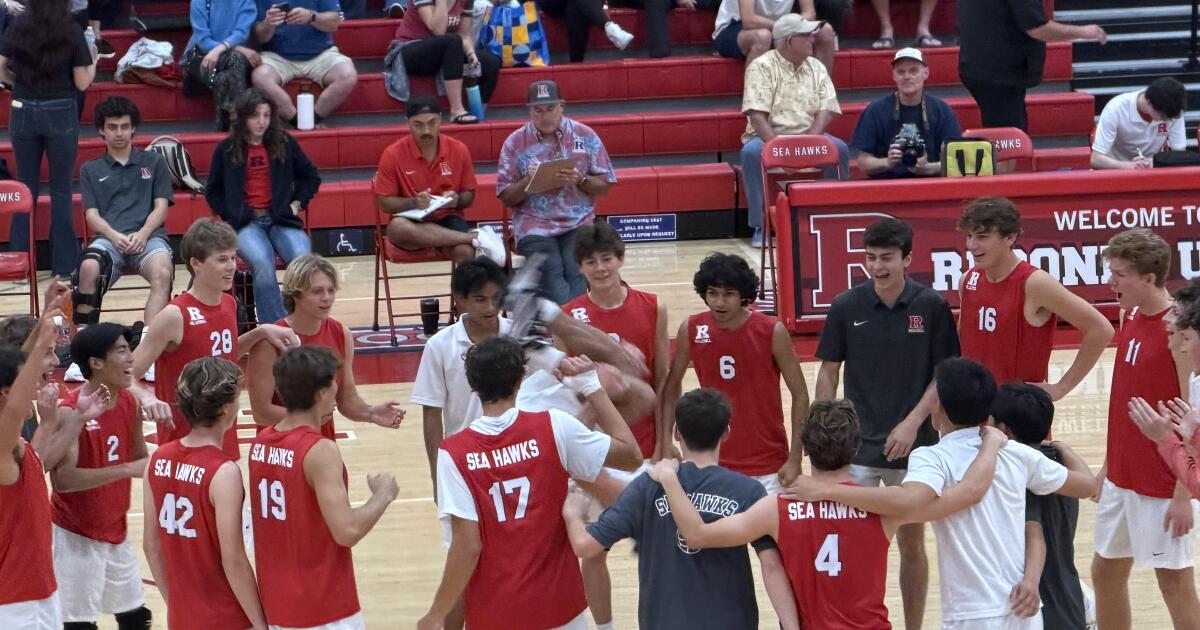
Redondo Union didn’t care that Mira Costa’s volleyball team was ranked No. 1 in California. This was their South Bay rival coming to their gym Thursday night, and anything can happen when a team digs deep and doesn’t fear losing.
The Sea Hawks (14-2) were aggressive from the outset and came away with a 27-25, 21-25, 25-22, 21-25, 15-13 victory.
“Chemistry,” setter Tommy Spalding said about the Sea Hawks’ triumph. He’s one of three players headed to MIT, and all three had big matches.
At one point on back-to-back plays, Carter Mirabal had a block and Vaughan Flaherty followed with a kill off an assist from Spalding. Chemistry.
JR Boice, a Long Beach State commit, was delivering kills, and Cash Essert’s serving and all-around play kept Mira Costa’s Mateo Fuerbringer looking frustrated. The Sea Hawks’ focus was on Fuerbringer, who came alive in the fifth set with six kills, but Redondo was able to come back from an 11-9 deficit.
It was only Mira Costa’s second loss in 25 matches. Redondo Union took over first place in the Bay League.
Baseball
Orange Lutheran 3, Jacksonville (Fla.) Trinity Christian 2: The Lancers advanced to the semifinals of the National High School Invitational in Cary, N.C., behind a walk-off single in the eighth inning by Andrew Felizzari. Brady Murrietta had tied the score with a squeeze bunt in the bottom of the seventh. CJ Weinstein had two doubles for the Lancers.
Venice (Fla.) 12, Harvard-Westlake 0: The Wolverines were limited to three hits at the National High School Invitational in Cary, N.C.
Casteel (Queen Creek, Ariz.) 3, St. John Bosco 2: The Braves suffered their first defeat in North Carolina. Jack Champlin threw five innings and also had two RBIs.
Chatsworth 6, Taft 3: Tony Del Rio Nava threw six innings and had two RBIs in the West Valley League win.
Granada Hills 4, El Camino Real 3: A two-run single by Nicholas Penaranda in the seventh inning keyed a three-run inning for the Highlanders in their West Valley League upset. JJ Saffie had three hits for ECR.
Cleveland 4, Birmingham 3: The Cavaliers pushed across a run in the top of the 10th inning to break a 3-3 tie in the West Valley League win. Joshua Pearlstein finished with three hits, including a home run.
Sun Valley Poly 4, San Fernando 2: Fabian Bravo gave up four hits in 6 2/3 innings for the Parrots, who are tied with Sylmar for first place in the Valley Mission League. Ray Pelayo struck out eight for San Fernando.
Verdugo Hills 15, Kennedy 1: Cutlor Fannon had two doubles and four RBIs in the five-inning win. Anthony Velasquez added two singles and four RBIs.
Westlake 9, Agoura 4: Jaxson Neckien hit a three-run home run to power the Warriors.
Thousand Oaks 7, Calabasas 5: Gavin Berigan, Jeff Adams and Cru Hopkins each had two hits for the Lancers.
Oaks Christian 11, Newbury Park 2: Dane Disney contributed three hits in the Marmonte League win. Carson Sheffer had two doubles and three RBIs.
Santa Monica 12, Simi Valley 4: Ryan Breslo and Johnny Recendez had two RBIs and a triple for Santa Monica. Ravi Chernack had three RBIs.
Dana Hills 7, Corona Santiago 0: Gavin Giese finished with eight strikeouts over six innings and gave up one hit for Dana Hills.
Softball
Sherman Oaks Notre Dame 10, Sierra Canyon 0: Kelsey Luderer contributed three hits and two RBIs while freshman Ainsley Jenkins threw five scoreless innings.
Chaminade 15, Louisville 2: Norah Pettersen had two hits and four RBIs.
Carson 10, San Pedro 0: Atiana Rodriguez finished with three hits, including a double and triple, and three RBIs.
Huntington Beach 6, El Modena 2: Willow Kellen had three hits for the Oilers.
Murrieta Mesa 15, Chaparral 0: It’s a 16-0 start for the Rams. Tatum Wolff hit two home runs.

NEWYou can now listen to Fox News articles!
The fiancée of Buffalo Sabres star Rasmus Dahlin received a roaring welcome home in her first appearance of the season Wednesday night, months after undergoing a lifesaving transplant after she suffered heart failure during a vacation in France.
Carolina Matovac, 25, was shown on the jumbotron during Wednesday’s game against the Boston Bruins. Fans cheered as she waved, and Dahlin, who was also shown on the screen in a split, cracked a smile at the crowd’s reaction.
Carolina Matovac and Rasmus Dahlin of the Buffalo Sabres pose on the red carpet at the Metro Toronto Convention Centre in Toronto, Ontario, Canada, Feb. 1, 2024. (Nicole Osborne/NHLI via Getty Images)
“Welcome home to Carolina Matovac, the fiancée of our captain Rasmus Dahlin,” the arena announcer said. “She is back with us, attending her first game of the season. The Sabrehood loves you, Carolina.”
In an open letter to fans in September, Dahlin shared that Matovac had been feeling ill for several days during their trip, which led to her experiencing “major heart failure.”
“Fortunately, she received CPR on multiple occasions, and up to a couple of hours at a time to keep her alive, which ultimately saved her life. Without her receiving lifesaving CPR, the result would have been unimaginable. It is hard to even think about the worst-case scenario,” he wrote at the time.
Rasmus Dahlin (of the Buffalo Sabres prepares for a faceoff during a game against the New York Rangers at KeyBank Center in Buffalo, N.Y., Oct. 9, 2025. (Bill Wippert/NHLI via Getty Images)
Matovac remained on life support for weeks before receiving the transplant in France.
JACOB WINTERTON, FORMER OHL PLAYER AND BROTHER OF NHL’S RYAN WINTERTON, DEAD AT 25 AFTER CANCER BATTLE
In January, Matovac revealed she was pregnant when her heart failed, adding that her unborn child was the reason she went to the hospital initially.
“You will always hold a special place in our hearts as our first baby, even though we never had the chance to meet. Our love for you is endless,” she wrote in a post on Instagram on what was supposed to be her due date.
“Though you didn’t get to experience this world, you played a vital role in ensuring that I could continue to be a part of it.”
Buffalo Sabres defenseman Rasmus Dahlin follows the puck in the first period against the Ottawa Senators at the Canadian Tire Centre in Ottawa, Ontario, Canada, on April 1, 2025. (Marc DesRosiers/Imagn Images)
CLICK HERE TO DOWNLOAD THE FOX NEWS APP
Despite taking some time to be with Matovac as she recovered in their native Sweden, Dahlin is second on the team with 65 points, and the Sabres are on the cusp of ending an NHL-record 14-season playoff drought.
The Associated Press contributed to this report.
Follow Fox News Digital’s sports coverage on X, and subscribe to the Fox News Sports Huddle newsletter.

What Iowa coach Ben McCollum said after defeating Nebraska on Thursday

Scholarships available for Nevada Youth Range Camp

Hillary Clinton to return to New Hampshire | Fox News Video

How hunters are helping to feed those in need throughout New Jersey

Reckoning over César Chávez’s legacy deepens in New Mexico amid swift erasure plans

Florida High School Football Rankings: Top 25 teams – Oct. 21

How old is Bo Nix? What to know about Oregon quarterback ahead of 2024 NFL Draft

Cleary's 21 help Le Moyne down Central Connecticut State 69-64 in OT

99th annual Pony Swim held in Virginia

Indiana Members Credit Union announced as new anchor tenant at Bottleworks District

Video: Will ICE Change Under Its New Leader?

DHS shutdown breakthrough comes at cost for Republicans as funding fights nears end

Rubio joins crucial G7 talks as Iran war set to dominate second day

A surprise resignation could open the door for an independent to win a Montana Senate seat

Video: Savannah Guthrie Says She Believes Her Mother Was Taken for Ransom
-

 Detroit, MI1 week ago
Drummer Brian Pastoria, longtime Detroit music advocate, dies at 68
-

 Science1 week ago
How a Melting Glacier in Antarctica Could Affect Tens of Millions Around the Globe
-

 Movie Reviews1 week ago
‘Youth’ Twitter review: Ken Karunaas impresses audiences; Suraj Venjaramoodu adds charm; music wins praise | – The Times of India
-
 Science1 week ago
I had to man up and get a mammogram
-

 Sports6 days ago
IOC addresses execution of 19-year-old Iranian wrestler Saleh Mohammadi
-

 New Mexico5 days ago
Clovis shooting leaves one dead, four injured
-
 Business1 week ago
Disney’s new CEO says his focus is on storytelling and creativity
-

 Texas1 week ago
How to buy Houston vs. Texas A&M 2026 March Madness tickets