Sports
How Borussia Dortmund's Yellow Wall became the envy of European football


Nobody is quite sure about when the largest grandstand in Europe earned the name it is now famous for, though it is certain it happened more recently than most people think.
The Yellow Wall at Borussia Dortmund’s Westfalenstadion was described by German author and writer Uli Hesse in 2018 as the thing that Bayern Munich, the most successful and powerful club in that country, did not have: “a massive terrace that seemed like a throwback to football’s golden age”.
This architectural beast can hold 24,454 spectators for Bundesliga games — more than twice as many as Celtic’s fabled ‘Jungle’ did in the 1960s, and only slightly less than the maximum capacity of the Kop at Anfield during the same period, a golden age in Liverpool’s history.
“Unlike the Jungle or the Kop, the term Yellow Wall is not very old,” Hesse stressed, using Kicker, the most popular football magazine in Germany, as a reference point for its relevance. Only in May 2009 did the description ‘Yellow Wall’ appear in its pages for the first time and that was because of the reflections of Dortmund’s then goalkeeper Roman Weidenfeller when he found out 10,000 of the club’s fans had travelled to a game against Eintracht Frankfurt.
“It’s incredible; even when we are playing away from home, the yellow wall will be there,” Weidenfeller said.
Yet another 21 months would pass before Kicker started to use the expression regularly, helping it become an established term in the global football language.
This was around the time Dortmund won the Bundesliga two seasons in a row under the management of Jurgen Klopp, who had transformed underachieving giants into a club competing for domestic and also European honours.
His Dortmund side would lose the Champions League final to Bayern at Wembley in May 2013.
This weekend, the club have the opportunity to win, at the same London venue, the same trophy for the first time since their only triumph in the competition in 1997. On this occasion, Real Madrid are the opponents and Dortmund, who finished fifth in the Bundesliga this season, 27 points behind champions Bayer Leverkusen, are a talented side but not quite in the same state of rude health as 11 years ago.
Klopp’s charisma and achievements helped Dortmund become the second club for lots of football supporters across Europe. Yet iconology was also a significant feature of Dortmund’s attraction.
Their popular former manager, who left Liverpool in May after almost nine years, described the experience of seeing the Yellow Wall as you emerge from the Westfalenstadion’s bowels as an almost out-of-body experience.
Dortmund fans say farewell and thank you to a departing Klopp in 2015 (Patrik Stollarz/AFP via Getty Images)
“This dark tunnel, it’s exactly two metres high (just under 6ft 7in), and when you come out it’s like being born,” the 6ft 3in Klopp said. “You come out and the place explodes — out of the darkness, into the light. You look to your left and it seems like there are 150,000 people up on the terrace all going completely nuts.”
Weidenfeller was a leader in Klopp’s team: “If you are the enemy, it crushes you, but if you have it at your back as a goalkeeper, it’s a fantastic feeling.”
This view was supported by Bayern’s Champions League and World Cup-winning midfielder Bastian Schweinsteiger, who later played for Manchester United and MLS team Chicago Fire. When he was asked whether he was more worried by Dortmund’s players or their manager, Klopp, he responded: “It’s the Yellow Wall that scares me the most.”
The sheer scale of the structure offers an array of vantage points. “From the front of the lower tier you can almost scratch the goalkeeper on the back — while way up high below the roof, where there is an inclined angle of 37 degrees, it’s like a ski jump,” concluded the German news magazine, Der Spiegel.
According to Hesse, Daniel Lorcher, born in 1985, was “more or less responsible” for creating the Yellow Wall term. In 2004, when Dortmund were facing doom on and off the pitch and as their financial position became bleaker, the club’s largest ultras group produced a mosaic that paraphrased an Oscar Wilde aphorism, “Many walk through dark alleys, but only a few are looking at the stars.”
Lorcher was a leading member of The Unity, who stood in the centre of what was then known simply as the Sudtribune, right behind the goal. It was their job to make as much noise as possible but Lorcher felt there were greater possibilities at Dortmund, due to the size of that stand. If the ultras could involve other fans, persuading them to dress in bright yellow while holding flags and banners of the same colour, say, the effect would be startling, helping Dortmund’s players, as well as potentially creating more of an intimidating atmosphere for opponents.
This not only required a huge amount of fabric, but it all had to be in the right shade of yellow.
Lorcher and other ultras contacted a Danish retail chain which had stores all over Germany. “They sold us more than three miles of cloth and we produced four thousand flags,” Lorcher told Hesse. “We rented sewing machines for weeks on end and then had to learn how to use them. It was hard work, but we had lots of fun.”
As the 2004-05 season reached its finale and Dortmund avoided oblivion, “the flags bathed the entire stand in yellow” before a home game with Hansa Rostock, Hesse wrote in his book, Building The Yellow Wall.
One of the banners read: “At the end of the dark alley shines the yellow wall,” and another said: “Yellow Wall, South Stand Dortmund.”
Since 2005, the Westfalenstadion has been known as Signal Iduna Park after the club decided to use a sponsorship deal to reduce a debt, which was eventually paid off to bank Morgan Stanley three years later.
There were lots of contributing factors towards Dortmund’s precarious financial state during that period and one of them was the demand for stadiums to be converted into all-seater venues in the wake of the 1989 Hillsborough disaster in England.
In the summer of 1992, the Westfalenstadion’s north stand terracing was converted into a seated area, reducing the overall capacity from 54,000 to less than 43,000. The club’s directors realised they could charge more money for a comfier experience but there was a reluctance to subject the southern Sudtribune (as it is still referred to by older Dortmunders) to the same treatment after discussions with fans, who made them realise the terrace was the club’s only real marketing tool.
After Dortmund beat 3-1 Juventus in Munich, securing the Champions League title in May 1997, the south stand was doubled in size. As the stadium became bigger and safer, Dortmund spent more money than ever on players. But more success did not follow and, by 2005, there was a real chance the club might go out of business.
Today, Dortmund’s ground is the biggest in Germany, while their mean attendance in the Bundesliga is greater than any other Bundesliga club — including Bayern: this season, Dortmund averaged over 81,000 and Bayern, at their futuristic Allianz Arena, were at 75,000. Between Dortmund and the third- and fourth-placed teams (Eintracht Frankfurt and Stuttgart), the drop was nearly 26,000, which is only slightly more than the capacity of the Yellow Wall alone, a terrace that could accommodate the population of a reasonably-sized town.

The Yellow Wall salutes Marco Reus at his final home game this month (Dean Mouhtaropoulos/Getty Images)
Though the stadium’s capacity is reduced to make it an all-seater stand on European nights, the three clubs with the lowest average attendances in the Bundesliga (Union Berlin, Darmstadt and Heidenheim) could get their entire crowds onto the Sudtribune with room to spare; yet the club have not really sought to capitalise on it economically in a direct way.
Hesse even suggests the Yellow Wall “hurts” Dortmund in this sense, because ticket prices have been kept so low.
On average, season-ticket holders pay €14 (£11.90/$15.10) per match, but if Dortmund put seats there and charged more, the club, according to Hesse, would lose a sense of their soul.
The fact that, according to the financial experts at Forbes and Deloitte, Dortmund are not even in the top 20 clubs in Europe when it comes to matchday revenue (when they have one of the biggest stadiums on the continent) is a reflection of the attitude that exists in their region, the industrial heartland of Germany. Instead, there is a residual monetary benefit from the Yellow Wall, with businesses including chemical company Evonik, brewer Brinkhoff’s and pump manufacturer Wilo keen to be associated with a creation that is authentic to a working-class region of the country.
The Westfalenstadion has become a tourist destination but the Yellow Wall remains unaffected for the time being.
The biggest decision for visitors, says Hesse, is whether to join the party on the terrace, or watch its radiance from afar.
(Top photo: Alex Gottschalk/DeFodi Images via Getty Images)




NEWYou can now listen to Fox News articles!
All Elite Wrestling (AEW) star Kenny Omega blasted a social media user over a remark made about Will Ospreay and Charlie Kirk.
The X user made a critique about Ospreay’s mic skills on Thursday, writing, “Will Ospreay is as bad on the mic as charlie kirk, but can’t sell the neck as well as he did.”
COMPLETE PRO WRESTLING COVERAGE ON FOX NEWS DIGITAL
Kenny Omega enters the ring during the New Japan Pro-Wrestling Wrestle Dynasty event at Tokyo Dome in Tokyo, Japan, on Jan. 5, 2025. (Etsuo Hara/Getty Images)
Omega, who is friends with Ospreay inside and outside the ring, slammed the poster.
“What the f— is wrong with you? It isn’t hard to try having some class,” he wrote in response.
“A dear friend battles back from a career threatening injury, is no doubt still fighting pain today, and is somehow mocked and compared to a dude that was murdered. I get that a joke is a joke but these things should really be kept separate in my opinion.”
Kenny Omega looks on after the tag match during the Power Struggle – Super Jr. Tag League 2018 at Edion Arena Osaka on November 03, 2018 in Osaka, Japan. (Etsuo Hara/Getty Images)
When one X user came to the defense of the commenter, Omega responded once more.
“Please extend my apologies, genuinely. Perhaps I’ve become too sensitive after my own brush with death. I also know of Will’s efforts behind the scenes more than most so it was sad to see such a harsh comparison,” the current AEW champion added.
Kirk, a conservative commentator and the founder of Turning Point USA, was shot and killed during an event on the campus of Utah Valley University in September. Tyler Robinson was arrested in Kirk’s murder.
Turning Point USA founder Charlie Kirk spoke during his “American Comeback Tour” at Utah Valley University on Sept. 10, 2025, in Orem, Utah. Kirk was fatally shot while appearing at the event. (Trent Nelson/The Salt Lake Tribune/Getty Images)
CLICK HERE TO DOWNLOAD THE FOX NEWS APP
Robinson’s trial is currently ongoing.

The final weekend of the 2026 FIFA World Cup is here, with France and England playing for third place on Saturday before defending champion Argentina takes on 2010 winner Spain for the title on Sunday.
Here’s everything you need to know about the last two matches of the 39-day, 48-team tournament in North America (all times Pacific).

Saturday’s third-place game
France vs. England
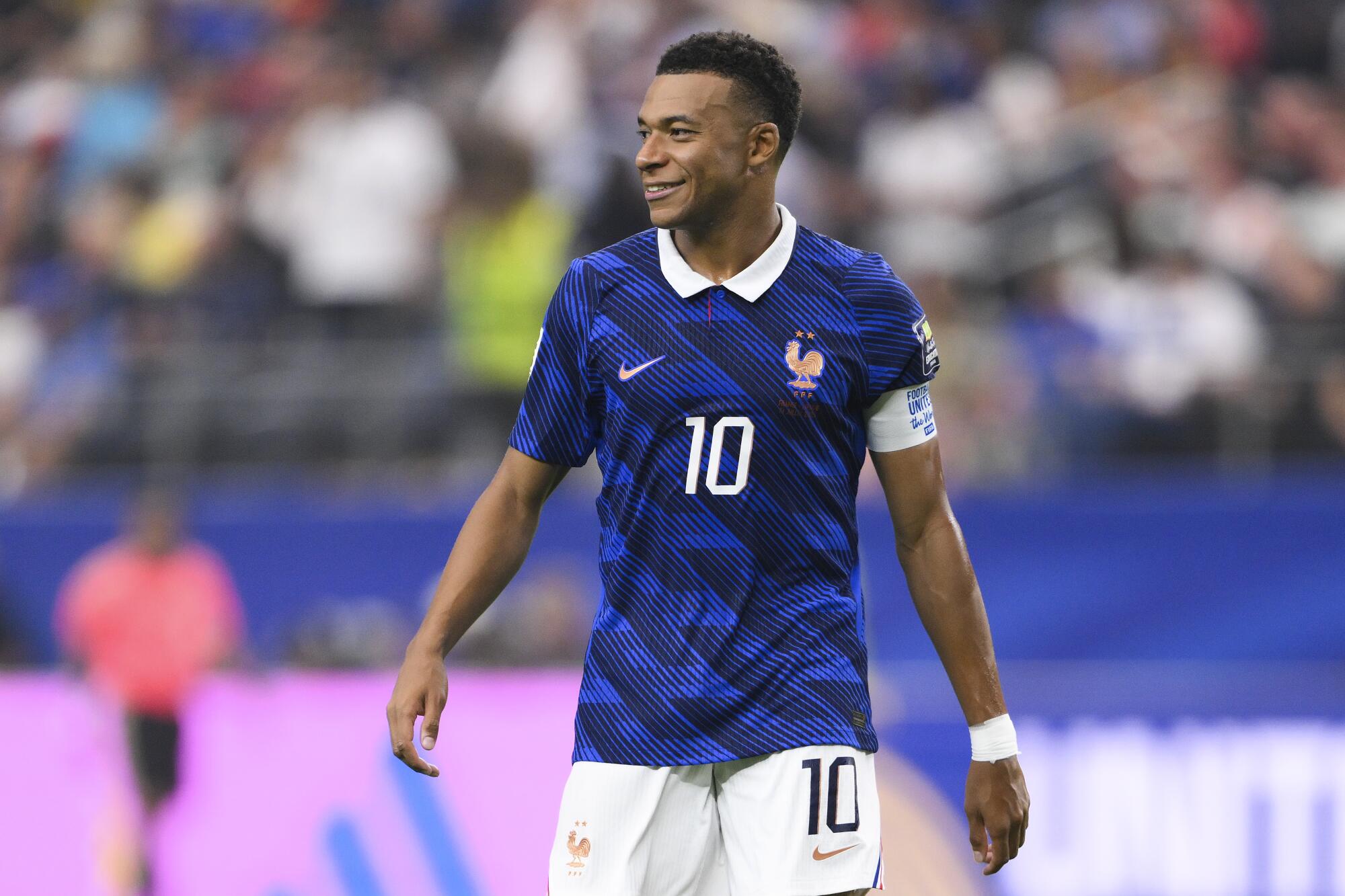
France star Kylian Mbappé smiles during a World Cup semifinal match against Spain on Tuesday.
(David Ramos / Getty Images)
Where: Hard Rock Stadium, Miami Gardens, Fla.
Time: 2 p.m.
TV: Fox, Telemundo | Streaming: Fox One, Peacock
The buzz: This is a game neither team really wants to play. The disappointment of missing the final is fresh and the weather report calls for temperatures in the high 80s with 68% humidity and a chance of thundershowers — a brutal South Florida summer day. The $2-million difference in prize money between third and fourth place isn’t likely to make any of that more palatable. Still, the game will have meaning for France since it will be the final match for coach Didier Deschamps, the winningest World Cup manager in history. And captain Kylian Mbappé, tied with Argentina’s Lionel Messi for most goals in the tournament (8), has a chance to become the first player to win consecutive Golden Boots. England is playing in the consolation final for the second time in three World Cups; it lost to Belgium 2-1 in 2018. But this one will probably sting even more since the Three Lions were five minutes away from their first final in six decades before collapsing against Argentina. This could be the last World Cup game for England’s Golden Generation of Harry Kane, Jordan Pickford, John Stones and Jordan Henderson.
Sunday’s championship game
Spain vs. Argentina

Argentina star Lionel Messi celebrates after a win over England in the World Cup semifinals on Wednesday.
(Buda Mendes / Getty Images)
Where: MetLife Stadium, East Rutherford, N.J.
Time: Noon
TV: Fox, Telemundo | Streaming: Fox One, Peacock
The buzz: Argentina has a chance to become the first repeat World Cup champion since Brazil in 1962, which would give Messi another grand achievement in his sixth and likely final World Cup. Messi enters the weekend as the all-time leader in goals, assists and games played in tournament history. But unbeaten Argentina hasn’t made things easy, with its winning goals in the four knockout-round games coming in the 92nd minute or later. Spain, the reigning European champion, will be playing to put a second star on its jersey to match the one it won in 2010. La Roja, with the sixth-youngest roster in the World Cup, got to the final on the strength of spectacular defense led by Unai Simón, who has six clean sheets in seven games. Mikel Oyarzabal is the team’s leading scorer with five World Cup goals. The teams had one common opponent in this tournament, tiny Cape Verde, a World Cup debutante. It played Spain to a scoreless draw in its opener, then held Argentina to a 1-1 standoff into extra time before falling.


NEWYou can now listen to Fox News articles!
One of the most memorable moments of the 2026 Winter Olympics came early, when skier Lindsey Vonn delivered a gutsy performance for the ages by competing at 41 just a week after injuring her knee in a crash.
Unfortunately, as admirable as her perseverance was, she injured herself badly in another crash just 13 seconds into her run in the women’s downhill final.
Five months later, Vonn is still very much dealing with her injuries.
MARCELLO HERNÁNDEZ ROASTS JAKE PAUL, TIGER WOODS AND BILL BELICHICK IN ESPYS MONOLOGUE
Lindsey Vonn speaks on stage during the 2026 ESPYs. (Mike Coppola/Getty Images)
“It’s been a very slow process,” Vonn told People while attending the ESPYs Wednesday in New York City. “It’s been five months since I’ve been able to actually go to the gym in a somewhat meaningful way. And walking is actually still really hard for me. My ankle is still broken.”
Regardless of the outcome, her decision to attempt that run remains one of the most courageous moments of the Games.
Lindsey Vonn was involved in a serious crash during the women’s downhill event at the 2026 Winter Olympics. (Screengrab by IOC via Getty Images)
ZERO BS. JUST DAKICH. TAKE THE DON’T @ ME PODCAST ON THE ROAD. DOWNLOAD NOW!
Remember when I mentioned that injury before the Olympics? That wasn’t just a minor bump in the road; it was a completely ruptured ACL.
There was no questioning her courage, but the aftermath has been difficult.
Lindsey Vonn walks through pit lane ahead of the 2026 Monaco Grand Prix. (Beata Zawrzel/NurPhoto)
“I was in a wheelchair for so long. I was on crutches for so long,” Vonn said. “It was honestly almost 3½ months that I was unable to walk unassisted. I got very emotional when I was able to walk on my own.”
CLICK HERE TO DOWNLOAD THE FOX NEWS APP
This week, Vonn posted an update on her recovery and said she has “a very long road ahead.”
-

 Indiana5 minutes ago
Chance for storms continue into the weekend across Central Indiana
-

 Iowa11 minutes ago
Will Moon, Iowa football donor and owner of Iowa 80 truck stop, dies at 64
-

 Kansas17 minutes ago
Kansas City Current vs San Diego Wave FC: Where to watch, TV channel, live stream & kick-off time | Goal.com US
-

 Kentucky23 minutes ago
Adkins among new appointments to Kentucky State Fair Board
-

 Louisiana29 minutes ago
How vital is New Orleans to Louisiana’s economy? See the data after Landry’s ‘special’ comments.
-

 Maine35 minutes ago
Maine Democrats must show moral courage on Palestine | Opinion
-

 Maryland41 minutes ago
Maryland residents got a pro-data center text linked to an ‘interfaith’ website. Who’s behind it?
-

 Michigan47 minutes ago
Two from Colombia extradited, face federal drug trafficking charges in West Michigan

