Sports
How a onetime top Dodgers prospect became an advisor to four U.S. presidents

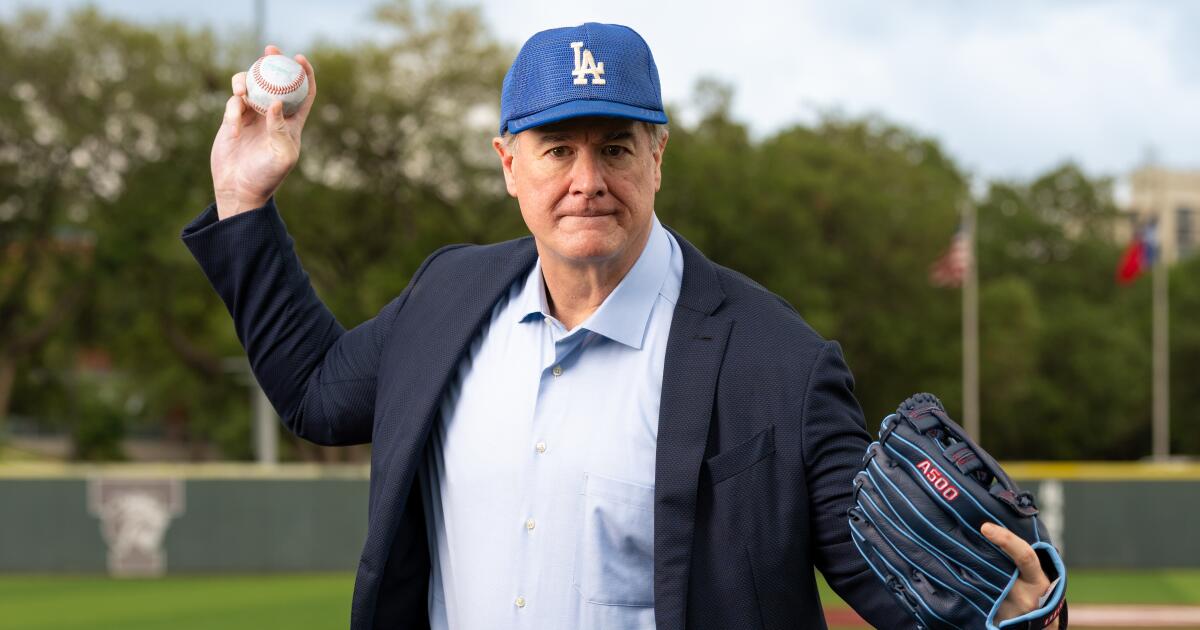
The ninth in an occasional series of profiles on Southern California athletes who have flourished in their post-playing careers.
When the Dodgers drafted David Lesch in January 1980, they had visions of his fastball lighting up radar guns at Dodger Stadium.
He never made it that far.
Lesch never climbed above the lowest rung on the minor league ladder, where he pitched just 10 innings and gave up more runs, hits and walks than he got outs. Less than 18 months after he was drafted, Lesch, wracked by a rotator cuff injury, was released, his major league dream over before he was old enough to legally buy a beer.
“I went to Disney World after that,” he said.
But that wasn’t the only decision the Dodgers made that changed Lesch’s life. When he was drafted, the team gave him just a small bonus, but sweetened the deal by offering to pay for college if he ever went back to school. For the team, it seemed a safe bet.
“They probably have this algorithm saying ‘this is the No. 1 draft pick. If he doesn’t make it, he’s not going back to college. He’ll be assistant baseball coach of his high school or something,’” Lesch said.
Oops.
Lesch not only went back to college, but he also wound up getting three degrees, including a master’s and a PhD from Harvard. It was arguably the most important investment in humanity the Dodgers made since signing Jackie Robinson, because Lesch went on to become one of the world’s top experts on the Middle East, writing 18 books and more than 140 other publications while advising four presidents and a cadre of United Nations diplomats.
David Lesch interacts with students in his history class at Trinity University in San Antonio.
(Courtesy of David Lesch)
“That was the best deal,” Lesch, 65, said by phone from San Antonio, where he is the Ewing Halsell Distinguished Professor of History at Trinity University.
“Without that I probably could not have said yes to Harvard because of the price. The Dodgers committed to paying.”
And by doing so, the Dodgers may have altered history just a bit.
Lesch’s regular meetings with Syrian president Bashar al-Assad, which ended with Lesch facilitating an important if temporary breakthrough in U.S.-Syrian relations? The diplomatic and conflict-resolution work in Syria and the wider U.N. initiatives on regional issues throughout the Middle East? The thousands of students Lesch inspired to go on to perform important diplomatic and public-service roles of their own?
None of that happens if Lesch’s shoulder had held on or if the Dodgers had reneged on their deal.
“It was very fortunate that he hurt his rotator cuff. Baseball’s loss is academia’s gain,” said Robert Freedman, a scholar and expert on Russian and Middle Eastern politics who taught Lesch at the University of Maryland Baltimore County.
“I’ve been teaching for, I guess, 60 years now and I can tell when a student can see a complex problem and can penetrate right to the heart of the problem very quickly. He was one of those students.”
Still, it took a slightly offhand comment from Freedman, who now teaches at Johns Hopkins, to launch Lesch on his post-baseball career.
“We were having lunch and he was looking for a project and I mentioned to him ‘you know, there hasn’t been a good American scholar doing work on Syria for many, many years,’” he said.
“That struck his interest.”
Playing a child’s game and managing life-and-death Middle East politics share very little in common. But Lesch made the transition seamlessly.
“It is like he’s several different people, or has been,” said journalist and author Catherine Nixon Cooke, whose book “Dodgers to Damascus: David Lesch’s Journey from Baseball to the Middle East” traces those parallel lives.
“I’m wondering if, in a sense, it all worked out the way it was supposed to,” Cooke continued. “Even though his dream was to be a major leaguer, David certainly has reinvented himself to this really remarkable man following a completely different path.
“It was the Dodgers who paid for him to go to Harvard and so it’s kind of a weird thing. Baseball took away his dream because he got hurt, but baseball also gave him his backup plan.”
Lesch was still a teenager when, 20 minutes into his first spring training camp in Vero Beach, Fla., Dodgers manager Tommy Lasorda plucked him off a minor league practice field to pitch batting practice in the main stadium.
Waiting for him were Ron Cey, Bill Russell, Steve Garvey, Davey Lopes and Reggie Smith, the heart of a lineup that would win a World Series a season later.
It was the first time — and nearly the last — that Lesch faced big-league hitters. And it didn’t start well.
Batting practice pitchers throw from behind an L-shaped screen that protects them from comebackers and Lesch had never used one. That, combined with his understandable nervousness, caused him to short-arm his first fastball, which sailed at Cey’s head, sending him sprawling into the dirt.
“He got up and gave me this mean look,” Lesch said. “I remember it so vividly right now. I really thought I was going to be released that day.”
Instead, he gathered himself and finished the session, earning pats on the back from both Garvey and Lasorda. The incident, he said, has colored the rest of his life.
“I’ve met with presidents, prime ministers, been in war zones, all sorts of things,” Lesch said. “Anytime I say ‘well, you know, this should make me nervous,’ I think about that episode and the fact that I made it through and did OK.”
In high school, Lesch had focused on basketball and baseball. Academics? Not so much. So after spending his freshman year of college at Western Maryland College, he transferred to Central Arizona, a junior college, so he would be eligible for the January 1980 draft, allowing him to trade his books in for a baseball.
The so-called secondary draft, which was discontinued six years later, was specifically targeted toward winter high school graduates, junior college players, college dropouts and amateurs who had been previously drafted but did not sign. As a result, the bonuses teams offered winter draft picks were just a fraction of what players taken in the June draft received.
Lesch’s was so low, he can’t even remember what it was.
“I want to say $10,000 to $15,000,” he said. “No more than $20,000.”
When it became clear the Dodgers weren’t going to budge on the money, Lesch’s father, Warren, a family physician in suburban Baltimore, pulled out the Harford County phone book and looked up the number for Baltimore Orioles coach Cal Ripken Sr. Lesch played high school ball against Ripken’s son Cal Jr., who had been a second-round draft pick of the Orioles two years earlier. So his father thought the Ripkens might have some advice on what to ask of the Dodgers.

David Lesch, a former Dodgers draft pick, stands on the baseball diamond at Trinity University in San Antonio.
(Courtesy of David Lesch)
“Ripken goes ‘does your son like school and is he smart?’” Lesch’s older brother Bob remembers. “So Ripken suggested if they offer you XYZ bonus money, take less and say ‘I’ll take this amount, but you have to cover education if he doesn’t make it.’”
Neither side thought that clause would ever be triggered; Lesch, a big, intimidating right-hander who threw bullets from behind Coke-bottle eyeglasses, wasn’t headed to a classroom, he was going to Dodger Stadium.
Until he wasn’t.
Lesch missed a couple of weeks with a back injury. By overcompensating for the sore back, he developed paralysis in the ulnar nerve in his right arm, limiting him to five appearances in his first minor league season.
He arrived healthy for his second spring in Vero Beach and threw three no-hit innings in his first outing against double-A and triple-A players, creating such a buzz that Ron Perranoski, the Dodgers’ major league pitching coach, showed up to watch his second game. By then the shoulder and back stiffness that shortened his first season had returned, and Lesch was rocked. Perranoski left early and unimpressed.
Lesch’s delivery had one major flaw: He threw directly overhand, as opposed to three-quarters or even sidearm, which can increase velocity but also places additional strain on the shoulder and elbow. As a result, his fastball could top out in the mid-90s one day, but when the stiffness and pain returned, it left him throwing in the low 80s.
The inconsistency continued to plague Lesch, and eventually the Dodgers decided they’d seen enough and released him. When he got back to Maryland, Lesch’s father sent him to see an orthopedic surgeon, who found the problem wasn’t in his back or elbow but rather the rotator cuff.
“We didn’t live in the era of pitch counts. So he just pitched,” said David Souter, a high school and college teammate who went on to develop big-league pitchers.
“He had the ability if he was developed and stayed healthy. I think he probably overthrew and tore his rotator cuff and nobody knew it.”
If Lesch had come along 10 years later, when rotator cuff surgeries were common, he might have returned to the mound. But in 1981, a rotator cuff injury was a death sentence for a pitcher.
“It’s just a crapshoot based on physiology,” Lesch said. “I probably was destined. Something would have happened.”
If he could do it over again, Lesch said he would change one thing.
“I’d throw sidearm,” he said. “It’s much less stress.”
He threw to big league hitters just one more time. Following the strike that interrupted the 1981 season, Ripken Sr. phoned Lesch back and asked him to throw batting practice at Memorial Stadium to help the Orioles prepare for the resumption of play. As a reward, the Orioles let Lesch hit — he never had batted in the minors — and he drove a pitch over the left-field wall, then dropped the bat and walked away.
He never stepped on a major league field again.
The Dodgers’ investment in Lesch’s education appeared manageable when he enrolled at a satellite campus of the University of Maryland, in part because his brother Bob was the school’s sports information director.
But it was 1981 and the Middle East was at the forefront of geopolitics. Lesch became convinced the Middle East would be central to world affairs for decades to come. Inspired and encouraged by Freedman and another professor, Lou Cantori, he applied to graduate school at Harvard, Georgetown, Johns Hopkins and the University of Chicago, knowing he couldn’t afford any of those schools on his own.
“I probably could not have said yes to Harvard when they accepted me because of the price,” Lesch said. “The Dodgers had committed to paying and whatever it was, it was a lot more collectively — my undergraduate MA and PhD — than I had gotten in the bonus.”
That wasn’t the only time his baseball background worked in his favor. Years after starting at Harvard, Lesch stumbled upon written evaluations of his application and learned that his grade-point average and other factors were similar to those of other applicants, but it was his athletic career that had swung enough votes in his favor to get him accepted.
“Failure is at the core of sports. And so you have to have this resiliency,” Lesch said. “What a lot of the top colleges have found is that these young kids out of high school who somehow get a 4.6 GPA, they come in — and I’ve seen this as a professor — they get their first C and they’re distraught.
“Athletes stick with it. They say ‘how can I turn this around? How can I get better?’ Admissions departments across the board have looked at athletes much differently.”
The struggles Lesch experienced on the diamond did not follow him into academia. Yet becoming an expert on the Middle East definitely was a backup plan.
“His first passion was clearly baseball and basketball,” said Souter, the former teammate. “Every kid dreamed … that.”
If the shoulder injury wasn’t a strong enough sign that that dream was over, the fire that destroyed Lesch’s childhood home a few years later was. The flames, which severely burned both his parents, also erased his baseball career, consuming all the photos and memorabilia he had collected, save for the championship ring from his one minor league season, which he found buried in the embers. It was the only thing to survive the blaze intact.

David Lesch’s championship ring from his one minor league season, the only surviving keepsake of his professional career after a his family’s home was destroyed in a fire.
(Courtesy of David Lesch)
A post-graduate trip to Syria, the first of more than 30 visits he has made to the country, sealed the deal a few years later. The love he once had for baseball he now felt for a strange and mysterious place that was as old as history itself yet as secretive as the classical ciphers.
Soon Lesch was helping arrange high-level meetings between Syrian president Hafez al-Assad and President George H.W. Bush, a baseball fan who seemed as interested in Lesch’s Dodgers days as his Middle Eastern expertise. But his big break came during the first presidential term of Bush’s son George W. Bush, when Bashar al-Assad, who succeeded his father as Syria’s president, welcomed Lesch for the first of many interviews that informed his book, “The New Lion of Damascus: Bashar al-Assad and Modern Syria.”
“His forte is listening,” Cooke, the biographer, said of Lesch, whose polite, unassuming manner reflects an adult life spent mostly in San Antonio. “When he goes in to try to mediate something, he is a big listener. There is a side of David that doesn’t talk much. But he’s listening.”
The book humanized al-Assad and opened, for a time, the possibility of normalized relations between Syria and the West, with Lesch serving as an unofficial liaison between Damascus and Washington, as well as other Western capitals.
“He’s absolutely a critical player in what we would call two-track diplomacy,” Freedman said. “If the government wants to reach out but doesn’t want to take the political consequences, they send somebody to sound out the situation.
“It’s absolutely critical that we have people like that who can speak the language and understand the overall context, which sadly is lacking in the current administration.”

David Lesch teaches students in his history class at Trinity University in San Antonio.
(Courtesy of David Lesch)
But that opening closed as quickly as it opened. Lesch’s close contacts with al-Assad raised suspicions among some in Syria, and Lesch was poisoned twice. His relationship with al-Assad was severed completely shortly afterward when he criticized al-Assad for failing to implement promised reforms and becoming a “bloodthirsty tyrant.” The Syrian civil war took nearly 700,000 lives and displace another 6.7 million people before al-Assad and his family fled into exile in Russia in 2024.
“Many governments think that they can reduce war to a calculation,” Lesch said. “What we cannot measure accurately or fully appreciate is the human element. We cannot assess a people’s sense of grievance, passion, revenge, ideological commitment and historical circumstances that shaped the nature of their response and staying power.
“This is where academics can make a contribution to policy, giving it the depth and insight gleaned from years of study and learning the culture and the people.”
Baseball’s loss wasn’t just academia’s gain. It may prove to be humanity’s as well.
“I don’t really have any regrets,” Lesch said. “My career turned out great. I could not think of doing anything else at this point and, in fact, in a way I’m glad [baseball] didn’t work out.”

Sports
Bryce Harper hits for cycle, Kyle Schwarber blasts three homers in Phillies blowout win over Mets

NEWYou can now listen to Fox News articles!
The Phillies’ turnaround following the dismissal of manager Rob Thomson reached a new milestone when two of the franchise’s biggest stars delivered a historic performance.
Kyle Schwarber launched three home runs, including two in the third inning, while Bryce Harper completed the cycle to add yet another achievement to his accomplished career.
The offensive explosion powered Philadelphia to a 15-3 rout of the New York Mets on Saturday, as the Phillies continued their surge and received a signature performance from two of the game’s most recognizable stars.
Philadelphia Phillies’ Kyle Schwarber celebrates his home run with Bryce Harper during the third inning against the New York Mets in Philadelphia, Pennsylvania on June 20, 2026. (Chris Szagola/AP)
Schwarber’s first home run traveled 456 feet, while his second blast of the third inning measured 457 feet off Mets reliever Cionel Pérez.
He capped his night with a two-run homer in the seventh inning. Schwarber’s major league-leading home run total climbed to 28, and the performance marked the fifth three-homer game of his career.
Cristopher Sanchez allowed one earned run in six innings to lower his ERA to 1.80.
It’s his 23rd straight start at Citizens Bank Park in which he allowed two earned runs or fewer, the second-most such starts by a pitcher at the same ballpark in MLB history since 1913, trailing only Jacob deGrom’s 24 at Citi Field for the Mets from Sept. 9, 2019 to Aug. 31, 2022.
ZERO BS. JUST DAKICH. TAKE THE DON’T @ ME PODCAST ON THE ROAD. DOWNLOAD NOW!
Bryce Harper and Kyle Schwarber of the Philadelphia Phillies leave the field after defeating the New York Mets at Citizens Bank Park in Philadelphia, Pennsylvania, on June 20, 2026. (Rob Tringali/MLB Photos via Getty Images)
Schwarber is the 67th player in major league history and second this season with multiple home runs in an inning, joining Houston’s Yordan Alvarez on June 12.
Schwarber is the fourth Phillies player to hit two home runs in an inning, along with Trea Turner (Aug. 19, 2023), Von Hayes (June 11, 1985) and Andy Seminick (June 2, 1949).
Philadelphia Phillies designated hitter Kyle Schwarber hits a solo home run in the bottom of the third inning against the New York Mets at Citizens Bank Park in Philadelphia, Pennsylvania on June 20, 2026. (Mitchell Leff/Getty Images)
Meanwhile, Harper hit a solo home run in the first inning, his 16th of the year. He doubled and singled in the third, then hit a two-run triple to the gap in left-center field in the fifth for his first career cycle and the 11th in Phillies history.
CLICK HERE TO DOWNLOAD THE FOX NEWS APP
The Phillies and Mets will wrap up their three-game series Sunday night, with first pitch set for 7:20 p.m. ET.
The Associated Press contributed to this report.

The 2026 FIFA World Cup is well into the second run of group play, with every team still eager to post wins and most looking to secure a place in the knockout stage.
Here’s everything you need to know about matches being played Sunday, Monday and Tuesday in the 48-team tournament across the U.S., Mexico and Canada (all times Pacific). Tuesday’s matches will conclude the first two games of group play for every team at the World Cup.
Sunday’s Group G matchups:
Belgium vs. Iran

Belgium’s Romelu Lukaku, right, is challenged by Egypt’s Ramy Rabia during a World Cup Group G match on June 15.
(Alex Grimm / Getty Images)
Where: SoFi Stadium
Time: noon
TV: FS1, Telemundo
The buzz: Iran twice rallied from deficits to draw with New Zealand in its first game, while Belgium, outplayed by Egypt in its opener, was lucky to escape with a point on an own goal early in the second half. Belgium’s aging golden generation of Romelu Lukaku, Kevin De Bruyne, Thibaut Courtois, Thomas Meunier and Axel Witsel is going to need to do much better if they hope to avoid another early World Cup exit.
New Zealand vs. Egypt

New Zealand’s Callan Elliot, left, and Iran’s Mehdi Ghayedi battle for the ball during a World Cup Group G match on June 15.
(Andre Penner / Associated Press)
Where: BC Place, Vancouver
Time: 6 p.m.
TV: FS1, Telemundo
The buzz: One of these teams could make history since neither has ever won a World Cup game. New Zealand earned its first point in the World Cup since 2010 with a draw against Iran. The winner likely advances to the next round.

Sunday’s Group H matchups:
Spain vs. Saudi Arabia

Spain’s Mikel Oyarzabal, top, challenges for the ball during a draw with Cape Verde on June 15.
(Mattia Ozbot / Getty Images)
Where: Mercedes-Benz Stadium, Atlanta
Time: 9 a.m.
TV: Fox, Telemundo
The buzz: Both teams opened the World Cup with surprising results. Second-ranked Spain was unable to score in a draw with No. 67 Cape Verde. Saudi Arabia was 10 minutes away from upsetting Uruguay, only to settle for a tie. Spain desperately needs a win to get its World Cup back on track, while another good performance from Saudi Arabia — unbeaten in its last three games — would have the Arabian Falcons in position to reach the knockout stage.
Uruguay vs. Cape Verde

Cape Verde goalkeeper Vozinha holds the nation’s flag after a draw with Spain on June 15.
(Buda Mendes / Getty Images)
Where: Hard Rock Stadium, Miami Gardens, Fla.
Time: 3 p.m.
TV: FS1, Telemundo
The buzz: With all four teams playing to draws in their openers, the group is wide open. That creates a rare opportunity for tournament debutant Cape Verde, the second-smallest country to qualify for a World Cup. Vozinha, Cape Verde’s goalkeeper, made seven saves to shut out Spain. If he can frustrate Uruguay the same way, Cape Verde could be through to the round of 32.

Monday’s Group J matchups:
Argentina vs. Austria

Argentina’s Lionel Messi reacts after scoring his third goal against Algeria at the World Cup on June 16.
(Charlie Riedel / Associated Press)
Where: AT&T Stadium, Arlington, Texas
Time: 10 a.m.
TV: Fox, Telemundo
The buzz: Argentina opened its World Cup title defense with a 3-0 win over Algeria on a hat trick from Lionel Messi. The Argentina captain, playing in his record sixth World Cup, is tied with Germany’s Miroslav Klose for the most career World Cup goals (16). Austria, meanwhile, would all but assure itself of a spot in the knockout round with a point.
Jordan vs. Algeria

Algeria’s Zineddine Belaïd kicks the ball during a World Cup loss to Argentina on June 16.
(Michael Steele / Getty Images)
Where: Levi’s Stadium, Santa Clara, Calif.
Time: 8 p.m.
TV: FS1, Telemundo
The buzz: Little was expected of Jordan, making its first appearance in the World Cup. And it delivered little in a 3-1 loss to Austria. But Algeria, ranked 28th in the world, entered the tournament with high hopes and one of African soccer’s most potent attacks. However, it had only one shot on goal in its loss to Argentina and needs a big rebound to avoid an early trip home.

Monday’s Group I matches:
France vs. Iraq

France’s Kylian Mbappé celebrates after scoring against Senegal on June 16.
(Adam Hunger / Ap Photo/adam Hunger)
Where: Lincoln Financial Field, Philadelphia
Time: 2 p.m.
TV: Fox, Telemundo
The buzz: Kylian Mbappé proved his fitness with a brace in France’s opening win over Senegal, giving him 14 World Cup goals, tied for fourth on the all-time list. He has a great chance to pad that total against an Iraq team that gave up four goals to Norway. Iraq still is looking for its first-ever World Cup point.
Norway vs. Senegal

Norway’s Erling Haaland celebrates after scoring against Iraq on June 16.
(Justin Setterfield / Getty Images)
Where: MetLife Stadium, East Rutherford, N.J.
Time: 5 p.m.
TV: Fox, Telemundo
The buzz: Norway, playing in its first World Cup this century, made up for lost time with a 4-1 win in its opener, getting two goals from Erling Haaland. Norway probably will move on to the next round no matter what happens, but a point would lock down a spot. Senegal and Sadio Mané, on the other hand, desperately need a win.

Tuesday’s Group K matchups:
Portugal vs. Uzbekistan

Portugal’s Cristiano Ronaldo walks on the field during a match against the Democratic Republic of the Congo on June 17.
(Molly Darlington / Getty Images)
Where: NRG Stadium, Houston
Time: 10 a.m.
TV: Fox, Telemundo
The buzz: Cristiano Ronaldo entered this World Cup with visions of winning his first title. But he’ll go home early and empty-handed unless fifth-ranked Portugal improves on the listless performance it had in a draw with the Democratic Republic of the Congo. Uzbekistan, playing in its first World Cup, was not intimidated by the big stage, weathering a withering Colombia attack in a 3-1 loss. Expect it to bunker in again against Portugal.
Colombia vs. DR Congo

Yoane Wissa, left, celebrates with teammates after scoring for the Democratic Republic of the Congo against Portugal on June 17.
(Karen Warren / Associated Press)
Where: Estadio Akron, Zapopan, Mexico
Time: 7 p.m.
TV: FS1, Telemundo
The buzz: The Democratic Republic of the Congo’s only other World Cup appearance came in 1974, when the country was known as Zaire; it lost all three games and didn’t score a goal. It’s already done better with Yoane Wissa’s score in first-half stoppage time giving the team a point against Portugal. A win here and it’s through to the knockout phase. The same is true of Colombia, which got a 65th-minute goal from Luis Díaz and another from substitute Jáminton Campaz deep in stoppage time to beat stubborn Uzbekistan.

Tuesday’s Group L matchups:
England vs. Ghana

England’s Harry Kane celebrates after scoring against Croatia on June 17.
(Tony Gutierrez / Associated Press)
Where: Gillette Stadium, Foxborough, Mass.
Time: 1 p.m.
TV: Fox, Telemundo
The buzz: England opened its World Cup with a surprisingly comfortable win over Croatia behind two goals from captain Harry Kane. But the Three Lions are only equal atop the table with Ghana, which got a goal deep in stoppage time from Caleb Yirenkyi to beat Panama. If there’s a winner here, it probably will decide the group. A point likely sends both teams through.
Panama vs. Croatia
Where: BMO Stadium, Toronto
Time: 4 p.m.
TV: Fox, Telemundo

Panama’s Ismael Díaz attempts a shot against Ghana on June 17.
(Kevin C. Cox / Getty Images)
The buzz: Croatia has played in two straight World Cup semifinals, but that streak is in jeopardy after a 4-2 loss to England. Panama outshot, outpassed and outpossessed Ghana in its first game but came away with nothing after conceding a goal in stoppage time, leaving the Central Americans still looking for their first World Cup win.




Sports
Jazz Chisholm explains why he still won’t wear a cup after fouling a pitch into his own groin

NEWYou can now listen to Fox News articles!
Men around the country are still wincing from the sight of New York Yankees second baseman Jazz Chisholm Jr. fouling a pitch straight into his own groin.
It was bad enough that Chisholm had to leave the game, and it left many wondering why he wasn’t wearing a cup to protect himself.
Well, now we have an answer.
ZERO BS. JUST DAKICH. TAKE THE DON’T @ ME PODCAST ON THE ROAD. DOWNLOAD NOW!
New York Yankees second baseman Jazz Chisholm Jr. took a brutal shot to the groin on Thursday night. (Wendell Cruz-Imagn Images)
Yankees beat writer Gary Philips shared some quotes from Chisholm explaining why he wasn’t a cup guy before taking a foul ball to the cojones, and why he isn’t going to be a cup guy moving forward.
WEEKS AFTER BULLFIGHTER SUFFERED PERFORATED RECTUM, ANOTHER WAS GORED IN GROIN AND REQUIRED EMERGENCY SURGERY
Chisholm said that the pain level was a “million,” and that, “If you ever got hit in the testicles, you would know.”
Most males reading this just nodded at that statement.
But Chisholm revealed that despite cups being mandatory in the minor leagues, he still skipped them and will continue to because he trusts his own defensive abilities.
“I’ve never worn a cup,” he said. “I’ve never been hit in the balls. That was just unlucky.”
Now, there are times when I wonder why men don’t wear cups all the time just for some peace of mind (I feel that way about helmets too). You wouldn’t regret not wearing a cup until the moment you’re at a cookout and a rogue volleyball puts you in shambles.
But I also like that Chisholm trusts himself to react and protect the boys. I’ve always said that a fairly significant part of a man’s life is devoted to protecting his lower anatomy.
You’re ever vigilant, trying to steer clear of anything that could leave you doubled over on the ground, and spouting off every expletive you know and several others you didn’t realize you knew.
Jazz Chisholm Jr. says he’ll rely on his defensive abilities instead of wearing a cup moving forward. (David Richard-Imagn Images)
Waist-high branches, table corners, projectiles, bicycle seats, even a pet jumping in your lap when you’re not ready.
CLICK HERE TO DOWNLOAD THE FOX NEWS APP
Chisholm is self-aware enough to know where his self-preservation reflexes stand, and I respect that.
But if he takes another foul ball to the lower area of his body, he might want to start rethinking that stance on cups.
-

 Los Angeles, Ca1 hour ago
31st annual Rodeo Drive Concours d’Elegance provides perfect Father’s Day activity
-

 Detroit, MI1 hour ago
3 Isaiah Stewart Trade Packages That Would Make Sense for Detroit Pistons
-

 San Francisco, CA2 hours ago
Giants Reach Franchise Milestone Never Before Seen in San Francisco
-

 Dallas, TX2 hours ago
Mavericks’ Potential 2026 NBA Draft Trade Down Target Revealed
-

 Miami, FL2 hours ago
Could the Heat bring Duncan Robinson back in a Deal for Giannis Antetokounmpo?
-

 Boston, MA2 hours ago
Volunteer rescuer seriously injured Friday helping unresponsive teenage hiker in NH – The Boston Globe
-

 Denver, CO2 hours ago
7 injured in 3 overnight crashes across Denver, police say
-

 Seattle, WA2 hours ago
Kraken Acquire Panthers Wing Mackie Samoskevich | Seattle Kraken

