Sports
Gregg Berhalter rebuilt the USMNT. Will he be the one to lead them in 2026?


When Gregg Berhalter took over as U.S. men’s national team head coach five and a half years ago, the program was still fighting to emerge from the darkest moment in its history.
The 2017 loss to Trinidad and Tobago that meant the U.S. failed to qualify for the following year’s World Cup in Russia was more than a wake-up call. It forced leadership at U.S. Soccer to examine every blemish in the mirror. It highlighted the failures of previous cycles to develop young talent. A year after that game, Berhalter was put in place to move the national team forward.
Now, after an unsuccessful group stage at Copa America on home soil, the U.S. program must once again face its failures.
This time, part of that evaluation is whether Berhalter is the right person to lead the program into the 2026 World Cup, which the United States co-hosts with neighbors Canada and Mexico.
If it’s up to Berhalter, the answer is simply, “Yes.” The coach only had one word to share when asked after the loss to Uruguay on Monday that sent his team out of Copa America after the group stage if he believed he was still the right person for the job. He also acknowledged that the decision would not be up to him. U.S. Soccer leadership will evaluate Berhalter over the coming days.
GO DEEPER
Inside the VAR review of Uruguay’s winning goal against the USMNT
“Our tournament performance fell short of our expectations. We must do better,” U.S. Soccer sporting director Matt Crocker wrote in a statement provided by the federation 90 minutes after the Uruguay game ended. “We will be conducting a comprehensive review of our performance in Copa America and how best to improve the team and results as we look towards the 2026 World Cup.”

The U.S. lost to Panama and Uruguay during the Copa America group stage. (Photo by Hector Vivas/Getty Images)
Berhalter’s task when he was hired was not a simple one, nor was it one that involved linear progress.
His first U.S. teams were a mix of the old and the new, trying to find a blend between experience and pure, stark youth. His first tournament call-ups in the summer of 2019 included Weston McKennie, Tyler Adams and Christian Pulisic, all of whom had yet to play in a Gold Cup, as well as Jozy Altidore and Michael Bradley, who both had more than 100 caps. Berhalter next called up a competitive roster for the 2021 Nations League. The team’s progress under his direction was evident.
The roster was built mostly around youth, with players such as Sergino Dest (then with seven caps), Antonee Robinson (10), Adams (12), McKennie (21), Yunus Musah, Brenden Aaronson (both four), Pulisic (15), Gio Reyna (also four), Josh Sargent (13) and Tim Weah (10).
The U.S. went on to win that tournament, picking up its first signature win over Mexico in the process. It was the first of three consecutive Nations League titles, and Berhalter continued adding new, young faces into the program.
He successfully navigated 2022 World Cup qualifying with one of the youngest teams in international soccer. And while getting back to the World Cup was an imperfect path — the U.S. finished third in CONCACAF qualifying — getting to the tournament in Qatar allowed the program to close the door on that 2018 failure. Berhalter’s young team then impressed in the World Cup, performing well in the group phase before bowing out to the Netherlands in the first knockout round.

Berhalter helped the U.S. return to the World Cup in 2022 after the team failed to qualify in 2018 (Photo by Tim Nwachukwu/Getty Images)
The idea behind the entire process was to build toward that home World Cup in 2026.
Berhalter did a good job in the first cycle with this team, but the past year has felt far more halting. U.S. Soccer leaders must now determine whether the coach who engineered the transition from 2018 to 2022 is the right person to continue building toward that 2026 tournament.

GO DEEPER
How Uruguay’s masterly man-marking shut the USMNT out of the Copa America
Crocker has said “yes” to that question once already, when he and U.S. Soccer’s leadership team, including president Cindy Parlow Cone and CEO and secretary general JT Batson, brought Berhalter back last summer. But the USMNT’s failure to get out of its Copa America group has caused yet another referendum on the program.
Taken in isolation, it would be harsh to put all of the blame for this failure on Berhalter and the coaching staff. Weah’s first-half red card undoubtedly impacted the Panama result, which altered the path to the knockout rounds. But the results as a whole over the past year suggest stagnation more than progress. Berhalter’s teams still lack a signature win over a top opponent. These last 12 months have seen losses to Germany and Colombia, the latter by an embarrassing 5-1 scoreline. A draw against Brazil was a positive, but it was followed within weeks by this Copa America exit.
The failure to get out of the group was a massive missed opportunity on multiple levels, from the growth of the team to the potential impact on growing the sport in the U.S. in a summer of soccer that can capture new fans and build toward 2026.
Berhalter is a process-oriented coach, precisely attuned to the details of his program. His grinding work ethic is well-known to anyone who has been around the team over these five and a half years. For Berhalter, what happened in the Copa America was a setback.
“We know we’re capable of more, and in this tournament, we didn’t show it,” Berhalter said. “It’s really as simple as that.” But, much as he has done throughout his tenure, Berhalter also framed it as a moment from which to take lessons and build.
“When you’re in tournament football, there’s very little that separates success from failure,” Berhalter said. “It’s one action, it’s one decision from the referee, and you could be in trouble. For us, it’s having this understanding that every time we step on the field, it has an impact. And I think we’re getting there, but we’re not always there. And that’s something that we can improve.”

Players credit Berhlater for creating the group’s close bond. (Photo by Michael Reaves/Getty Images)
After Monday’s loss at Kansas City’s Arrowhead Stadium, players in the mixed zone backed Berhalter with some of the same ideas they discussed during the job’s most recent hiring process. The culture of the team, which they have largely credited to Berhalter, remained a strength in the group. There was a trust in one another, they said.
“I believe we all have a comfort with Gregg, and we all understand him and we’ve had him for a long time,” McKennie said in the mixed zone. “He’s progressed the team very far from where we started. I think the connection that we have with him is what’s important, in having a coach players would run through a brick wall for, players that listen to him. And so I think whatever happens, happens, but I think if he’s the coach, we’re all happy.”
Only now, U.S. Soccer must weigh whether that comfort is a strength or, potentially, a weakness.
Is that comfort level within the group under Berhalter preventing them from pushing on? Are the red cards — specifically Weah’s and defender Dest’s in a Nations League game in Trinidad last November — signs of too much leeway? Is a group filled with young players too accustomed to discussion around their team as a ‘golden generation’ growing complacent?
The results at the Copa, one win and two defeats, and over the past year, should at least challenge the way this team is discussed.
Yes, the group is filled with players who are playing across Europe, including a handful who are at some of the biggest clubs in the world. And yes, it was still the second-youngest team across both the Copa America and European Championship, going on in parallel in Germany this summer. But their roles for those clubs vary.
Few are asked to carry their team, and compared to the world’s best international sides, arguably outside of Pulisic, the U.S. still lacks bonafide stars, the difference-makers that can turn games on their head at the highest levels. That has manifested itself with a team that has struggled to create enough goals, both in Qatar and this summer.
This U.S. team has talent, but in the grand scheme of global soccer, it remains an upstart trying to challenge the very best. The team cannot afford to believe it has arrived. It’s an idea that veteran center-back Tim Ream seemed to hint at in the mixed zone after the Uruguay game.
“This is a fantastic group, as everyone knows and one that is very close, but sometimes the intensity falls through the cracks,” Ream told Univision. “We have to continue to put our heads down and continue to work, continue to be humble enough to know there are things we can continue to improve, every single day, every single training session, every single game.
“If guys have that mindset, then they can continue to be on an upward trajectory. When we start to think that we are a finished product, then guys are going to stagnate and just stay at the level they are at.”
Some of that should fall on the players, of course. That was most certainly a theme from the team after Monday’s defeat. “I don’t think this tournament really had anything to do with the staff or the tactics or the way we play,” Reyna said. “I think it was more individual mistakes.”
But some of it also falls on Berhalter and the staff.
If the leaders at U.S. Soccer feel this team must be challenged to get to the next level, there are legitimate questions as to whether the culture in the program right now is set up to do that, and if it is, whether Berhalter is the person to do it.
“I don’t think so. I don’t think we’ve progressed enough since the World Cup,” USMNT legend Clint Dempsey said on Fox on Monday night, when asked if Berhalter is still the right voice to lead the program. “We’re not on the right track. … For me, it hasn’t been good enough.”
As for the next steps, there are many factors beyond just on-field performance U.S. Soccer will consider. The federation likely is aware of the discourse around Berhalter and the national team, in which a growing sector of fans has trained its focus on the coach as the problem. “Berhalter out” has been a rallying cry on social media, ubiquitous in any discussion or debate around the team.
The biggest question, though, is who they would look to if they were to replace Berhalter.
There aren’t obvious candidates for the position.
One finalist from the last hiring cycle, Jesse Marsch, only recently took the Canada job. Notably, Canada advanced to the knockout stage of the Copa America, albeit with just one goal in the three group games. Some of the big-name candidates that fans would hope to see cost many multiples of the salary U.S. Soccer currently pays Berhalter, and that doesn’t even begin to account for whether those names would even want the gig.
The decision U.S. Soccer makes in the coming days, and, if it chooses to move on from Berhalter, the weeks that follow, will have a massive impact on what happens in two years when the World Cup comes back to these shores. The disappointment of a similar result in that tournament would dwarf this current failure.
Considering the stakes and the expectations, the USMNT job feels bigger than even the monumental task of climbing out of that failure in Trinidad nearly seven years ago.
GO DEEPER
USMNT’s Copa America exit raises major questions. But is Pulisic the one to answer them?
(Top photo: Julio Aguilar/Getty Images)



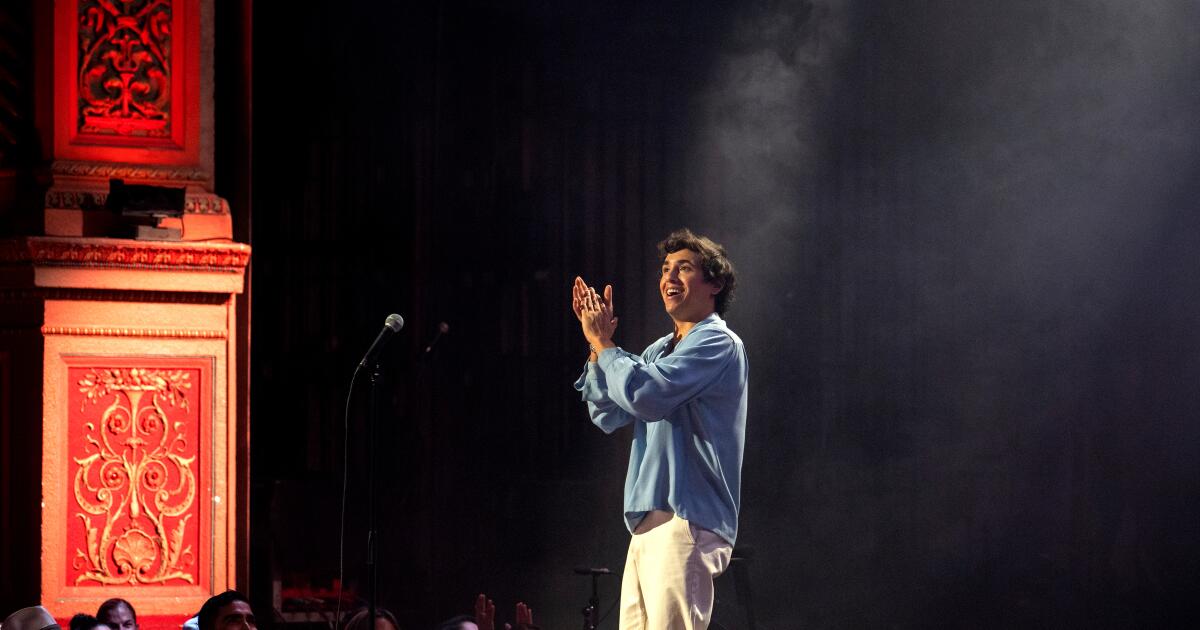
Comedian and “Saturday Night Live” standout Marcello Hernández will host this year’s ESPY Awards, ESPN announced Wednesday.
The event, honoring excellence in sports performance, will be broadcast live on ABC and the ESPN app from the David H. Koch Theater at Lincoln Center on July 15, making it the first ESPYs in New York City since 1999. For the last 25 years, the awards ceremony was held in Los Angeles.
“I started doing comedy 10 years ago, in Cleveland, Ohio, and I would take the train 12 hours to New York to sell comedy tickets on the street in Greenwich Village in exchange for stage time,” Hernández said in a statement. “It is an honor, and frankly feels crazy to be hosting the ESPYs this year in New York. I’m sure the energy is going to be great.”
Hernández recently headlined the biggest Spanish-language comedy show ever at the Hollywood Bowl as part of the Netflix Is a Joke Festival in May, and wrapped up his fourth season of “SNL” soon after. His first stand-up special, “American Boy,” premiered on Netflix in January.
He’s also a sports enthusiast, having grown up playing soccer and competing at the collegiate level during his time at John Carroll University in Ohio.
“Marcello is one of the most electric, young comedians today. His genuine enthusiasm for sports and his ties to New York City make him a natural fit to host this year’s ESPYs,” Craig Lazarus, ESPN vice president and executive producer of the ESPYs, said in a statement.
Hernández succeeds last year’s emcee, comedian Shane Gillis, as well as past hosts that include Jimmy Kimmel, John Cena, LeBron James and Peyton Manning.
In January, Puck reported that the change in venue is an effort to capitalize on the popularity of Fanatics Fest, the massive sports festival taking place in New York’s Javits Center from July 16-19, which also coincides with the World Cup final on July 19 at MetLife Stadium in New Jersey.
“This return to the heart of Manhattan brings the celebration of sports back to its roots for an unforgettable night at an iconic cultural landmark,” an ESPN spokesperson said in a statement.
Sports
AJ Brown trade outcome: Dianna Russini paid a heavy price while Mike Vrabel emerged unscathed

NEWYou can now listen to Fox News articles!
Mike Vrabel and A.J. Brown were winning on Tuesday because the long-rumored trade that reunited them was finally complete. Brown was free of his recent unhappiness with the Philadelphia Eagles, while Vrabel spoke easily and smartly about how his Super Bowl team was getting better.
It was one lovely victory lap for everybody.
Except for Dianna Russini.
New England Patriots head coach Mike Vrabel celebrates after the AFC championship game against the Denver Broncos at Empower Field At Mile High in Denver, Colo., on Jan. 25, 2026. (Cooper Neill/Getty Images)
MIKE VRABEL BREAKS HIS SILENCE ON DIANNA RUSSINI CONTROVERSY
Yes, this is about her as much as Vrabel and Brown. Those three names will be linked for a long time in NFL circles based on what happened going back as far as September of 2025, and then definitely through this offseason that was about, well, the relationship between the coach and the reporter.
If you aren’t up to speed on that relationship, you’ve got homework. And you will probably catch up easily because the reference material is everywhere — the photos of Russini and Vrabel together, the denials of anything untoward between two married people, the collapse of the professional friendship narrative, and everything after.
So, to the uninitiated, you’re excused. Go now and read the soap opera’s opening chapters. Because this might be the saga’s end, barring a major surprise.
And let me cut to that end:
Philadelphia Eagles wide receiver A.J. Brown walks on the field during an NFL training camp in Philadelphia on July 29, 2025. (Matt Rourke/AP Photo)
Brown wins. He’s wholly unscathed, in fact, and happy as a clam with a new team he grew up adoring.
Vrabel wins, too. Yes, he took some lumps, suffered some humiliating moments in front of reporters and had some family conversations he termed “very difficult,” but he’s ultimately none the worse for wear.
And then there’s Russini. She lost. Big time.
FORMER NFL REPORTER MICHELE TAFOYA WEIGHS IN ON WHY RUSSINI’S CREDIBILITY IS GONE
It was saddening to watch Vrabel’s presser because it was Russini who first reported teams were calling the Eagles about Brown back in September of 2025. She first reported the Eagles weren’t interested in trading Brown.
Russini called it when she told everyone the Patriots were interested (so were the Los Angeles Rams, by the way). And she was right again when she said earlier this year that Brown wouldn’t be traded around the start of the league year in March but watch out for June.
She was dead-on accurate with practically all of it.
Dianna Russini, left, and Mike Vrabel, right, are shown in a split composite image featuring Russini with an ESPN microphone and Vrabel on the Titans sideline wearing a headset. (Imagn Images)
But everyone has surmised all that information came out of her relationship with Vrabel. All that insider work came from other alleged inside work.
Russini’s information was great but how she seemingly attained it eventually led to her resigning from The Athletic. And sullying her professional reputation.
Losses.
MIKE VRABEL STEPS AWAY INDEFINITELY TO SEEK COUNSELING
Vrabel? He seemed just fine on Tuesday.
About the hardest thing he had to do was answer a question about Brown’s obvious displeasure last year in Philly.
“I don’t know what happened,” Vrabel said. “I’m not trying to figure out what happened in Philadelphia. I’m trying to focus on what’s going to happen here and trying to get him acclimated to what we do and how we do it.”
Vrabel, during this press conference, congratulated a reporter for winning a marathon. He thanked Executive Vice President for Player Personnel Eliot Wolf for making the trade happen. And he took a bunch of football questions.
Dianna Russini attends the 2026 Fanatics Super Bowl Party at Pier 48 in San Francisco, California, on Feb. 7, 2026. (Cindy Ord/Getty Images)
CLICK HERE TO DOWNLOAD THE FOX NEWS APP
There was not one question about whether he indeed for months leaked to Russini details of where the Patriots and Eagles talks were. Not one question about how his family “counseling” sessions are going or if his marriage is certain to survive.
There was nothing uncomfortable because it seems the local media lost interest or its curiosity on a day the story that Russini beat them on for months was laid bare before them.
And, the thing is, if Vrabel didn’t have to sweat this occasion, he’s probably in the clear. He’s not likely to get tough questions about the whole affair (pardon the pun) again unless more facts come out that raise the issue from the grave.
So, yeah, Mike Vrabel has survived. He’s won.
FOLLOW ARMANDO SALGUERO ON X: @ARMANDOSALGUERO

Reaching the summit is a dream. But staying there? That’s an altogether different challenge.
Maja Stark has a special appreciation for that now, a year after winning the U.S. Women’s Open at Erin Hills and feeling the hefty weight of expectation that came along with it.
For her, the aftermath of that victory brought heightened anxiety, and searing criticism from outsiders when the Swedish professional’s play took a dip.
“You get comments and stuff saying, ‘What happened? You just won a major; why do you suck all of a sudden?‘” Stark said at the Chevron Championship in April. “That does take some energy and just makes you focus on the wrong things. Then I got even more stressed and anxious.”
Maja Stark plays a shot from a bunker on the 17th hole during the third round of the Chevron Championship on April 25.
(Alex Slitz / Getty Images)
Stark said she sought professional help in the form of a mental coach, sports psychologist and therapist and now believes she’s better able to withstand the scrutiny that comes with winning at the highest tier.
That career-shaping pressure will be on display again this week when the USGA brings the U.S. Women’s Open to Riviera Country Club for the first time, merging the game’s most prestigious women’s championship with a historic venue celebrating its centennial year. The tournament takes place Thursday through Sunday.
Riviera is a theater, sitting low beneath high hillsides that almost serve as balconies. Players have described the course as a stage because it can feel as if you’re being watched even when you’re alone.
“I think there’s something very nostalgic about the facility,” said Jim Richerson, Riviera’s general manager. “The golf course has never had any major renovations or changes. The clubhouse is the exact same footprint today as it was when it was built in the 1920s.”
The U.S. Women’s Open is the oldest of the LPGA Tour’s five majors, and has long served as the standard by which women’s golf measures itself. It’s open to professionals and elite amateurs through a qualifying process, and the tournament is known for identifying the player who can withstand the most pressure under the most demanding conditions.
NBC will televise the championship and although Mike Tirico will not call the event, he knows the significance of holding it at Riviera.
“Without there being a Masters for women’s golf, that tournament really is the crown jewel of the sport,” Tirico said. “It has become the event people dream of winning. … It’s just appropriate that it’s contested at a place like Riviera that for so many generations has come to define a great championship test of golf.”
A look at some of the players to watch:
Nelly Korda
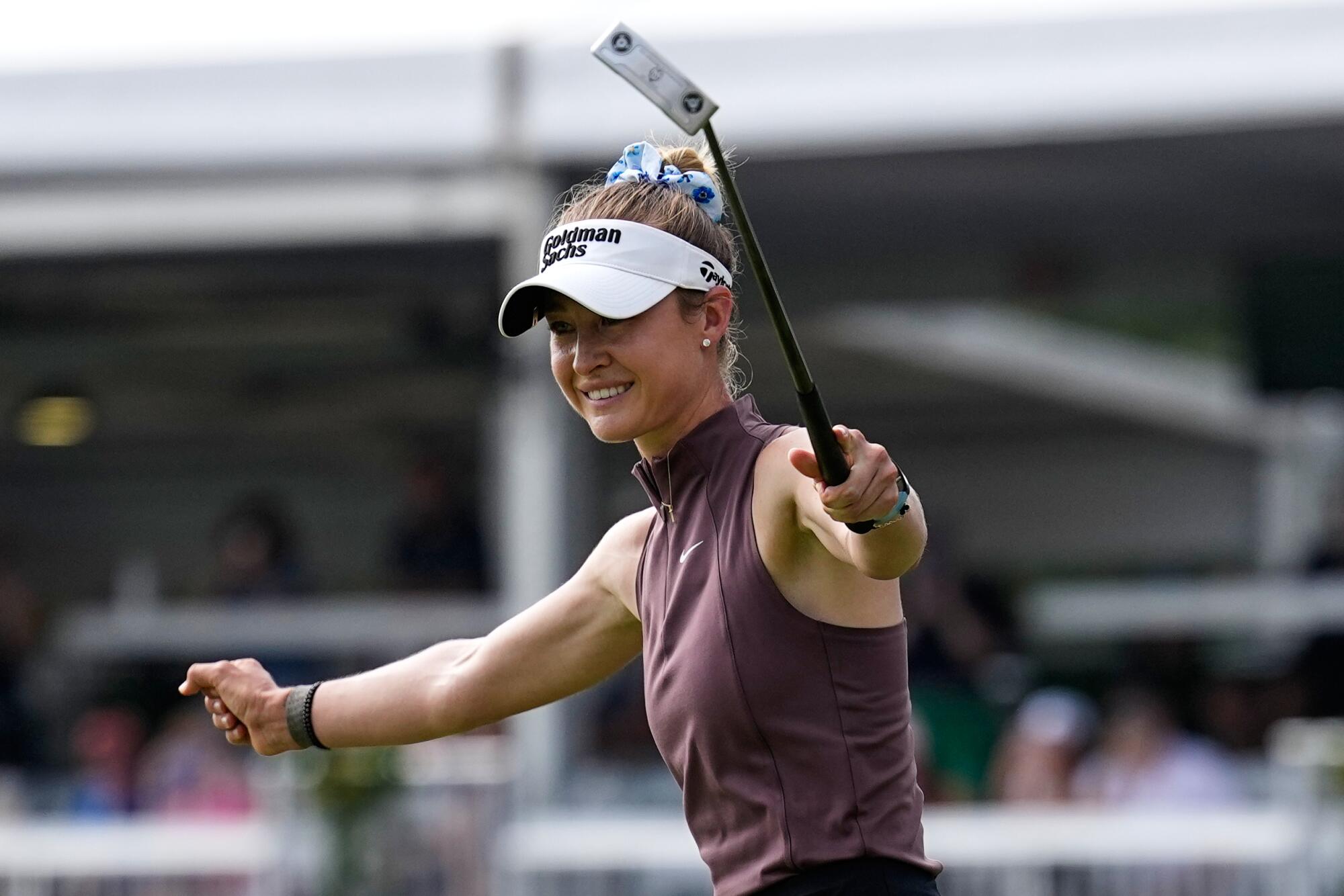
Nelly Korda celebrates after winning the Chevron Championship on April 26.
(David J. Phillip / Associated Press)
The world’s No. 1 player is a major needle mover for women’s golf and is a significant source of ratings when she’s in contention. She had a record five consecutive victories last season and seven overall. Her missing major is the U.S. Women’s Open. She finished in a runner-up spot last year and left Erin Hills firmly believing a win was within reach.
Jeeno Thitikul

Jeeno Thitikul plays a shot from the fairway during the first round of the Queen City Championship on May 14.
(Jeff Dean / Associated Press)
The former World No. 1 is still in pursuit of her first major championship. She’s a big question mark in the field.
Lydia Ko

Lydia Ko hits from the fairway during the second round of the LPGA Honda Thailand on Feb. 22.
(Kittinun Rodsupan / Associated Press)
This Hall of Fame player is the only golfer in modern Olympic history to win a complete set of medals — gold, silver and bronze — across three different Olympic Games. She’s still looking for her first U.S. Women’s Open win.
Charley Hull

Charley Hull hits off the 16th tee during the first round of the Mizuho Americas Open on May 7.
(Seth Wenig / Associated Press)
A colorful character who went viral during the 2024 Open for smoking a cigarette while signing autographs and playing. She was among a cluster who finished second in that tournament. She has three victories on the LPGA Tour but has yet to win a major.
Rose Zhang

Rose Zhang hits from the ninth tee during the final round of the Queen City Championship on May 17.
(Dylan Buell / Getty Images)
Zhang, who has been splitting time between Stanford and the LPGA, amassed a remarkable collection of victories as an amateur and three years ago, became the first player in 72 years to win an LPGA Tour event in her professional debut.
Minjee Lee

Minjee Lee prepares to putt during the third round of the Chevron Championship on April 25.
(Sarah Stier / Getty Images)
Lee, an Australian star, has won three majors including the U.S. Women’s Open in 2022. Her younger brother, Min Woo, won the 2016 U.S. Junior Amateur, making them the first brother-sister tandem to win the USGA’s junior championships.
Yuka Saso

Yuka Saso lines up a putt during the first round of the Mizuho Americas Open on May 7.
(Seth Wenig / Associated Press)
She is the anomaly of anomalies, with zero wins on the LPGA Tour with the exception of two U.S. Women’s Open victories. She won the first of those at 19 years, 11 months and seven days — astoundingly tying her for the youngest player to win the Open with Inbee Park, who was precisely that old when she won in 2008.
Lilia Vu

Lilia Vu watches her shot from the seventh tee during the third round of the Queen City Championship on May 16.
(Dylan Buell / Getty Images)
Vu grew up in Fountain Valley and was a standout at UCLA. She won two majors in 2023 but lately has been battling back problems.
Michelle Wie West

Michelle Wie West of the United States hits from the third tee during the first round of the Mizuho Americas Open on May 7.
(Sarah Stier / Getty Images)
Wie West retired three years ago after the Open at Pebble Beach, but is coming out of retirement to use her last year of exemption to play at Riviera. Her husband, Jonnie West, son of late NBA icon Jerry West, will be caddying for her.
-
 Business4 minutes ago
In a first for the country, voters in Monterey Park ban data centers
-
 Entertainment7 minutes ago
Review: Muscling past a flat script, a big-screen ‘Masters of the Universe’ embraces its own silliness
-
 Politics19 minutes ago
Hilton and Becerra lead California’s unsettled governor’s race; Steyer faces elimination
-
Sports27 minutes ago
‘SNL’ star Marcello Hernández to host 2026 ESPYs as show leaves L.A. for New York
-

 World37 minutes ago
US House passes Iran war powers resolution in rare moment of Trump backlash
-

 News1 hour ago
House votes to rein in Trump on Iran as war loses GOP support
-

 Los Angeles, Ca2 hours ago
Police investigate deadly stabbing in Tarzana; suspect in custody
-

 Detroit, MI3 hours ago
Detroit Tigers sweep Tampa Bay Rays in win as Dillon Dingler stays hot

