Sports
Feeding the ‘demon inside’: Ex-employee tells how and why he stole $22 million from Jaguars


Feb. 2, 2023 began like any other morning for Amit Patel. He was sitting in his cubicle on the ground floor of EverBank Stadium, home to the Jacksonville Jaguars. Patel, a manager in the team’s financial department, was closing out the last cycle of expenses, as he did at the beginning of each month.
When Jaguars chief financial officer Mark Sirota asked Patel to come to Sirota’s office, he thought it might be to discuss a new project. But then Patel got there and Sirota lowered his voice and asked Patel to shut the door behind him. Sirota then told Patel a delegation from NFL security was in a suite upstairs waiting to talk to him.
Sirota escorted Patel through the office, then the bowels of the stadium. As they made their way to an elevator, Patel looked back and saw a contingent of human relations officials and team security trailing them. When he arrived on the fourth floor and stepped into a suite, he was met by one of the team’s lawyers and three men in suits, one of whom was sitting behind a laptop.
“I already knew they had everything on the computer in front of them. My entire gambling history,” Patel, 31, told The Athletic in an interview from his attorney’s office in Jacksonville last week.
When the NFL security team asked where Patel got the money to place the bets they had discovered, he lied. He said it was from family wealth and cryptocurrency. When they asked whether they could have access to his phone and computer, he looked to the Jaguars’ lawyer for advice, only to realize the lawyer was there to protect the team, not him. He handed his devices over and the lawyer took him for a walk around the concourse. As they walked, Patel feverishly calculated what those security officials might identify as they transferred data from his computer and phone.
When his boss later asked him for his password to the company’s virtual credit card program, Patel knew it was over. He was caught.
FBI investigators subsequently discovered that Patel, over a four-year period, had embezzled more than $22 million from the Jaguars by creating fraudulent charges on the club’s virtual credit card and then covering his tracks by sending falsified files to the team’s accounting department. Patel’s attorney said the vast majority of what he stole he gambled away via online sports gambling sites. The government said he also used the money to fund a jet-set lifestyle and to purchase vehicles, a condominium, a designer watch worth over $95,000 and other extravagances.
Last Tuesday, in U.S. District Court in Jacksonville, Patel stood before a judge, voice quivering, and said he was “ashamed” of his actions. The prosecution asked for a sentence of 84 months, emphasizing the scale of his fraud, the media attention the case received and the message it would send to others who might “steal millions and live like a king.” Patel’s attorney asked for probation, citing his client’s gambling addiction and subsequent recovery efforts as reasons for leniency.
Patel received a 78-month sentence.
In his first interview since he pleaded guilty last year, Patel said that after months of anticipation, dread and unease, he feels a sense of relief to finally face his punishment.
“I’m dealing with the consequences of something that happened a year and a half ago. I’ve been a completely different person since then through my recovery,” Patel said. “I’m dealing with something that’s happened in the past when I was a different person.”
Patel had roughly two dozen friends and family on hand at his sentencing, some of whom made statements vouching for his character. His older brother said he was the prototypical golden child who excelled at sports and school only to be derailed by alcohol abuse and gambling addiction. His high school teacher said he was a “model student.” His girlfriend insisted he was a good person who had taken responsibility for his actions and committed to a life of sobriety.
Government attorneys described him as a fabulist who conned his company and enjoyed the spoils. Court filings included pictures of Patel partying at swanky hotels, flying on private planes and flashing expensive bottles of champagne. In that filing, the prosecutor handling the case wrote that Patel continued to “enjoy the finer things” even after he was fired. Megha Parekh, the Jaguars chief legal counsel, issued a blistering assessment of Patel, stating that his actions invited an inordinate amount of scrutiny on the organization and diverted key resources and time from current employees: “He was our teammate and he betrayed us.”
Those depictions, while seemingly in contrast, coexist in Patel’s retelling, and he frequently toed the line between expressing remorse for his actions and ascribing those actions to a problem outside his control.
“I was battling with a secret addiction that nobody knew about,” Patel said. “Everyone thought I was doing great, dandy. You know, on Instagram they see you having fun, you’re with your friends and family, but there’s a mental demon inside.”
Patel grew up in a strict household where his parents, who immigrated from India, expected academic excellence from their two sons. He said he was impacted greatly by two losses earlier in his life: Patel’s father died of a heart attack when Patel was 13, and one of his best friends died in a car accident nine years later when he was in college. By that time, Patel said his drinking, drug use and gambling were all-consuming.
But Patel also had an abundance of love and support coupled with ambition and opportunity. He was, as the government attorney described in court, an example of the American Dream. Popular and well-liked among his classmates. Elected class president at the Paxon School for Advanced Studies in Jacksonville. Captain of his high school lacrosse team. And he had an entrepreneurial spirit, dabbling in e-commerce and side projects that suffused him with cash and freedom.
Like many people his age, Patel was drawn to gambling during the online poker boom of the early aughts and the ubiquity of fantasy sports. He said he first experienced the rush of gambling on a cruise trip to the Bahamas the summer before he left for college. The cruise featured a poker tournament and, though his mom forbade him to enter because he had previously squandered money on online poker by using her credit card, his stepfather slipped him a $100 bill.
A crowd formed around the poker table and he was in the middle of it all, winning the tournament and a $2,000 prize. He paid his mother back for a portion of the cruise and bought his then-girlfriend a necklace. He later posed for a picture with the money splayed out on a table and made that his Facebook profile avatar.
Patel enrolled at Florida State in 2010 but said the combination of partying and gambling led him to switch from his major of choice (engineering) to something more manageable (accounting). Poor grades prompted his transfer to Flagler College as he prioritized gambling over all else. He took a bus to an in-person poker tournament at the Seminole Hard Rock Hotel in Hollywood, Florida, where he finished 15th out of about 1,500 entrants, winning almost $7,500. But he was able to return to FSU for an MBA. Out of college, he went to work for Deloitte, and while there he used his corporate credit card to fund his gambling habit. But he avoided trouble because his brother helped him pay it off.
In 2018, he landed his dream job with the Jaguars, a team he grew up supporting. By that point, he’d progressed from playing fantasy football to betting on baseball via offshore accounts to placing wagers on essentially anything he could. “You wake up in the middle of the night and you’re betting on Turkish women’s volleyball,” he said.
He’d ignore his mom’s calls, forget to brush his teeth, stay up late into the night, constantly refreshing his phone for scores and highlights while his girlfriend slept next to him. Once, in Las Vegas, he drove to the Nevada/Arizona border just so he could place a daily fantasy sports bet, which isn’t permitted in Nevada. When his bank account was low, he’d sell personal items, donate plasma, take out payday loans or rustle up work doing cell phone repairs. There were times he’d visit the ATM multiple times in a day, depositing and depleting.
“The worst part is there’s always a win around the corner,” Patel said. “And so that’s what you’re always chasing.”
In September 2019, Patel, then a mid-level employee with the Jaguars, was in the hole from gambling losses, his credit card maxed out. He was drunk, trying to think of a way to dig himself out of debt and feeling the “itch.” That’s when he allowed himself to consider using funds from the company VCC program he managed.
“I mean, the devil inside me is like let me just deposit $25,000 from the card. I’ll turn it into $50,000. I’ll put the $25,000 back,” Patel said.
Given the level of attrition and lack of oversight within the Jaguars’ depleted accounting and finance department, the prospect of getting caught seemed low. In corporate finance, there is a concept called the fraud triangle: Opportunity. Incentive. Rationalization. Patel had all three.
The hole deepened as Patel’s gambling losses mounted. And so he continued using funds obtained from the Jaguars VCC program to place astronomical bets via FanDuel and DraftKings in hopes that he’d win big and save himself. Patel said his VIP rep at FanDuel would add 10 percent to his account for every $600,000 he spent, in addition to entry fees that were refunded and travel perks he was comped. A spokesperson for FanDuel declined to comment as the company still considers the situation an “ongoing matter.”
In the early days of the scheme, Patel would see an unannounced meeting placed on his calendar and believe the team had figured out his subterfuge. As the years passed and his actions went undetected, that fear never abated, he said, but he just couldn’t stop.
He’s not sure what tipped off NFL security early in 2023. (Employees of NFL teams are forbidden from betting on games.) But he recounted some brazen moves he made in the months before his termination. Twice, he bet on the Jaguars – once while he was in Kansas City for a game against the Chiefs — an $18,000 six-way parlay involving five UFC fights and the Jags covering the spread. (The five fights went his way, he said, but the Jags didn’t cover.) Later, he said he bet “a few hundred thousand dollars” on a Jaguars-Titans game, another loss. He also tried to withdraw money from a wire to place bets through FanDuel, which triggered a notification from the anti-money laundering team at the site. (He said his account was suspended after he unsuccessfully answered questions about the source of his funds.)
“I was so far in the hole I was like ‘Maybe I can win a million really quick on this game and pay them back,’” he said. “I was desperate.”
In the immediate aftermath of getting fired by the Jaguars, Patel did not stop gambling. Instead, he continued scrambling to try to win and pay the team back. An absurd idea, he recognizes now, considering the sum he owed.
Patel was in rehab by the time the FBI got involved. His attorney referred him for alcohol and drug abuse, as well as gambling addiction. He cooperated with the government’s investigation and in December 2023 pleaded guilty to charges of fraud and an illegal monetary transaction.
In the 99 days he spent in rehab, Patel said he felt guilt and shame for the pain he caused his loved ones, friends and coworkers. But he also felt grateful. “I was so glad to be out of that torturous, endless cycle in my head,” he said.
Gambler’s Anonymous works similarly to Alcoholics Anonymous. You work the 12 steps. Identify the “character defects” that contribute to addiction. Patel still battles those, with perfectionism and ego surfacing more prevalently than he would like.
He bristled at the suggestion that he was a neophyte and historically bad gambler, as one report suggested. He was bothered by news accounts that only one person attended his plea hearing in his defense. (He told friends and family not to attend, he said.) And he pushes back on the government’s assertion that he was driven solely by greed.
He contends that he bought some luxury items to flip for profits to subsidize his gambling, while also acknowledging that he was frittering away money on a country club membership, spa services and more. Though the majority of the money he stole from the Jaguars ended up with FanDuel or DraftKings, the government contends that Patel transferred over $5 million to his PayPal and other financial accounts.
He admits he enjoyed the trappings that came with having access to millions of dollars but said the cost of certain trips and events were reimbursed by the online betting sites, an incentive for him to continue spending with them: “They just give you this illusion that you’re winning because they’re just making so much money off of you that they need to keep you happy and keep you gambling,” he said.
Patel said he still has urges to gamble — the most recent one came a few months ago when he got an email from the Hard Rock Hotel Casino group, commemorating the opening of its new sportsbook. Patel talked about it in the GA meeting he organized; the group now meets regularly in a local church.
“Not everyone will get addicted to gambling,” Patel said. “But everyone can get addicted.”
Patel will continue treatment while incarcerated. He is slated to begin his sentence within the next 90 days. His attorney requested he be placed at the federal facility closest to his family in Jacksonville. When he gets out, he’ll be put on a payment plan – $250 a month directed to the Jaguars. Both the prosecuting attorney and the judge acknowledged he is unlikely to ever pay back the entire sum he stole from the NFL franchise.
Said Patel: “I’ve just got to deal with these consequences and move on with my life and see how much I can use this to help a lot of other people.”
(Illustration: Eamonn Dalton / The Athletic; photos: Don Juan Moore, Julio Aguilar, Perry Knotts, Don Juan Moore / Getty Images; courtesy of U.S. Attorney)



Sports
Minor league team plates 10 runs in one inning on just one hit, zero errors in frigid conditions

NEWYou can now listen to Fox News articles!
The New Hampshire Fisher Cats, the Toronto Blue Jays’ Double-A affiliate, achieved a rare feat not seen in the post-expansion era.
Portland’s pitchers — New Hampshire’s opponent for a six-game series — combined for walks, wild pitches and hit batters, paving the way for the Fisher Cats to pull off the feat.
The Fisher Cats fell behind 2-0 early in Tuesday’s game against the Sea Dogs, the Eastern League affiliate of the Boston Red Sox.
But New Hampshire scored its first eight runs in the second inning without recording a single base hit.
A Portland Sea Dogs cap during a game between the Erie SeaWolves and the Portland Sea Dogs at Hadlock Field in Portland, Maine, Sept. 5, 2025. (Ella Hannaford/Minor League Baseball)
The Fisher Cats exploded for 10 runs in the inning — nine with two outs — on just one hit and no errors, the final box score in New Hampshire’s 12-7 win showed. The feat was fueled by Portland pitchers issuing eight walks and hitting two batters. Sea Dogs pitchers also uncorked four wild pitches and allowed a sacrifice fly and the inning’s lone hit.
BRAVES ACE CHRIS SALE SLAMS BASEBALL AGAINST HIS HEAD AFTER WALKING THE BASES LOADED IN WILD SCENE
Sea Dogs president Geoff Iacuessa couldn’t believe what unfolded.
“I don’t ever remember seeing that here or any other game I’ve ever seen,” Iacuessa told Portland’s WGME Channel 13. “It was crazy. I thought maybe something was going on with the scoreboard, and then I checked the GameChanger, and it was correct.”
The rare moment happened amid frigid conditions that prompted the stadium’s ground crew to clear the playing grass and infield after heavy snow fell earlier in the day. Temperatures were just a few degrees above freezing at first pitch.
The inning unraveled quickly after a quiet start, when Portland starter Hayden Mullins issued two walks and uncorked a wild pitch despite striking out the side in the first. New Hampshire then broke through with a sacrifice fly.
Hayden Mullins pitches for the Portland Sea Dogs during a game against the Harrisburg Senators at FNB Field in Harrisburg, Pa., Aug. 5, 2025. (Kyle Mace/Minor League Baseball)
Mullins eventually managed to record two outs, but then lost control, walking three straight to tie the game. Jorge Juan came on in relief but hit the first batter he faced with the bases loaded.
A wild pitch made it a 4-2 score, and a walk loaded the bases again for the Fisher Cats. Juan then hit a batter, making it 5-2, before firing another wild pitch to push the Sea Dogs deficit to four runs. Juan walked two more to push it to 7-2 before leaving the mound with a runner at each base again.
Cade Feeney took the hill next and finally stopped the leaking, but not before a wild pitch made it 8-2 and New Hampshire outfielder Ismael Munguia’s two-run single pushed the lead to 10-2.
Ismael Munguia of the New Hampshire Fisher Cats poses for a photo during the team’s photo day at Delta Dental Stadium in Manchester, N.H., March 30, 2026. (Michael Owens/MLB Photos)
Munguia represented his native Nicaragua in last month’s World Baseball Classic, appearing in four games.
CLICK HERE TO DOWNLOAD THE FOX NEWS APP
Not even a team at the major league level has scored more than four runs in an inning without recording its first hit, according to the Elias Sports Bureau.
MLB.com reports it has happened just 16 times in American League and National League history that a pitcher allowed five runs without surrendering a hit in 1⅔ innings or fewer.
Follow Fox News Digital’s sports coverage on X, and subscribe to the Fox News Sports Huddle newsletter.
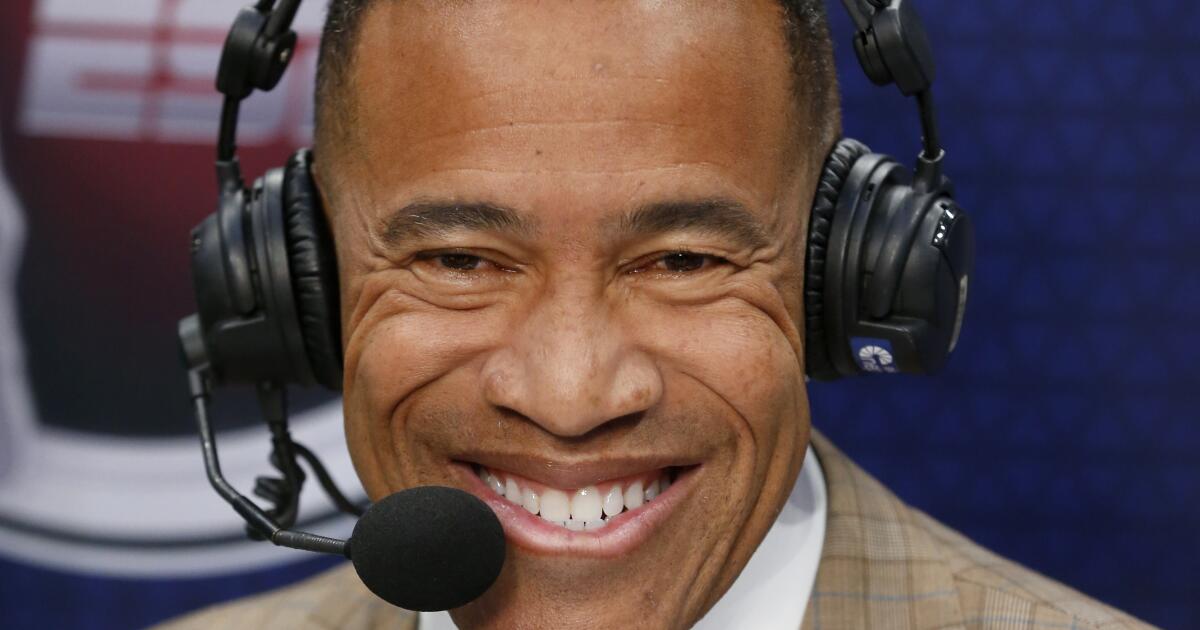
Mark Jones has been an on-air staple on ESPN since the first Bush administration — as in George H.W. Bush, who served from 1989 to 1992.
So, yeah, it’s been a long time.
And now, Jones says, “it’s time to move on.”
Jones’ final ESPN broadcast will be Sunday, when he will serve as the play-by-play announcer for the Orlando Magic at Boston Celtics game on the final day of the NBA’s regular season. It could very well be the last time the phrase “hotter than fish grease” is uttered on the network.
“It’s been a memorable journey these decades with the ABC/ESPN family, but I have decided that it’s time to move on,” Jones wrote in a statement posted Friday on Instagram. “From the day Dennis Swanson hired me in 1990 and working with the best producer in the business, Kim Belton, until today I will forever be grateful for the many friends and colleagues along the way.”
Jones, 64, started at ESPN in 1990. As a play-by-play announcer, he is best known for calling NBA games but he has also covered college football, men’s and women’s college basketball, the WNBA and UFL. On June 2, 2022, Jones, Mark Jackson and Lisa Salters were the first all-Black crew to call an NBA Finals game on TV.
In addition, Jones has hosted the “NBA Today” studio show and been an anchor and reporter on “SportsCenter.”
“Mark has made an enduring impact at ESPN since 1990, serving as a signature voice primarily within our NBA and college football coverage and across nearly all of our platforms,” ESPN said in a statement. “We’re grateful for Mark’s countless contributions and we wish him continued success.”
Separate from his work at ESPN, Jones has also been the primary TV play-by-play announcer for the Sacramento Kings since 2020.
Jones hasn’t indicated what he’ll be doing next, but he ended his announcement with a big prediction for the future — and threw in his signature phrase for good measure.
“As I move on to my next chapter I believe my best work is yet to come,” he wrote. “I’ll be out there cookin’ hotter than fish grease!”
Sports
Fever’s Lexie Hull speaks out against attacks on players as team’s popularity grows during Caitlin Clark era

NEWYou can now listen to Fox News articles!
Lexie Hull remembers what it was like playing for the Indiana Fever before Caitlin Clark arrived in town.
It’s different now. The arenas are louder, the opposing players are more motivated and social media is more volatile.
“The most challenging part is there’s just so much scrutiny. People have opinions online, and, unfortunately, that’s part of the job and the role that we play,” Hull told Fox News Digital about what’s harder about playing in Indiana since 2024.
“People need to know that everyone’s human. We’re real people. I think when things get blown out of proportion, when things get really personal and there’s personal attacks on people’s character, I think that’s where it gets over the line.”
Lexie Hull, left, and Caitlin Clark of the Indiana Fever during a game against the Seattle Storm at Climate Pledge Arena June 27, 2024, in Seattle. (Steph Chambers/Getty Images)
When asked if she has been the target of personal attacks online, Hull said, “I’m sure I have. I try not to read comments for that reason.”
Much of the controversial social media discourse about the Fever stems from heated moments on the court over the last two seasons. Clark and Fever fans often expressed outrage at times when an opposing player fouled her or delivered a physical play against Clark without a foul being called.
Hull was drafted by the Fever in 2022 and played two full seasons in a quieter, less-crowded Gainbridge Fieldhouse than the one she has played in the last two years, falling short of the playoffs both years.
But when Clark was drafted in 2024, Hull’s team became the center of the women’s basketball world.
Hull says she noticed a difference in how opposing players started to perform against her team that year, which she credits to the surge in popularity.
“Because of the fans that we’ve gotten since 2024, with the rise in, I think, like, popularity with the Indiana Fever being like a name that people know. … And there’s a million Fever jerseys and Fever shirts. I think, like, as an opposing team, you’d want to win even more because you feel there’s so many people rooting,” Hull said.
“It’s exciting to have that type of following across the country, and I think, like, for other teams, they have great fans and great people that show up for them, and they want to perform for those people, just like we want to perform for ours.”
When asked if she believes games have gotten more physical as a result, Hull said, “I think just the game itself is physical. I don’t know if it’s gotten any more physical. I think social media amplifies a lot of that.
“I think people want to win. I think people just want to win. … [The games] are all physical. … They all get chippy at times. Calls get made, calls don’t get made. That’s just part of the game.”
FEVER’S SOPHIE CUNNINGHAM DROPS ‘NO ONE LIKES US’ TAKE AS INDIANA DEALS WITH ADVERSITY
The Indiana Fevers’ Lexie Hull, Caitlin Clark and Sophie Cunningham watch as the Golden State Valkyries celebrate their 88-77 win in a WNBA game at Chase Center in San Francisco June 19, 2025. (Scott Strazzante/San Francisco Chronicle via Getty Images)
During a game between the Fever and the Connecticut Sun June 17, physicality boiled into a brawl. After Sun guard Jacy Sheldon poked Clark in the eye and fellow Sun player Marina Mabrey shoved Clark to the ground, Fever star Sophie Cunningham committed a hard foul on Sheldon, initiating an on-court fight that resulted in three ejections.
When asked if she believes her team is prepared for a similar incident in 2026, Hull said, “It shouldn’t get to that point.”
Instead, Hull said she is focused on helping her team win a championship. And she embraces all the attention and popularity despite the challenges that come with it.
“Growing up, I didn’t necessarily watch the WNBA as much, didn’t have dreams of playing in the league at a young age, and now girls have the ability to watch us, see us, dream about being professional athletes. And that’s what’s been the most rewarding part about it,” Hull said of the positives that come with the attention.
She came one game shy of reaching the WNBA Finals last year, leading the Fever through the playoffs after Clark and Cunningham were lost for the season with injuries. In a career-best year, Hull averaged career highs in points (7.2), rebounds (4.3), and assists (1.8) while shooting 36.7% from 3-point range and appearing in all 44 games.
In the playoffs, she averaged 10.3 points, 5 rebounds and 2 assists in 8 games. It all came to an end in a 107-98 overtime loss to the Las Vegas Aces in Game 5 of the WNBA semifinals.
With Clark and Cunningham healthy and back this year, the Fever go into 2026 as a top contender for the title.
“Tasting that and being so close and feeling like we have so much more to give, I think that just changes our mindset a little bit,” Hull said.
The trio of Clark, Cunningham and Hull proved to be an efficient and gravitating force in popularity when they were all on the court at the same time last year. Along the way, they earned a mysterious nickname on social media, which they later adopted for themselves — “Tres Leches,” which translates from Spanish to “three milks” and refers to a popular Latin American sponge cake.
“We saw it on Twitter at some point, and people ran with it,” Hull said of the nickname. “It was funny.”
In terms of navigating the attention, Hull, Clark and their teammates now have two years of conditioning in that arena.
CLICK HERE TO DOWNLOAD THE FOX NEWS APP
Indiana Fever guard Lexie Hull (10), Indiana Fever guard Caitlin Clark and Indiana Fever guard Sophie Cunningham laugh near the team bench June 3, 2025, during a game against the Washington Mystics at Gainbridge Fieldhouse in Indianapolis. (IMAGN Syndication: The Indianapolis Star)
“I think everyone does a really good job of not giving the rise in attention any attention. I think we’re just showing up the same we do everyday,” Hull said.
“Knowing that there’s more eyes on us, knowing that there’s more seats in the stands, all of that is exciting, but I don’t think that necessarily changes how we go about the game, go about our relationships, go about what we post on social media. It just adds to the engagement.”
Follow Fox News Digital’s sports coverage on X and subscribe to the Fox News Sports Huddle newsletter.

Who is Rueben Bain Jr\ufeff? Miami Hurricanes draft prospect visits Bengals

Full-length Replay: Boston | FOX Sports

Recap: Denver Nuggets B squad defeats Oklahoma City Thunder C squad 127-107. – Denver Stiffs

Seattle Mariners snap 5-game skid with 9-6 win over Astros

Of course Eric Swalwell should drop out of the gubernatorial race

Florida High School Football Rankings: Top 25 teams – Oct. 21

How old is Bo Nix? What to know about Oregon quarterback ahead of 2024 NFL Draft

Cleary's 21 help Le Moyne down Central Connecticut State 69-64 in OT

99th annual Pony Swim held in Virginia

Indiana Members Credit Union announced as new anchor tenant at Bottleworks District

Swalwell’s former female staffer drops bombshell allegations of sexual assault, exposing himself: report

NASA’s Artemis II prepares for splashdown on Earth

Trump proposes painting executive office building white

Rep Randy Fine joins House Freedom Caucus: ‘Strongest group of conservative patriots in Congress’

Trump issues NATO ultimatum to reopen Strait of Hormuz ‘within days’
-

 Atlanta, GA6 days ago
1 teenage girl killed, another injured in shooting at Piedmont Park, police say
-

 Education1 week ago
Video: YouTube’s C.E.O. on the Rise of Video and the Decline of Reading
-

 Movie Reviews1 week ago
Vaazha 2 first half review: Hashir anchors a lively, chaos-filled teen tale
-

 Education1 week ago
Video: Toy Testing with a Discerning Bodega Cat
-

 Georgia4 days ago
Georgia House Special Runoff Election 2026 Live Results
-

 Pennsylvania4 days ago
Parents charged after toddler injured by wolf at Pennsylvania zoo
-

 Arkansas14 hours ago
Arkansas TV meteorologist Melinda Mayo retires after nearly four decades on air
-
 Milwaukee, WI5 days ago
Potawatomi Casino Hotel evacuated after fire breaks out in rooftop HVAC system