Sports
Darryl Strawberry wanted to quit baseball at 19. These two Mets brought him back


To this day, 43 years later, Darryl Strawberry still has a nickname for his 1981 season with the Class A Lynchburg Mets.
“I call it,” Strawberry said by phone last week, “the suck season.”
The suck season was, at the time, the most challenging of Strawberry’s life. It was the season he first confronted failure on the baseball diamond. It was the season he first heard racist slurs from the stands. It was the season he came oh-so-close to quitting baseball and hanging up his jersey for good.
And so when Strawberry’s No. 18 is retired June 1 at Citi Field, it’s only fitting that among his honored guests will be the two people who pushed him through the suck season: manager Gene Dusan and teammate Lloyd McClendon.
“Everybody looks at the success, but I look at the people who had a great impact on me,” Strawberry said. “There’s no way that I would be standing on the field having my number retired had it not been for people like them getting me through the most challenging, difficult times at a young age.”
The first month of Strawberry’s first full season in pro ball had not gone well. Failing on the field for the first time is hard enough for any player. Strawberry had several extra spotlights on him.
The prior summer, he had been the No. 1 pick out of Crenshaw High School in Los Angeles, where his coach had called him “the black Ted Williams” in Sports Illustrated. His signing bonus, while not a record, more than doubled that of the previous No. 1 pick.
And he was a black man playing in a southern city in Virginia. So when he struggled on the field, he heard it from the Carolina League crowds. Home games, road games, any games — Strawberry heard the worst of it.
“They were calling me all kind of names and saying negative things,” Strawberry said. “You’re talking about the deep south. I was like, ‘This is crazy.’ I grew up in Southern California and we never had to experience that growing up.”
“Listen, it was 1981. Society as a whole didn’t quite embrace us — black folks,” McClendon said. “They used to pass the hat for anybody who hit a home run. We hit home runs and we got nothing.”
By early May, Strawberry wanted to take his bat into the stands, he said. Instead, he took his bat home.
“I just checked out,” he said. “I did go AWOL.”
“He left for a couple days,” Dusan said. “It was concerning that he left. I felt like he’d be back. I knew he’d be back.”
Rather than chase Strawberry, Dusan gave him space. He didn’t even tell the higher-ups in the Mets front office.
“If I did that today, they’d fire me,” he chuckled. “Things were different in the early ’80s.”
Two days later, Strawberry returned to the park, thanks largely to his relationships with Dusan and McClendon. Strawberry and McClendon had bonded the year before in rookie ball in Kingsport, Tenn., when they roomed together and had each other’s backs during their first summer in the South.
“I guess we had to protect each other,” McClendon said.
Lloyd McClendon, pictured in 2019 as a coach with the Tigers, was an important figure in Darryl Strawberry’s early pro years. (Rich von Biberstein / Icon Sportswire via Associated Press)
And McClendon hadn’t been there at the start of the ’81 season in Lynchburg because of a broken hand he suffered in spring training. But when Strawberry left the team, that rehab period became a lot shorter for McClendon.
“When I saw him at the park, then I was happy,” Strawberry said, “to see a face and someone of color just like me.”
Dusan made sure the two roomed together again, even though McClendon had gotten married.
“You have to take care of him,” McClendon remembered Dusan saying, “because he’s not going to make it if you don’t.”
“I don’t know if I was old enough to be a mentor at the time,” said McClendon, who was 22 that season, “but I was certainly a friend and a voice he could talk to. Whatever little wisdom that I had I tried to pass along.”
And Dusan’s tough-love approach as a manager was what Strawberry needed at that point. The day Strawberry returned to the club, Dusan didn’t exactly rejoice.
“I’m glad you’re back. I’m glad you’re healthy,” he told the player. “We’ve got to go to work.”
From that day forward, Dusan remembered, Strawberry became the best player he ever coached.
“He was there every day for extra hitting,” Dusan said. “Once he applied himself, he was the man.”
There was a reason Strawberry was always there for extra hitting.
“Let me put it this way: In a very good way, Gene was a pain in the ass to Darryl and I,” McClendon said. “When we were on the road, he would wake us up at 8 every morning and we had go to the ballpark. I guess he saw something special in both of us. He saw it in Darryl, for sure.”
“Gene Dusan was like a father figure to me that I didn’t have. He embraced me to fight through some adversities early,” Strawberry said. “I became a part of his family. It was just very personal to me.”
How much a part of the family? Strawberry helped babysit Dusan’s children.
“Geno kept me going, kept me focused on not looking up there and interacting with the people up there (in the stands),” Strawberry said. “That really helped me because I really didn’t want to play anymore, for a minute there.”
“He taught us so much about not just baseball but life in general and how you go about your business,” said McClendon, who went on to manage more than 1,100 major-league games. “You stand up and live by your word and learn to be a man of honor. It was pretty cool.”
For Strawberry, the suck season remains an important part of his story. That first experience of adversity helped him through the many later challenging periods he endured, both self-inflicted and not. It was a learning moment, he said, one that came up whenever his children wanted to give something up at a difficult time.
In ’82, playing for Dusan in Double-A Jackson, Miss., Strawberry broke through with 34 homers, 45 stolen bases and an OPS over 1.000. Two years after the suck season, Strawberry was the National League’s Rookie of the Year.
“I made the right decision to fight through the adversities and start believing,” Strawberry said. “I’m forever thankful for that and for real people. These are real people. These are not people that sugarcoat everything about you. But the people that showed me how to overcome.”
“It’s hard to believe,” Dusan said about watching the teenager he managed have his number retired. “I appreciate how he feels about me. I’m proud of him.”
(Photo of Darryl Strawberry batting for the



NEWYou can now listen to Fox News articles!
All Elite Wrestling (AEW) star Kenny Omega blasted a social media user over a remark made about Will Ospreay and Charlie Kirk.
The X user made a critique about Ospreay’s mic skills on Thursday, writing, “Will Ospreay is as bad on the mic as charlie kirk, but can’t sell the neck as well as he did.”
COMPLETE PRO WRESTLING COVERAGE ON FOX NEWS DIGITAL
Kenny Omega enters the ring during the New Japan Pro-Wrestling Wrestle Dynasty event at Tokyo Dome in Tokyo, Japan, on Jan. 5, 2025. (Etsuo Hara/Getty Images)
Omega, who is friends with Ospreay inside and outside the ring, slammed the poster.
“What the f— is wrong with you? It isn’t hard to try having some class,” he wrote in response.
“A dear friend battles back from a career threatening injury, is no doubt still fighting pain today, and is somehow mocked and compared to a dude that was murdered. I get that a joke is a joke but these things should really be kept separate in my opinion.”
Kenny Omega looks on after the tag match during the Power Struggle – Super Jr. Tag League 2018 at Edion Arena Osaka on November 03, 2018 in Osaka, Japan. (Etsuo Hara/Getty Images)
When one X user came to the defense of the commenter, Omega responded once more.
“Please extend my apologies, genuinely. Perhaps I’ve become too sensitive after my own brush with death. I also know of Will’s efforts behind the scenes more than most so it was sad to see such a harsh comparison,” the current AEW champion added.
Kirk, a conservative commentator and the founder of Turning Point USA, was shot and killed during an event on the campus of Utah Valley University in September. Tyler Robinson was arrested in Kirk’s murder.
Turning Point USA founder Charlie Kirk spoke during his “American Comeback Tour” at Utah Valley University on Sept. 10, 2025, in Orem, Utah. Kirk was fatally shot while appearing at the event. (Trent Nelson/The Salt Lake Tribune/Getty Images)
CLICK HERE TO DOWNLOAD THE FOX NEWS APP
Robinson’s trial is currently ongoing.

The final weekend of the 2026 FIFA World Cup is here, with France and England playing for third place on Saturday before defending champion Argentina takes on 2010 winner Spain for the title on Sunday.
Here’s everything you need to know about the last two matches of the 39-day, 48-team tournament in North America (all times Pacific).

Saturday’s third-place game
France vs. England
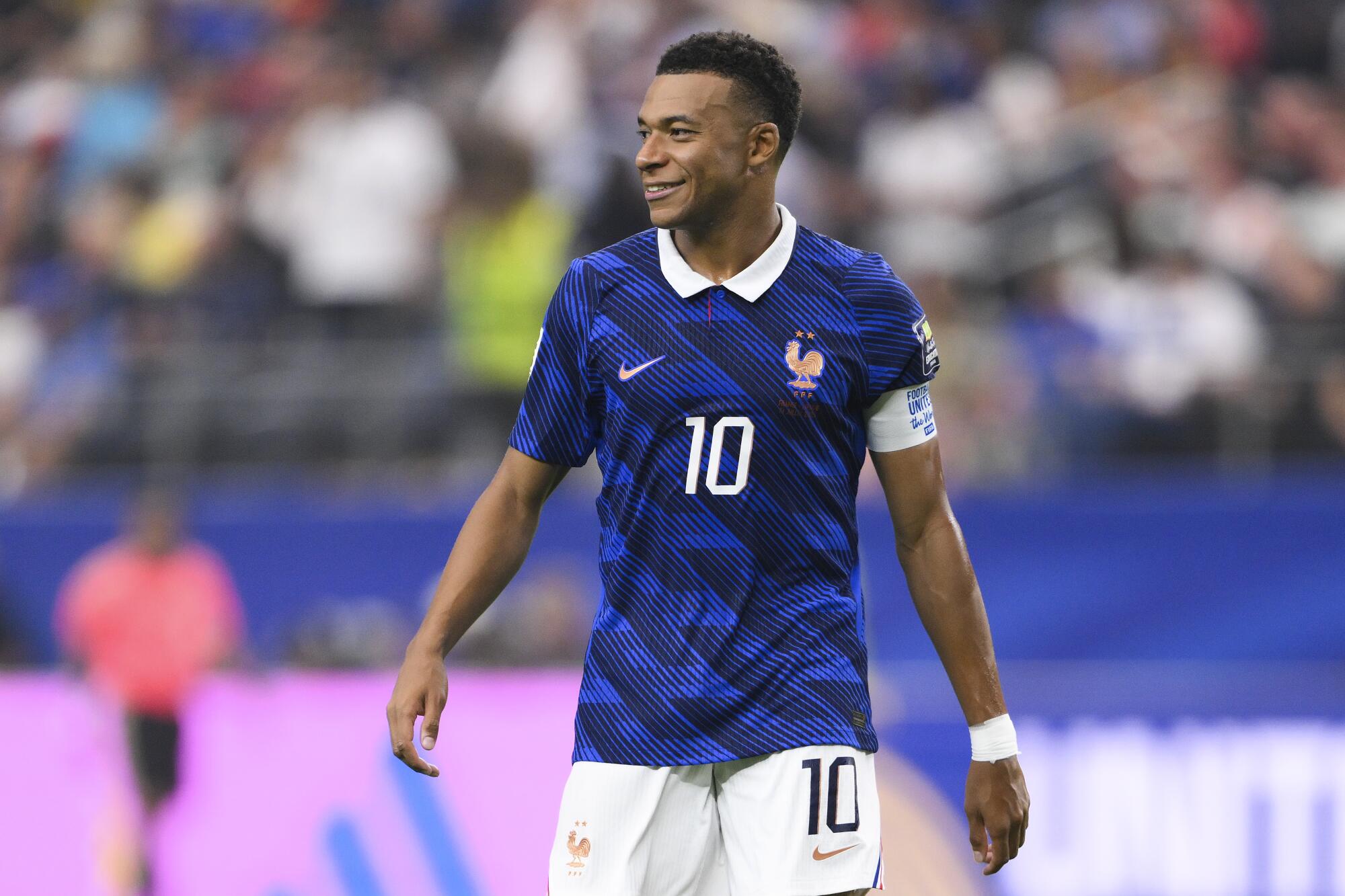
France star Kylian Mbappé smiles during a World Cup semifinal match against Spain on Tuesday.
(David Ramos / Getty Images)
Where: Hard Rock Stadium, Miami Gardens, Fla.
Time: 2 p.m.
TV: Fox, Telemundo | Streaming: Fox One, Peacock
The buzz: This is a game neither team really wants to play. The disappointment of missing the final is fresh and the weather report calls for temperatures in the high 80s with 68% humidity and a chance of thundershowers — a brutal South Florida summer day. The $2-million difference in prize money between third and fourth place isn’t likely to make any of that more palatable. Still, the game will have meaning for France since it will be the final match for coach Didier Deschamps, the winningest World Cup manager in history. And captain Kylian Mbappé, tied with Argentina’s Lionel Messi for most goals in the tournament (8), has a chance to become the first player to win consecutive Golden Boots. England is playing in the consolation final for the second time in three World Cups; it lost to Belgium 2-1 in 2018. But this one will probably sting even more since the Three Lions were five minutes away from their first final in six decades before collapsing against Argentina. This could be the last World Cup game for England’s Golden Generation of Harry Kane, Jordan Pickford, John Stones and Jordan Henderson.
Sunday’s championship game
Spain vs. Argentina

Argentina star Lionel Messi celebrates after a win over England in the World Cup semifinals on Wednesday.
(Buda Mendes / Getty Images)
Where: MetLife Stadium, East Rutherford, N.J.
Time: Noon
TV: Fox, Telemundo | Streaming: Fox One, Peacock
The buzz: Argentina has a chance to become the first repeat World Cup champion since Brazil in 1962, which would give Messi another grand achievement in his sixth and likely final World Cup. Messi enters the weekend as the all-time leader in goals, assists and games played in tournament history. But unbeaten Argentina hasn’t made things easy, with its winning goals in the four knockout-round games coming in the 92nd minute or later. Spain, the reigning European champion, will be playing to put a second star on its jersey to match the one it won in 2010. La Roja, with the sixth-youngest roster in the World Cup, got to the final on the strength of spectacular defense led by Unai Simón, who has six clean sheets in seven games. Mikel Oyarzabal is the team’s leading scorer with five World Cup goals. The teams had one common opponent in this tournament, tiny Cape Verde, a World Cup debutante. It played Spain to a scoreless draw in its opener, then held Argentina to a 1-1 standoff into extra time before falling.


NEWYou can now listen to Fox News articles!
One of the most memorable moments of the 2026 Winter Olympics came early, when skier Lindsey Vonn delivered a gutsy performance for the ages by competing at 41 just a week after injuring her knee in a crash.
Unfortunately, as admirable as her perseverance was, she injured herself badly in another crash just 13 seconds into her run in the women’s downhill final.
Five months later, Vonn is still very much dealing with her injuries.
MARCELLO HERNÁNDEZ ROASTS JAKE PAUL, TIGER WOODS AND BILL BELICHICK IN ESPYS MONOLOGUE
Lindsey Vonn speaks on stage during the 2026 ESPYs. (Mike Coppola/Getty Images)
“It’s been a very slow process,” Vonn told People while attending the ESPYs Wednesday in New York City. “It’s been five months since I’ve been able to actually go to the gym in a somewhat meaningful way. And walking is actually still really hard for me. My ankle is still broken.”
Regardless of the outcome, her decision to attempt that run remains one of the most courageous moments of the Games.
Lindsey Vonn was involved in a serious crash during the women’s downhill event at the 2026 Winter Olympics. (Screengrab by IOC via Getty Images)
ZERO BS. JUST DAKICH. TAKE THE DON’T @ ME PODCAST ON THE ROAD. DOWNLOAD NOW!
Remember when I mentioned that injury before the Olympics? That wasn’t just a minor bump in the road; it was a completely ruptured ACL.
There was no questioning her courage, but the aftermath has been difficult.
Lindsey Vonn walks through pit lane ahead of the 2026 Monaco Grand Prix. (Beata Zawrzel/NurPhoto)
“I was in a wheelchair for so long. I was on crutches for so long,” Vonn said. “It was honestly almost 3½ months that I was unable to walk unassisted. I got very emotional when I was able to walk on my own.”
CLICK HERE TO DOWNLOAD THE FOX NEWS APP
This week, Vonn posted an update on her recovery and said she has “a very long road ahead.”
-

 Technology11 minutes ago
Apple’s plot to crush OpenAI
-

 World17 minutes ago
Leaked Iran report finds record public anger as regime focuses on holding power
-

 Politics23 minutes ago
White House dishes out new election security jab over Olive Garden’s pasta pass ID policy
-

 Health29 minutes ago
Doctors warn your ‘stomach bug’ may actually be a parasite that’s harder to detect
-

 Sports35 minutes ago
AEW star Kenny Omega blasts social media user over Charlie Kirk comment
-

 Technology41 minutes ago
New bank scam laws could stop suspicious payments
-
 Business47 minutes ago
Environmental groups press to halt Imperial Valley lithium venture
-
 Entertainment53 minutes ago
Netflix stock plunges to 52-week low following mixed earnings report

