Sports
An inside look at the control center behind Honda's IndyCar racing effort

At the top of a hill in a sprawling Santa Clarita industrial park in the shadow of Magic Mountain’s roller coasters, a significant chapter in the history of motorsports was written.
But the story isn’t finished yet.
From the outside, the building is nothing special. Behind its walls, however, Honda Racing Corporation has designed, tested and built the engines that have won 14 of the last 21 IndyCar championships and all five IndyCar races this season. In Sunday’s Indianapolis 500, a race Honda has won 15 times since 2004, four of the top six starters will have Honda engines, including two-time winner Takuma Sato, who qualified second.
It’s a level of dominance unmatched in IndyCar history — in a series Honda probably helped save.
A technician works on an engine at Honda Racing Corporation. All of Honda’s engines for North American racing series are built in Santa Clarita.
(Robert Hanashiro / For the Times)
Amid the open-wheel civil war between Championship Auto Racing Teams and the Indy Racing League, Honda was prepared to walk away. Robert Clarke, who started Honda Performance Development (before it was renamed HRC in 2024) and made it a cutting-edge research and development facility, convinced American Honda president Koichi Amemiya to supply engines to IRL teams in 2003 after Honda left CART in 2002.
“It just was not Honda’s image of what a race car should be. That’s why Honda initially didn’t want to be involved,” Clarke said. “In my discussion with the president it was ‘OK, we developed all these skills and know-how. Are we just going to give that up and just walk away?’ That’s crazy.
”We invested literally billions of dollars. And we’ve seen the success.”
Chevrolet and Toyota eventually did quit, leaving Honda as the only IndyCar engine manufacturer for six seasons. Amemiya then doubled down, funding Honda’s move to its 123,000-square-foot home while expanding its workforce to 250 from an original staff of fewer than 10.
Honda hasn’t looked in the rearview mirror since.
Clarke, 75, left Honda in 2008 though he’s still something of an executive emeritus, one who wears the brand on his sleeve and often refers to the company with the collective pronoun “we.”

Robert Clarke, left, speaks to IndyCar driver Dario Franchitti at Mid-Ohio Race Course in July 2007.
(Jay LaPrete / Associated Press)
He was 10 when his father took him to his first race to watch a friend run in an amateur open-wheel event. When young Robert was invited into the garage and allowed to work on the car “I was hooked,” he said. “My bedroom walls were covered with pictures of Formula One cars and all kinds of racing.”
He took the long road to Honda racing, though, studying architecture and art/industrial design in college, then teaching for five years at Notre Dame. His first job at Honda was in the motorcycle accessory and product planning departments but when the company announced it was going to enter open-wheel racing, Clarke volunteered and he was soon tasked with building the program from the ground up.
That was in 1993. By the time Clarke left Honda 15 years later, the company’s place as a major force in IndyCar racing was secure and Honda’s two-story hilltop headquarters became his legacy.
The focus of work in the building now is mainly on supporting Honda teams in IndyCar and the IMSA WeatherTech SportsCar Championship. As such, it has become a one-stop shop for racing teams, housing comprehensive engine research and development operations; prototype and production parts manufacturing; engine preparation and rebuilding; a material analysis facilities; more than a half-dozen engine dynamometer test cells; a machine shop; electronics lab; parts center; multiple conference rooms; and administrative offices.
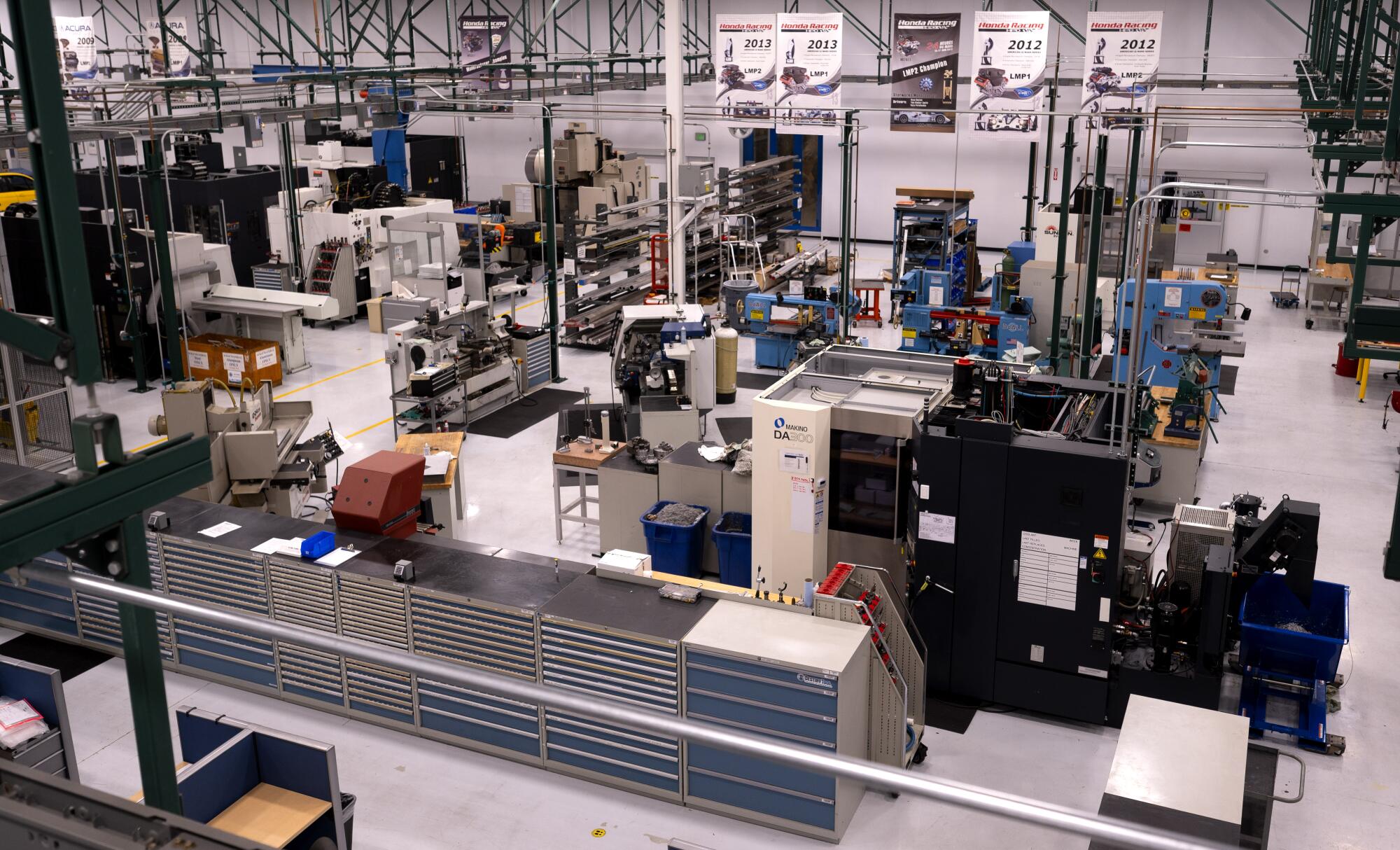
A view of the machine shop at the at the Honda Racing Corporation in Santa Clarita.
(Robert Hanashiro / For the Times)
Next year it will provide support for Honda’s effort to supply Formula One engines to Aston Martin.
Mostly the building is a maze of quiet office space where engineers sketch out their designs on computer screens, well-lit assembly bays where mechanics assemble the prototypes, and the noisy high-tech dyno rooms where those prototypes are tested. Every stage of a racing engine, from conception and construction to being shipped to the track, is managed at the facility.
“We develop the technology quickly,” said David Salters, the British-born engineer who heads HRC. “We try them. Sometimes they work, sometimes they don’t work and you try again. The point of having a racing facility inside your company is you can be agile. You can try stuff. You can train the people.
“The people are the most important thing of all this.”
The whole process is more NASA than NASCAR in that there’s not a speck of grease or oil on the bright, white vinyl flooring and everybody’s hands are clean.

David Salters, president of Honda Racing Corporation.
(Michael L. Levitt / LAT Images via American Honda Motor Co.)
“This is a world-class facility. It needs to be clinical and professional in the processes and systems we have here,” said Salters, who was head of engine development for the Ferrari F1 team and held a similar position at Mercedes-Benz before joining Honda a decade ago.
“It’s like an operating theater. We’re basically dealing with engines or electrical systems, which are like jewelry. They cannot tolerate dirt or anything like that. Everything has to be spotless and clean and well-organized. This is aerospace.”
And when the engines don’t work, they’re brought back to HRC and the engineering process is repeated in reverse in search of flaws. As for why they’re doing all that in a sleepy bedroom community better known for its paved bike paths and rustic hiking trails than for its motorsports history, that’s easy: Location, location, location.
Clarke originally expected to recruit engineers from Indianapolis and Charlotte, N.C., the heartland of American racing, while Honda insisted on keeping its operations near its corporate offices in Torrance. Clarke feared dropping people from the Midwest and South into L.A.’s traffic-clogged sprawl would be such a culture shock, he’d lose his best engineers.
So he chose Santa Clarita, which was isolated enough to not feel like L.A., but close enough to Torrance to be accessible. And the building came with an “Only in L.A.” feature: It shares a driveway with the studio where the popular TV series “NCIS” is filmed.
“Every so often a helicopter will land in the car park and we’re all told we can’t go outside in case we get swept away,” Salters said with a chuckle. “There was some ‘Star Trek’ thing where they decided our foyer could be useful. So for a few weeks we had a movie set in our foyer; we rented it out.
“You’ve got to look at business opportunities.”

Adi Susilo, chief engineer of powertrain at Honda Racing Corporation, looks over large monitors before the start of the 12 Hours of Sebring in March.
(Robert Hanashiro / For the Times)
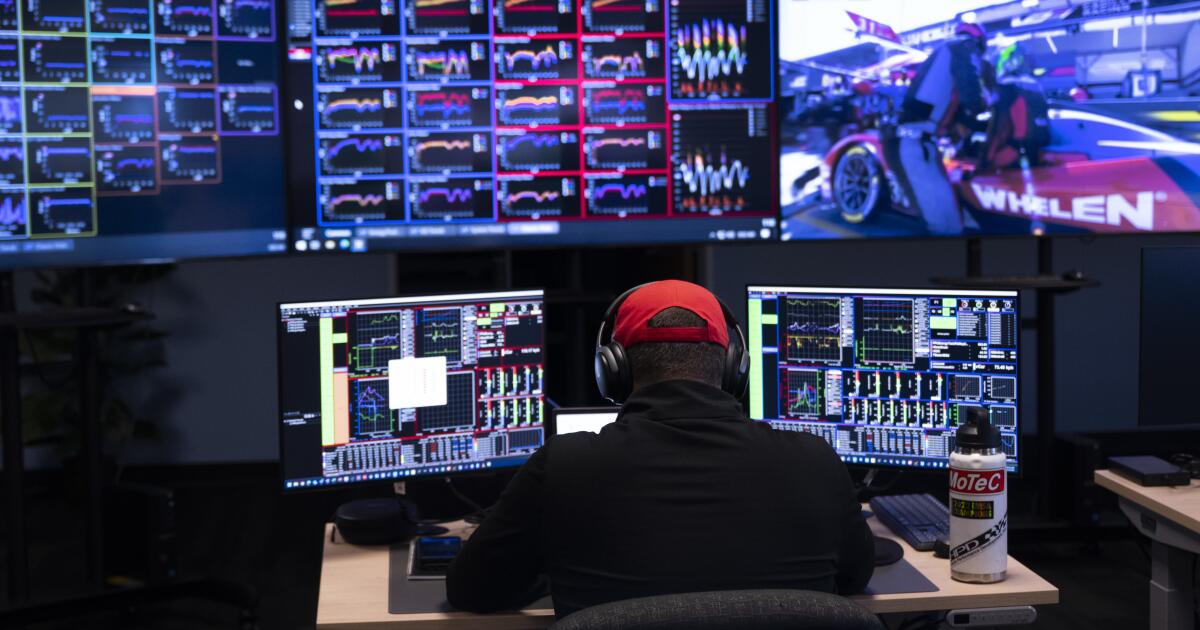
It’s early on a chilly Saturday in March and HRC’s headquarters is mostly empty save for one corner on the building’s second floor where nearly a dozen people, some wearing headphones, have gathered behind computer screens facing six giant TV monitors.
A continent away, in central Florida, more than 50 cars are lined up for the 12 hours of Sebring. Each driver with a Honda engine has an engineer monitoring their car’s performance.
Before the pandemic, engineers would travel and work with race teams on site. But for the last four years the engineers have been working mostly at HRC, monitoring in-car telemetry that provides real-time information about everything from engine status and tire pressure to suspension behavior.
“Data is king,” said Adi Susilo, one of the HRC engineers. “Humans make mistakes. Data rarely does.”
F1 teams have monitored telemetry remotely for years, but it didn’t become common in IndyCar racing until 2023. Now it’s a vital part of every major racing series, including NASCAR.
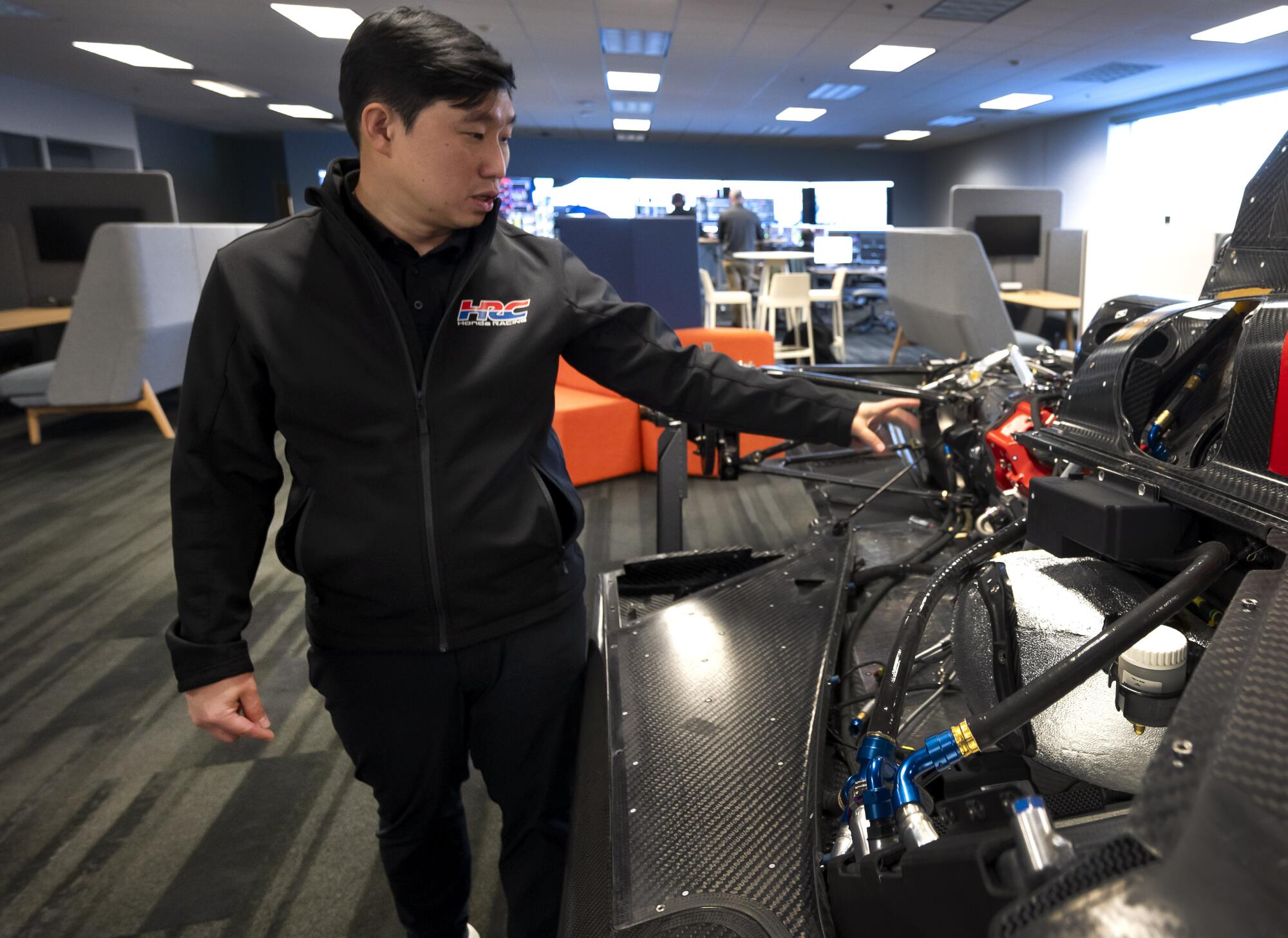
Powertrain chief engineer Adi Susilo looks at a full-size mock up of an IMSA prototype at Honda Racing Corporation.
(Robert Hanashiro / For the Times)
Engineers work out of what looks like a college classroom, only quieter. When the sound of a disembodied voice does cackle out of a headphone, it sounds like NASA Mission Control, the tone flat and unemotional, the conversation short and to the point.
“It’s better for solving problems,” said Susilo about working away from the track. “If there’s a problem, you just walk downstairs and talk to the guy who built the engine.”
That won’t be the case Sunday. For the Indy 500, Susilo said it’s all hands on deck, so most of Honda’s race-day engineers are in Indianapolis where the telemetry will be broadcast to their work stations in trailers at the track.
“A few of the IndyCar races are run that way,” he said, “but the 500 is almost always run that way just because everyone’s out here for the event. We’re also testing a new, hopefully more robust, telemetry streaming as it’s much harder to make sure we get 15 car’s worth of data.”
At first, the idea of having engineers looming electronically over the timing stand was a hard sell. Trusting someone with clean fingernails watching the race on monitors thousands of miles away wasn’t easy for some crew chiefs.
“What happens for people like me is that you have to erase the old-school way of thinking,” said Mike Hull, a former mechanic and driver who is now the managing director for Chip Ganassi Racing and chief strategist for driver Scott Dixon, a six-time IndyCar champion. “You’re electronically shoulder to shoulder with them.
“If you don’t listen to what somebody has to say, it stifles free thinking. Free thinking sends you down a path that you may not have originally been on, but makes you stronger at what you’re doing.”
1

2

3

4

1. Race engines being assembled at Honda Racing Corporation. 2. A technician in the HRC machine shop works on an engine. 3. Engineers monitor data during the 12 Hours of Sebring in March. 4. A engineer monitors telemetry remotely from HRC headquarters. (Robert Hanashiro / For the Times)
Dixon, the 2008 Indy 500 champion who will start Sunday’s race in the second row, agrees. Which is he why he’s made several trips to HRC to personally thank the engineers who design his engines and those who help direct his races.
“You always feel like there’s a big group behind you,” he said. “You just don’t get to see all them in one place but you know the machine is there, working pretty hard.”
One drawback, Dixon said, is you have to be careful what you say on the radio during races because you never know who’s listening.
“Twenty people at home, just on the team side, will be listening just on that one car,” he said. “So the communication is very wide open. You definitely have to watch your Ps and Qs.”
Two years later race teams have grown so comfortable with people looking over their shoulders, the engineers have become as much a part of the team as the cars. So when a nearby wildfire forced the evacuation of the building, Honda rented rooms at a nearby hotel, set up their TVs, computer monitors and a coffee machine in a conference room and worked from there.
“We’re pretty blind without it. The race teams are pretty competitive,” Susilo said. “They feel that instinct still does work. But it’s more data-driven.”

Honda powertain engineer Jake Marthaler monitors data during the 12 Hours of Sebring in March.
(Robert Hanashiro / For the Times)
Given the investment, the pressure can be intense.
“Every two weeks we want to have the latest development. We want to have made progress,” Salters said. “Every two weeks you have a deadline and the deadline does not move. It’s not like they’re going to say ‘OK, we’ll just delay the race a week.’ The flag drops, you’ve got to be ready.
“It’s sort of an engineering sport isn’t it? It’s like a true sport; the best team will win.”
If the IndyCar-Honda marriage has mostly been good for both sides, it has recently hit a rocky patch.
Honda’s supply contract with IndyCar ends next year and the company hasn’t hid its distaste over the cheating scandals that have recently tarnished the series. Last week Team Penske drivers Josef Newgarden, the two-time defending Indy 500 champion, and Will Power were forced to the back of the field for the start of Sunday’s race after illegally modified parts were found on their cars. Team Penske, which uses Chevrolet engines, was also caught cheating at the beginning of the 2024 season.
On Wednesday, the team fired three of its top racing executives. IndyCar, which is owned by Roger Penske (also the owner of Team Penske) said it is exploring the creation of an independent governing body absent of Penske employees.

Scott Dixon drives into the first turn during practice for the Indianapolis 500 on Friday.
(Michael Conroy / Associated Press)
That may not be enough to restore trust in the series. Honda, which supplies engines to 13 full-season IndyCar entries and three Indy 500-only cars, has declined to comment on the rules violations, but confirmed its continued participation in the series beyond 2026 may depend on Penske’s ability to separate himself from policing the series he owns and also competes in.
Honda said in a written statement Thursday that it has many concerns, among them “the relatively high overall cost to participate as an engine supplier” and “the potential (perceived or real) conflict of interest which may exist” with Penske’s ownership of the racing series, three of the cars competing in the series and his “significant stake” in Ilmor Engineering, which designs and manufactures engines for Chevrolet, Honda’s biggest competitor.
“Honda continues to have ongoing negotiations with IndyCar’s management and technical teams regarding our future as an engine supplier for the series,” said Chuck Chayefsky, manager of Honda & Acura Motorsports.
Whatever road Honda takes with IndyCar, it’s unlikely to change most of the day-to-day work at HRC, which is heavily involved with IMSA and will soon be working on F1 power-unit development.
So while the cars may change, the racing will never stop.
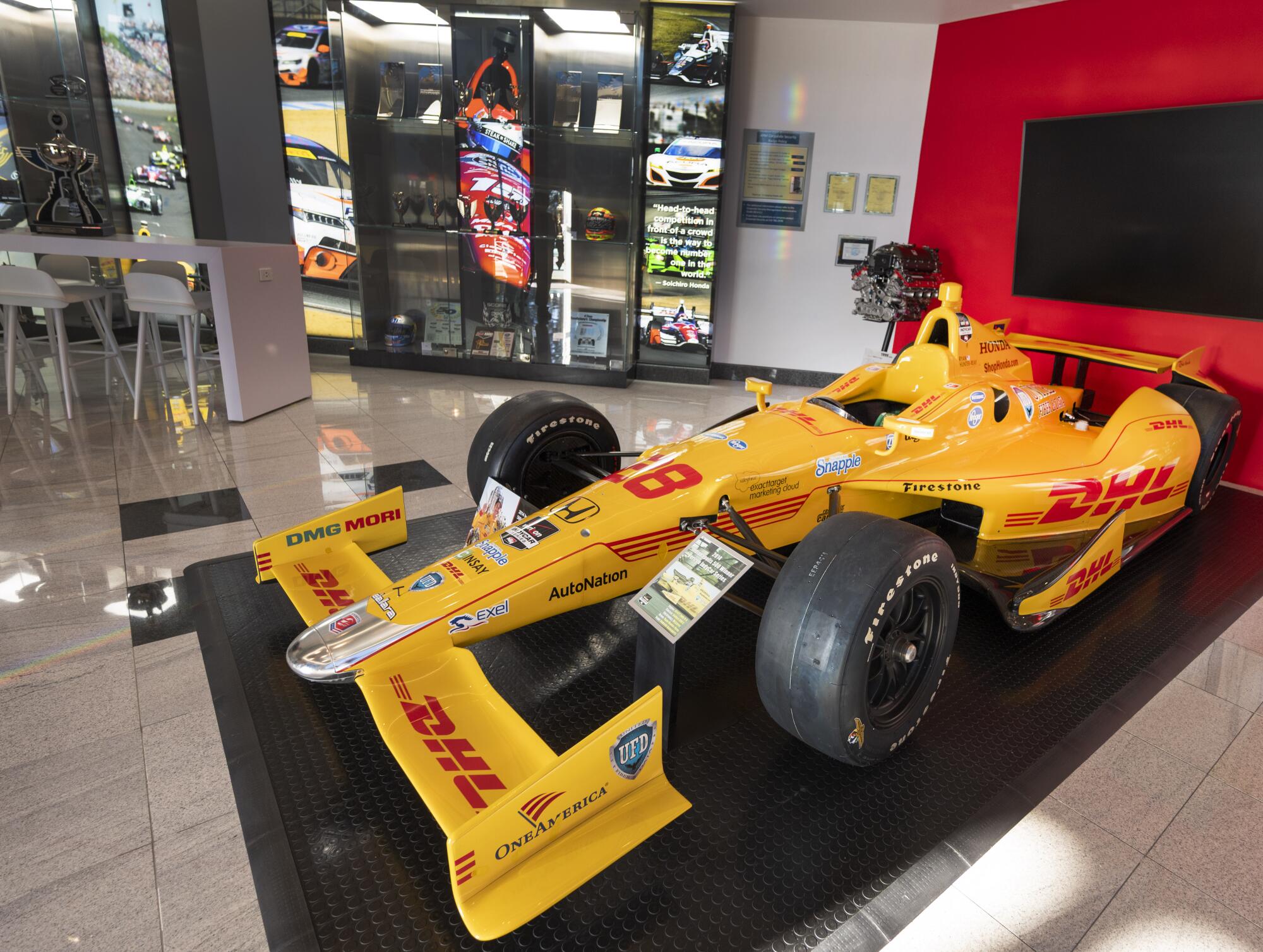
The car Ryan Hunter-Reay drove to victory for Andretti Autosport in the 2014 Indianapolis 500 sits on display at Honda Racing Corporation in Santa Clarita.
(Robert Hanashiro / For the Times)
“Thirty years ago our sole purpose in life was to look after racing in North America for Honda and Acura,” Salters said before last week’s events in Indianapolis. “Last year we changed that. We’re now part of a global racing organization. That’s another opportunity for associates here.”
“The automotive world, it’s pivoting,” he continued. “We are trying some new stuff. We’ll see how it goes.”
One chapter has been written. But the story isn’t finished.



Sports
Anthony Richardson free to seek trade after injury setbacks amid Colts’ shift to Daniel Jones

NEWYou can now listen to Fox News articles!
Anthony Richardson Sr.’s future in Indianapolis faces more uncertainty than ever.
The Indianapolis Colts granted Anthony Richardson, the team that used the fourth overall pick in the 2023 NFL Draft on the quarterback, permission to explore a trade. His agent, Deiric Jackson, confirmed the latest development in the 23-year-old’s tumultuous career to ESPN on Thursday.
Veteran quarterback Daniel Jones beat out Richardson in a preseason competition for the starting job. Jones made the most of another opportunity as an NFL starter, helping the Colts win eight of their first 10 games of the 2025 regular season.
Indianapolis Colts quarterback Anthony Richardson heads off the field after an NFL football game against the Denver Broncos on Sunday, Dec. 15, 2024 in Denver, Colorado. (AP Photo/David Zalubowski)
However, his season was ultimately derailed by an Achilles injury. The setback came two years after he tore an ACL with the New York Giants. The Colts appear ready to move forward with Jones, clouding Richardson’s future in Indianapolis.
Jones is set to become a free agent in March, meaning the Colts must either use the franchise tag or sign him to a new deal. Richardson has started just 15 games in three seasons with the Colts, his tenure largely shaped by injuries.
A shoulder surgery limited Richardson to four games during his rookie campaign, while a series of setbacks cost him four games in 2024.
Indianapolis Colts quarterback Anthony Richardson (5) looks for an open receiver during the game against the Houston Texans at NRG Stadium. (Troy Taormina/Imagn Images)
Richardson suffered what was described as a “freak pregame incident” during warmups last season, landing him on injured reserve after attempting just two passes in two games in 2025. He has thrown 11 touchdowns against 13 interceptions in his NFL career.
Colts general manager Chris Ballard said Tuesday that the vision problems stemming from Richardson’s orbital fracture last October are “trending in the right direction.” He added that Richardson has been “cleared to play.”
Indianapolis Colts quarterback Anthony Richardson (5) celebrates his touchdown against the New York Jets during the fourth quarter at MetLife Stadium in East Rutherford, New Jersey. (Brad Penner/Imagn Images)
Riley Leonard, a sixth-round pick in the 2025 NFL Draft, is expected to return to the Colts next season.
When asked about Richardson’s standing with the Colts moving ahead, Ballard replied, “I still believe in Anthony.”
Follow Fox News Digital’s sports coverage on X, and subscribe to the Fox News Sports Huddle newsletter.
Related Article

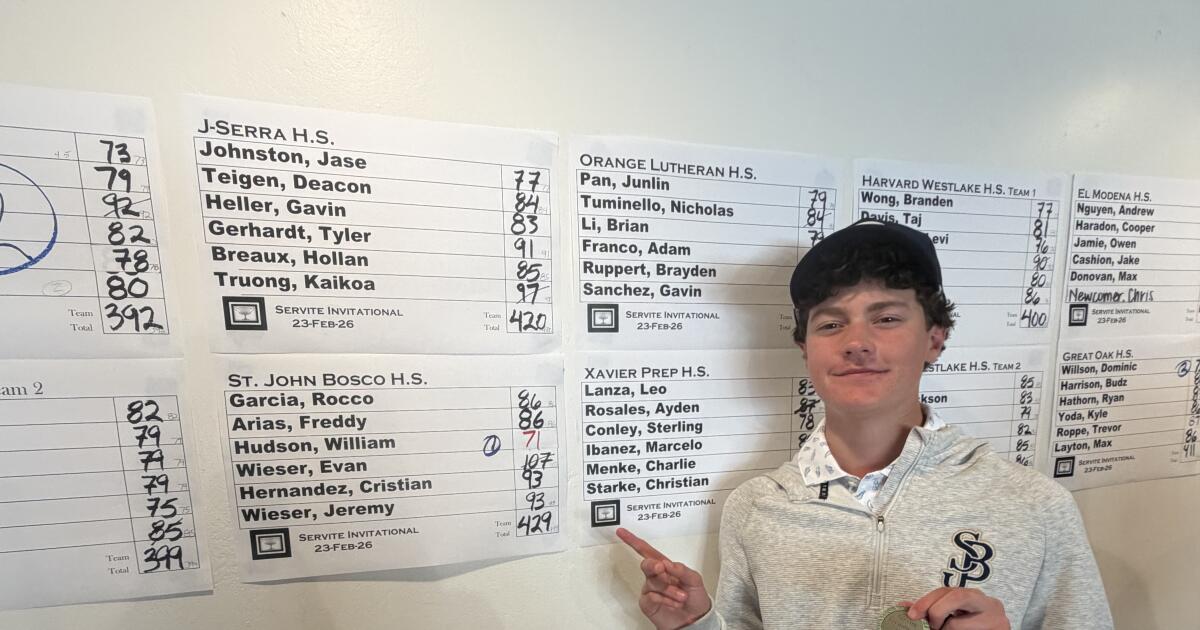
William Hudson, a 14-year-old freshman golfer, shot 71 on Monday at Western Hills Country Club in Chino Hills to win the Servite Invitational.
“It was very important to me and my school,” Hudson said.
Some think it’s the first time a St. John Bosco student won an invitational title.
Hudson is a straight-A student who picked up his first golf club when he was 3. He has a daily routine involving practicing at 6 a.m. before heading to school. He’s also enrolled in a school entrepreneur program that involves taking classes at a junior college that will qualify for college credits.
“They are long days, but I get through it,” Hudson said.
He comes from a family that enjoys golf. His great-grandfather played until his death at 98 last year.
“I love how it can take me to interesting places and meet interesting people,” Hudson said. “I can play for the rest of my life. It’s a lifelong sport.”
It’s looking like another strong year for golfers in Southern California, with several individual champions returning, including Jaden Soong of St. Francis and Grant Leary of Crespi.
Now Hudson has thrust himself into the conversation.
This is a daily look at the positive happenings in high school sports. To submit any news, please email eric.sondheimer@latimes.com.
Sports
Dashcam video shows former WWE executive Vince McMahon rear-ending vehicle on Connecticut highway

NEWYou can now listen to Fox News articles!
Police have released new video showing former WWE Chairman Vince McMahon speeding before crashing his 2024 Bentley Continental GT into another luxury car on a Connecticut highway last summer.
McMahon appeared to be followed by a state trooper in Westport moments ahead of the eventual collision. McMahon’s vehicle reached speeds of more than 100 mph, state police said.
A trooper’s dashcam video showed McMahon accelerating and then braking too late to avoid rear-ending a BMW. The car McMahon was driving then swerved into a guardrail and careened back across the highway. A cloud of dirt, apparently mixed with vehicle debris, was visible in the immediate area of the crash.
WWE owner Vince McMahon enters the arena during WrestleMania at AT&T Stadium on Apr 3, 2022 in Arlington, Texas. (Joe Camporeale/USA Today Sports)
“Why were you driving all over 100 mph?” a state trooper asked McMahon after catching up to the wrecked Bentley.
“I got my granddaughter’s birthday,” McMahon replied, explaining he was on his way to see her. The encounter was recorded on police bodycam video.
No serious injuries were reported in the July 24 crash, which happened the same day former professional wrestler Hulk Hogan died of a heart attack in Florida.
In an image taken from Connecticut State Police police bodycam video, Vince McMahon is questioned in his car after an accident on July 24, 2025, in Westport, Connecticut. (Connecticut State Police via The Associated Press)
Aside from the damage to the rear of the BMW, another vehicle driving on the opposite side of the parkway was struck by flying debris. The driver of that third car happened to be wearing a WWE shirt, police video suggested.
McMahon was cited for reckless driving and following too closely. In October, a state judge allowed him to enter a pretrial probation program that could erase the charges if he completes it successfully.
He was also ordered to make a $1,000 charitable contribution. His attorney, Mark Sherman, called the crash simply an “accident.”
“Not every car accident is a crime,” Sherman said. “Vince’s primary concern during this case was for the other drivers and is appreciative that the court saw this more of an accident than a crime that needed to be prosecuted.”
Vince McMahon attends a press conference to announce that WWE Wrestlemania 29 will be held at MetLife Stadium in 2013 at MetLife Stadium on Feb. 16, 2012 in East Rutherford, New Jersey. (Michael N. Todaro/Getty Images)
State police said a trooper was trying to catch up to McMahon on the parkway and clock his speed before pulling him over. They said the incident was not a pursuit, which happens when police chase someone trying to flee officers. They also said it did not appear McMahon was trying to escape.
“I’m trying to catch up to you, and you keep taking off,” State Police Det. Maxwell Robins said in the video.
“No, no no. I’m not trying to outrun you,” McMahon clarified.
An accident information summary provided to the media shortly after the crash did not mention that a trooper was following McMahon.
The trooper’s bodycam video also shows him asking McMahon whether he was looking at his phone when the crash happened. McMahon said he was not and added he hadn’t driven his car in a long time.
After Robins tells McMahon that his car is fast, McMahon replies, “Yeah, too (expletive) fast.”
Fox News Digital submitted a public records request to obtain the police video, which was first acquired by The Sun.
McMahon stepped down as WWE’s CEO in 2022 amid a company investigation into sexual misconduct allegations. He also resigned as executive chairman of the board of directors of TKO Group Holdings, the parent company of WWE, in 2024, a day after a former WWE employee filed a sexual abuse lawsuit against him. McMahon has denied the allegations. The lawsuit remains pending.
The Associated Press contributed to this report.
Follow Fox News Digital’s sports coverage on X, and subscribe to the Fox News Sports Huddle newsletter.
Related Article

House explosion in Cleveland’s Slavic Village neighborhood catches neighboring houses on fire

A total lunar eclipse will turn the moon blood red on Tuesday

Alabama ‘Fully Aware’ of Losing Streak to Tennessee Ahead of Road Rematch

Over $150K worth of drugs seized from man in Juneau, police say

Warmer temps increase rattlesnake risks: Arizona Game and Fish

Florida High School Football Rankings: Top 25 teams – Oct. 21

Cleary's 21 help Le Moyne down Central Connecticut State 69-64 in OT

How old is Bo Nix? What to know about Oregon quarterback ahead of 2024 NFL Draft

99th annual Pony Swim held in Virginia

Indiana Members Credit Union announced as new anchor tenant at Bottleworks District

Where Iran’s ballistic missiles can reach — and how close they are to the US

Has India’s influence in Afghanistan grown under the Taliban?

Bill Clinton to testify before House committee investigating Epstein links

Read Judge Schiltz’s Order

Vulnerable House Dem lashes out at Trump’s ‘racist’ SOTU challenge: ‘That was uncomfortable’
-

 World2 days ago
Exclusive: DeepSeek withholds latest AI model from US chipmakers including Nvidia, sources say
-

 Massachusetts2 days ago
Mother and daughter injured in Taunton house explosion
-

 Montana1 week ago
2026 MHSA Montana Wrestling State Championship Brackets And Results – FloWrestling
-

 Oklahoma1 week ago
Wildfires rage in Oklahoma as thousands urged to evacuate a small city
-

 Louisiana5 days ago
Wildfire near Gum Swamp Road in Livingston Parish now under control; more than 200 acres burned
-

 Denver, CO2 days ago
10 acres charred, 5 injured in Thornton grass fire, evacuation orders lifted
-

 Technology6 days ago
YouTube TV billing scam emails are hitting inboxes
-

 Technology6 days ago
Stellantis is in a crisis of its own making