Sports
A year after Adam Johnson’s death, why are NHL players resistant to skate-cut protection?


The thought comes in flashes, sudden reminders. When a player gets checked into the bench and his legs dangle over the boards. When someone goes hard to the net, trips over a stick and goes soaring through the air, legs flapping behind him like coat tails. When there’s a battle in the corner and guys are kicking at the puck in an effort to dislodge it.
Even when someone just hops over the boards for a shift change. It’s always there, gnawing at Chicago Blackhawks center Jason Dickinson.
“Personally, it’s never not been on my mind,” Dickinson said. “Ever since I was in junior, I was always super paranoid about my arms being up on the boards and someone jumping over. It was always there in my head that those are blades. Those are sharp. I’ve been cut by much duller things.”
Dickinson’s been on both sides of skate cuts. He had a harrowing near-miss two seasons ago when he caught a skate to the collarbone in a game against the Vegas Golden Knights. And last season, he very nearly took out the eye of Boston Bruins center Jakub Lauko while falling into the boards. Both instances have stayed with him, serving only to deepen that nagging concern in the back of his mind.
GO DEEPER
Adam Johnson manslaughter case: Explaining the legal delays
Dickinson is a thoughtful and conscientious player. So if anyone in the NHL were going to embrace cut-resistant technology — around the neck, around the wrists, around the Achilles tendons — it’d obviously be Dickinson, right?
Wrong.
“I don’t wear a shirt when I play — I get super hot,” Dickinson said. “So wearing something on my wrist or my neck, I’m going to sweat even more than I already do. So am I at risk for cramping? So I understand. I tried wearing them and I just started overheating. I want to wear them. I wanted to wear them. But I also need to feel good. So if I’m on the bench and I’m getting light-headed or I’m cramping, now I’m also at risk for injury elsewhere. It’s a tough thing.”
One year ago this week, former Pittsburgh Penguins forward Adam Johnson died after an opponent’s skate sliced his neck during a game in Britain’s top hockey league. Amid the shattering grief within the global hockey community arose a discussion about the need to better protect hockey players from what essentially amounts to a three-millimeter-wide knife blade affixed to each player’s foot. As the game gets faster and faster and the players get bigger and bigger, more and more players are losing control of their legs in high-speed collisions in front of the net, along the boards and at the benches. Edmonton Oilers forward Evander Kane had his wrist cut open by Pat Maroon’s skate two years ago. Former Ottawa Senators defenseman Erik Karlsson had his Achilles tendon lacerated by Matt Cooke 11 years ago. Nearly every player has a story about a near-miss; they all just got lucky.
Hockey players see themselves as invincible, a foolhardy but necessary mindset in a fast and violent game. Johnson’s death reminded everyone that they’re not. The on-ice death of a peer was going to serve as a catalyst for change, for players to adapt. It had to.
So one year later, what has changed at the NHL level?
Hardly anything at all.
Neck protection is now mandatory at many of the lower levels, but in the NHL, most teams have one, maybe two, often no players wearing any. They cite comfort. They cite the awkward appearance. They cite their routines.
“I’m not necessarily surprised,” said Blackhawks winger and Johnson’s former Minnesota-Duluth teammate Joey Anderson, who was required to wear a neck guard after Johnson’s death because he was in the AHL at the time, and who continues to wear it in the NHL. “At this age, guys are pretty stubborn. They’re into their routines and set in their ways. It’s hard for guys to change.”
The option to be stubborn, though, is increasingly limited to players at the highest level.
Since Johnson’s death, USA Hockey has made neck protection mandatory for players competing in youth, girls, high school and junior hockey. The International Ice Hockey Federation has done the same for players in all its tournaments, rather than simply those featuring teenagers. All three Canadian major junior leagues now have mandates on the books; the Western Hockey League had been the holdout.
Perhaps most relevantly, the American Hockey League — the final pre-NHL step for many players and a league long used as a testing ground for rule and equipment changes — is now requiring neck protection for all its players and officials.
“Hopefully that’s what’s going to end up happening as we move forward here, that it’s just going to be a piece of their equipment,” AHL president and CEO Scott Howson told the Associated Press before his league started its season. “With the different products out there, hopefully all the players can find something that they can adapt to and eventually like — or, at the very least, not notice when they’re playing hockey.”
In other words, regardless of whether NHL players are on board, the market for neck protection has never been more robust.
The hope, according to those within the industry, is that increased demand leads to higher quality, more options and more palatable price points.
The comfort factor is crucial for widespread adoption by professionals, but it’s less of a pressing issue for beer leaguers, children and others who are competing in leagues with mandates already in place. For that captive audience, according to many manufacturers and stakeholders within the game, the question is a little more simple: How well does the cut-resistant equipment actually work?
“Mandating a piece of equipment which is potentially ineffective is not the answer. The answer is more complicated than just making a rule,” Dr. Mike Stuart told The Athletic. Stuart is the chief medical officer for USA Hockey, a member of the IIHF medical committee, the father of three former NHL players and a longtime champion of increased safety standards in the game.
“We have to make sure what we’re doing is going to be effective,” Stuart said. “And that means developing high-quality and affordable cut-resistant products.”
It’s not that the current standard is lacking, Stuart said. Hockey Canada has long required neck protection certified by Canada’s Bureau de normalisation du Quebec (BNQ), and the BNQ standard is the baseline for the Hockey Equipment Certification Council, a non-profit organization that USA Hockey relies on to certify safety gear such as helmets and visors. The HECC says its goal is to have certification for neck guards in place by 2025. Manufacturers can already apply to the program.
It’s a starting point, according the HECC — not the finish line.
“Let’s try for the best cut-resistant materials with the best anatomic coverage,” Stuart said. “But let’s also test it as best we can and make it hockey-specific.”

T.J. Oshie (right) wears neck protection while his teammates, including John Carlson (left), do not. (Jeff Vinnick / NHLI via Getty Images)
For finicky NHL players, comfort and maneuverability is just as important as efficacy when it comes to protective gear. Capitals winger T.J. Oshie’s equipment company, Warroad, was already offering protective gear, and Johnson’s death sparked a massive increase in interest. Warroad’s most effective product in this area is the Tilo “neck and wrist top,” a turtleneck of sorts that offers skate-cut protection around the neck and wrists. Oshie was involved in the design of the shirt, and his experience with standalone neck and wrist sleeves informed the process.
Oshie is American, but whenever his youth teams played in Canada, they were required to wear neck protection. The ones they used were thick, bulky pieces of foam that were hot and itchy and generally awful to wear.
“We’d just end up taping it into a little ball and it turned into a necklace,” Oshie said. “It wasn’t protecting anything.”
Players competing during IIHF tournaments have done the same. “I have pictures from national teams where players would remove the cut-resistant material and wear a little piece of cloth around their neck to satisfy the requirement,” Stuart said. “As a medical professional trying to prevent catastrophic injuries, that mandate is not effective.”
Modern neck guards are made of thinner but stronger fabric, but they still fall out of place or bunch up, leaving much of the neck exposed. Same with the wrist sleeves. By including them as part of the shirt, Oshie said the protection stays in place where players need it. Unsurprisingly, it’s not cheap — the Warroad website lists it at $199 per shirt.
After Johnson’s death, Warroad couldn’t keep up with the initial flood of orders and requests, but Oshie immediately brought some of the shirts to the rink in Washington. A handful of Oshie’s Capitals teammates tried the shirt. None of them stuck with it. They were surprised at how much more comfortable it was than the old bulky guards, but they still found it too warm, too noticeable, too different.
“The one thing I’ve seen in the last 17 years that I’ve been in the league is hockey players aren’t very quick to change what they have,” Oshie said. “Some of the greats in the league now are still using the same cup from when they were in juniors. There’s definitely a superstition thing that goes along with hockey players. When they find something they like, they’re sticking with it. Even if there’s something better.”
One of the first things Oshie did every summer when he was at the University of North Dakota back in the mid-2000s was take the infernal cage off his helmet. A clear view of the ice felt freeing, but it did leave him feeling a little exposed. So he tried a visor. Didn’t take. It always fogged up, there was a glare and it affected his sight too much. So Oshie took off the visor and went old-school, free and easy.
“I was still a stubborn college kid. I was like, ‘I don’t need a visor,’” Oshie said. “Then I took a skate to my right eye and eyebrow. I was like, ‘All right. Maybe I do need a visor.’”
He’s worn one ever since. He learned to manage the fog. He got used to the glare. He can see the puck just fine. It was the same thing the first time he wore his own brand’s shirt, with the built-in neck and wrist protection. After a few practices, it felt entirely normal, like any other article of clothing.
Oshie, who’s sidelined long-term with a chronic back issue, wore the shirt for the duration of last season. But he was very much the exception. While his Warroad gear is in all 32 locker rooms, he said the Philadelphia Flyers’ Travis Konecny is the only NHL player currently wearing the specific Tilo neck-and-wrist protection shirt.
Edmonton Oilers winger Jeff Skinner does wear neck protection, made by Bauer, but he didn’t have some sort of epiphany like Oshie did in college. Johnson’s death didn’t cause a fundamental shift in the way he thought about the game and his own invincibility. Skinner was with the Buffalo Sabres last year, and shortly after Johnson’s death, a stack of turtlenecks designed to protect the neck from skate cuts showed up in the locker room, as it did in a lot of locker rooms. Skinner tried it.
“For me, I don’t know, it felt fine, so I just kept it,” he said.

The Oilers’ Jeff Skinner wears a Bauer neck protector. (Codie McLachlan / Getty Images)
Skinner only wears the turtleneck during games, not practices. Deep down, he knows the inherent danger of his sport, but it’s not something he thinks about all the time. After all, skate cuts are hardly the only potentially catastrophic injury on the ice. There are rising slap shots headed right for your face and elbows from hard-charging defensemen, and a torn ACL or broken leg can happen at any moment.
“If it happens right in front of you, then maybe it crosses your mind,” he said of skates endangering players. “There’s a lot of stuff going on. There’s body parts flying everywhere, and the puck you’ve got to worry about.”
Skinner commended the league and the manufacturers for making protective gear available, but he also doesn’t blame players who don’t want to wear them. Hockey players are notoriously finicky about the equipment they wear — skates must be tied just so and tape must be applied here, not there. Some players change skates constantly, some wear the same pair all season. Same with sticks and gloves. Some players wear lucky undershirts that have more holes than fabric after years of use. Some, like Dickinson, don’t wear anything at all under their gear.
“Equipment’s a personal thing,” Skinner said.
Johnson’s death hit Anderson harder than most, as the two had been friends and teammates. Wearing the protective collar was a no-brainer for Anderson. But you won’t see him proselytizing around the locker room.
“Guys can see it,” Anderson said. “I’m not an old guy, especially in this locker room. It’s not really my place to push things on guys. If someone asked me, I’d encourage it. But it’s not my place to step in. At the younger levels, they’re enforcing it now. Guys (in the NHL) are just grandfathered into their ways.”
And that’s how the change is likely to happen — slowly, from the ground up. With so many of the lower leagues now requiring protective gear, younger players will grow accustomed to it and bring it with them once they graduate to the NHL. Dickinson guessed that in 10 years, 90 percent of the league will be wearing neck protection regardless of whether the NHL requires it. After all, helmets weren’t mandatory in the NHL until 1979, but Craig MacTavish was still going lidless as late as 1997 because he was grandfathered in.
The rise of concussions didn’t convince all players that helmets were worthwhile. Gruesome eye injuries from sticks and pucks didn’t change hearts and minds overnight about visors. And Johnson’s death, shattering as it was for the hockey world, did little to change NHL players’ attitudes about protective neck gear.
“The story did end up fizzling out,” Dickinson said. “Unfortunately, it’s not a hot topic. But I think it should still be on guys’ minds. There’s real risk.”
There’s also real reason for optimism, even if it takes a generation to bear out. Stuart has witnessed it — and spurred it — firsthand. In 2002, while a co-director of the Mayo Clinic Sports Medicine Center, he co-authored a study on facial protection in hockey. He presented that research to the AHL, and it helped prompt the league to make visors mandatory for the 2006-07 season. Seven years later, they were mandatory for new NHL players. He sees that as “a kind of prelude” to the cut protection dialogue.
“I’m very encouraged because I think the entire hockey family is becoming more accepting. They realize the importance. And we also certainly understand the comfort factor, the cost factor,” he said. “These are all things that we have to work together on to make it not only effective but comfortable and affordable. And I think that’s happening.”
(Illustration: Dan Goldfarb / The Athletic. Photos: Patrick Smith, Jeanine Leech / Icon Sportswire, Brett Holmes / Icon Sportswire / Getty Images)



NEWYou can now listen to Fox News articles!
The 2026 MLB All-Star Game arrived in Philadelphia with the feel of a 250th birthday bash for the United States, complete with plenty of red, white and blue and a roster full of stars who had earned their stripes.
But Citizens Bank Park, long known as a hitter-friendly backdrop, produced fewer fireworks than expected as the American League shut out the National League 4-0 in the 96th Midsummer Classic.
CLICK HERE FOR MORE SPORTS COVERAGE ON FOXNEWS.COM
A general view of Citizens Bank Park during the 96th MLB All-Star Game presented by Mastercard on, July 14, 2026, in Philadelphia, Pennsylvania. (Rob Tringali/MLB Photos via Getty Images)
Toronto Blue Jays pitcher Dylan Cease struck out the side in the first inning, setting the tone for a dominant AL pitching performance as 10 relievers helped finish a three-hitter in Tuesday night’s shutout of the NL.
New York Yankees outfielder Cody Bellinger hit a two-run single and Ben Rice followed with an RBI single in the first against Cristopher Sánchez of the host Philadelphia Phillies.
Chicago White Sox infielder Miguel Vargas added an eighth-inning home run off the Los Angeles Dodgers’ Justin Wrobleski, who was pitching on his 26th birthday, for the game’s only extra-base hit. The AL won for the 18th time in 23 games and holds a 49-45-2 advantage overall.
Singles by Juan Soto in the fourth, Pete Crow-Armstrong in the eighth and Otto Lopez in the ninth were the only hits by the NL, which failed to advance a runner past first.
Pitchers combined for 27 strikeouts, 15 by AL hurlers.
MLB ALL-STAR GAME SCARE AS RAYS SLUGGER JUNIOR CAMINERO EXITS AFTER TAKING 98 MPH FASTBALL TO HAND
Tampa Bay Rays’ Yandy Diaz loses control of the bat in the fifth inning during the MLB All-Star Game between the American League and National League on July 14, 2026, in Philadelphia, Pennsylvania. (Matt Rourke/AP)
Phillies slugger Kyle Schwarber, last year’s hero in the first-ever swing-off tiebreaker, led off for the NL. Schwarber replaced designated hitter Shohei Ohtani, who skipped the showcase to undergo a knee procedure ahead of the season’s second half.
Philadelphia Phillies designated hitter Kyle Schwarber bats during the third inning of the 2026 MLB All-Star Game at Citizens Bank Park in Philadelphia, Pennsylvania, on July 14, 2026. (Al Bello/Getty Images)
Detroit Tigers outfielder Riley Greene and two New York Yankees, first baseman Ben Rice and Bellinger, gained American League starting spots because of injuries.
Tampa Bay Rays’ Junior Caminero was hit on the outside of his left hand by a 97.6 mph sinker from St. Louis Cardinals closer Riley O’Brien in the third inning and immediately left the game. The 23-year-old, fourth in the major leagues with 28 home runs, stayed down for a few moments before he popped up and ran straight into the clubhouse. X-rays were negative.
CLICK HERE TO DOWNLOAD THE FOX NEWS APP
Players across the majors will have the day off Wednesday before the Phillies host the New York Mets on Thursday. Action across the rest of the league resumes Friday.
The Associated Press contributed to this report.
Follow Fox News Digital’s sports coverage on X, and subscribe to the Fox News Sports Huddle newsletter.
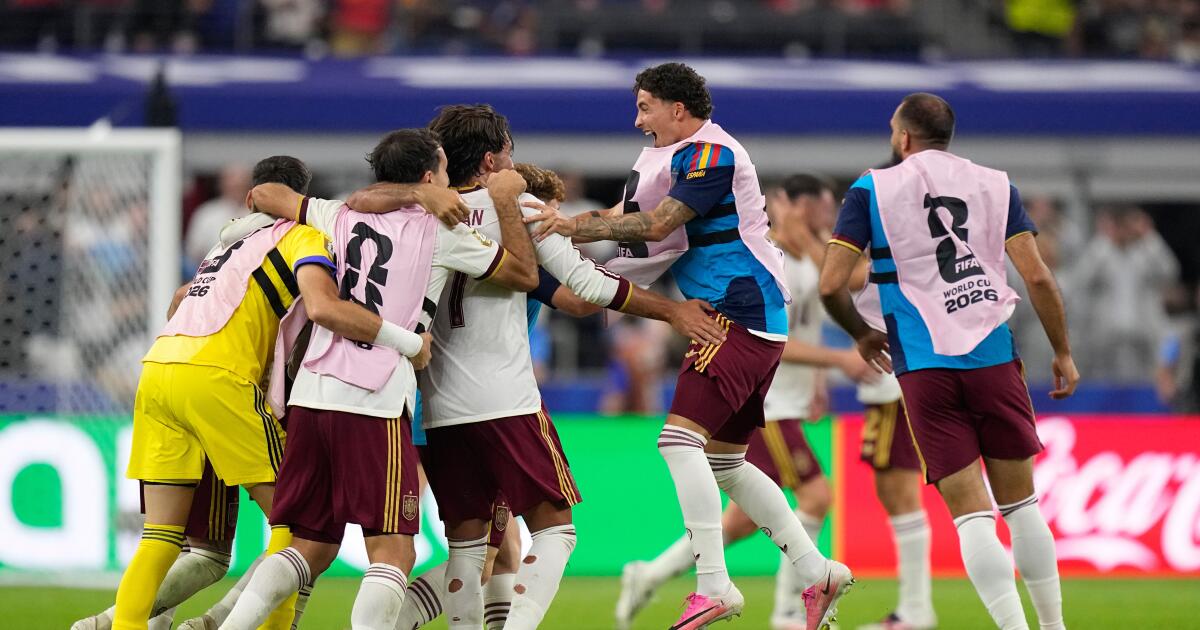
ARLINGTON, Texas — In a World Cup boasting a galaxy of stars, a lunch-bucket team of blue-collar everymen may wind up outshining them all.
Spain clinched a berth to the final Tuesday by smothering France 2-0 at AT&T Stadium, running its unbeaten streak to 37 games while eliminating a team that had run roughshod through the tournament.
And it wasn’t even close. France came into the game with 16 goals, second only to Argentina in the tournament, then failed to put a shot on goal in the first 81 minutes.
It had Kylian Mbappé, who is tied with Lionel Messi for the scoring lead this summer and was the Golden Boot winner four years ago in Qatar. He was all but invisible until, frustrated, he felled Spanish keeper Unai Simón with a cheap shot in the final minutes, drawing a well-deserved yellow card.
France couldn’t even score into an open net, with Desire Doue lining a low shot right at a rapidly retreating Simón, who had come well off his line and left the goal unattended. For Simón, Tuesday’s clean sheet was his sixth in seven games in this tournament.
Spain will meet the winner of Wednesday’s second semifinal between England and reigning champion Argentina on Sunday at MetLife Stadium in East Rutherford, N.J.
France’s Kylian Mbappé reacts after losing to Spain during a World Cup semifinal in Arlington, Texas, on Tuesday.
(Julio Cortez / Associated Press)
“Whoever comes, comes,” teenage center back Pau Cubarsí said in Spanish. “I don’t think I want any of them. Let it be God’s will. We’re going to New York and then we’ll figure out who needs to come.”
Winning with defense may not be attractive, but it’s certainly been effective. And for Spain, the approach certainly fits with its team-first mentality.
“There was some talk that our defense and goalkeeping weren’t up to par. But I think we’ve silenced a lot of critics,” Cubarsí said. “We’ve only conceded one goal and we’re in the final.
“This is a team effort, both those who play and those on the bench.”
Added right back Pedro Porro: “We’re just continuing to work with humility. We’ve been doing things right and building on our strengths. We’ve also been correcting the things we haven’t done well. We’re just taking it step by step.”
It wasn’t so much that France played poorly, although it did. It was that Spain forced it to play that way.
France had never trailed in the tournament, but it fell behind in this one on Mikel Oyarzabal’s successful penalty shot in the 22nd minute. Lucas Digne was called for the foul when he chested down an errant pass from Spain’s Marc Cucurella on the edge of the 18-yard box, then reached out his left boot to control it, only to catch the leg of Spain’s Lamine Yamal who was charging in from the blind side.
Salvadoran referee Iván Barton immediately pointed to the spot and Oyarzabal stepped up and obliged, beating French keeper Mike Maignan into the side netting at the right post for his fifth goal of the tournament. The score was the first Maignan had allowed in the knockout rounds, breaking a 360-minute scoreless streak and it would be all Spain would need to get to the final for the first time since 2010, when it won its only World Cup.

Spain goalkeeper Unai Simón makes a save in front of France’s Theo Hernandez during a World Cup semifinal in Arlington, Texas, on Tuesday.
(Jessica Tobias / Associated Press)
Maignan didn’t do any better on the second shot he faced, this one coming 13 minutes into the second half when Porro came in alone on the keeper, then used his right foot to flick the ball by the goalkeeper to double Spain’s lead.
“My son couldn’t come today because he’s feeling a little under the weather with a fever,” said Porro, who dedicated his goal to the boy. “It was a mix of emotions because he couldn’t be here, and then his dad scored a goal.
“I wanted to look out at the stands and the only people there were my partner, my father-in-law and my physical therapist.”
For Porro, the goal was a measure of redemption as well. There were doubters when coach Luis de la Fuente named him to the World Cup team and those critics grew louder when de la Fuente made him a starter.
But those critics fell notably silent Tuesday.
“I don’t have to prove anything to anyone,” Porro said. “Obviously, I never imagined — not even in my wildest dreams — that I’d be playing in this World Cup the way I am.

Spain’s Pedro Porro celebrates after beating France during a World Cup semifinal Tuesday in Arlington, Texas.
(Florencia Tan Jun / Getty Images)
“But it’s also thanks to my teammates, and thanks to the coach for the confidence he’s shown in me from the very beginning.”
Spain hasn’t lost a game in the knockout phase of a World Cup since 2006 — when it fell to France — playing to draws in the round of 16 in the past two tournaments before being eliminated both times on penalties. They didn’t let it come down to that this time.
“We’re in a final. It’s a once-in-a-lifetime experience,” said Cubarsí, 19. “Maybe I’m still too young for everything I’m going through right now. But soccer is something to be enjoyed. Opportunities will come your way if you’re willing to make sacrifices and all that.”
For French coach Didier Deschamps, meanwhile, the loss marked his penultimate game with a team he’s taken to two World Cup finals in 15 years as coach. He had earlier announced he would be stepping aside after the tournament. Instead of capping raucous Bastille Day celebrations in France with a trip to the World Cup final, Deschamps and his squad will travel to Miami to play in the third-place game.
Some players knelt at the final whistle, head down, staring at the turf.
“There’s obviously a lot of disappointment,” Deschamps said. “The players are devastated because we had high hopes. Even so, we have to be realistic and acknowledge that today we were a step behind technically against a team that played very well.
“It’s our fault, first and foremost.”
Well, not really. The credit should go to Spain.
Sports
Folarin Balogun admits that red-card reversal affected USA World Cup teammates: ‘A lot of outside noise’

NEWYou can now listen to Fox News articles!
The United States Men’s National Team had all the momentum when Folarin Balogun’s red card from the Round of 32 was suspended, giving him a chance to play in the Round of 16 — at least, that’s what American soccer fans thought.
The day before the USMNT’s Round of 16 game against Belgium, which Balogun was originally supposed to miss because of a red card in the previous game, FIFA ruled that he would be eligible.
The ruling added to what was already a huge controversy, as it was argued Balogun should not have been red-carded in the first place. Nonetheless, Balogun was active despite an appeal and strong reaction from Belgium.
United States forward Folarin Balogun kicks the ball against Bosnia and Herzegovina in the Round of 32 of the 2026 FIFA World Cup at Levi’s Stadium in Santa Clara, California. (David Gonzales)
However, it was hardly a needle-mover, as Belgium embarrassed the Stars and Stripes with a 4-1 win. If anything, the needle might have moved the wrong way, Balogun himself said.
“My initial reaction was I was happy to be back in the team, but when I kind of started to reflect, I knew it was going to cause a lot of controversy, and I could almost see within my teammates a bit of nerves, because it is something that is so unique,” Balogun told CBS on Tuesday.
“The closer we got to the game, I tried to just focus as best as I could, but it was difficult. A lot of outside noise and that’s hard to avoid.”
Balogun said the entire situation was “confusing,” as the team was initially practicing without him. But the team found out on the bus to practice that Balogun would be active.
“Everybody was screaming and shouting,” Balogun said.
BELGIUM MANAGER PRAISES CLASSY GESTURE BY FOLARIN BALOGUN AFTER RED CARD CONTROVERSY: ‘I REALLY LIKED THAT’
Folarin Balogun of the U.S. celebrates scoring their first goal during the FIFA World Cup 2026 Round of 32 match against Bosnia and Herzegovina in Santa Clara, California. (Phil Noble / Reuters via Imagn Images)
But that did not change the whirlwind of emotions, which may or may not have contributed to the loss.
“It’s more just being able to separate the emotion from the job at hand. We’re all professionals, so it’s not something I think was too difficult to be able to separate once we got over the initial announcement. You saw it was a difficult game against Belgium and that can kind of overshadow whether we were focused or not. From me being inside the camp and inside the setup, I know we had full concentration going into the game,” he said.
President Donald Trump admitted to calling FIFA President Gianni Infantino to ask for a review of the red card.
“All I did was, I asked for a review, because I didn’t think it was a foul,” Trump said. “And again, I’m good at this stuff. I didn’t think it was a foul. I thought it was two great athletes who crashed into each other and got entangled. That was not a guy punching somebody in the face or anything that would be different.
Team USA striker Folarin Balogun celebrates scoring a goal during the FIFA World Cup 2026 Round of 32 match against Bosnia and Herzegovina at Levi’s Stadium in Santa Clara, California. (Jamie Squire/Getty Images)
CLICK HERE TO DOWNLOAD THE FOX NEWS APP
“I think it’s a terrible… if they wouldn’t allow a top player, maybe the best, maybe among the best on the team, to play, I think it would have had a big stain. I relayed it. I didn’t tell him what to do. I don’t believe he made the decision. I think it was a committee that made the decision, and they made the right decision because, No. 1, it wasn’t a foul, and you want to see a game with your best players.”
Belgium was knocked out by Spain in the quarterfinals, and Spain will face France in the first semifinal match Tuesday in Atlanta.
Follow Fox News Digital’s sports coverage on X, and subscribe to the Fox News Sports Huddle newsletter.
-
News24 minutes ago
ICE should do traffic stops despite recent shootings, Trump says, seeming to oppose new suspension
-

 Los Angeles, Ca2 hours ago
Southern California hits hottest day of its extreme heat warning
-

 Detroit, MI2 hours ago
Steve Yzerman out as Detroit Red Wings GM, moves to senior advisor role
-
 San Francisco, CA3 hours ago
Supervisors urge California to expand S.F. speed-camera program
-

 Dallas, TX3 hours ago
Five teens injured after crashing carjacked vehicle during Dallas police chase
-

 Miami, FL3 hours ago
Tokyo-style Neapolitan pizza is coming to Miami, led by legendary pizzaiolo chef Bun
-

 Boston, MA3 hours ago
SEE THE GOOD: Roxbury center reminds young adults ‘You got this’ – Boston News, Weather, Sports | WHDH 7News
-
Denver, CO3 hours ago
Five Points affordable housing building honors Dr. Justina Ford | Rocky Mountain PBS


