Sports
A stroke took his words away. Baseball is giving them back


CLEARWATER, Fla. — When Charlie Manuel began to speak again, he could not talk. It had been five days since his stroke. His heart was better. He’d regain the feeling in his right side with time. But, last September, there were no words.
“I knew what I wanted to say,” Manuel said months later. “That really gets to you. You know what to say and you can’t say it.”
Manuel is the ultimate baseball lifer, with more than six decades in the game. The Phillies’ all-time winningest manager, known for his love of hitting, trademark malapropisms and colorful language, was always most at home behind the batting cage. Five months after the Phillies fired him as manager in 2013, they hired him as an advisor to the front office. He hadn’t yet budged. The role is now largely ceremonial, but Manuel had never viewed it that way. “I’m real, for one thing,” Manuel said. “I’m honest.” He was a constant at spring training. He had bullied his way through constant health problems, to hell and back in 80 years. This was different.
The stroke had damaged a specific part of his brain that controls language expression; the doctors diagnosed Manuel with expressive aphasia and dysarthria. It was the most demoralized and discouraged his wife, Missy, had ever seen him. He exists to talk hitting and, now, he could not form a complete sentence. He did not want visitors. He would not talk on the phone.
“Sixty-one years in baseball and this is how I’m going out,” Charlie told his wife.
“You’re not going anywhere yet,” Missy said.
The critical-care team at Lakeland Regional Health Medical Center had intervened during a routine cardiac catheterization on Sept. 16. They had to move fast: Manuel was having a stroke. “It looked like a TV show,” Missy said. “And I’m just running, trying to keep up with them.” Charlie was awake. He squeezed Missy’s hand.
The surgeon had inserted one stent into Manuel’s heart; another 45-minute procedure followed to remove the clot that caused the stroke. The doctors were hopeful he’d recover, but they were not certain how much damage the stroke had inflicted. “Time is brain,” they kept telling Missy. The Phillies released a 62-word statement asking for “thoughts and prayers at this time.”
Missy was both terrified and optimistic.
So, she turned on the Phillies on an iPad in Charlie’s hospital room. Days became weeks. The doctors tested his cognition. If there was any doubt, Missy told them, they should come by when the Phillies were playing. It might not have always sounded like Charlie, but he was in there.
“He was second-guessing,” Missy said. “He was, you know, armchair managing. He was breaking down the pitcher, the hitter.”
The Phillies kept winning. Manuel was discharged from inpatient care during the National League Championship Series. He returned to his Winter Haven, Fla., home to watch the Phillies lose Game 6 and Game 7.
He was disappointed, but — even worse — the proper words weren’t there. It hit him, the gravity of this challenge he faced.
“I couldn’t curse,” Manuel said.
The twist is beautiful, and it’s something Manuel can appreciate. His folksy mannerisms were the subject of daily rants on 94.1 WIP while he managed the Phillies — before and after his World Series title. But he has become a larger-than-life figure in Philadelphia, a city that extends that status to few.
He was a .198 hitter in the majors, but his country accent and prodigious homers made him a folk hero as a player in Japan. He was the hitting whisperer to great Cleveland offenses but came to the Phillies as an outsider. He was an easy target for upset fans, then won five straight division titles from 2007-11. The Phillies haven’t won one since, and time has been good to Manuel’s legacy. Now, strangers are obligated to shout “Cholly!” when they see him. And, in the days after Manuel’s stroke, the sports-talk station invited callers to leave supportive messages. WIP sent Missy three large audio files. She played them to Charlie while they were in the hospital.
He smiled.
“I think that helped him a lot,” Missy said. “Just that encouragement from people — people from everywhere. And there are Phillies fans everywhere. Lots of them had had a stroke. A ton of speech therapists, and occupational therapists. I would just play them.”
But, for the first month, Manuel would not answer his phone. He was depressed. He did not sound like he should. “Sometimes I didn’t talk at all,” Manuel said. “I’d just go in my room and sit down.” Missy nudged him. One of the few people Charlie trusted, his old pitching coach Rich Dubee, drove 90 minutes to sit with him. Dubee could sense the concern.
“You know just by his mannerisms, he was aware that he wasn’t saying the right words sometimes,” Dubee said. “He was real conscious of that.”
Three months after the stroke, Manuel remained guarded. He started to emerge from that darkness in December. Missy brought him to visit some of the grandkids at the circus in Sarasota, Fla., and a few Phillies fans recognized Manuel. He’s always invited people into his orbit. It’s why he has achieved mythical status in Philly. It’s why people feel compelled to approach him.
At the circus, he took some photos.
“Did they know you had a stroke?” Missy asked.
“No,” he said. “I didn’t talk to them long enough.”
But she saw newfound confidence. Manuel had been so self-conscious with his speaking.
“I mean, it’s natural,” Manuel said. “I’m not upset or nothing. But what are we going to do about it?”
Charlie Manuel, here with one of his grandchildren, has been in professional baseball since 1963. (Courtesy of the Manuel family)
He finished his first speech therapy session in October feeling hopeful. “I enjoyed talking to you,” Manuel said to Pam Smith. “I think this is going to help.” Smith, a speech therapist at Winter Haven Hospital, thought Manuel was mild-mannered and quiet. At times the drills for word retrieval became tedious. Charlie was frustrated. But his demeanor changed whenever he talked about his interests.
“So,” Smith said, “one day I pulled out some baseball trivia. Now there’s the ticket.”
Most stroke patients will not fully return to their previous state, Smith said. There will be a residual deficit in Manuel’s speech. This has prompted Manuel to joke — it’s on a tee for him. Speech problem? This is how I’ve always sounded! He was never a grammar aficionado. He often misspoke when he managed. What angered him was someone conflating his sloppy communication skills for a lack of intelligence. He had his style and it was unmistakable.
He wanted it back.
“I go real fast,” Manuel told his therapist, “and I can’t remember the words.”
They made small progressions. They started to have fun with it. One day, they were working on his writing. That, too, was affected by the stroke. “We got off target with what we were really trying to write because Manuel wanted to be able to sign his name,” Smith said. “He wants to be able to sign baseball cards.” He practiced his autograph again and again. Manuel is at his sharpest when he’s talking hitting; Smith is his newest pupil.
Searching for words like base hits #strokesurvivor pic.twitter.com/uXrkGZY9VD
— Charlie Manuel (@CMBaseball41) November 29, 2023
Motivation is a powerful aid.
“That’s kind of a trick in therapy,” Smith said, “is to get somebody involved in something that they like.”
Back in October, the Phillies’ marketing staff did its part, making plans for Manuel to be at a World Series game, should the Phillies get there. The entire ballpark would go wild if he was on the field for a ceremonial first pitch six weeks after suffering a stroke.
Missy liked the idea. It could energize Charlie, who was feeling down. It was good to have a goal. He was less enthused about it. He would not have been able to throw the baseball. He was intimidated thinking about all of the people who would want to talk to him.
Two months later, Manuel laughed. “Ahh, I don’t know,” he said.
The objective is different now. Manuel still has a place in the team’s front office; his official title is senior advisor to the general manager. That entails scouting some amateur players and attending minor-league games to see the Phillies’ farm system. Manuel is determined to keep going.
“I could go fishing all I want,” Manuel said. “I could play golf all I want to. But, at the end of the day, I still like being around a baseball game.”
Sometimes he still stumbles now when he talks. He’ll miss a word. He’ll pause when he does not have the right word. He’ll mutter the wrong word. He does not always sound like he did because the muscles he uses for speech were weakened by the stroke. But some stroke patients with aphasia cannot talk at all. His brain is solving some of the puzzles.
“He’s getting back to where Chuck was Chuck,” Dubee said.
I’m proud that these fun, funny & dedicated therapists @LKLDRegional Bannasch Institute were my coaches! They got me up and moving everyday. I’m happy to get home but I’ll miss all my new friends. I appreciate and thank all the HCWs here who helped w/my stroke recovery❤️❤️❤️💪🏻 pic.twitter.com/2yg5BUMHnS
— Charlie Manuel (@CMBaseball41) October 6, 2023
Manuel did something last month that reassured Missy. He had that tone again. He was fixated on someone’s swing. He knew how to cure it. (The player is not on the Phillies, so Manuel would rather keep it classified.) For days, it’s all he talked about. Missy loved it.
Then Manuel startled Smith, his therapist. “I have to be talking better by spring training,” he said.
That’s the goal.
“Yeah, I want to come,” Manuel said. “If the Phillies want me to come to spring training, I’ll come to spring training… (But) because I want to come doesn’t mean I can. I’ll do what I am supposed to do.”
In one recent therapy session with Smith, he shared a secret. A long time ago, Manuel wrote something. He reads it every so often.
“You wrote a poem?” Smith said.
Manuel did — with some help. It’s from the early ’70s when he rode the bench with the Minnesota Twins. He called it, “My Most Memorable Day.” In it, “some hillbilly hitting .182” pinch hits for his idol, Harmon Killebrew. Manuel faces Jim Palmer and he crushes a homer.
The roar from the stands gave a deafening scream…
Then Charlie fell out of bed, it was only a dream.
For decades, he recited it by memory. He felt bad because he had to read it from a piece of paper for Smith. He became emotional and the words were harder to form. Smith did not interrupt. “He wants to say it right,” Smith said. He kept going.
“I just thought that was the coolest thing I’d ever heard,” Smith said. “The funny thing is, yeah, he lights up when he talks about baseball. He has a twinkle in his eye.”
He monitors his heart rate. He takes three-mile walks through the neighborhood. He can curse again. He wants to get back to bench pressing.
“Actually,” Manuel said, “I want to do it just to see if I can do it.”
“That’s the whole thing,” Missy said. “A lot of this, he does it to prove to himself he can do it.”
Charlie glanced at Missy.
“I’ll put it to you like this: I’m going to always be in baseball,” Manuel said. “I will always be in baseball.”
On Thursday, Manuel turns 80. “I don’t want a party,” he said. “I’m living, that’s a party. I don’t do parties. My life has been a party.” And there is something else.
Pitchers and catchers report in 43 days.
(Top image: Eamonn Dalton / The Athletic; Photo: Mitchell Layton / Getty Images)



Sports
UConn’s Braylon Mullins hits game-winning 3-pointer to shock Duke, advance to men’s Final Four

NEWYou can now listen to Fox News articles!
The UConn Huskies needed to dig themselves out of a hole in the second half against the Duke Blue Devils, and behind Braylon Mullins’ clutch 3-pointer and Tarris Reed Jr.’s high-percentage scoring, they were able to pull off an incredible comeback victory to advance to the Final Four.
The Huskies were able to effectively pressure the Blue Devils into a turnover with less than seven seconds left. Caden Boozer had his pass deflected and the ball got into Mullins’ hands.
UConn guard Braylon Mullins (24) celebrates after a basket against Duke during the second half in the Elite Eight of the NCAA college basketball tournament, Sunday, March 29, 2026, in Washington. (AP Photo/Stephanie Scarbrough)
UConn guard Braylon Mullins, right, celebrates his game winning basket with guard Malachi Smith (0) during the second half in the Elite Eight of the NCAA college basketball tournament against Duke, Sunday, March 29, 2026, in Washington. (AP Photo/Stephanie Scarbrough)
The freshman was well beyond the 3-point line when he chucked up the ball. His prayer was answered as the ball went through the back of the net. UConn’s 19-point comeback was complete as the Huskies’ bench jumped in jubilation.
UConn was able to get the ball into Reed many times over the course of the game and for nearly half of the second half, the Huskies were in the bonus. Reed finished with 26 points on 10-of-16 from the field with nine rebounds. He was 6-of-9 from the free-throw line.
MICHIGAN ROUTS TENNESSEE TO WIN REGIONAL FINAL, ENTER NCAA MEN’S FINAL FOUR
Duke guard Dame Sarr celebrates a basket against UConn during the first half in the Elite Eight of the NCAA college basketball tournament, Sunday, March 29, 2026, in Washington. (AP Photo/Stephanie Scarbrough)
Duke was up three points with 28 seconds to go. UConn guard Silas Demary Jr. was fouled and went to the free-throw line for two shots. He missed the first and made the second. The second free throw enabled UConn to set up its press defense and force the turnover in the end.
The Huskies outscored the Blue Devils 44-28 in the second half after being down 44-29 in the first half.
Cameron Boozer led Duke with 27 points and grabbed eight rebounds.
UConn forward Tarris Reed Jr. (5) dunks during the second half against Duke in the Elite Eight of the NCAA college basketball tournament, Sunday, March 29, 2026, in Washington. (AP Photo/Abbie Parr)
CLICK HERE TO DOWNLOAD THE FOX NEWS APP
UConn is back in the Final Four for the third time in three years. The Huskies will be looking to get back to the national championship after winning two titles in the last three years. UConn will take on Illinois and Michigan will go up against Arizona in the Final Four.
Follow Fox News Digital’s sports coverage on X and subscribe to the Fox News Sports Huddle newsletter.

SACRAMENTO — The team that can’t stop dancing won’t stop dancing.
The top-seeded UCLA women’s basketball team beat Duke 70-58 in the Elite Eight. It wasn’t balletic, but beautiful.
Sunday’s game at Golden 1 Center in Sacramento wasn’t a fun, free-flowing joy ride that so many of the Bruins’ wins have been this season.
It was a rattling, teeth-gritting, heart-thumping roller-coaster ride — weeeeee!
The Bruins weren’t having fun, exactly. They were having the time of their lives.
And in the end, they shoved their way to the front of the stage — and back to the Final Four.
Now the TikTok countdown is on before final exams in Phoenix, where redemption and legacy and a rematch await with either winner of the No. 1 Texas vs. No. 2 Michigan tussle in the Fort Worth Regional final.
And any questions — ahem, mine — about how the barely-battled-tested boogie-down Bruins respond to a significant stress test were answered.
The Bruins are built for this.
They’re not just talented. And they’re not just talented dancers (and postgame, Lauren Betts, Charlisse Leger-Walker and Gabriela Jaquez reprised the routine that went viral when they did it with the UCLA Dance Team during halftime of a men’s game this season).
They’re tough. And they’re locked in.
And unlike last season, when their program’s Final Four debut ended in a 85-51 national semifinal blowout loss to eventual champion Connecticut, they’re ready for what comes next.
They let us know in the second half Sunday.
Duke came floating in, still buzzing from Friday’s buzzer-beater in the Sweet 16. That slow-motion-in-real-time three-pointer by Ashlon Jackson that rolled around and around the rim as though the basketball gods needed just a little more time to determine UCLA’s opponent Sunday.
UCLA’s Lauren Betts, left, Gabriela Jaquez celebrate after the Bruins defeated Duke on Sunday to advance to the Final Four.
(Eric Thayer / Los Angeles Times)
It was to be Duke, who proved a dangerous No. 3 seed. The Bruins weren’t prepared for the Blue Devils to be so prepared for them, trailing at the break for just the second time this season. The first time was in November against Texas, when the Bruins — now a program-record 35-1 — suffered their only loss this season.
Still their only loss.
Even a fool could read the determination on the Bruins’ faces as they roared back from a 39-31 halftime deficit; they’d come so far together, but they so badly wanted to go further.
No one was ready to get off the ride, not least the six seniors who played the entirety of the second half, seizing momentum and the moment and hitting the Blue Devils (27-9) with a white-knuckled flurry of activity.
“Compliment them,” Duke coach Kara Lawson said, “for turning up their defensive intensity.”
There were 50-50 balls in name only, because UCLA seemed to be winning 100% of them.

UCLA players were ripping away passes. They were diving all over the floor and were all over the boards. They ratcheted up the intensity so much it spread into the stands, where the largely pro-Bruins crowd of 9,627 cheered deliriously.
Shots started falling. Turnovers stopped cascading. UCLA found its rhythm.
And UCLA’s 6-foot-7 star center Betts did what she does, with 15 points, eight rebounds and two blocks in the second half, of which she played all 20 minutes.
“I was just pretty mad,” she said. “You know, my senior season is on the line, so I kind of got to wake up a little bit.”
Angela Dugalic continued to be the matchup nightmare she has been all March; the 6-4 sixth woman scored 15 timely points to take some pressure off Betts.
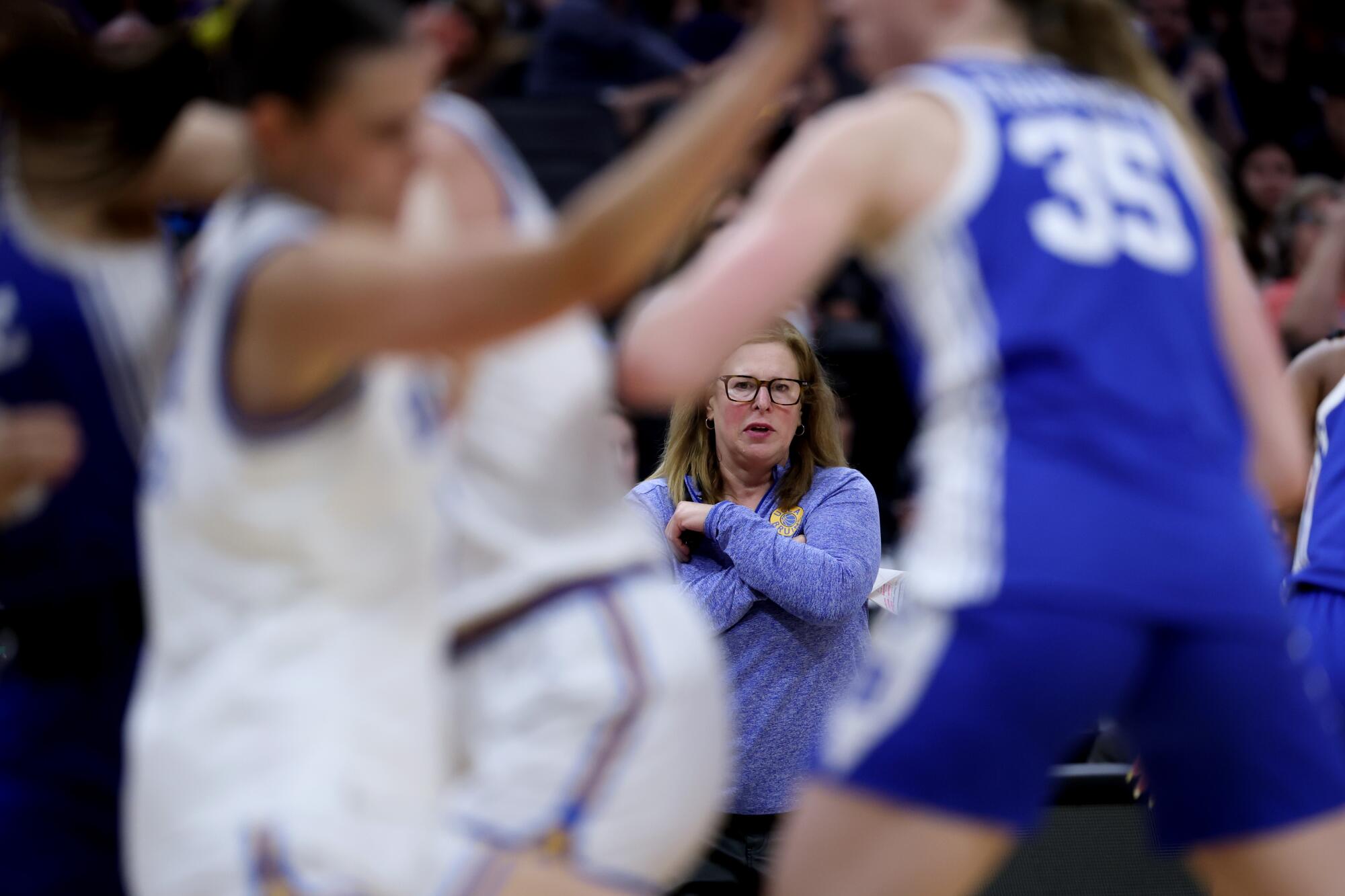
UCLA coach Cori Close watches play during the Bruins’ win over Duke on Sunday.
(Eric Thayer/Los Angeles Times)
“I’m just so proud of her,” Betts said. “The confidence and her poise … you could get in your head in moments when we’re down … but she did all the right things and what we needed at the time.”
It was an entertaining Elite Eight clash that was brought to you by two coaches who staged, like up-and-coming chefs, under two of the greatest leaders the sports world has known.
UCLA coach Cori Close and Lawson committed to making sure we won’t lose John Wooden’s and Pat Summitt’s recipes — never mind all the seismic, disorienting shifts happening in college sports.
A former Tennessee star, Lawson brings Summitt’s brand crackling intensity to Duke, a mindset that she’s said calls for supreme confidence, chasing excellence and holding oneself to an all-around standard of success.
UCLA’s bench was uplifted all season by Close’s warm intentionality, learned from years of mentorship from Wooden. The main ingredients, she’ll tell you, requiring a dollop of growth, gratitude, of giving and not taking.
“[Our] team culture is not this nebulous thing or phrases on a wall,” Close said. “It’s a group of people that are willing to be committed to the hard, right behaviors over and over again. I cannot tell you how many times throughout that game we referred to our values, who we are, what our identity was, what we had to get back to.
“… I’m just really humbled and thankful to be a part of a team and staff that cares about things from the inside out. What you saw on the court is a reflection and a byproduct of what’s happened on the inside.”

NEWYou can now listen to Fox News articles!
Max Verstappen snatched the torch from Lewis Hamilton and became one of the most unstoppable Formula 1 drivers in the sport from 2021 to 2024.
The 2025 and 2026 seasons have been a struggle for the Red Bull racer. He finished second to McLaren’s Lando Norris in the drivers’ standings last season, ending his streak of world championships, and has yet to finish in the top five this year.
Red Bull driver Max Verstappen of the Netherlands steers his car during the Japanese Formula One Grand Prix at Suzuka in central Japan, Sunday, March 29, 2026. (AP Photo/Hiro Komae)
After finishing eighth in the Japanese Grand Prix, Verstappen suggested he was contemplating retirement at the age of 28.
“Privately I’m very happy,” Verstappen told the BBC. “You also wait for 24 races. This time it’s 22. But normally 24. And then you just think about is it worth it? Or do I enjoy being more at home with my family? Seeing my friends more when you’re not enjoying your sport?”
He made clear he was suggesting that 2026 could be his final season.
“I want to be here to have fun and have a great time and enjoy myself. At the moment that’s not really the case,” he said. “Of course I do enjoy certain aspects. I enjoy working with my team. It’s like a second family. But once I sit in the car it’s not the most enjoyable unfortunately. I’m trying. I keep telling myself every day to try and enjoy it. It’s just very hard.”
ISRAELI RACING STAR ‘NERVOUS’ AS FAMILY DEALS WITH IRAN’S RETALIATORY STRIKES, EXPRESSES HOPE FOR REGION
Red Bull driver Max Verstappen, right, of the Netherlands and Mercedes driver Kimi Antonelli of Italy talk during the drivers parade ahead of the Japanese Formula One Grand Prix at Suzuka in central Japan, Sunday, March 29, 2026. (AP Photo/Eugene Hoshiko)
Part of the struggles for Verstappen has been trying to get acclimated to the regulation changes.
“I can easily accept to be in P7 or P8 where I am,” he said. “Because I also know that you can’t be dominating or be first or second or whatever, fighting for a podium every time. I’m very realistic in that and I’ve been there before. I’ve not only been winning in F1.
“But at the same time when you are in P7 or P8 and you are not enjoying the whole formula behind it, it doesn’t feel natural to a racing driver,” he continued. “Of course I try to adapt to it, but it’s not nice the way you have to race. It’s really anti-driving. Then at one point, yeah, it’s just not what I want to do.”
Maybe a break in the schedule will help clear Verstappen’s head.
Formula 1 will have a few weeks off as two races that were set for April in Bahrain and Saudi Arabia were canceled because of military operations in Iran.
Red Bull driver Max Verstappen of the Netherlands leaves during the qualifying session of the Japanese Formula One Grand Prix at the Suzuka Circuit in Suzuka, Japan, Saturday, March 28, 2026. (Franck Robichon/Pool Photo via AP)
CLICK HERE TO DOWNLOAD THE FOX NEWS APP
The next race is set for May 3 in Miami.
The Associated Press contributed to this report.
Follow Fox News Digital’s sports coverage on X and subscribe to the Fox News Sports Huddle newsletter.

12 ways to celebrate spring in Maine, from openings to festivals

USC baseball takes two of three from Maryland to win another series

Hail, damaging winds possible late Monday, all day Tuesday for Southeast Michigan

‘That comes with a price tag’: How snow removal is busting town budgets – The Boston Globe

April Snowflakes Expected Across Central Minnesota And Western Wisconsin This Week

Florida High School Football Rankings: Top 25 teams – Oct. 21

How old is Bo Nix? What to know about Oregon quarterback ahead of 2024 NFL Draft

Cleary's 21 help Le Moyne down Central Connecticut State 69-64 in OT

99th annual Pony Swim held in Virginia

Indiana Members Credit Union announced as new anchor tenant at Bottleworks District

Video: Iran to Allow More Oil Ships Through Strait of Hormuz, Trump Says

Dem senator warns deportation could let Virginia woman’s illegal immigrant killer ‘escape accountability’

Newsletter: G7 ministers to hold talks on war’s economic fallout
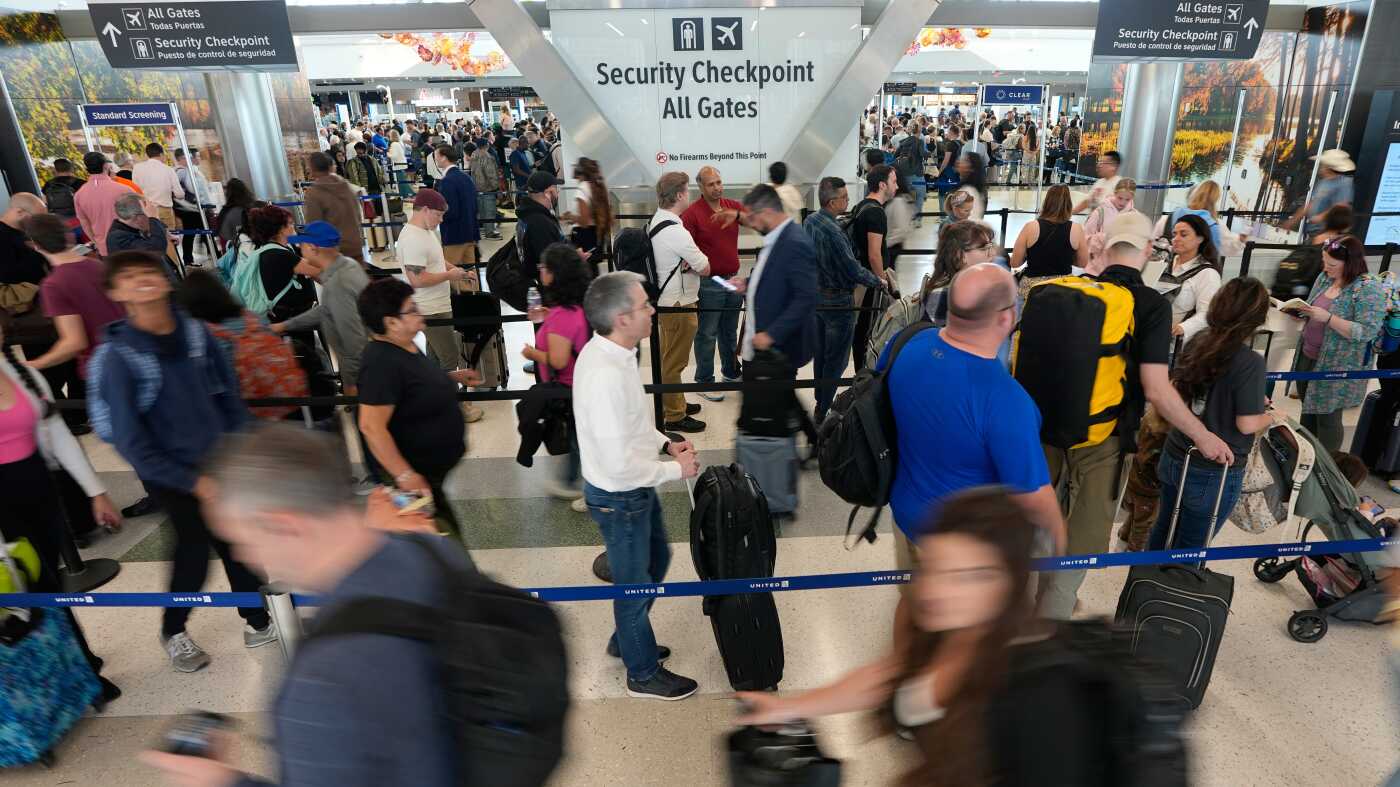
ICE officers could remain at airports after TSA workers are paid

Scathing report claims nation’s oldest labor union ‘betrayed’ MAGA members through ‘shocking’ spending
-

 Sports1 week ago
IOC addresses execution of 19-year-old Iranian wrestler Saleh Mohammadi
-

 Miami, FL4 days ago
Jannik Sinner’s Girlfriend Laila Hasanovic Stuns in Ab-Revealing Post Amid Miami Open
-

 New Mexico1 week ago
Clovis shooting leaves one dead, four injured
-

 Politics1 week ago
Schumer gambit fails as DHS shutdown hits 36 days and airport lines grow
-

 Tennessee7 days ago
Tennessee Police Investigating Alleged Assault Involving ‘Reacher’ Star Alan Ritchson
-

 Minneapolis, MN4 days ago
Boy who shielded classmate during school shooting receives Medal of Honor
-

 Science1 week ago
Record Heat Meets a Major Snow Drought Across the West
-

 Technology1 week ago
YouTube job scam text: How to spot it fast