Sports
2026 NBA Draft potential No. 1 pick reshaping NIL, basketball: Meet AJ Dybantsa


BROCKTON, Mass. — The first time AJ Dybantsa got paid for basketball, he didn’t want the money.
When the nation’s top recruit was named Massachusetts Gatorade Player of the Year as a high school freshman, it came with a cash prize: $1,000. That was a lot of money for a 14-year-old who insists he didn’t even get good at basketball until a year before.
For a teenager, that can go toward video games, shoes or even his future. But Dybantsa didn’t want it for himself. Instead, he thought about Brazzaville.
He first visited his father Ace’s hometown, the capital of Congo, when he was 4. Ace and his wife, Chelsea, used the trip to give their son perspective on their life back in Brockton and the importance of giving back to the community.
So, when the Gatorade check arrived, Dybantsa didn’t know what to do with it. Keeping it didn’t feel right.
“Do it for your heart,” Ace told his son. “Don’t take the money. That will come later.”
Ever since then, the 17-year-old Dybantsa has done things differently.
“Don’t take anything for granted,” Dybantsa told The Athletic recently. “People are less fortunate and don’t have what we have. If I continue this route, I’m going to get a lot more money than that. So, I might as well just donate (that check) back to the community.”
Name, image and likeness (NIL) rights have transformed American amateur sports, and Dybantsa has been Poseidon riding this financial wave. He was the third male basketball player to sign a sneaker deal with Nike while still playing in high school and then became the newest face of Red Bull soon thereafter. Dybantsa rose toward the top of his class at St. Sebastian’s, a Boston-area school, and then became the hottest teenage free agent in the sport when he signed lucrative deals with Prolific Prep (Calif.) as a junior and then Utah Prep as a senior.
Ace had a plan for his kids, AJ, Jasmyn and Samarra, before they were even born, getting a job as a police officer at Boston University so they could get free tuition. But when they turned out to be promising athletes, their plans changed.
“AJ, when he was in sixth grade, he said, ‘Dad, I’m not going to BU,’ ” Ace recalled with a laugh. “I said, ‘God dammit!’ ”
AJ expected to use the majority of this season to study all his college options and make a decision before March Madness. He had blue bloods Kansas and North Carolina in his final four, but Alabama and BYU were right there with them. Then, just before Thanksgiving, Dybantsa told his parents it was time. He was ready to commit after catching a BYU game in person Nov. 16.
Dybantsa will likely arrive in Provo, Utah, as the presumptive No. 1 pick in the 2026 NBA Draft, unequivocally the biggest star in college basketball for a year.
“He’s what the NBA is looking for,” said a NBA front-office executive, who was granted anonymity so they could speak freely. “Wings with legitimate size that understand the game, can create offense and then, in theory, can guard multiple guys.”
When Dybantsa donated the Gatorade check to the local Boys & Girls Club as a high school freshman, he presumed that money coming later would be once he shook NBA commissioner Adam Silver’s hand on draft night. But NIL exploded overnight, and Dybantsa was the star of the bidding war that has defined this new era of college basketball.
AJ Dybantsa meets a young fan at a school in his hometown of Brockton, MA. (Jared Weiss / The Athletic)
The irony was he had no idea how much he was making. Ace’s job was to handle the business side; AJ’s job was books and ball.
“People just gonna talk, but I (didn’t) even know how much I’m getting. They just tell my dad all of that,” Dybantsa said. “I’m trying to make it to the NBA, so wherever they can get me the fastest there with the best development, there’s a whole lot of pillars that come with it. Money’s going to come if I do the work, so I’m not worried about the money in a year.”
‘Ain’t no Plan B’
One day early in Dybantsa’s junior season, he was towering over a group of elementary school students while visiting a class in his hometown. The children are in awe of this gigantic kid who isn’t that much older than them.
Most of them don’t exactly know who he is, but they know he is somebody. Dybantsa used to be the one looking up to people, but now they look up to him.
“It’s a good feeling. Basketball was funner when there was nothing going on when we were all 10 years old,” Dybantsa said. “Nobody got skill, everybody’s the same. It was way more fun. But now people judge you for who you are. The same people who hate on you are the same people in the stands trying to ask for a picture. The game’s still fun, but it’s different now.”
Once he’s walking back to his dad’s car, the dynamic shifts back to normal. Ace tells AJ he needs to go home, do his homework and make some lunch. He has to clean his room, even if he only visits for a few days a month.
“I tell AJ all the time, you may be No. 1 in the country, but in my house, you ain’t No. 1,” Ace says with a big smile. “When the coach yells at him, I say, ‘AJ, I love you, don’t I?’ He says, ‘Yes, you do.’ When the coach yells at you, he loves you. He wants you to correct what you’re doing wrong.”
Ace’s favorite stories to recall are of all the times he called his son’s coaches and told them to “bench his ass” because AJ did not uphold his parents’ lofty standards. In sixth grade, AJ didn’t make the honor roll. Ace told the coach they were driving to New Jersey for a tournament, but his son was not playing in either of their games.
“The coach looked at me and said, ‘You’re really gonna drive six hours?’ ” Ace said. “I told him, ‘You heard what I said.’ ”
When they arrived at the gym, Dybantsa went to warm up just as he always does, but then his coach approached and whispered something in his ear. Dybantsa spent the game watching from the sideline. But for the second game, the coach decided the punishment was enough.
Lesson learned, at least by his standard. But not Ace’s.
“So, on the drive home, I (told AJ), ‘Next time, I won’t even bother bringing you to the tournament,’ ” Ace said. “Ever since then, honor roll.”

AJ (left) and Ace Dybantsa (right) together in January 2024. (Jared Weiss / The Athletic)
The younger Dybantsa brings up the phrase “sugarcoating” often. He is criticized by his dad every day, so criticism from his coaches and the public doesn’t phase him.
“If you get sugarcoated your whole life, you ain’t ever gonna get better,” Dybantsa said. “(My dad) being tough on me and my sisters has impacted us in a way. Everybody wants something handed to them, but we know life is not gonna work like that.”
He has an aversion to sweets now. Tell him like it is, and he can work with that. Ask anyone who has been around Dybantsa about what makes him special, and it will take a while before you hear about his game.
“AJ is the total package on and off the floor,” said Ryan Bernardi, his coach at Prolific Prep. “He is extremely respectful, he’s charismatic, great personality. … I believe these traits were instilled in him by his parents.”
Passing always came naturally to Dybantsa, as he claims that he’s just now learning how to be a true scorer. Bernardi and Ace were constantly on him for not being aggressive enough in pursuing his shot while at Prolific. The younger Dybantsa always maintains the last thing he wants is to be known as a ball hog.
“My mindset will never be just scoring. I’m always going to pass,” Dybantsa said. “There’s never going to be a game where I have zero assists. I like making sure that everybody eats.”
What makes Dybantsa such a tantalizing prospect is that he is already such a complete player, a former center turned playmaking wing. His blend of balance, IQ, skill and explosiveness make him one of the most promising players to enter college this century. Dybantsa was measured during his September visit to Kansas at 6-foot-8 1/2 in socks with a 7-1 wingspan, according to Ace. His height is up half an inch from the beginning of the year.
He’s a gazelle attacking the rim and can pull up over anyone from every spot on the floor, levitating to a height where contests are merely suggestions that luck should intervene on the defense’s behalf. Dybantsa’s passing reads out of pick-and-rolls are some of the best at his position. He’s a brick wall on defense, flipping his hips to steer drivers more smoothly than players half his size. There is much room for improvement, but the holes in his game are measured at a molecular level.
When Boston-area skill trainer Brandon Ball first started shaping Dybantsa’s game, most of his pupils worked out twice a day during the summer. But Dybantsa, then 14, was different. It reminded Ball of his star client Terrence Clarke, who was one of the top players in the nation at the time, before dying in a car accident.
Dybantsa would arrive at the gym at 6 a.m., and they would work on building his skill set. He would lift weights at 9 a.m. and then return to the gym to work on his jumper at noon. He would have a game at 6 p.m., which should be the end of it. But no, one more workout on the floor postgame.
“Most kids can’t do three times a day, but he has great body language at every single stop,” Ball said. “He understood the mission early, and Terrence was the same way. The kid’s work ethic is different.”
Most kids that age have lives outside the gym. Not Dybantsa. He proudly claims he doesn’t do anything outside of ball and school. Ask him what his hobbies are, they’re basketball and basketball. There’s a reason BYU’s more buttoned-up campus culture wasn’t a deterrent for him.
There’s a commonality to most players who maximize their careers in the NBA. They were the ones who were getting in extra work while their peers were playing video games or going to the movies. They were taught something on the court once and then can do it an hour later as if they’ve known it their whole life.
As Dybantsa grew and quickly became one of the best players in the country, it cemented his unwavering belief that basketball was going to be his future, not that anyone who knew him was questioning it at that point.
“My life motto is ‘Ain’t no Plan B. I plan who I’m supposed to be,’ ” Dybantsa said. “People always ask me if I have a Plan B. Nah, I don’t.”
Prince of the NIL revolution
A year ago, Dybantsa had never heard of Utah Prep. Few people had.
It’s a reclamation project of a defunct school that relocated to Hurricane, Utah, but it’s not pronounced hurricane. Ask a local to explain its Scouse roots for you to understand.
Shortly after joining a star-studded roster at Prolific Prep, an Adidas school, Dybantsa signed a deal with Nike that ends before his college career begins. Now that NIL has made every high school offseason a free-agency period, Prolific knew there was a good chance Dybantsa was heading off to a Nike program for his senior year. Enter Utah Prep.
“For everyone involved, this was a first of its kind,” Bernardi said. “A new precedent had been set, and we are all trying to figure it out as it goes. I think the mindset of ‘What’s your offer’ has been the biggest change and you have to make quicker decisions.”
BYU donors facilitated an April visit to the school for Ace and Chelsea before they took a trip down to Provo to see the college’s campus. That was when they first met incoming BYU coach Kevin Young, who was then the top assistant for the Phoenix Suns but traveled out of Arizona in the middle of a playoff series to host the visit.

Dybantsa cheers with BYU student fans during a recent game in Provo, Utah. (Chris Gardner / Getty Images)
Utah Prep reportedly offered Ace $600,000 and an ownership stake in the fledgling program, according to the Salt Lake Tribune. Done deal. AJ visited, saw the mountains in the distance and signed up for the move. There was nothing else to do there, which is just how he liked it.
When Dybantsa was asked why he didn’t attend one of the iconic high school programs like Montverde Academy in Florida — which reportedly offered $1 million for AJ’s senior season — he explained how he wanted to do things differently.
“Montverde, we can use them as an example, I’m trying to show people you don’t have to go to a school like that to accomplish certain things,” AJ said. “They’re a great school, and they’ve got the most league guys from high school. So, there’s no knock going there. But you don’t have to go to a school like that.”
Just about every major NBA agent recruited AJ, but Ace decided to continue to manage his career while bringing on Shaquille O’Neal’s former agent, Leonard Armato, as an adviser.
Ace negotiates offers, goes to Armato for his input, comes to AJ for his decision, and a choice is then made. Agencies have been capitalizing on the NIL gold rush but often charge fees upwards of 20 percent, significantly more than their cut on NBA contracts. Ace has become a master schmooze and thrives in this new gig.
Reports have pegged Dybantsa’s NIL package to be worth around $7 million, though people with knowledge of the negotiations said the amount coming directly from BYU’s NIL collective is closer to $5 million. In the early stages of the NIL era, there is some ambiguity as to what defines an actual deal with the school.
The NCAA does not directly regulate NIL as the market has been shaped by court decisions over the past several years. The proposed House v. NCAA settlement in October has cleared the way for a revenue-sharing model from the schools to the players that could go into effect as soon as July 2025. But the players are not employees and there’s no union, so there is no collective bargaining to establish an agreed-upon system.
Dybantsa’s role in the recruitment was to get the answers he needed for his career. He asked coaches for their vision of building an offense through him and how he would bring winning to their team. He didn’t just want to know how the head coach operates, but what his recovery and nutritional program would look like. He wants to be a pro before he’s technically a pro.
The call that sealed the deal was from Kevin Durant, who played for Young in Phoenix. All Dybantsa wanted was to emulate Durant’s path to greatness, so he was sold on Young being his guide.
“You don’t want to just sign with somebody. You want to be partners with them,” Dybantsa said. “There’s a lot more to an offer than just money. People only see the money part of it, but it’s not just about money.”
In the late stages of his recruitment, AJ and Young were speaking directly while Ace was handling negotiations with the schools. In the end, Alabama and North Carolina matched BYU’s offer, unbeknownst to AJ.
Even when Dybantsa first informed his father in late November he was ready to commit to BYU, Ace kept the focus on basketball and didn’t reveal the price tag. Ace told his son to think it over while the elder Dybantsa paid one last visit to UNC.
When Ace returned, AJ was fully locked in on BYU. They called the school and signed the paperwork before Ace finally told AJ how much the NIL market determined he was worth.
AJ’s response?
“Wow.”
‘I’m not gonna change’
At Dybantsa’s games, the baseline under the opposing team’s basket is lined shoulder to shoulder with every young photographer and videographer trying to break into the big leagues, just like him. When the teams switch baskets at halftime, there is a mad rush of swinging tripods to get the best spot on the other side of the gym.
The days of walking the streets in solitude are coming to an end. He is already becoming instantly recognizable.
“(He’s) trying to navigate being the main character and understanding how much people look up to him and will follow him,” Bernardi said. “I think his consistent vocal presence will be a big key for him as he turns into a great leader.”
When he returned to Boston for a game with his new school, Utah Prep, every set of eyes is carefully careening his way. His aura captures the whole arena now. Aside from the blinged-out chain around his neck, he still carries himself like nobody is watching.
“I’m not gonna change. They might,” Dybantsa said. “There are some people I know that become famous and change their whole personality. They want to have this lavish lifestyle, but I just stick to who I am, and I think people mess with that.”
Dybantsa plans to return to Boston in January to see family, and they’ve already scheduled a shoe giveaway to a local high school. He never comes home empty-handed.
He’ll return as one of the highest-paid amateur basketball players in American history. Ace has been running the show while his son focuses on basketball and being a kid. Eventually, AJ can build his empire as he climbs the ladder to NBA stardom.
Getting to the big stage isn’t the hard part. Separating yourself is. Ace knows he won’t have much luck telling a nationally renowned college coach to bench his son because he didn’t get back on defense. Those days are over.
That’s why AJ joined a program where he’ll be treated the same way since he was little. Ace has no choice but to give it a break and trust his son is ready, as long as AJ still cleans his room when he comes home. Some things might never change.
“He’s probably going to correct me, but he’s not going to be yelling at me,” AJ said. “Well … he might.”
(Illustration: Meech Robinson / The Athletic; top photos: Barry Chin / The Boston Globe via Getty Images; Jim Poorten, Altan Gocher, Hans Lucas, Ezra Shaw / Getty Images)



NEWYou can now listen to Fox News articles!
Tiger Woods was released from jail Friday night after he was arrested earlier in the day on a DUI charge following a car crash in Florida.
In a mugshot released hours after his arrest, Woods’ eyes appeared bloodshot, as he donned a blue polo inside the Martin County Jail in Florida.
Woods was seen leaving the jail in the passenger seat of a black SUV after his release on bail late Friday, according to The Associated Press.
Martin County Sheriff John Budensiek confirmed in a news conference that Woods was traveling at “a high rate of speed” when his vehicle collided with another car, resulting in his vehicle rolling over onto the driver’s side.
Tiger Woods was booked into Martin County, Florida, jail on March 27, 2026. (AP)
Authorities said Woods “exemplified signs of impairment.” He blew “triple-zeroes” for alcohol but refused a urine test.
“DUI investigators came to the scene here, and Mr. Woods did exemplify signs of impairment. They did several tests on him. Of course, he did explain the injuries and the surgeries that he had. We did take that into account, but they did do some in-depth roadside tests,” Budensiek added.
“We really weren’t suspicious of alcohol being involved in this case, and that proved to be true at the jail. … But when it came time for us to ask for a urinalysis test, he refused. And, so, he’s been charged with DUI, with property damage and refusal to submit to a lawful test.”
Woods was spotted on the phone after the crash, wearing navy blue shorts.
Woods was charged with DUI, property damage and refusal to submit to a test, all misdemeanor charges. No one was injured, authorities said. Woods was alone in the car and crawled out of the passenger door after the crash.
Tiger Woods was driven from the Martin County Jail after being arrested for driving under the influence following a car crash on March 27, 2026, in Stuart, Florida. (Joe Raedle/Getty Images)
VANESSA, KAI TRUMP TAKE IN TIGER WOODS’ RETURN TO GOLF AT TGL FINALS
“This could’ve been a lot worse,” Budensiek noted.
President Donald Trump commented on the arrest of his “very close friend.”
“I feel so badly. He’s got some difficulty,” Trump said. “There was an accident, and that’s all I know. Very close friend of mine. He’s an amazing person, an amazing man, but some difficulty.”
Woods has not commented on the arrest.
Tiger Woods was arrested on a DUI charge after getting into a car crash on Friday. (Associated Press)
Woods currently is dating Trump’s ex-daughter-in-law, Vanessa, whose daughter, Kai, is set to play college golf in Miami next week.
This is Woods’ second DUI arrest within the last decade. In 2017, he was taken into custody, also in Jupiter Island, after taking prescription drugs and being asleep behind the wheel of a running car at 3 a.m.
In 2021, he got into a wreck that resulted in serious leg injuries that kept him off the golf course for the entire year.
Golfer Tiger Woods stands by his overturned vehicle in Jupiter Island, Fla., Friday, March 27, 2026. (Jason Oteri/AP)
Woods made his return to competitive golf earlier this week in the TGL championship after rupturing his Achilles just before last year’s Masters (this year’s tournament is in less than two weeks). Woods has not appeared on the links since the 2024 PGA Championship, in which he missed the cut.
Follow Fox News Digital’s sports coverage on X, and subscribe to the Fox News Sports Huddle newsletter
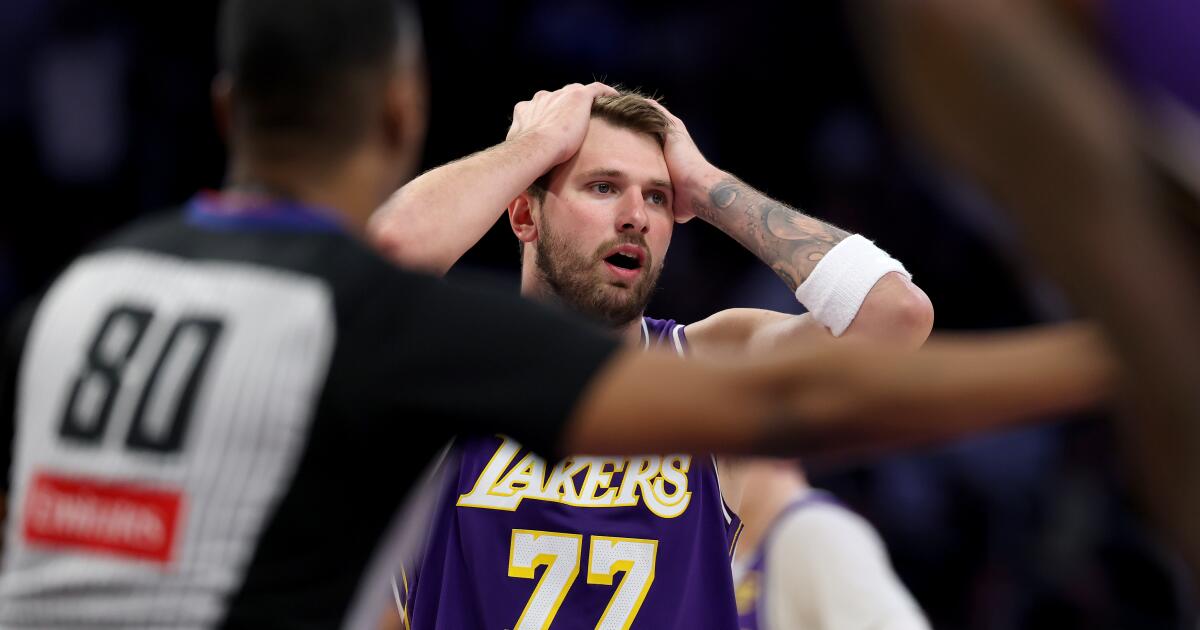
For the second time in less than a week, Luka Doncic faces a one-game suspension because of technical foul accumulation.
Only a week after Doncic’s 16th technical foul was rescinded by the NBA, the Lakers superstar picked up another one in a 116-99 win over the Brooklyn Nets on Friday and is in line to miss the Lakers’ next game against the Washington Wizards on Monday.
In the third quarter with the Lakers trailing by one against the lowly Nets (17-57), Doncic was called for an offensive foul against Nic Claxton as the Lakers (48-26) were trying to inbound the ball after a dunk by Ziaire Williams. After the Lakers turnover, Williams and Doncic appeared to exchange words with Doncic pushing Williams aside with one hand. Williams then flailed his arms behind him and slapped Doncic in the throat.
“He was yelling in my face three times,” said Doncic, who finished with 41 points, eight rebounds and three assists in the win. “I just wanted to get out of there. … I didn’t even talk. I just wanted to get out of there. And they said I pushed. My push was exaggerated, which was obviously not [the case].”
Both were assessed technical fouls with 5:12 remaining in the third quarter, and Williams’ hit was reviewed for a possible flagrant, although it was not upgraded.
The NBA requires players to sit out for one game without pay after their 16th technical foul of the season. But Doncic avoided that fate after the NBA rescinded the foul that would have forced him to the bench for a critical road game last week. Lakers coach JJ Redick said the Lakers will try to appeal Doncic’s latest foul but he did not see what happened on the play.
Last week, Doncic avoided a suspension after the NBA rescinded the foul that would have forced him to the bench for a critical road game against the Eastern Conference-leading Detroit Pistons. Doncic is slated to miss Monday’s game against the Wizards, who have lost 17 of their last 18 games and have the third-worst record in the Eastern Conference (17-56).
Lakers star Luka Doncic reacts to a referee’s call during the second half Friday against the Brooklyn Nets at Crypto.com Arena.
(Allen J. Schaben / Los Angeles Times)
Doncic picked up his first 16th technical foul last week against the Orlando Magic after getting into an argument with Orlando forward Goga Bitadze. Doncic claimed Bitadze directed a vulgar comment about Doncic’s family in Serbian toward the Lakers star guard. Bitadze refuted the story, saying it was actually Doncic who said the curse word out loud first and that he was only repeating what he heard.
The NBA rescinded both fouls upon review the following day.
Doncic, the NBA’s leading scorer, has scored 30 points or more in 12 consecutive games, the longest such streak in his career. He has 43 30-point games this season, tying Elgin Baylor and Jerry West for sixth-most in a season by a Lakers player. He has scored 40 points or more in the last 12 games.
Against the Nets, Austin Reaves finished with 26 points, eight rebounds and five assists and LeBron James had 14 points, eight assists and six rebounds.
Before the game, Redick said the Nets game would be like playing on the road since the Lakers had spent almost two weeks away from Crypto.com Arena and had returned home in the wee hours of Thursday morning from Indianapolis.

Lakers guard Austin Reaves celebrates after shooting a three-pointer against the Nets in the second half Friday.
(Allen J. Schaben / Los Angeles Times)
The challenge was to find the energy to play, which wasn’t a problem for Doncic, who had 24 points in the first half. Doncic was nine for 15 from the field in the first half and four for six from three-point range in 20 minutes. He finished shooting 15 for 25 from the field as the Lakers shot 54% from the floor. They shot 44% (11 for 25) from three-point range.
That the Lakers were facing a Nets team with the second-worst record in the NBA didn’t matter.
That the Lakers were facing a Nets team had lost nine of its last 10 games didn’t matter.
That the Lakers were facing a Nets team that’s last in the league in scoring (106.3 points per game) didn’t matter.
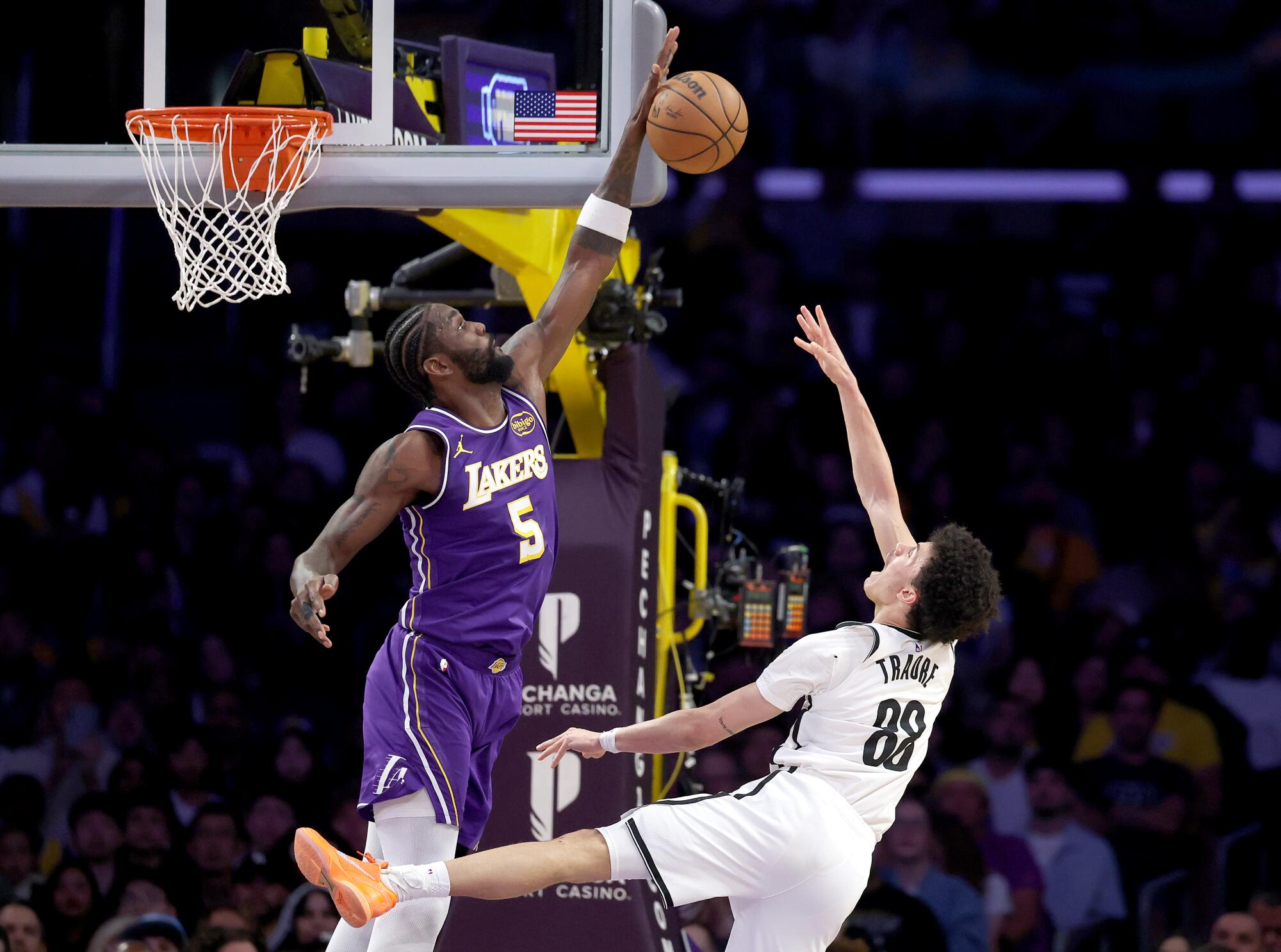
Lakers center Deandre Ayton, left, blocks a shot by Brooklyn Nets guard Nolan Traore in the first half Friday.
(Allen J. Schaben / Los Angeles Times)
What mattered to the Lakers was finding a way to win as the regular season winds down.
“I felt like we were a step slow,” Redick said. “And I told the guys at halftime, ‘This is our seventh game of the road trip. Anytime you come back, there’s a day in between, that’s just you’re in another city until you can get adjusted to the time zone and you get a couple days break.’ So the next two [off] days will be good for us.”
Notes: Lakers broadcast analyst Stu Lantz missed Friday night’s game against the Nets because of health issues. Derek Fisher, who won five NBA titles with the Lakers, took over Lantz’s role for the game. Public address announcer Lawrence Tanter also missed the game because of a health matter. Jason Barquero filled in for Lantz. “The entire Lakers organization is wishing Lawrence all the best in his recovery, and we look forward to welcoming him back soon,” the team said in a statement.


NEWYou can now listen to Fox News articles!
Tiger Woods was involved in a car crash on Jupiter Island in Florida on Friday, according to multiple reports.
The Martin County Sheriff’s Office told ESPN that the crash happened on Jupiter Island. Woods’ condition was not immediately known.
Woods competed in the TGL championship earlier this week with his girlfriend, Vanessa Trump, and her daughter, Kai, in the stands. It was his return to competitive golf after rupturing his Achilles last year, just ahead of the Masters.
Tiger Woods of Jupiter Links Golf Club looks on before the match against the Los Angeles Golf Club at SoFi Center on March 23, 2026, in Palm Beach Gardens, Florida. (Adam Glanzman/TGL/TGL Golf via Getty Images)
The 15-time major winner, five of which have come at Augusta, was noncommittal about playing at this year’s Masters. President Donald Trump said on “The Five” on Thursday that he would be at Augusta but not play.
Woods has had trouble behind the wheel in the past. In 2021, he got into a wreck that resulted in serious leg injuries that kept him off the golf course for months.
This is a breaking story. Check back for more updates.

Three Detroit Pistons Players That Have Impressed Most Without Cade Cunningham

People We Meet: Ranjit Brar’s ‘horrible’ road led him back to San Francisco

Cowboys Showing Significant Interest in Son of Philadelphia Eagles Legend

Mock Draft Roundup: Miami Defensive End Is Popular Pick For Lions

Red Sox at Reds preview: Sonny Gray makes his first start for Boston – The Boston Globe

Florida High School Football Rankings: Top 25 teams – Oct. 21

How old is Bo Nix? What to know about Oregon quarterback ahead of 2024 NFL Draft

Cleary's 21 help Le Moyne down Central Connecticut State 69-64 in OT

99th annual Pony Swim held in Virginia

Indiana Members Credit Union announced as new anchor tenant at Bottleworks District

Dem senators dodge crucial question on illegal alien accused of killing Chicago college student

EU Parliament unblocks key political hurdle in digital euro talks

Man arrested in plot to firebomb Palestinian activist’s home after undercover op

WATCH: Senate hearing goes silent after Angel Father confronts top Dem over daughter’s death

US diplomat Marco Rubio denounces settler violence, tolls in Hormuz strait
-

 Detroit, MI1 week ago
Drummer Brian Pastoria, longtime Detroit music advocate, dies at 68
-

 Movie Reviews1 week ago
‘Youth’ Twitter review: Ken Karunaas impresses audiences; Suraj Venjaramoodu adds charm; music wins praise | – The Times of India
-

 Sports7 days ago
IOC addresses execution of 19-year-old Iranian wrestler Saleh Mohammadi
-

 New Mexico6 days ago
Clovis shooting leaves one dead, four injured
-
 Business1 week ago
Disney’s new CEO says his focus is on storytelling and creativity
-

 Tennessee5 days ago
Tennessee Police Investigating Alleged Assault Involving ‘Reacher’ Star Alan Ritchson
-

 Technology6 days ago
YouTube job scam text: How to spot it fast
-

 Texas1 week ago
How to buy Houston vs. Texas A&M 2026 March Madness tickets