Southwest
Oklahoma's oldest Native American college faces uncertain future due to financial woes

- Founded in 1880, Bacone College evolved into an Indigenous-led institution, fostering an intertribal community and offering degrees.
- Currently, the college is grappling with financial woes after struggles with mismanagement, leadership instability and lawsuits.
- In response to financial difficulties, Bacone has suspended classes, facing the risk of permanent closure.
The hallways of Bacone College are cold and dark. In the main hall, there are no lectures to be heard, only the steady hum of the space heater keeping the administrative offices warm.
Students aren’t attending classes here this semester, but work still needs to be done. In the college’s historic buildings, there are leaks to plug, mold to purge and priceless works of Native American art to save from ruin. Not to mention devising a plan to keep the college from shuttering for good. It’s a daunting task for the nine remaining employees.
But on this rainy December morning, the college’s president is running a DoorDash order. “If we have the money, we can pay,” Interim President Nicky Michael said regarding salaries. Even she has to find a way to make ends meet.
US ARMY DENIES REQUEST TO RETURN REMAINS OF NATIVE AMERICAN BOYS WHO DIED AT PENNSYLVANIA BOARDING SCHOOL
Founded in 1880 as a Baptist missionary college focused on assimilation, Bacone College transformed into an Indigenous-led institution that provided an intertribal community, as well as a degree. With the permission of the Muscogee Nation Tribal Council, Bacone’s founders used a treaty right to establish the college at the confluence of three rivers, where tribal nations had been meeting for generations.
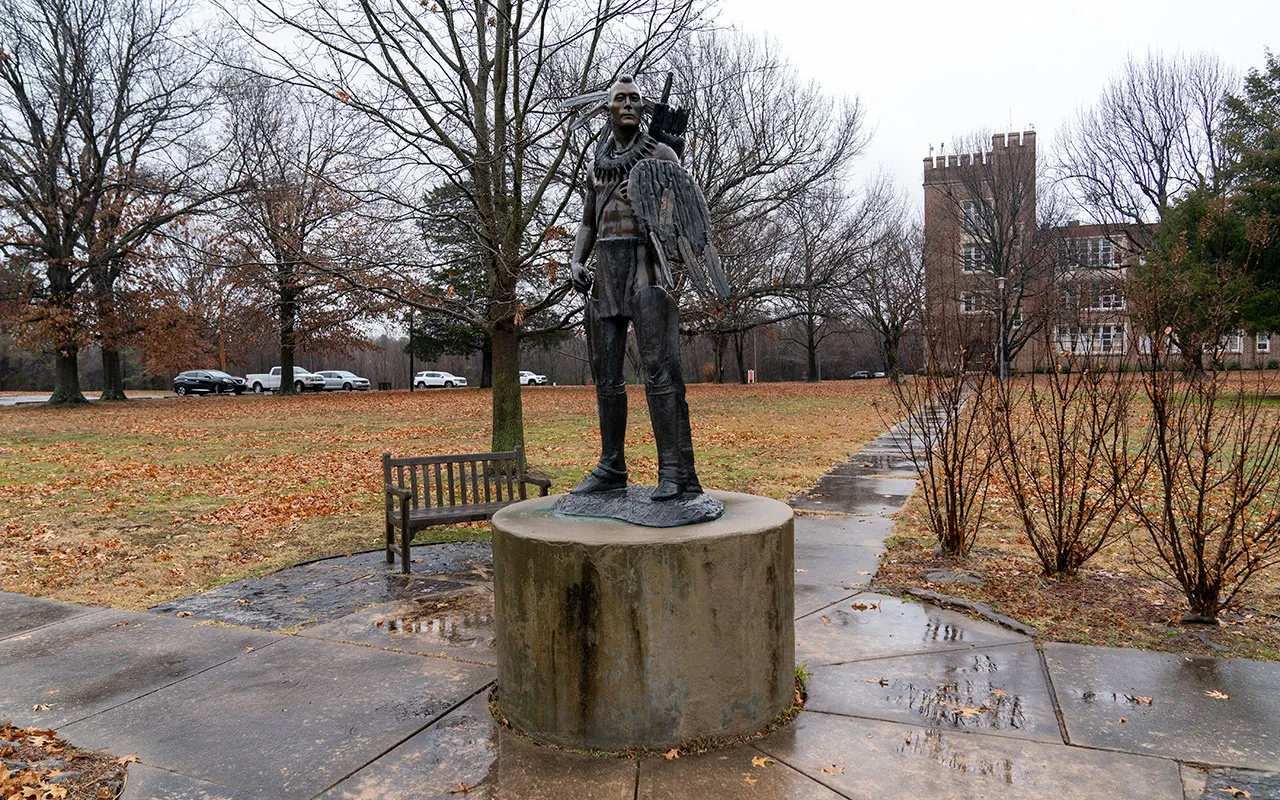
A statue of a Chickasaw warrior sits on display at Bacone College on Jan. 8, 2024, in Muskogee, Oklahoma. The Native American school is nearing the brink of closure as years of poor financial decisions, inconsistent leadership and disrepair threaten what was once a haven for Indigenous academics. (AP Photo/Nick Oxford)
Throughout the 20th century, the center of this was Bacone’s Native American art program, which produced some of the most important Indigenous artists of their time, including Woody Crumbo, Fred Beaver, Joan Hill and Ruthe Blalock Jones.
They and their contemporaries pushed the boundaries of what was considered “Native American art.” During a period of intense hostility against tribal sovereignty by the U.S., Bacone became defined by the exchange of ideas its Native faculty and students created and represented a new opportunity for Indigenous education and academic thought.
“Bacone was the only place in the world where that could happen for Native people,” said Robin Mayes, a Cherokee and Muscogee man who attended Bacone in the ’70s and taught silversmithing there in the ’90s. “It’s a tragedy to think that it’s going to be discontinued.”
For decades, the college has been plagued by poor financial choices and inconsistent leadership, triggering flashpoints between administration, students and staff over the mission and cultural direction of the college.
Some have accused recent administrations of embezzlement, fraud and intimidation, resulting in multiple lawsuits. Students expressed frustration with a lack of resources and cultural competency among some school leaders. The college also has had trouble maintaining its accreditation.
Last year, a lawsuit crippled Bacone’s finances. Ultimately, Michael made the decision to suspend classes for the spring semester. She hopes the deferment is temporary, but if the college can’t muster up millions of dollars, Oklahoma’s oldest continually operating college likely will close its doors.
“It has endured for over 140 years through terrible decisions,” said Gerald Cournoyer, an instructor who was hired in 2019 to restart the college’s art program.
“Providing oversight for Bacone has been a struggle because of the leadership or lack thereof,” said Cournoyer, who also is a renowned Lakota artist. Some presidents focused time and money on athletic programs, others on Bacone’s Baptist missionary roots. “When you put absolutely no money, nothing, not $20, not $10, into your fundraising efforts, this is what you get.”
During the time Patti Jo King was the director of the Center for American Indians at Bacone from 2012 to 2018, leadership wanted to build a state-of-the-art museum to replace the 80-year-old building housing many priceless pieces of Native art.
“We didn’t even have the money to keep it open seven days a week,” said King, now a retired Cherokee professor, writer and academic.
Even when she first arrived on campus, King said Bacone’s financial debts already had caught up to it. The student dorms didn’t have hot water, staff were severely underpaid and graduation rates among the college’s remaining students were low.
Still, she and other faculty endeavored to make it a place where Native students could find community, but Bacone’s old problems never went away. Like Cournoyer, after years of working toward rebuilding, she left in frustration.
Today, the old museum is empty. Its artifacts were moved to another location so they wouldn’t be exposed to extreme temperatures.
The remaining staff act as caretakers of the historic stone buildings that predate Oklahoma, themselves important pieces of the past. In the museum, Ataloa Lodge, the fireplace is made of stones sent to the college from Indigenous communities across the country: one from the birthplace of Sequoyah, one from the grave of Sitting Bull, another from the field where Custer died. Five hundred in all, each stone a memory.
Michael, the interim president, and others have been cleaning up buildings in hopes they might soon host graduation banquets and student gatherings. Other staff chase off looters. Rare paintings still hang across campus, including pieces by members of the Kiowa Six, who became internationally famous a century ago, and Johnnie Diacon, a Muscogee painter and alumnus whose work can be seen in the background of several episodes of the television show Reservation Dogs.
A few years ago, experts from a museum in Tulsa warned that many of the paintings are contaminated with mold, which will spread to other nearby works of art. Leslie Hannah, a Cherokee educator who sits on the college’s board of trustees, said he’s concerned, but the cost of restoring them falls far down the list, behind broken gas lines, flooded basements and a mountain of debt.
Bacone’s current financial crisis stems partially from a lawsuit brought by Midgley-Huber Energy Concepts, a Utah-based heating and air company that sued the college over more than $1 million in unpaid construction and service fees. Twice last year, the Muskogee County Sheriff’s Office put Bacone’s property up for sale to settle the debt. Both times the auction was called off, most recently in December.
MHEC owner Chris Oberle told KOSU last month that he intended to purchase the historic property. Attorneys for MHEC have not returned repeated requests for comment from the Associated Press.
Alumni have called the validity of any sale of the property into question, pointing to the treaty right that established the campus and its listing on the National Register of Historic Places. Attorneys for the college declined to comment, citing the ongoing litigation.
PRO-NATIVE AMERICAN ACTIVISTS FIGHTING TO SAVE INDIGENOUS TRADITIONS IN NATIONWIDE WAR AGAINST WOKENESS
Michael said she doesn’t know what stalled the auction, but she is grateful for more time to try to save Bacone.
Across the country, there are only a few dozen tribal colleges, according to the American Indian College Fund, a nonprofit that supports Native American access to higher education. Tribal colleges must be sponsored by a federally recognized tribe and have a majority Native student enrollment. But unlike most of those colleges, Bacone was built on its identity as an intertribal school, a quality that former staff and alumni say made it special.
Now a private institution, Bacone no longer receives state or federal assistance. Its finances have long relied heavily on student tuition, and now it has no students. Michael said judging from the finances, it’s a miracle the college managed to keep its doors open this long.
“Now I’m looking back on this thinking this was set up for failure,” she said.
Read the full article from Here

Southwest
FAA restricts Texas airspace after Pentagon reportedly strikes down Customs and Border Protection drone
NEWYou can now listen to Fox News articles!
The Federal Aviation Administration (FAA) restricted flights Thursday near Fort Hancock, Texas, after a U.S. Customs and Border Protection (CBP) drone was reportedly shot down by a laser sytem operated by the Pentagon.
While government agencies have not identified who the drone belonged to, top Democrats on the Transportation and Infrastructure Committee released a joint statement Thursday evening claiming the drone belonged to CBP.
U.S. Reps. Rick Larsen, Bennie Thompson and Andre Carson said their “heads are exploding over the news” that a CBP drone was shot down by the Pentagon with “a high risk counter-unmanned aircraft system.”
The legislators added that this incident is “the result of [the White House’s] incompetence” after a “short-sighted” decision to “sidestep a bipartisan, tri-committee bill to appropriately train C-UAS operators and address the lack of coordination between the Pentagon, DHS and the FAA.”
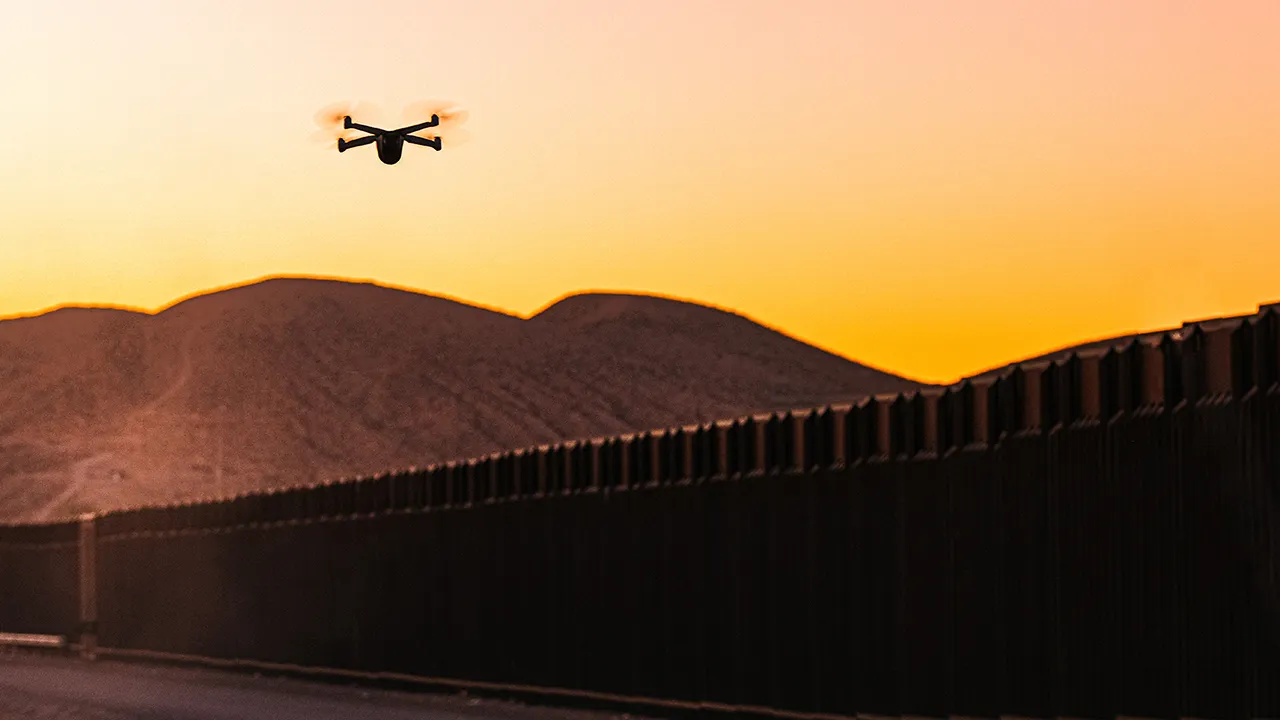
The FAA expanded a temporary flight restriction near Fort Hancock, Texas, after lawmakers said a Pentagon-operated counter-drone system may have shot down a U.S. government drone. (iStock)
In a joint statement provided to Fox News Digital, the Department of War, CBP and the FAA said the DOW used counter-unmanned aircraft system to respond to a “seemingly threatening unmanned aerial system operating within military airspace.”
The departments said the engagement took place “far away from populated areas and there were no commercial aircraft in the vicinity,” adding they “will continue to work on increased cooperation and communication to prevent such incidents in the future.”
The departments said they are “working together in an unprecedented fashion to mitigate drone threats by Mexican cartels and foreign terrorist organizations at the U.S.-Mexico border.”
“The bottom line is the Trump Administration is doing more to secure the border and crack down on cartels than any administration in history,” the statement added.
FBI RAMPS UP COUNTER-DRONE EFFORTS AS PATEL WARNS OF GROWING THREATS FROM CRIMINALS, TERRORISTS
Congressional aides told Reuters that the Pentagon reportedly used the high-energy laser system to accidentally shoot down the CBP drone near the Mexican border, an area that frequently sees incursions from drones believed to be operated by Mexican drug cartels.
The FAA told Fox News Digital that a temporary flight restriction (TFR) was “already in place” around the Fort Hancock area and that the TFR “has been expanded to include a greater radius to ensure safety.”
The restriction does not impact commercial flights, the agency said.
The FAA said in a Notice to Air Missions (NOTAM) that airspace around Fort Hancock was temporarily restricted for “special security reasons.”
CLICK HERE TO DOWNLOAD THE FOX NEWS APP
The restriction comes a couple of weeks after the FAA grounded flights to and from El Paso International Airport for 10 days before lifting the order roughly eight hours later.
Drones operated by Mexican drug cartels breached American airspace earlier this month near El Paso International Airport in Texas, leading the FAA to temporarily close the airport. (Kirby Lee/Getty Images)
A Trump administration official previously told Fox News that the initial lockdown came in response to “Mexican cartel drones” that breached U.S. airspace.
A U.S. official later confirmed that the U.S. military had shot down what was later determined to be a party balloon near El Paso.
Fox News Digital reached out to the White House for comment and was directed to the joint statement provided by the Department of War, Customs and Border Patrol and Federal Aviation Administration.
Fox News Digital’s Anders Hagstrom and Reuters contributed to this report.
Related Article

Read the full article from Here

NEWYou can now listen to Fox News articles!
A wave of corporate relocations is reshaping the U.S. economy, and Texas is emerging as the clear winner.
According to a report by CBRE, one of the nation’s largest commercial real estate brokerage firms, 561 companies have relocated their headquarters nationwide since 2018. The research shows many companies are reassessing tax climates, operating costs and growth prospects as they consider a move.
That’s significant because these moves are often driven by long-term financial and growth strategies, not just geography — giving business-friendly states a competitive edge.
From Texas to Tennessee, those states are racking up new headquarters, while blue strongholds like California and New York are losing companies at a notable clip.
DALLAS MAYOR PREDICTS ‘AVALANCHE’ OF NYC FINANCIAL FIRMS FLEEING NEW SOCIALIST POLICIES UNDER MAMDANI
Dallas recorded the highest number of corporate headquarters relocations in the country. (Beata Zawrzel/NurPhoto/Getty Images)
The Lone Star State clearly dominates the relocation map. Dallas-Fort Worth captured 100 headquarters moves between 2018 and 2024 — the most of any metro in the country — while Austin secured another 81 and Houston added 31. Combined, those three markets accounted for more relocations than most entire states, cementing Texas’ outsized role in reshaping the corporate landscape.
Meanwhile, California metros saw the steepest net losses, led by the San Francisco Bay Area with a net loss of 156 headquarters over the same period.
As blue states debate regulation and tax policy, Texas business leaders say the state’s approach is paying off. Megan Mauro, interim president and CEO of the Texas Association of Business, points to the state’s tax structure and lighter regulatory climate as key draws.
“We have a light regulatory touch and no personal or corporate income tax,” Mauro said, citing Texas’ recent $25 billion surplus as evidence of what she calls a competitive tax environment.
Her argument aligns with research from CBRE, which found that companies most often cite lower taxes, reduced operating costs and stronger growth opportunities when relocating their headquarters.
The shift has intensified scrutiny of tax policy in high-cost states. Steve Moore, economist and co-founder of Unleash Prosperity, said those states risk driving away wealth and investment.
“It is common sense for business leaders to pick places for future financial success rather than economic suffocation,” Moore told Fox News Digital.
CALIFORNIA’S LOOMING CAPITAL FLIGHT PROBLEM COULD RESHAPE STATE IN 3 KEY AREAS
California Gov. Gavin Newsom has previously said that he does not support the “billionaire tax” measure. (Sean Rayford/Getty Images)
He argued that proposals such as California’s 2026 Billionaire Tax Act are accelerating the outflow of the state’s ultra-wealthy residents to lower-tax states like Texas and Florida.
“These business tycoons are running to states like Florida and Texas because of lower taxes, economic freedom and future economic prosperity,” he said, describing it as “voting with their feet.”
That shift is also reflected in population data.
From 2021 to 2024, Texas and Florida posted the largest net population gains, while California and several northeastern states recorded some of the steepest losses, according to IRS and U.S. Census Bureau data.
Moore added that the broader economic implications extend beyond corporate balance sheets.
Growth in states like Texas can expand the tax base and provide additional funding flexibility for infrastructure, education and other priorities — often without raising tax rates.
CLICK HERE TO DOWNLOAD THE FOX NEWS APP
President Donald Trump pointed to job growth and other economic milestones during his State of the Union speech on Feb. 24, 2026. (Win McNamee/Getty Images)
Economic performance frequently shapes midterm messaging, and migration trends like these are poised to feature in debates over tax competitiveness.
Whether those patterns endure remains to be seen. For now, though, population flows are reinforcing a broader argument: tax policy is no longer an abstract debate — it’s shaping where Americans choose to build their futures.
Related Article
Read the full article from Here

NEWYou can now listen to Fox News articles!
“America First” has been more than a slogan for President Trump. It has become a governing framework and near-mandate for his administration. America First policy decisions have manifested across immigration strategy, energy regulation, and, perhaps most clearly, trade policy.
The beef market has been in desperate need of an America First recalibration after President Joe Biden’s failed policies. Ground beef prices have become astronomical, reaching an average of $6.69 per pound in December, the highest price since tracking began in the 1980s.
These price increases are outpacing those of other food categories due to structural problems within the domestic beef market. Analysis from the American Farm Bureau Federation shows the domestic herd has fallen to a 75-year low and is continuing to shrink as fewer calves are retained for breeding. As a result, the U.S. cattle herd is unlikely to expand until at least 2028.
From my time as governor of Texas and agriculture commissioner for the nation’s leading cattle-producing state, I understand both the gravity of this situation and the need for a deliberate policy response.
Cattle are shown in pens at the Cattlemen’s Columbus Livestock Auction in Columbus on Wednesday, Oct. 8, 2025. (Melissa Phillip/Houston Chronicle/Getty Images)
In October, President Donald Trump addressed the need for beef affordability measures and signaled plans to increase imports, which he recently finalized through an executive order, opening the U.S. to an additional 80,000 metric tons of lean beef trimmings from Argentina this year.
This step is valuable because the U.S. does not produce enough beef to meet domestic demand, necessitating imports. Argentina is a strategic and well-suited partner to remedy our beef shortage because they specialize in lower-cost, lean beef. These trimmings from Argentina will be blended with fattier domestic beef to produce hamburgers and ground beef products – affordable staples in high demand.
Importing the specific type of affordable beef directly addresses supply and aligns with an America First approach. Expanding lean beef imports will reduce pressures on our beef supply, thus reducing costs for consumers while protecting cattle ranchers’ premium production.
THE SURPRISING REASON WHY AMERICANS COULD FACE HIGH BEEF PRICES FOR YEARS
The impacts of these smart imports are complemented and multiplied by broader efforts to strengthen the cattle sector, including Agriculture Secretary Brooke Rollins’ October plan to fortify the American beef industry and President Trump’s directive for the Department of Justice to crack down on foreign-owned meat packing cartels.
Beyond these efforts, the administration should reassess the existing allocation of tariff-rate quotas (TRQs), which were configured in 1995. Reworking would acknowledge shifts in global production patterns and domestic market needs, putting U.S. ranchers in a better position.
Today, the overwhelming share of tariff-free beef imports are dedicated to Australia and New Zealand. Both countries focus heavily on premium, grass-fed exports – products that compete directly with higher-end U.S. beef in domestic and international markets.
By contrast, lean beef imports from South America primarily serve the lower-cost blended segment. Ranchers and their supporters criticizing the import increase from Argentina, but failing to push back about the near-unlimited market access Australia and New Zealand have are fighting the wrong battles.
The beef market has been in desperate need of an America First recalibration after President Joe Biden’s failed policies.
Some policymakers have raised concerns that imports would sideline American ranchers and that we should focus on cutting red tape, lowering production costs and supporting cattle herd growth. These priorities are valid – but they’re not mutually exclusive with strategic imports.
RFK JR BACKS BEEF, DECLARING ‘WAR ON PROTEIN IS OVER’ AS HE THANKS AMERICA’S CATTLE RANCHERS
The notion that imports should be avoided is misguided and ignores structural supply realities. Strategic imports like lean trimmings can stabilize prices while allowing U.S. producers to concentrate on premium markets, where profitability is strongest. This is how we pave the path for rancher success.
CLICK HERE FOR MORE FOX NEWS OPINION
If U.S. ranchers are forced to simultaneously try and dominate serving both low-margin ground products and high-margin premium markets with higher-end cuts, they may become overwhelmed. From a long-term market perspective, overextension can discourage heifer retention and delay necessary herd rebuilding.
President Trump and his team are on the right path with the Argentina deal. This expansion should be defended unapologetically, incorporated beyond just 2026, and considered as part of a long-term strategy rather than a temporary measure.
CLICK HERE TO DOWNLOAD THE FOX NEWS APP
Permanently expanding Argentina’s tariff-free access to the U.S. market for lean beef trimmings is how we ensure prices stop rising. The administration should also consider opportunities for expanded imports from other South American nations, such as Paraguay and Uruguay, where production aligns with U.S. market gaps.
Building an American First beef market requires precision and long-term thinking. The current policy shifts are moving in the right direction, which will support ranchers, strengthen our market and deliver affordability for American consumers.
CLICK HERE TO READ MORE FROM RICK PERRY
Related Article
Read the full article from Here

Gas prices could jump as Middle East tensions threaten global oil supply

ChatGPT could miss your serious medical emergency, new study suggests

Charles Barkley scolds sports fans for getting wrapped up in Olympic hockey frenzy

China’s ultrasound brain tech race heats up

Block to cut more than 4,000 jobs amid AI disruption of the workplace

Florida High School Football Rankings: Top 25 teams – Oct. 21

Cleary's 21 help Le Moyne down Central Connecticut State 69-64 in OT

How old is Bo Nix? What to know about Oregon quarterback ahead of 2024 NFL Draft

99th annual Pony Swim held in Virginia

Indiana Members Credit Union announced as new anchor tenant at Bottleworks District
Gas prices could jump as Middle East tensions threaten global oil supply

Pakistan calls troops, orders 3-day curfew as 24 killed in pro-Iran rallies

US says Kuwait accidentally shot down 3 American jets

House Republicans push Johnson to go to war with Senate over SAVE Act

Israel FM says Europe too divided, slams Spanish PM
-

 World4 days ago
Exclusive: DeepSeek withholds latest AI model from US chipmakers including Nvidia, sources say
-

 Massachusetts5 days ago
Mother and daughter injured in Taunton house explosion
-

 Denver, CO5 days ago
10 acres charred, 5 injured in Thornton grass fire, evacuation orders lifted
-

 Louisiana1 week ago
Wildfire near Gum Swamp Road in Livingston Parish now under control; more than 200 acres burned
-

 Technology1 week ago
YouTube TV billing scam emails are hitting inboxes
-

 Politics1 week ago
OpenAI didn’t contact police despite employees flagging mass shooter’s concerning chatbot interactions: REPORT
-

 Technology1 week ago
Stellantis is in a crisis of its own making
-

 News1 week ago
World reacts as US top court limits Trump’s tariff powers