There is a house a little south of D.C. that is, most of the time, just a house. A tidy, brick-faced single-family home on a quiet street full of other similar, unassuming homes.
Washington, D.C
Washington’s most exclusive new music venue: Noochie’s ‘Front Porch’


“We back again, y’all,” the homeowner, 28-year-old Antwon Vincent, a rapper who performs under the name Noochie, announced to a crowd of about 10 one frigid December night. “Rain, sleet or snow. Whether it’s hot or it’s cold.”
Then he introduced that evening’s featured performer to the stage — er, porch. Grammy-nominated singer-songwriter Eric Roberson walked through the front door, shook Noochie’s hand and started crooning a slow-jam love song into a mic as if he were appearing on a late-night talk show with a studio audience.
Welcome to Noochie’s “Live From the Front Porch,” the D.C.-centric, residential equivalent of NPR’s “Tiny Desk” concert series. It has featured big-name acts like Raheem DeVaughn and Ruben Studdard and attracted hundreds of thousands of viewers on YouTube and Instagram.
“Live From the Front Porch” originated about five years ago, when Noochie, who had been signed to Atlantic Records, was in the process of leaving his contract. Since he was in limbo with his record label, he didn’t want to release any official music, not knowing where ownership rights would lie. Instead he grabbed his iPhone and a portable speaker and started recording himself freestyling over industry beats from his front porch. Then he shared the results on Instagram.
“I was like, let me do something that has no attachment to anything and let me just rap it. I’m not going to monetize from this, but it’ll just show people that I’m skilled and give people a visual, too,” the “Sneaky Tape 2” artist says. “It was completely out of hunger.”
Noochie kept up the performances through the pandemic, and in March 2023, his friend Tyler Benson offered to help him increase the series’s production value. Benson replaced the rapper’s iPhone with a professional camera, which gave the duo an opportunity to do multiple takes and edit as needed. Benson’s changes also meant Noochie could capture more of his front porch, so he had an idea: “Let me put a whole band on the porch.” He swapped his portable speaker for live instrumentals.
Expanding “Live From the Front Porch” to “Live From the Front Porch Presents” happened almost by accident.
“There was no goal to put other people on it,” Noochie says, chuckling. “This started because other people weren’t putting me on stuff. People weren’t calling me. … People that I wanted to work with weren’t working with me. So I was like, ‘You know what, let me just go to square one with my own people, at my house, with my skills that I know how to do.’ I mixed all the audio myself.”
Noochie had always dreamed of having go-go legends the Backyard Band perform for his birthday, so in July he made the invite, set up the porch and decided to record the session. “Instead of being selfish,” he remembers thinking, “I can give it to everybody.”
In the nine months since, the Front Porch sessions have animated the D.C. music scene, as followers try to track down the exact location of the house and speculate on the timing of the next concert.
But Noochie wants the events to be in service of the musicians as much as the fans.
That’s what Don Choo, a longtime family friend who used to work with Noochie’s father, D.C. hip-hop trailblazer Oneway Boobe (real name Roger Vincent), says is the real appeal of “Live From the Front Porch.” It gives artists an opportunity to home in on what they love most — the music.
“Some of the best jam sessions have happened here because there’s no ‘Lights, camera, action’ with thousands of people. This is just the artist vibing out. You get better music that way because it’s a performance that comes from the heart, it’s not to wow an audience,” Choo said on the night of the Eric Roberson concert. “Like there’s nobody here, there’s no audience, it’s just us.”
That feeling means a lot to Noochie — it’s the essence of what he’s trying to preserve and promote. The tidy, brick-faced single-family home used to belong to his father. It was here that he watched his father push through his own challenges as a musician.
“I grew up in the era of him pursuing hip-hop in a city that was really only accepting of go-go,” Noochie says. “It was kind of like I already got to experience seeing an uphill battle firsthand.”
The rapper inherited this house just a year before his father was incarcerated in 2018.
“My dad, he was the reason I started. He’s incarcerated right now, and this was his house. He tried to sell it, but I fought for it to make sure it didn’t go nowhere, and fast-forward, here we are, and it brought a whole other meaning to what this house has meant already,” Noochie says. “This used to be the studio; like Shy Glizzy got his start here, Fat Trel has been here, there’s a lot of history here.”
Noochie, who will perform this weekend at the National Cannabis Festival, sees “Live From the Front Porch” as a way of continuing his father’s legacy — and carving out his own.
“He was a nucleus to all these people, so I’m just keeping it going; that’s how I look at it,” he says. “It’s a different group of individuals, but the spirit of it is the same. Just making sure that we all chasing the dream and we all get closer to it together.”

Berk Kutay Gokmen
28 June 2026•Update: 28 June 2026
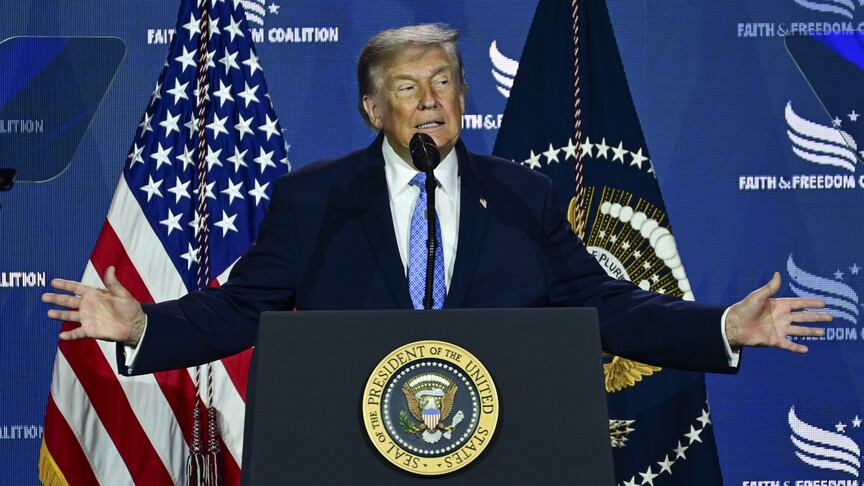
US President Donald Trump on Sunday criticized Democratic mayoral nominee Janeese Lewis George, calling her a “communist” and attacking her policy positions ahead of Washington, DC’s mayoral election.
“Janeese Lewis George, the Communist who is almost certainly going to be elected Mayor of Washington, D.C., has stated that she wants to empty the prisons, make D.C. a Sanctuary City, oppose ICE, welcome Criminal Illegal Aliens back into our beloved Capital, resist Anti-Crime Crackdowns, Defund the Police, continue and expand Cashless Bail, and so many other Capital destroying ‘things’,” Trump wrote on his Truth Social platform.
George won the Democratic primary for mayor of Washington, DC, earlier this month, securing her party’s nomination in the heavily Democratic city and becoming the likely successor to outgoing Mayor Muriel Bowser after the November general election.
Trump said he would not allow Washington, DC, to be “destroyed.”
“In the end, it will never work out, nor will I let it even have a chance because I have worked too hard to make Washington, D.C., the Envy of the World, with almost No Crime, and a Beautification process that has been second to none,” he said.
Trump also said he would “meet with Janeese Lewis George,” adding that Washington, DC, is “again a Safe and Prestigious Community.”
“Many people, including myself, have worked long and hard to get it there, and we will not let it be destroyed by a Communist adherent who has no intention to, MAKE WASHINGTON GREAT AGAIN!” he added.

Just in time for the Fourth of July, the Smithsonian Institution in Washington, D.C., has rolled out a big new exhibit highlighting nature in all its glory, with specimens from across America. But the Hawaiʻi offerings are a bit of a dud.
The Smithsonian’s National Museum of Natural History is a vast repository, occupying a stately edifice on the National Mall. It holds some 148 million objects, including more than a million from Hawaiʻi, including eight priceless feathered cloaks, but when the institution’s curators picked out one item to exemplify each state for this exhibit, they gave Hawaiʻi a rock.
Yes, a rock.
Seen in person, it’s a striking black clump of glittering pāhoehoe lava, and of course we are proud of our lava, but it comes across as, well, underwhelming.
Civil Beat is focusing on transparency, accountability and ethics in government and other institutions. Help us by sending ideas and anecdotes to sunshine@civilbeat.org.
Millions of visitors are expected to arrive in Washington, D.C. in the next two weeks. Many will be drawn by the fanfare associated with the 250th anniversary of the signing of the Declaration of Independence. In the eyes of many Americans, President Trump has tainted the occasion by claiming personal sponsorship of it.
To be fair, the city is looking pretty good, decked out in its finery for the events, and some improvements have been made. Flags are flying; the lawns look green and lush. The scene is drawing large crowds of tourists from all over the world, cheerfully milling about and popping into the many free museums that line the mall.
There are also some notable exceptions: The reflecting pond by the Lincoln Memorial is definitely tainted by algae infiltration. There’s also a bit of slime attached to what was reportedly a no-bid job for the renovation work by a Trump donor.
Also to be fair here: Hawaiʻi has had difficulties with its own reflecting pool, the now-waterless water feature at the State Capitol.

Amid the ongoing partisan warfare, Hawaiʻi’s state government, along with about 10 other Democratic-controlled states, has decided not to participate in the D.C. festivities. That includes the Great American State Fair, now being set up on the National Mall, which will host some 56 themed pavilions where individual states are expected to highlight what they believe makes them special. Sprawling over 10 city blocks, crowned by a 110-foot ferris wheel, the festival will feature concerts, military flyovers, fireworks displays, movie screenings and exhibit spaces representing the nation’s states and territories.
In a statement, Erika Engle, a spokeswoman for Gov. Josh Green, said the state is not officially participating, adding that no funds had been allotted for it by the Legislature or Congress.
She added that Washington, D.C, “is 5,000 miles away.”
That’s a distance that hasn’t previously inhibited the governor, whose peregrinations to the nation’s capital have almost qualified him as a frequent flyer.
This is supposed to be a sign of how Hawaiʻi’s leaders are effectively rejecting Trump. As if Trump cares whether Hawaiʻi participates or not.
It’s a strange place to make a stand. July Fourth is bigger than any president. The signing of the Declaration of Independence represents a rare kind of bravery. The 56 signers risked their lives to sign it, knowing they would have a target on their backs, placed there by King George III, one of the world’s most powerful monarchs.
In fact, people who signed resolutions against the king in the past could expect persecution not just in this life but in the next. In England in the 1630s, the autocratic King Charles I decided to bypass the elected body and instead to rule by executive order. Discarding established law and tradition, he disbanded Parliament for 11 years.
The English people thought that was high-handed and, amid a set of bloody civil wars that killed 200,000 people, he was eventually executed. But when his son was restored to the throne in 1660, the 59 people who had signed the former king’s death warrant were themselves hunted down. Many were drawn and quartered; the lucky were imprisoned for life.
Oliver Cromwell, the Parliamentary ringleader, had already died but his corpse was exhumed and he was hanged. His body was hung in chains and his decapitated head was impaled on a pike and put on public display for 20 years. Almost 100 years later, his embalmed head was still being carted about as a gruesome trophy, even as the signers of the Declaration of Independence put pen to paper.
Back in 1776, the memory of what vengeful kings do to their enemies was high in the minds of those who were publicly protesting Charles II’s autocratic heir, George III. In fact, one of the first ships built and commissioned by the Connecticut General Assembly, launched just two weeks before the Declaration of Independence was signed, was named the Oliver Cromwell.
Democracy has had its ups and downs.
Back to the exhibit at the Smithsonian.

The goal of the curators was to reflect America’s natural diversity and how humans interact with it. In dozens of exhibits spread over 5,000 square feet, visitors can learn about the oddities and idiosyncrasies in the natural world, from rocks to birds to butterflies to snakes to fossils to plants and also how humans have incorporated these items into crafts and artistry. It touched on the problems of animal extinction and climate change.
A video graphic allows people to track bird migration routes across the continental United States.
One display explains the long history of traditional blacksmithing in Guam, another provides examples of Samoan siapo bark cloth.
In addition to several lava rocks representing Hawaiʻi, the exhibit also featured a lovely Niʻihau snail shell necklace and a goby fish from Kāneʻohe Bay, which the exhibition touted as one of the largest sheltered bodies of water in Hawaiʻi, known for its living corals.
But more striking symbols of Hawaiʻi seemed notably sparse and some obvious elements are missing. How nice it would have been to see a feathered cape or an example of one of the brightly colored lizards that have played such an important role in Hawaiian mythology. I would have liked to have seen more of Hawaiʻi’s beautiful birds and butterflies.
Another thing that appears to have gone missing are Hawaiian philanthropic donors making the case for the state’s natural splendors. The display’s list of financial sponsors shows philanthropy from both blue and red states but nothing from Hawaiʻi.
That’s partly because we are suffering another form of extinction. We have a lot fewer large companies based in Hawaiʻi than we once did, and so there are fewer corporate sponsors. Even Hawaiian Airlines, once a mainstay of exhibits like this that appeal to frequent travelers, has been subsumed into an airline from another state.
We do have more billionaires than we once did, of course, but they own estates in so many places that it is hard to know what they actually consider home.
They just better not steal our rocks.

Sign up for our FREE morning newsletter and face each day more informed.

To mark Gun Violence Awareness Month, residents in Southeast D.C. came together to search for a lasting solution.
The Trigger Project held a peace walk Saturday afternoon reflecting on lives impacted by gun violence
The Trigger Project decided to host the walk to give victims’ loved ones a chance to be among others who have experienced the pain of losing a loved one.
The agency said it prides itself on getting the word out about how to prevent gun violence through lived experiences, community leadership and partnerships. The group aims to uplift young people through healing, opportunity and connection while addressing the root causes of gun violence. Another critical part of the event was to ensure that young people have a safe space where they can hang out.
“We’re losing too many of our babies to the streets, you know what I’m saying?” said Darlene Williams, who said she has been a victim of gun violence and also lost her granddaughter to gun violence. “Like I say, the guns don’t kill, people kill. [..] Be around other people, you know what I’m saying, that’s going through the same thing that we’re going through.”
-

 Colorado11 minutes ago
Southern Colorado remains in drought despite recent storms; NWS urges caution ahead of Fourth of July
-

 Connecticut14 minutes ago
CT Lottery Cash 5, Play3 winning numbers for June 28, 2026
-

 Delaware19 minutes ago
6 things to know about Delaware actor Ryan Phillippe
-

 Florida25 minutes ago
Mothers gather in Florida to honor children lost to gun violence
-
Georgia29 minutes ago
Georgia Lottery Cash 3, Cash 4 results for June 28, 2026
-

 Hawaii34 minutes ago
Suspect sought in Kailua drive-by shooting
-
 Idaho41 minutes ago
Severe weather postpones 16th annual Idaho Patriot Thunder Ride
-
Illinois44 minutes ago
Illinois Lottery Pick 3, Pick 4 results for June 28, 2026

