Washington, D.C
Trump Will Remake D.C.’s Culture in His Image


The last time Donald Trump won the presidency, there was a lot crowing in Washington’s beau monde about how the new administration would upend the city’s social life. D.C. has never been a particularly friendly town, but in 2016, its residents decided to take a harder stand than usual. The capital’s hostesses linked arms against any top Trump officials seeking invitations to their homes. The region’s restaurateurs, though expected to serve everyone, vowed to make a night on the town for Republicans as unpleasant as possible. And those in chattering classes remarked with much glee that at no point in the city’s recent history had the place been so socially divided.
The result was that, rather than integrate into Washington life, as staffers and officials from every other presidential administration have, Trump’s coterie was forced to build its own parallel society. Soon, largely undeveloped neighborhoods—Navy Yard and the Wharf prominent among them—became hot spots for young staffers. And no wonder. Those places fit well with Zoomer taste: new construction, rooftop pools, parking everywhere. Meanwhile, more senior officials colonized Kalorama, on the grounds that it was just like Georgetown, but even more insulated from the hateful public eye.
Eight years later, the situation is pretty much the same. D.C. exists as two parallel societies stuck within the bounds of late 2016. On one side, the greater part of the city is trapped in an Obama-nostalgia doom loop: Le Diplomate still dominates the scene on Fourteenth Street. The establishments of Dupont Circle are still celebrating Obergefell vs. Hodges as if the decision were just handed down last week. And, in Shaw, you can still find the odd “Chicago” bar, a tribute to the 2008 Obama campaigners who have long since left the neighborhood.
The Trump version of D.C. is no more vital. Those shiny buildings on the river are still obliviously humming along, worlds unto themselves. Mission in Navy Yard is still a hot bar with a certain sort of person, despite, or because of, its vulgarity. Shelly’s Back Room over by the White House has lost none of its luster, in large part because it is one of the only places in the capital that allows the public to smoke inside. The only major change in this world’s social setting from the first Trump presidency is a loss: the Trump International Hotel, which closed down shortly after the president’s inglorious departure in 2021. I can’t say I regret it: Every time I visited in those four years—whether for a gala, dinner, or some other evening event—I was always struck by how hollow, cavernous that main hall was.
How did the city get stuck in 2016 for so long? Typically, each president makes a mark on Washington’s local culture that survives his tenure, usually in the neighborhoods where his staffers settle. Bill Clinton brought in the crew that made Adams Morgan a hip area. George W. Bush oversaw the revival of Georgetown and Glover Park. And Barack Obama’s team gentrified the historically black neighborhoods around U Street. (Obama himself liked D.C. so much that he still lives here.) Trump, as I have said, built his own fantasy version of the city.
Subscribe Today
Get daily emails in your inbox
But something funny happened when Joe Biden took office in 2021. Rather than making his own mark on the city, here, as in so many other things, Biden was like a ghost, and the D.C. continued to function as if he were never here at all.
There are a few possible explanations for the cultural hole. The first is the fact that Biden was elected and took office during a pandemic. He famously campaigned out of his home in Delaware—where he spent much of his presidency anyway—and did not arrive in D.C. with an army of staffers looking for places to live. The second is related to the first: Hardly anyone in the federal government goes into the office anymore, meaning that there is little incentive to form a distinctively Bidenesque after-hours culture. And the third reason is the hazy temporality that surrounds all things Biden. No one was ever going to stick around for him.
Now that Trump is back for round two, everything will change. Once again, the city will renew itself. There is no stopping it now. There is no Resistance to lock the Trump administration out of polite society. For better or worse, Trump will remake Washington, D.C. in his image.



According to the National Park Service at the National Mall, famous cherry blossoms around the nation’s capital have hit peak bloom conditions. The National Park Service X account for the National Mall proclaimed this morning, “PEAK BLOOM! PEAK BLOOM! PEAK BLOOM!”
It became apparent yesterday that the bloom would be at peak today. “Despite a sunny afternoon and patches of blue sky, the cherry blossoms remain at Stage 5: Puffy White,” the Park Service wrote on X yesterday. Stage 5, “Puffy White”, is the final stage blossoms go through before being in full bloom. They start at Stage 1 as a “Green Bud”, grow into Stage 2 with “Florets Visible”, and then florets become extended at Stage 3. In Stage 4, there is “Peduncle Elongation” which sets the stage for the puffy blossoms to appear in Stage 5. Puffy White and Peak Bloom are defined as when 70% of the blossoms on the trees reach that stage.

Peak bloom varies annually depending on weather conditions; the most likely time to reach peak bloom is between the last week of March and the first week of April. According to the Park Service, extraordinary warm or cool temperatures have resulted in peak bloom as early as March 15 in 1990 and as late as April 18 in 1958.
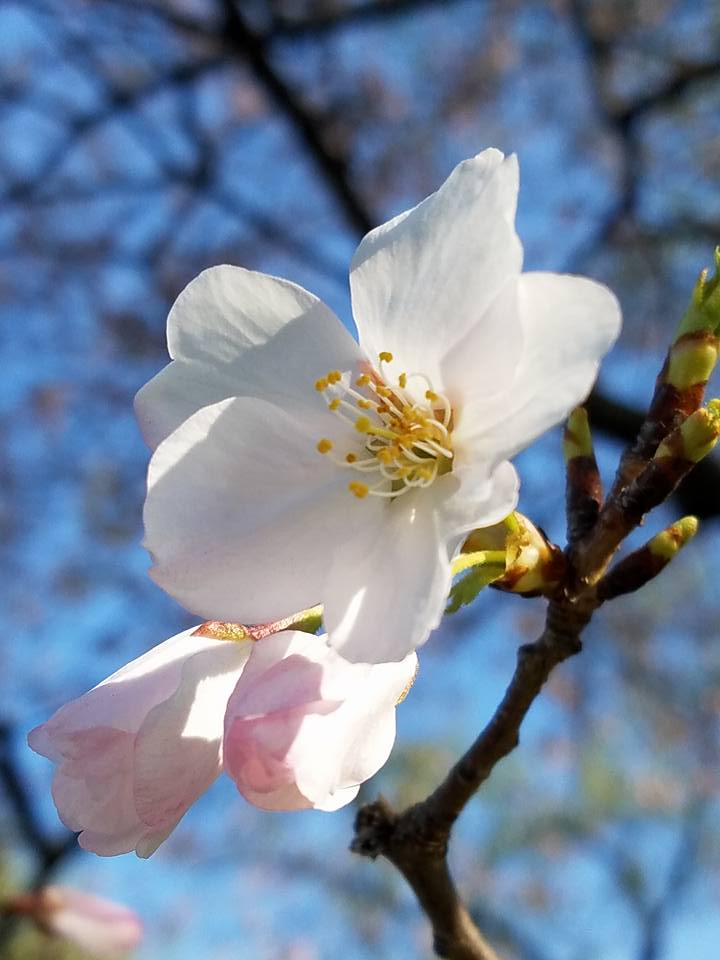
The planting of cherry trees in Washington DC originated in 1912 as a gift of friendship to the People of the United States from the People of Japan. In Japan, the flowering cherry tree, or “Sakura,” is an important flowering plant. The beauty of the cherry blossom is a symbol with rich meaning in Japanese culture.
Dr. David Fairchild, plant explorer and U.S. Department of Agriculture official, imported seventy-five flowering cherry trees and twenty-five single-flowered weeping types from the Yokohama Nursery Company in Japan. After experimenting with growing them on his own property in Maryland, he deemed that the cherry tree would be perfect to plant around the Washington DC area. This triggered an interest by a variety of individuals to plant the tree around Washington. In 1909 the Mayor of Tokyo, Yukio Ozaki, donated 2,000 trees to the United States on behalf of his city. When the trees arrived, they were riddled with disease and insects and to protect other agriculture, they were burned. The Tokyo Mayor made a second donation of trees in 1910, this time amounting to 3,020 trees. This started the forest of cherry trees that now line the Potomac basin around Washington DC. In a gesture of gratitude back to Japan, President Taft sent a gift in 1915 of flowering dogwood trees to the people of Japan. Thousands of trees have been added since, including another gift of 3,800 trees from Japan in 1965.


WASHINGTON (7NEWS) — Authorities are searching for an SUV after an officer with the Metropolitan Police Department (MPD) was struck by a hit-and-run driver in Southwest D.C. on Wednesday night.
The crash happened just before 10 p.m. at Martin Luther King Jr. Avenue and Forrester Street, SW.
Police confirmed the officer, an adult man, was conscious and breathing when he was rushed to a nearby hospital for treatment of his injuries. There is no word on his condition.
The driver involved fled the scene, and investigators are looking for a white Range Rover with a partial South Carolina tag of “403.”
Anyone with information is urged to call 202-727-9099 or text tips at 50411.
This is a developing story that will be updated as more information becomes available.
Washington, D.C
Community gathers for RFK stadium site open house meeting as Commanders prepare for DC return

WASHINGTON – Community members gathered on Tuesday night to review redevelopment plans for the RFK Stadium site and offer feedback as the Washington Commanders prepare for a return to the District.
The steel structure of the old stadium has now been removed, and officials say comments on the project’s environmental impact statement are due at the end of April. The final master plan is taking shape with input from residents.

Community gathers for RFK stadium site open house meeting as Commanders prepare for DC return
FOX 5’s Melanie Alnwick said a strong crowd gathered in D.C. Tuesday to speak with developers and city planners. The RFK site is divided into six districts, including the Plaza District, Riverfront District and Stadium District, each with proposed features for residents to evaluate. Members of the community viewed design concepts, asked questions and used green and red stickers to mark what they supported or opposed.
In the Kingman Park District, a primarily residential area, residents raised concerns about preserving green space and the placement of parking garages.
Groundbreaking for the Plaza District is scheduled for 2029, with the stadium targeted to open in 2030. The Commanders are investing $2.7 billion in the project, the largest private investment in city history, with another $1 billion coming from D.C. taxpayers.
City leaders say the redevelopment could create up to 6,500 housing units, 30,000 construction jobs, 2,000 permanent jobs and generate an estimated $5.1 billion in tax revenue.
Community gathers for RFK stadium site open house meeting as Commanders prepare for DC return
Another community meeting is set for Saturday at St. Coletta Church, with a site walk planned in April. More online.
St. Coletta Meeting Details
- When: Saturday, March 28, 10 am to 12 pm
- Where: St. Coletta of Greater Washington, 1901 Independence Avenue SE (Closest Metro: Stadium-Armory)
Online Survey
For those unable to attend an in-person event, the District will offer an online survey where residents can provide feedback on the master plan. The survey will request input on topics similar to those discussed at the events. The Office of Planning will combine this feedback with comments received at the in-person events, via email, and at the community visioning meetings that were held from October 2025 through February 2026.
- The survey link will be available from March 30-April 10 at OurRFK.dc.gov.
Community Site Walk
On Saturday, April 18, neighbors of the RFK Stadium campus are invited to join a walking tour led by staff from the Office of Planning. The walk will include visits to areas that are important to the redevelopment and stopping points for discussion. This interactive outdoor workshop will allow stakeholders to step into the shoes of a planner and share their ideas for the site’s future.
- When: Saturday, April 18, 10 am
- Where: Stadium-Armory Metro Station, 192 19th Street SE
- RSVP: A registration link will be available soon at OurRFK.dc.gov.
The Source: Information in this article comes from The Office of DC Mayor Muriel Bowser and previous FOX 5 reporting.

‘Hannah Montana’ Vinyl Returns to Charts Following 20th Anniversary Special

Nebraska Gov. Jim Pillen appoints Antonio Gomez to Racing and Gaming Commission

4 Southern Nevadans named to USA flag football national roster

NH lawmakers approve bill that would make judges’ job evaluations public

‘Hard to see’: Jersey Shore town to tear down lifeguard building before it collapses from erosion

Florida High School Football Rankings: Top 25 teams – Oct. 21

How old is Bo Nix? What to know about Oregon quarterback ahead of 2024 NFL Draft

Cleary's 21 help Le Moyne down Central Connecticut State 69-64 in OT

99th annual Pony Swim held in Virginia

Indiana Members Credit Union announced as new anchor tenant at Bottleworks District

Video: Savannah Guthrie Says She Believes Her Mother Was Taken for Ransom

Stefanik grills University of Michigan leader on lack of audit after string of Chinese national arrests

Photos: More than one million displaced by Israel’s evacuations in Lebanon

DHS shutdown live updates as Senate holds test vote on funding bill

Video: Jury Rules Against Meta and YouTube for Addictive Features
-

 Detroit, MI1 week ago
Drummer Brian Pastoria, longtime Detroit music advocate, dies at 68
-

 Science1 week ago
How a Melting Glacier in Antarctica Could Affect Tens of Millions Around the Globe
-

 Movie Reviews1 week ago
‘Youth’ Twitter review: Ken Karunaas impresses audiences; Suraj Venjaramoodu adds charm; music wins praise | – The Times of India
-

 Sports5 days ago
IOC addresses execution of 19-year-old Iranian wrestler Saleh Mohammadi
-
 Science1 week ago
I had to man up and get a mammogram
-

 New Mexico4 days ago
Clovis shooting leaves one dead, four injured
-

 Texas7 days ago
How to buy Houston vs. Texas A&M 2026 March Madness tickets
-

 Tennessee3 days ago
Tennessee Police Investigating Alleged Assault Involving ‘Reacher’ Star Alan Ritchson