Washington, D.C
The Ned announces its Washington D.C. opening • Hotel Designs


In 2017, The Ned established itself as a space for the discerning in London before expanding to New York and Doha. Each Ned’s Club location is unique, drawing from the rich histories of their settings yet unified by a common philosophy to share a space where professionals can meet, create, revel and have a good time.

Image credit: Ned’s Club/Rendering
The fourth and newest location— Ned’s Club Washington D.C., is inspired by the glamour of the ‘roaring twenties’ era and neoclassical designs, paying tribute to the Club’s location at the intersection of two historic properties, the 12-story Walker Building and an old bank building. The Club will occupy the upper three floors once home to iconic D.C. institutions such as Riggs Bank and American Security and Trust Company, and honour the Capital’s rich history with vintage vibes of the Art Deco era.
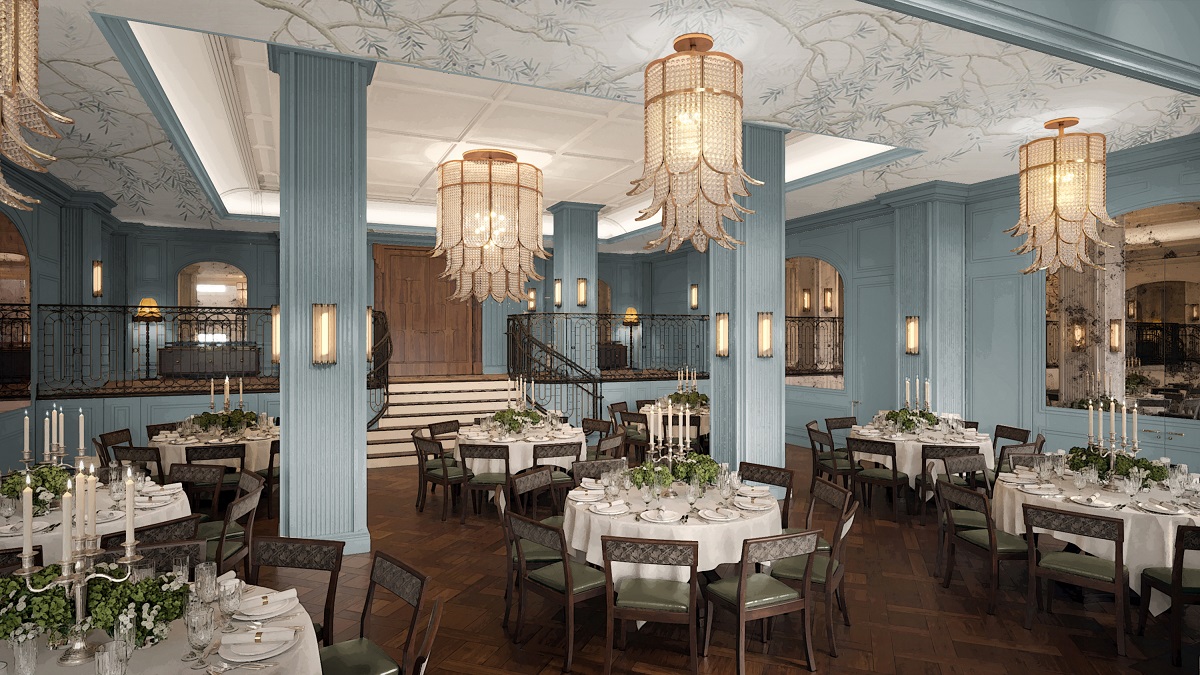
Image credit: Ned’s Club/Rendering
“We are thrilled to unveil Ned’s Club Washington D.C., our modern interpretation of the private member’s club, as the latest in our global collection,” expressed Gareth Banner, Group Managing Director. “It’s an honour to welcome new members to this extraordinary venue, which stands as a testament to the city’s rich history. At Ned’s Club Washington D.C., we’re not just providing physical spaces but an environment that reimagines networking, entertainment, dining and events in an iconic building and location that only D.C. could offer.”

Image credit: Ned’s Club/Rendering
Taking residence within President’s Park, with a panorama of the U.S. Treasury and White House, Ned’s Club Washington D.C. offers a globally-influenced design that complements D.C.’s distinctive character.
The interiors, by Soho House Design and Stonehill Taylor, pull inspiration from the property’s Art Deco historical vestibule. Throughout the member club floors, history and art converge with custom mosaic designs on the floor complemented by a palette of vibrant gold, blue, and green. Here, members are treated to a range of spaces designed to fuse work and leisure. The tenth floor stands as a tribute to former U.S. presidents, each room reflecting the unique styles of their eras.

Image credit: Ned’s Club/Rendering
By day, The Library resonates with calmness—its furnishings echoing the sophisticated elegance reminiscent of past eras, complete with a classic fireplace. At night, it transforms into a vibrant social space with an elegant bar. The Drawing Room extends beyond culinary offers, presenting sweeping views of Washington D.C.’s iconic landmarks. The Dining Room features stained-glass fixtures and rich wooden accents to create an ambiance akin to the sun-drenched dining settings treasured during the Kennedy years.
Within the Conservatory, members are welcomed into an indoor space with greenery and natural aesthetics. Perched at the pinnacle, the Loft Restaurant and Rooftop Terrace are adorned with custom mosaic artworks that pay homage to the historical Walker Building. Here, guests indulge in sweeping views from a vantage point that captures the grandeur of the US capital.

Image credit: Ned’s Club/Rendering
Following the other Ned art collections, which illustrate inclusivity at their core, Ned’s Club Washington D.C. will exhibit two permanent art collections. The first is a pointed look at gender imbalance in the American political landscape. Taking as its starting point the ratio of male presidents in American history to the number of women Presidents, the collection inverts these numbers. Entitled No President and displayed in one space together, a carefully selected collection will present the work of 46 American women artists. The second collection champions local artists, displaying the work of those who are born, based, or trained in Washington, D.C. The local collection will include site-specific commissions and a diverse range of artists, from museum-level names to emerging talent.
In addition to world-class design, members can look forward to a host of tailored events such as CEO-led workshops, rare whisky tastings, panel discussions, live music, and entertainment that capture the spirit of D.C. Ned’s Club members also enjoy access to all members-only spaces at The Ned London, The Ned NoMad New York and The Ned Doha, as well as invitations to special offsite events around the world.
Main image credit: Ned’s Club / Rendering



D.C. released draft plans for the community surrounding a new Washington Commanders stadium at the former site of RFK Stadium.
Renderings included with the draft plan show the idea is to have a community with open spaces, parks, retail and housing. Walkability and access to the Anacostia River were essential for many who weighed in.
“We’ve been working throughout the development of this master plan with WMATA and the District Department of Transportation, and in this project, as all projects, having lots of ways for people to get to one place is really important, whether on foot, on bike, you’re in a vehicle, you’re taking transit, you’re taking Metrorail or the bus – all of those are provided for,” Office of Planning Director Anita Cozart said. “So, the big part of the master plan is making sure that there is space for those.”
The master plan includes space for a grocery store and as many as 6,500 new houses with 30% of those houses dedicated as affordable.
The community will develop around the stadium after it’s built, Cozart said.
The plan includes the visions and desires of thousands of people and agencies who weighed in on it, but it’s not final. The public is invited to inspect the plan and comment until Aug. 14.
“What did we get right about this master plan; what are some things that we might need to tweak,” Cozart said. “The next step after that is the master plan goes to the City Council.”

Club exercises Tamara Bolt’s 2027 option, extends Madison Haugen through end of season
Washington, D.C. (06/30/2026) – The Washington Spirit has made two midseason roster moves ahead of the resumption of the regular season early next month, the club announced today. The club has exercised its 2027 option on forward Tamara Bolt’s contract and extended short-term injury replacement (STR) player Madison Haugen through the end of the 2026 season.
“As we look ahead to kicking off the second half of the season, we’re confident in the group of players we have together and our midseason roster moves reflect that,” said Sporting Director James Hocken. “Our roster is constantly evolving to best serve the club’s aim of bringing trophies home to DC.”
Bolt signed with the Spirit in January 2025 before spending the calendar year on loan with Dallas Trinity FC of the USL Super League. Since returning to DC prior to this season, the Salvador, Brazil native has appeared in five matches for the Spirit. Bolt played three seasons with top-flight Brazilian side SC Internacional before joining the Spirit, appearing in 36 matches and tallying six goals in the process.
Haugen joined the Spirit as a short-term injury replacement player this past preseason, adding depth to the team’s roster in the absence of its players out on maternity leave. The defender has yet to appear in a match for the Spirit this season. Haugen most recently competed for Portugal’s Sporting CP, scoring five goals across 21 appearances.
The Spirit maintains ongoing conversations with all players that will be free agents following the 2026 season. Updates will be provided as they occur.
The Spirit will next take the pitch at Audi Field on Friday, July 3 when the side returns from the NWSL-wide June break to host the Houston Dash. Kicking off the holiday weekend at 8 p.m. EDT, tickets are available at WashingtonSpirit.com/tickets.
About The Washington Spirit
The Washington Spirit is the premier professional women’s soccer team based in Washington, D.C. and plays at Audi Field in Buzzard Point. The Spirit was founded on November 21, 2012 and is an inaugural member of the National Women’s Soccer League (NWSL), the fastest growing sports league in the US. The club is home to some of the best players in the world who have won championships for both club and country. For more information about the Spirit, visit WashingtonSpirit.com and follow the club on Twitter, Instagram and Facebook.

This year’s Fourth of July celebrations in Washington, D.C. — marking the nation’s 250th birthday — will include hours of military flyovers and a massive fireworks display that could stretch late into the night, with some of the tightest security in decades, officials said Monday.
This Fourth will include “the largest display of fireworks our city has ever seen,” D.C. Metropolitan Police Department Interim Chief Jeff Carroll said at a news conference. Usually the fireworks begin at around 9 p.m., but this year, they are expected to begin at 11 p.m. and are “going to be longer than in previous years, we are told,” Mayor Muriel Bowser told reporters.
President Trump has said he plans to speak at 9 p.m., ahead of the fireworks. Starting at 1:15 p.m., hundreds of planes will participate in a “Fourth of July Airshow,” the president said. The National Mall also is hosting a daily event called the Great American State Fair that will run until July 10, and some local neighborhoods are hosting parades and other events on the Fourth.
The main festivities have been deemed a National Special Security Event, a designation used for massive events like Super Bowls and presidential inaugurations. Security measures will be more extensive than for any Fourth of July event in D.C. since shortly after the 9/11 attacks, Carroll said, with more blocking vehicles, more fencing, concrete barriers and other security measures that aren’t employed for a typical Fourth of July celebration.
The FBI isn’t tracking any credible threats to the Fourth of July, but “we always remain vigilant,” said Darren Cox, assistant director in charge of the FBI’s Washington field office.
Those planning to view the fireworks show from the Washington Monument grounds should expect “TSA-style” security, with magnetometers screening guests, according to Tara McLeese, special agent in charge of the Secret Service’s Washington field office.
Guests can arrive as early as 1 p.m., and should enter on the east side of the Washington Monument at Constitution Avenue and 14th St. NW, or at Independence Avenue and 14th Street SW, McLeese said.
McLeese said each guest in the restricted area is allowed only one clear bag no larger than a gallon, or a small clutch purse. There will be no storage for prohibited items.
The capacity of the primary viewing area at the Washington Monument is set at about 150,000, according to Secret Service Special Agent in Charge David Yamen, who runs the agency’s dignitary protective division. It is expected to hit capacity.
Attendees of the Great American State Fair at the National Mall are encouraged to remain there to watch the fireworks show, rather than attempting to enter the primary viewing zone on the Washington Monument grounds, said Scott Brecht, chief of the U.S. Park Police. Leaving one zone and moving to another will require additional security screenings, and reentry may not be possible.
To get to the National Mall on the Fourth, public transit use is encouraged. The D.C. Metro will be free after 5 p.m., Washington Metropolitan Area Transit Authority General Manager Randy Clarke said, “to really make sure people can not only enjoy the festivities all over the region as a community, but also make sure from a safety point of view we can get people going through.”
“If you’re going downtown for the fireworks, plan ahead, be ready for an increased security presence, crowds, and road closures,” D.C. Homeland Security and Emergency Management Agency Director Clint Osborn said. “I would say that if you’re going downtown and you’ve done this before, don’t assume you know what it’s going to look like.”
Join CBS for “The Great American Block Party 250,” a primetime special on Saturday, July 4, hosted by CBS Evening News anchor Tony Dokoupil and Entertainment Tonight’s Nischelle Turner, featuring live musical performances, celebrations around the country, and the largest fireworks show in history in the skies over the nation’s capital. Tune in July 4 at 8 p.m. ET on CBS and stream it on Paramount+ and CBS News 24/7.
-

 Texas2 minutes ago
Phoenix Merchant Partners and Texas Capital Alternative Asset Management Form Strategic Relationship
-

 Utah5 minutes ago
Therapy dogs offer a welcome break for firefighters battling Utah’s Iron, Cherry fires
-

 Vermont10 minutes ago
She moved from Paris to Vermont and found her ‘dream job’ opening a bakery – The Boston Globe
-

 Virginia17 minutes ago
Reopening date set for Virginia Creeper Trail after months of work
-

 Washington20 minutes ago
Colorado Democrats punish Washington ties in primaries
-

 Wisconsin25 minutes ago
Missing Wisconsin teen Joniah Walker found safe 4 years after disappearing from home
-

 West Virginia32 minutes ago
Transmission line proposals raise ratepayer cost concerns in West Virginia
-

 Wyoming35 minutes ago
Wyoming Department of Health warns of scam callers using official phone number

