Washington, D.C
DC bishop: Catholics should ‘get the facts’ on immigration, Church teachings


Catholics must educate themselves on “the facts” regarding the U.S. immigration system and the Church’s teachings on the matter, according to Washington, D.C., Auxiliary Bishop Evelio Menjivar-Ayala.
Following his participation in a panel at the New York Encounter titled “Seeking a Home: A Catholic View on the Status of Immigration to the U.S.,” Menjivar-Ayala told EWTN News that he is “very hopeful” about the future of immigration in the U.S. “When people show up for a talk like this, and you see standing room only, that tells you of the great desire of people to get informed, to get educated.”
The D.C. auxiliary bishop emphasized the need to “get the facts,” not only about the immigration system in the U.S. but also where the Church stands on the issue. “For the Church, the first and the most important thing is human dignity,” he said. “It is the dignity of every person, undocumented or citizen.”
While the government must enforce its laws and protect its sovereignty, Menjivar-Ayala said, it is necessary for the government to “look at the eyes of the person, the dignity of every human being,” and to ensure that enforcement is “done in a humane way that respects the dignity of the human person.”
“Let us educate ourselves,” he said, adding: “As they say, the social doctrine of the Church is the best-kept secret. And the Church teaches, has beautiful teachings, about the social dimension of our faith.”
Dialogue with Catholics in the Trump administration
Menjivar-Ayala noted that previous administrations in the past had participated in dialogue with the Catholic Church, consulting with organizations such as the Catholic Legal Immigration Network Inc. (CLINIC) on the issue of immigration. However, he said, the current administration has not.
Menjivar-Ayala noted the disparity between the Church’s emphasis on human dignity and the Trump administration’s position that every unauthorized border crossing is a criminal act.
He said we should be careful about narratives surrounding the issue and refrain from categorizing those who cross the border without authorization the same way as perpetrators of crimes such as murder, rape, or theft.
Menjivar-Ayala said criminals should be prosecuted as criminals and not categorized in the same way as immigrants, noting that “immigration laws are a different set of laws than criminal laws” but that the current administration is now “pulling them together.”
Responding to high-ranking officials who are Catholic, such as “border czar” Tom Homan, who has described the Catholic Church as being “wrong” about immigration, Menjivar-Ayala said he believes “it’s a question for them” about “how are you living the Gospel?”
“I would say that the question is not for me, because for me and for the bishops it is very clear. Every person has dignity, and in every migrant, no matter if they are documented or undocumented, we should see the face of Christ,” he said. “So the question is for them, for those who claim to be Catholic but are not seeing the face of Christ in the migrants.”
Menjivar-Ayala stressed the need for one’s politics to be informed by the Gospels and faith, rather than one’s faith being informed by politics or one’s personal views. “It is the Gospel that needs to tell me how I should see the world and not politics,” he said.
Life for the immigrant community in Washington, D.C.
Immigration enforcement among Catholic migrant communities in D.C. is “dying down a bit,” according to Menjivar-Ayala.
Sacred Heart Shrine in the Columbia Heights neighborhood reported that six of its parishioners were detained by Immigrations and Customs Enforcement (ICE) agents in August 2025, including an usher who was on his way to evening Mass.
Menjivar-Ayala said the immigrant community at Sacred Heart Shrine “has been affected the most” in the city but has also become the most tight-knit. During the panel, Menjivar-Ayala described parishioners in immigrant communities banding together to bring food and provide other support for one another. “I was thinking about that parish,” he said.
“I believe right now it’s dying down a bit, but nobody knows when you are going to have ICE in the streets,” he concluded.
Panel highlights broken system, need for congressional action
For the panel, Menjivar-Ayala was joined by Mario Russell, executive director of the Center for Migration Studies, and Ashley Feasley, a legal expert in residence at The Catholic University of America’s Immigration Law and Policy Initiative.
During her remarks, Feasley described the U.S. immigration system as “old,” having not been reformed since the late 1990s.
“What has happened here is people may have many perspectives about the failures of one president or another on immigration reform,” she said. “But the one place where I think we can really circle in on is the failure of Congress to act regardless of who is in the White House or who controls Congress.”
Feasley noted the presence of a number of comprehensive bills seeking to address border security and asylum but have had a difficult time garnering bipartisan support. This, she said, has ultimately been “one of the biggest problems.”
During his remarks Russell, similarly to Menjivar-Ayala, encouraged Catholics to inform themselves about the immigration system by reading reports such as those from the Center for Migration Studies or from diocesan sources.
“What is happening is basically what is happening,” he said. “Robert Reich, the old labor secretary, recently said, ‘Why would the Immigration Customs Enforcement go to Home Depot to find criminals? Why would they go to a posada or a corner to find criminals? Those are workers,’ so the evidence doesn’t support the narrative.”



WASHINGTON – Metro riders are seeing changes Thursday morning as WMATA adjusts its shuttle bus system following concerns about long lines and confusion tied to the Red Line summer shutdown.
Express shuttles to North Bethesda will now only pick up on Wisconsin Avenue near the Trader Joe’s. Local shuttles serving Bethesda, Medical Center and Grosvenor have been moved to the Friendship Heights Metro station, while some regular Metrobus routes are picking up on Western Avenue.
Red Line Shuttle Service Updates
• Local shuttle boarding will be relocated to Bus Bay K – the current C83/D96 bus stop on Wisconsin Ave.
• C83 and D96 buses will be relocated to the bus shelter on Western Ave near Wisconsin Ave.
• Express shuttle boarding will remain in the 5300 block of Wisconsin Ave NW.
What we know:
FOX 5’s Melanie Alnwick says Red Line riders say the shutdown has added time to their commute, though many are trying to stay positive. The shuttles connect North Bethesda and Friendship Heights through September 6, when Purple Line construction is expected to wrap up.
Metro Red Line summer shutdown leads to long shuttle lines
Metro Red Line Summer Shutdown: Changes to shuttle bus service after concerns
The workaround relies on dedicated shuttle bus lanes along northbound and southbound Wisconsin Avenue/355 and up to Rockville Pike. But truck drivers, delivery drivers and passenger vehicles have been stopping or parking in those lanes, forcing shuttles to go around and slowing traffic.
Metro and Montgomery County police have increased enforcement to keep the lanes clear. Metro Transit Police say they asked more than 60 drivers to move out of the bus lanes in the first days of the shutdown.
Metro is also adding about 100 parking spaces at Friendship Heights in the former Lord & Taylor garage. Some Montgomery County riders are opting for the MARC train downtown instead.
Metro’s Red Line shutdown is now in full effect: Here’s what you need to know
Metro Red Line Summer Shutdown: Changes to shuttle bus service after concerns
The Source: Information in this article comes from WMATA and previous FOX 5 reporting.

Washington D.C. police are searching for a vandal who was caught on surveillance video slashing the tires of multiple vehicles in a Georgetown alley on Tuesday afternoon. The suspect, who fled the scene on a red bicycle, targeted a Chevy Suburban and a Ford Escape on the 1700 block of 35th Street Northwest.
Washington, D.C
Reflecting Pool being drained – again – as Trump administration tries once more to fix DC landmark – WTOP News

Crews began draining the Lincoln Memorial Reflecting Pool on Sunday, according to Interior Secretary Doug Burgum, for the second time in three months.
(CNN) — Crews began draining the Lincoln Memorial Reflecting Pool on Sunday, according to Interior Secretary Doug Burgum, for the second time in three months.
In an interview released Tuesday with Katie Miller, a conservative podcaster and wife of President Trump’s deputy chief of staff Stephen Miller, Burgum said they started draining the pool as planned after the July Fourth fireworks show, noting some of the fireworks debris was still in the water.
Asked about the schedule for this round of renovations, he gave no specifics beyond a broad overview.
“Drain the water. Clean up the fireworks stuff. Repair the vandalism that was done. Fill it back up again,” Burgum said.
As of Tuesday evening, there was still water in the pool, and it was unclear if it will be drained further. Burgum indicated over the weekend that it may only need to be partially drained.
The move comes after weeks of problems – algae blooms, green-hued water, a chipping bottom and allegations of vandalism – have plagued the iconic landmark, making its woes the subject of a national fixation.
Members of the Trump administration, including President Donald Trump, have said vandals caused damage to the Reflecting Pool by gashing the lining, though they have not provided evidence to support that claim. In late June, the president said the pool would be drained after the July Fourth holiday to fix it.
The administration will use the same contractor, Virginia-based Atlantic Industrial Coatings, for this next round of repairs. Previously, the company landed a no-bid contract worth more than $14 million for their part of the work – sealing the pool and painting the bottom “American Flag- blue.”
Asked about the timeline for his part of the repairs, Eddie Gross, owner of Atlantic Industrial Coatings told CNN that “nothing has been set yet.” He declined to answer questions about his contract and the cost of additional repairs.
The Department of Interior did not respond to questions about the timeline for this round of repairs.
Burgum, in an interview on CNN’s “State of the Union” Sunday, suggested the repairs could happen with the pool only being partially drained. He sought to portray the costs as minor.
“It’s going to be a small number because the majority of the work was related to the labor and the materials for the liner,” Burgum said.
“We’ll use the same company, because they did a fantastic job,” he said.
Burgum also said the government could “absolutely” prove the damage was caused by vandals, and that there are photographs supporting the claim. But he dodged a question about whether those photographs show anyone damaging the pool.
The secretary also denied that Trump having his motorcade drive through the pool mid-renovation in May did any damage to the site.
“No, I was with him when we came that night … We were driving in a Cadillac Escalade. It is one of the presidential fleet of cars,” Burgum said, adding that the vehicle Trump took on the ride was “substantially lighter” than the armored presidential limousine known as “The Beast.”
“The whole base level of this industrial rubber layer was not yet completed, and so there was no damage that night whatsoever,” he said. “That was one of the questions we asked before we even brought the presidential motorcade there, but not a chance.”
The other contractor involved in the project, Greenwater Services, previously told CNN that when the pool is drained it will not affect their system, which is up and running.
Chas Antinone, the president of Greenwater Services, told CNN the company can shut down and then restart the so-called ozone nanobubbler, as necessary.
Companies involved in the renovation have found themselves at the center of national news as Reflecting Pool issues continued.
The-CNN-Wire
™ & © 2026 Cable News Network, Inc., a Warner Bros. Discovery Company. All rights reserved.
-
 Lifestyle3 minutes ago
Meow Wolf taps famed L.A. animation house for its new Los Angeles venue
-
Politics10 minutes ago
Column: Trump decries ‘communism’ while his government takes ownership of companies
-
 Science13 minutes ago
‘I’d rather my house burn down than get cancer’: Herbicide use upends California’s fight to save forests
-
 Sports18 minutes ago
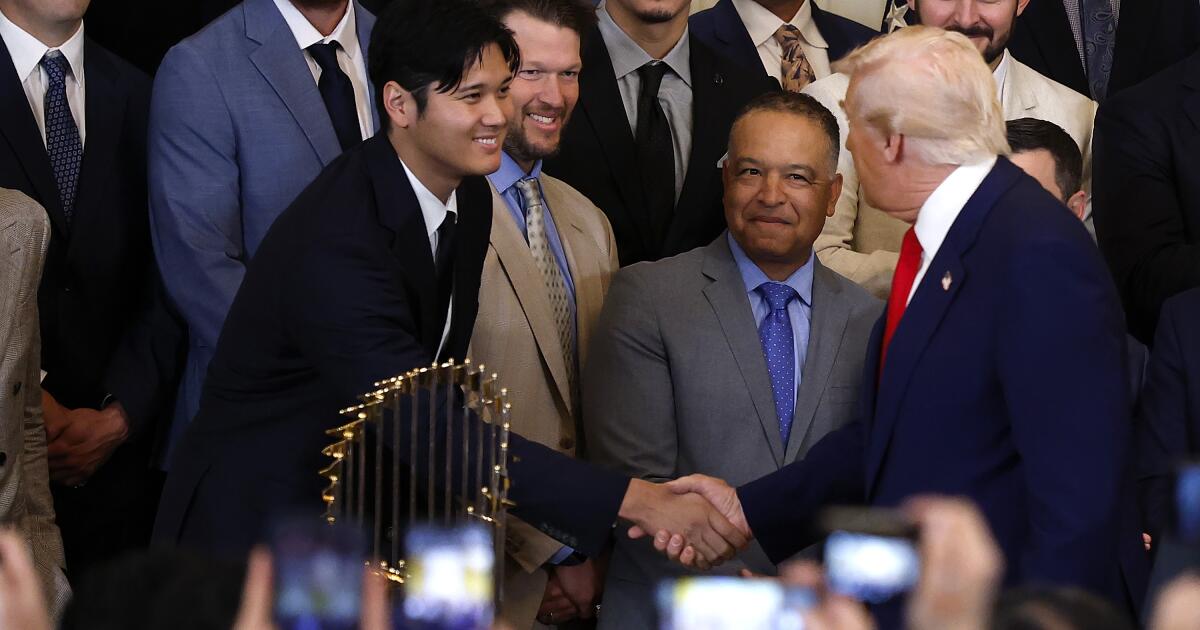
Dodgers scheduled to visit White House in late July to celebrate 2025 World Series win
-

 World28 minutes ago
Former US Olympian pleads not guilty in DC reflecting pool vandalism case
-
 News55 minutes ago
Former Olympian pleads not guilty in reflecting pool vandalism charges
-

 Los Angeles, Ca2 hours ago
Heat advisory, beach hazards in effect as Southern California sizzles
-

 Detroit, MI3 hours ago
Teen on moped hit by car after cruising through stop sign in Detroit


