Washington, D.C
Danny De Gracia: With DC In Chaos, We Need To Assess Local Needs, Pronto


When crises occur, our institutions are often ill-suited to respond due to excessive pedantry, navel-gazing and an overall lack of initiative. The best way is to just start figuring out what needs to be done.
We now have a president who issues on-the-fly directives that no one understands how to implement, and even fewer understand the implications of what these policies will mean for state and local governments.
I get the sense that Republicans and Democrats alike are taking a wait-and-see approach to the second Donald Trump administration’s policies, at least with respect to how they will deal with the effects of reduced (or completely cut) federal funding, reductions in federal agencies, and even how tariffs will affect everyone’s bottom line.
What does this mean? Elected Republicans may or may not personally agree with the blitz of executive orders, but you can bet all of them are going to pretend in public that they do, saying at best, “I have some concerns about (fill in the blank issue)” if their conscience or their constituents are giving them flack over it.
For the elected Republican, the game theory likely works like this: Perhaps, for example, they want the U.S. Department of Education and other agencies functionally gutted by DOGE; perhaps not. But they’ll let it happen anyway because they don’t want to be attacked over it, and they may even revel in it the whole way.
If this results in a beneficial outcome, they’ll claim to have supported it the whole time. If it doesn’t, and their constituents start revolting to the point they are endangered for reelection, they’ll claim that they had “concerns” the whole time. How do I know this? Just look at the manic way that legislators like Sen. Lindsey Graham flip-flop constantly.
Will Democrats Be Part Of The Solution?
And let’s not get started with the Democrats. If John F. Kennedy were alive today, he’d likely write a book entitled “Profiles in Cowardice” as an inglorious sequel to his “Courage” book.
Democrats are in the unique position of having a moral hazard where they can do one of two things: A) Do their constitutional duty in both federal and local government to “check” perceived abuses by the president, but in doing so, mitigate the effects of bad policies; or B) Allow the Republicans to succeed at everything on purpose so that they produce the obvious chaotic outcomes that will incense the American public against them, thus leading to a Democratic wave in the next election.
Mr. and Mrs. Hawaiʻi, you’re sandwiched between two useless factions in Washington, D.C., who are thinking more about their careers than they are about your safety, security and future prosperity. The good news is, all across America, the real rubber will meet the road in days to come with state legislatures and city councils who can (and should) fill the gaps left by the federal government.
If I were the president of the state Senate or the speaker of the House, the first thing I would do right now would be to get a full-spectrum policy perspective from 60,000 feet to ground level in Hawaiʻi about potential gaps and oversights that need to be addressed.
I would suggest the immediate creation of a “State of Hawaiʻi Next Steps Needs Assessment” in which, over the course of a narrow two-week period, the Legislature solicits qualitative data in the form of key interviews. Talk to everyone from residents who are in underserved and vulnerable communities, to people and organizations who will be affected by changes in federal funding or staffing, all the way up to subject matter experts in highly technical fields who have strategic concerns about public safety or regulatory moral hazards. The responses, with the help of artificial intelligence, can then be coded.
Do It Before The Session Ends
This is a little more advanced than your ordinary “information briefing” where legislators sit and watch PowerPoints and ask a question or two, because it would be structured specifically at getting as much information in the shortest amount of time possible and turning it around to reprioritize legislation before the current regular session ends.
In cases where the state constitution does not allow us to modify viable existing bills to fit new needs, a special session can be held to allow for follow-up. This can also include partnership with county councils, for even more local support for closing gaps.
We need to know, for example, if there’s a report someone wrote warning about a critical local safety risk, that’s now going to be sat on or ignored because their agency has been gutted. Or we need to know if there’s a program that was funded and is no longer that is going to result in a cliff effect that causes something in our local economy to flounder.

This information can then be organized and uploaded to a publicly visible website where all Hawaii residents, and especially community-based organizations, could read the key informant interviews and see the various trends. For example, maybe a nonprofit might see a list of people who they could personally help offset the termination of a grant, or they may be able to provide a service that is no longer available.
In either case, knowing what’s out there will be essential to preventing a crisis in the days to come where the current administration’s approach of “cut it all off, those people will figure it out” leaves too much to chance.
In closing, I would also like to make a personal appeal to our congressional delegation to try and talk offline to our new director of national intelligence, Tulsi Gabbard. Say what we may about her now, as someone who is close to the president, we should attempt to appeal to her previous, earlier virtues as a progressive and mention that the “old” Gabbard would have thrown previous presidents under the bus for doing (and saying) the things that our current president is doing.
I don’t remember the first DNI, John Negroponte, having as much time, post-9/11, as Gabbard does now to do TV interviews and social media posts, so she should have the scheduling freedom to be able to meet with her Hawaiʻi peers.
This is not about party anymore. This is about what can we do to ensure that things work for as many people as possible, without leaving gaps that invite chaos or harm upon our nation and states. Let’s get on that, ASAP.

Sign up for our FREE morning newsletter and face each day more informed.




Washington, D.C
What’s that noise? What you need to know about D.C. flyovers Friday and Saturday – WTOP News

Reagan National Airport will close for America 250 flyover rehearsals Friday and celebrations Saturday featuring the Thunderbirds, Blue Angels and more.

Reagan National Airport will close from 10 a.m. to 1 p.m. Friday for rehearsals ahead of this weekend’s America 250 celebrations, meaning people around D.C., Arlington and Alexandria may hear and see low-flying military aircraft.
According to Freedom 250 event organizers, Friday’s “Wings of Freedom” demonstrations over the National Mall will feature parachute teams, helicopters and military aircraft, including the U.S. Marine Corps’ MV-22 Osprey and F-35B, the Navy’s F-18F and F-35C, the Air Force’s F-22 Raptor, the Thunderbirds and a tri-bomber formation.
On Saturday, the FAA will close the airport from noon to midnight for the full celebration. All arrivals and departures at Reagan National are scheduled to end before noon.
Flyovers and demonstrations are scheduled throughout the afternoon and evening along the National Mall and Washington Monument grounds, including appearances by Air Force One, the Thunderbirds, Blue Angels, military aircraft fleet reviews, parachute demonstrations and B-2 stealth bombers.
Highlights include an Air Force One flyover scheduled for 7:03 p.m., a Thunderbirds demonstration beginning at 6:25 p.m., a tri-bomber formation at 6:02 p.m. and a stealth aircraft flyover at 7:38 p.m.
Friday’s schedule of flyovers and demonstration rehearsals along the National Mall and Washington Monument
- 10 a.m.: Golden Knights, Leap Frogs
- 10:15 a.m.: Army Helo Flyover
- 10:20 a.m.: USMC V-22 Osprey Demo
- 10:35 a.m.: USMC F-35B STOVL Demo
- 10:50 a.m.: USN F-18F Demo
- 11:10 a.m.: USN F-35C Demo Team
- 11:30 a.m.: USAF F-22 Raptor Demo
- 11:50 a.m.: NASA F-5s
- 12 p.m.: HUGE (1) Formation
- 12:05 p.m.: USAF Thunderbirds
- 12:55 p.m.: USAF Tri-Bomber
Saturday’s schedule of flyovers and demonstration along the National Mall and Washington Monument
- 1:14 p.m.: – NASA F-5 Flyover
- 1:24 p.m.: -NASA Fleet Review
- 1:44 p.m.: USCG Helo Flyover
- 1:54 p.m.: USCG Fixed Wing Flyover
- 2:09 p.m.: Golden Knights, Leap Frogs
- 2:29 p.m.: Army Helo Flyover
- 2:44 p.m.: USAF Fleet Review – Wave 1 – Heavies
- 2:54 p.m.: USAF Fleet Review – Wave 2 – AFSOC
- 3:04 p.m.: USAF Fleet Review – Wave 3 – Fighters
- 3:29 p.m.: Executive Rotary Wing Airlift
- 3:39 p.m.: USMC Fleet Review – Wave 1 – Rotary
- 3:49 p.m.: USMC Fleet Review – Wave 2 – Fixed Wing
- 3:59 p.m.: USN Fleet Review – Wave 1 – Rotary
- 4:09 p.m.: USN Fleet Review – Wave 2 – Fixed Wing
- 4:19 p.m.: USN Fleet Review – Wave 3 – Fighters
- 4:21 p.m.: USN F-18F Demonstration
- 4:59 p.m.: USN Blue Angels
- 5:26 p.m.: USMC MV-22 Osprey Demonstration
- 5:44 p.m.: USAF Fleet Review – Fighters
- 6:02 p.m.: USAF Tri-Bomber Formation
- 6:05 p.m.: USN F-35C Demonstration
- 6:25 p.m.: USAF Thunderbirds Demonstration
- 7:03 p.m.: Air Force One Flyover
- 7:07 p.m.: USAF Thunderbirds Delta Break
- 7:17 p.m.: HUGE 1 Flyover Led by the Newly Renovated Air Force One
- 7:38 p.m.: U.S. Stealth Airpower Flyover
- 7:39 p.m.: F-22 Raptor Demo
- 7:53 p.m.: F-22 Raptor in Afterburner
- 7:59 p.m.: B-1 Flyover
- 8:07 p.m.: B-1’s in Afterburner
- 8:11 p.m.: HUGE ONE Fly Over Review
- 8:22 p.m.: Golden Knights Twilight Jump
- 10:36 p.m.: B-1 Afterburner Night Pass
Get breaking news and daily headlines delivered to your email inbox by signing up here.
© 2026 WTOP. All Rights Reserved. This website is not intended for users located within the European Economic Area.

An Air Force major was arrested in uniform on the steps of the Capitol after he called for the impeachment of President Donald Trump.
U.S. Capitol Police arrested Jason Watson, an active-duty service member, on Wednesday afternoon following remarks at a news conference where he said Trump and Vice President JD Vance should be removed from office.
The event was organized by the Removal Coalition, a group that lobbies members of Congress to impeach Trump, and attended by Rep. Al Green, D-Texas, who has repeatedly introduced articles of impeachment against Trump.
“I’m here with him because Rep. Green is the only member of Congress that has demonstrated the courage and conviction to … force a vote on articles of impeachment,” Watson said at the event. “If Congress followed his example, we could remove the entire Trump administration, but Congress remains unconvinced of the urgency and necessity for them to honor their oaths, so we must persuade them with our unrelenting, uncompromising civil resistance.”
Watson said he is not a Democrat and does not share policy positions with Green, who lost his re-election bid this year. Green’s office did not immediately respond to a request for comment on Watson’s arrest.
Capitol Police said in a statement that it “is generally against the law for the public to demonstrate on the House Steps unless they are with a Member of Congress.”
“Yesterday afternoon, a man was escorted to the House Steps by a Member of Congress,” the statement said. “When the Member of Congress left the area, our officers gave the man lawful orders to stop the illegal demonstration or he would be arrested. The man refused our lawful orders.”
Capitol Police identified the man as Watson, adding that he was arrested on charges of “Crowding, Obstructing, and Incommoding” and that it is legal to protest in other spots on the Capitol grounds.
Service members are subject to stricter laws than the average citizen when it comes to protesting. The Uniform Code of Military Justice prohibits officers from “using contemptuous language towards the President, Vice president, the Secretaries of War and of a military department, Congress, and certain other officials,” according to an Air Force memo last year.
An Air Force spokesperson said in a statement Thursday: “Service members must comply with all laws, regulations and policies governing conduct and the wear of the uniform. All Department of the Air Force personnel are expected to uphold the highest standards of discipline and professionalism, both on and off duty.”
All service members, not just members of the Air Force, are prohibited from participating in “political activities” in uniform.
Watson’s criticism of Trump and Vance focused on the administration’s actions in Venezuela and Iran, calling them “an unconstitutional usurpation of Congress’ authority and a violation of the War Powers Clause.”
“These violations resulted in the deaths of 13 service members and injuries of hundreds more,” he said, referring to the number of U.S. military deaths tied to the Iran war. “For this, the president and vice president must be impeached, convicted and removed.”
Watson also called the administration’s immigration policies and tactics unconstitutional.
The Removal Coalition did not immediately respond to a request for comment, and Watson could not be reached.
President Donald Trump responded to criticism of a financial disclosure that listed $1.4 billion in crypto earnings largely driven by meme coins.
Berk Kutay Gökmen
02 July 2026•Update: 02 July 2026
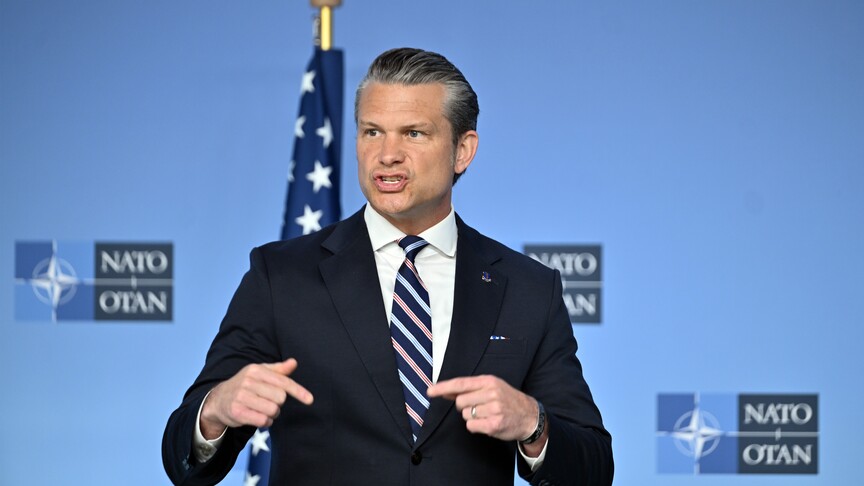
US Defense Secretary Hegseth on Thursday faced protesters while hosting the Trump administration’s DC Safe and Beautiful Task Force ceremony in Washington DC.
During the ceremony at Meridian Hill Park, which saw the gathering of National Guardsmen, dozens of demonstrators gathered near the park to protest Hegseth.
Footage shows the demonstrators chanting a short distance away from where Hegseth and roughly 200 members of the National Guard had gathered in the park
In social media posts, one protester was seen holding a Palestinian flag, while another person was holding a sign that reads “arrest Hegseth.” The protesters want a “Free DC,” according to social media posts.
In his address to the National Guard, Hegseth said that “this background noise is perfect,” referring to the protests.
“It’s the sound of ingrates, of ingratitude—of people who are so blinded by ideology they can’t see law and order and common sense in front of them,” he said.
Meridian Hill Park was repaired by the National Park Service and the Interior Department as part of a larger initiative to restore and enhance federal parks and public spaces throughout the nation’s capital in preparation for America’s 250th anniversary, which falls on this Saturday, July 4.
Though such beautification projects are typically popular with the public, the current initiative has been controversial both for its choice of projects and the use of no-bid contracts to hire firms to do the work, sometimes with disappointing results.
The work aligns with President Donald Trump’s DC Safe and Beautiful Task Force, established by a March 2025 executive order that directs federal agencies to coordinate public safety and beautification efforts across Washington.
-

 Crypto1 minute ago
OKX Announces Direct Crypto Aid for Venezuelans Hit by Devastating Twin Earthquakes
-

 Finance4 minutes ago
Regions expands municipal finance business with acquisition of Montgomery’s Frazer Lanier
-
Fitness9 minutes ago
Huge 30-Year Study Finds Exercise Variety Can Help You Live Longer – Here’s the Ideal Mix
-

 Movie Reviews19 minutes ago
The Kernel: Freshly popped film reviews — Batch #6 – Excalibur
-

 World31 minutes ago
AI ‘Organisms’ Come Alive in Kuala Lumpur as Dutch Artist Unveils Immersive Show
-

 Health54 minutes ago
Is Skipping Breakfast Bad? The Weight-Loss Truth May Surprise You
-
 Lifestyle1 hour ago
Nearly half of Americans surveyed don’t know what America 250 commemorates
-

 Technology1 hour ago
Amazon updated 2023’s Fire HD 10 tablet with 4GB of RAM

