Washington, D.C
Best 5 day trips near Washington D.C.


Not everyone can afford a week-long vacation in a distant paradise. For many of us, time and budget constraints make such a getaway seem like a distant dream, especially if you’re planning a family trip. The cost of vacations, from travel to accommodation and meals, can quickly spiral out of control. But fear not, there’s a more budget-friendly way to escape the daily grind, even if it’s just for a day.
Day trips are great because they are a fraction of the price of a vacation, and you get to sleep in your bed once the activities for the day have ended. There is a chance you’ll eat out once or twice and possibly even pick up a couple of souvenirs, but it won’t wreck your budget like a fancy vacation. In Washington, D.C., the hustle and bustle can get old quickly, and many people need to recharge away from so much ruckus. Why not take a lovely short break to one of these 10 day trip locations?
Harper’s Ferry is a beautiful small town in northern West Virginia, near Washington, D.C., Witnessing the Shenandoah and Potamac rivers gracefully merging among the moss-covered rocks and boulders in the rivers. The small town is exactly that: a small town. However, this small town has a fantastic vibe that’s hard to pass up. There’s even a hostel in the neighborhood if you need to stay a little longer for dirt cheap. Harper’s Ferry National Park is gorgeous, and it is a Civil War Museum and Fort that once belonged to John Brown. The Appalachian Trail meanders its way through the wilderness. Start at the Visitor’s Center, as directed by a traveler on TripAdvisor, and work your way down the main street, where you will find lots of unique shops and other small oddities. You will not want to miss this wonderful town.
Located just west of Luray, Virginia, lies Luray Caverns. Exploring the largest and most popular caverns in the eastern U.S. will fill you with a sense of awe as you wind through the intricate cave system. Some of the ceilings are an incredible 10 stories high, and some of the rooms are enormous, considering this is all taking place under your feet, underground. The cave is ready for visitors with its well-lit walkways and fantastic rock formations.
Maryland’s beautiful capital, Annapolis, is just a hop and a skip away from the always intense and busy Washington D.C.; in fact, you can be relaxing in Annapolis after a short 45-minute drive. Coined “a museum without walls,” Annapolis is dressed in four centuries of architecture. It’s also known for its nautical heritage, which involves sailboat racing on Wednesday nights. The quaint town is adorable and boasts many unique and wonderful shops along the main street through town. If you wish to add a splash of nature to your escape from D.C., check out the small, eight-acre Annapolis park.
The Shenandoah mountains are magnificent, and honestly, that term is not enough to describe the Shenandoah. The Shenandoah National Park feels like you’ve traveled to a different country entirely. It is hard to imagine this wild place existing so close to the capital of the U.S. This is an excellent place for a day trip if you are lucky enough to be close enough for such. There is much to see and more to experience, so while a day trip is lovely, spending a week in the Shenandoah mountains and experiencing the phenomenal night sky belongs on all bucket lists. For a quick day trip, Skyline Drive, which runs through the most scenic areas of the park, offers frequent pull-offs for photos without wrecks.
Maryland is no stranger to fabulous parks, and Rocks State Park is on the list. The 855-acre park is a nice escape from the nearby busy cities. Within Rocks State Park, visitors will find a rocky landscape in the heart of the wilderness. Bring your lunch to enjoy at one of the picnic areas, then go on a 3.5-mile hike through the park. Once you become sweat-drenched with tired legs from navigating the boulders, take a well-needed and quite fabulous break tubing or kayaking down Deer Creek.



According to the National Park Service at the National Mall, famous cherry blossoms around the nation’s capital have hit peak bloom conditions. The National Park Service X account for the National Mall proclaimed this morning, “PEAK BLOOM! PEAK BLOOM! PEAK BLOOM!”
It became apparent yesterday that the bloom would be at peak today. “Despite a sunny afternoon and patches of blue sky, the cherry blossoms remain at Stage 5: Puffy White,” the Park Service wrote on X yesterday. Stage 5, “Puffy White”, is the final stage blossoms go through before being in full bloom. They start at Stage 1 as a “Green Bud”, grow into Stage 2 with “Florets Visible”, and then florets become extended at Stage 3. In Stage 4, there is “Peduncle Elongation” which sets the stage for the puffy blossoms to appear in Stage 5. Puffy White and Peak Bloom are defined as when 70% of the blossoms on the trees reach that stage.

Peak bloom varies annually depending on weather conditions; the most likely time to reach peak bloom is between the last week of March and the first week of April. According to the Park Service, extraordinary warm or cool temperatures have resulted in peak bloom as early as March 15 in 1990 and as late as April 18 in 1958.
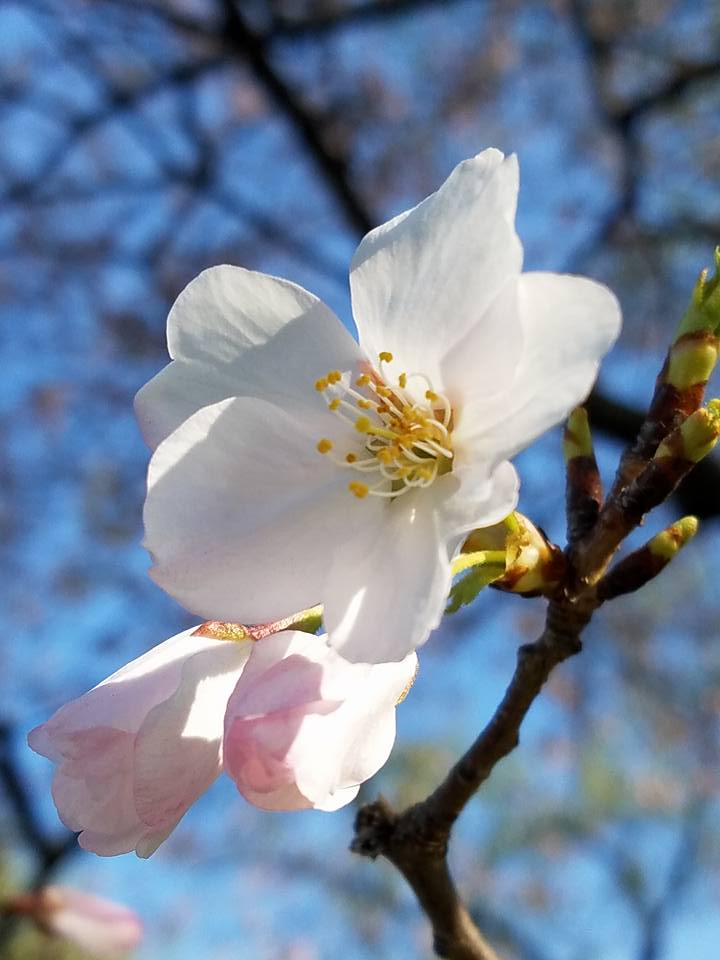
The planting of cherry trees in Washington DC originated in 1912 as a gift of friendship to the People of the United States from the People of Japan. In Japan, the flowering cherry tree, or “Sakura,” is an important flowering plant. The beauty of the cherry blossom is a symbol with rich meaning in Japanese culture.
Dr. David Fairchild, plant explorer and U.S. Department of Agriculture official, imported seventy-five flowering cherry trees and twenty-five single-flowered weeping types from the Yokohama Nursery Company in Japan. After experimenting with growing them on his own property in Maryland, he deemed that the cherry tree would be perfect to plant around the Washington DC area. This triggered an interest by a variety of individuals to plant the tree around Washington. In 1909 the Mayor of Tokyo, Yukio Ozaki, donated 2,000 trees to the United States on behalf of his city. When the trees arrived, they were riddled with disease and insects and to protect other agriculture, they were burned. The Tokyo Mayor made a second donation of trees in 1910, this time amounting to 3,020 trees. This started the forest of cherry trees that now line the Potomac basin around Washington DC. In a gesture of gratitude back to Japan, President Taft sent a gift in 1915 of flowering dogwood trees to the people of Japan. Thousands of trees have been added since, including another gift of 3,800 trees from Japan in 1965.


WASHINGTON (7NEWS) — Authorities are searching for an SUV after an officer with the Metropolitan Police Department (MPD) was struck by a hit-and-run driver in Southwest D.C. on Wednesday night.
The crash happened just before 10 p.m. at Martin Luther King Jr. Avenue and Forrester Street, SW.
Police confirmed the officer, an adult man, was conscious and breathing when he was rushed to a nearby hospital for treatment of his injuries. There is no word on his condition.
The driver involved fled the scene, and investigators are looking for a white Range Rover with a partial South Carolina tag of “403.”
Anyone with information is urged to call 202-727-9099 or text tips at 50411.
This is a developing story that will be updated as more information becomes available.
Washington, D.C
Community gathers for RFK stadium site open house meeting as Commanders prepare for DC return

WASHINGTON – Community members gathered on Tuesday night to review redevelopment plans for the RFK Stadium site and offer feedback as the Washington Commanders prepare for a return to the District.
The steel structure of the old stadium has now been removed, and officials say comments on the project’s environmental impact statement are due at the end of April. The final master plan is taking shape with input from residents.

Community gathers for RFK stadium site open house meeting as Commanders prepare for DC return
FOX 5’s Melanie Alnwick said a strong crowd gathered in D.C. Tuesday to speak with developers and city planners. The RFK site is divided into six districts, including the Plaza District, Riverfront District and Stadium District, each with proposed features for residents to evaluate. Members of the community viewed design concepts, asked questions and used green and red stickers to mark what they supported or opposed.
In the Kingman Park District, a primarily residential area, residents raised concerns about preserving green space and the placement of parking garages.
Groundbreaking for the Plaza District is scheduled for 2029, with the stadium targeted to open in 2030. The Commanders are investing $2.7 billion in the project, the largest private investment in city history, with another $1 billion coming from D.C. taxpayers.
City leaders say the redevelopment could create up to 6,500 housing units, 30,000 construction jobs, 2,000 permanent jobs and generate an estimated $5.1 billion in tax revenue.
Community gathers for RFK stadium site open house meeting as Commanders prepare for DC return
Another community meeting is set for Saturday at St. Coletta Church, with a site walk planned in April. More online.
St. Coletta Meeting Details
- When: Saturday, March 28, 10 am to 12 pm
- Where: St. Coletta of Greater Washington, 1901 Independence Avenue SE (Closest Metro: Stadium-Armory)
Online Survey
For those unable to attend an in-person event, the District will offer an online survey where residents can provide feedback on the master plan. The survey will request input on topics similar to those discussed at the events. The Office of Planning will combine this feedback with comments received at the in-person events, via email, and at the community visioning meetings that were held from October 2025 through February 2026.
- The survey link will be available from March 30-April 10 at OurRFK.dc.gov.
Community Site Walk
On Saturday, April 18, neighbors of the RFK Stadium campus are invited to join a walking tour led by staff from the Office of Planning. The walk will include visits to areas that are important to the redevelopment and stopping points for discussion. This interactive outdoor workshop will allow stakeholders to step into the shoes of a planner and share their ideas for the site’s future.
- When: Saturday, April 18, 10 am
- Where: Stadium-Armory Metro Station, 192 19th Street SE
- RSVP: A registration link will be available soon at OurRFK.dc.gov.
The Source: Information in this article comes from The Office of DC Mayor Muriel Bowser and previous FOX 5 reporting.

DHS shutdown live updates as Senate holds test vote on funding bill

Fangirl Culture is Front and Center as Detroit Mercy Theatre Company Presents a Zany Y2K Comedy

Authors gathering in San Francisco to raise awareness and money for the National Kidney Foundation

3 takeaways as the Mavericks lose a fun one, 142-135, at the Denver Nuggets

Jannik Sinner’s Girlfriend Laila Hasanovic Stuns in Ab-Revealing Post Amid Miami Open

Florida High School Football Rankings: Top 25 teams – Oct. 21

How old is Bo Nix? What to know about Oregon quarterback ahead of 2024 NFL Draft

Cleary's 21 help Le Moyne down Central Connecticut State 69-64 in OT

99th annual Pony Swim held in Virginia

Indiana Members Credit Union announced as new anchor tenant at Bottleworks District
DHS shutdown live updates as Senate holds test vote on funding bill

Video: Jury Rules Against Meta and YouTube for Addictive Features

New Jersey Gov Sherrill signs law barring ICE agents from wearing face coverings to shield identities

Escalation in the Middle East – Not Europe’s war? MEPs in the Ring

War with Iran disrupts fertilizer exports as U.S. farmers prepare for planting season
-

 Detroit, MI1 week ago
Drummer Brian Pastoria, longtime Detroit music advocate, dies at 68
-

 Science1 week ago
How a Melting Glacier in Antarctica Could Affect Tens of Millions Around the Globe
-

 Culture1 week ago
Test Your Memory of Great Lines From Classic Irish Poems
-

 Movie Reviews1 week ago
‘Youth’ Twitter review: Ken Karunaas impresses audiences; Suraj Venjaramoodu adds charm; music wins praise | – The Times of India
-

 Sports5 days ago
IOC addresses execution of 19-year-old Iranian wrestler Saleh Mohammadi
-
 Science1 week ago
I had to man up and get a mammogram
-

 New Mexico4 days ago
Clovis shooting leaves one dead, four injured
-

 Texas6 days ago
How to buy Houston vs. Texas A&M 2026 March Madness tickets