Virginia
Why retired officer says Marine Police guarding the Chesapeake Bay are being ‘wasteful’


RICHMOND, Va. — Andrew Cortez cares deeply about the Chesapeake Bay.
“The Chesapeake Bay is our natural heritage,” Cortez said. “A healthy bay helps everyone.”
The retired law enforcement officer was an investigator for 36 years, working to keep the Chesapeake in check with different agencies as a special agent with U.S. Fish and Wildlife.
He now has concerns about the group meant to do just that: the Virginia Marine Resources Commission, which oversees Virginia Marine Police.
“One of the things that really struck me is the amount of money they’re spending on what I would consider to be toys, unnecessary squandering of public money,” Cortez said.
WTVR
He’s talking about the recent purchase of a 2024 Pathfinder, a boat commonly used for fishing, costing $183,529.16.
Documents he received through a Freedom of Information Act Request, which he shared with CBS 6, show the purchase was made on March 5. The paperwork said it would be needed by April 4, 2024.
“They’ve got these rocket launchers; they’re sort of a holder for rods. For fishing rods,” Cortez said. “And it’s got the full fisherman package on it. It’s not something that would be used for law enforcement or for fisheries research.”
VRMC told CBS 6 that the vessel was purchased through the competitive bidding process in compliance with all state laws and policies.
“This vessel will be deployed in the Middle Area Law Enforcement Region for the Virginia Marine Police as a daily patrol vessel to enforce Virginia fishing and safe boating laws, as well as search and rescue operations. It has not been deployed in the field for law enforcement use yet because we are in the process of up-fitting it with law enforcement specific equipment (i.e. blue lights, siren, overt police markings),” Zachary Widgeon, VMRC’s Director of Communications sent CBS 6 in an email statement.
WTVR

Widgeon said the fishing rod holders will be removed, along with recreational fishing features that do not have a function for law enforcement patrol.
“Any attached fishing rod holders or live wells are standard on these models when they are delivered to the dealership before sale and there is no avenue for buyers to purchase these hulls without this equipment pre-installed. Fiberglass hull vessels are not custom built for each buyer and are adapted and upfitted from a pre-formed model to adapt them to law enforcement-specific needs and uses,” Widgeon continued in the email.
The response goes on to say: “This 2024 Pathfinder met the Statement of Need at a price that was reasonable in line with industry standards, superfluous features that do not affect its usage as a law enforcement patrol vessel are not relevant or considered in the purchasing process.”
“This is wasteful for an agency with a budget about the size of the Virginia Museum of Fine Arts,” Cortez said.
That’s not the only thing Cortez is concerned about.
There’s also been a drop in VMRC-related arrests and subsequent convictions.
Between 2017 and 2018, there were 1,202 arrests and 988 convictions, according to Virginia Marine Police Arrests/Convictions data.
Between 2021 and 2022, there were 667 arrests and 533 convictions.
Based on the numbers, Cortez thinks that’s far too few.
“Their conviction rate is 73 percent, which is dismal,” Cortez said. “In wildlife law enforcement, marine law enforcement, it should be in the high 90s, because you’re catching people in the act.”
WTVR

Widgeon said in an email that conviction and arrest numbers have fluctuated in the time frame comparing 2017-2018 and 2021-2022.
“The disparity in total numbers between the 2017-2018 and 2021-2022 period comes from three categories: saltwater reactional license violations, Fisherman Identification Program (FIP) violations, and miscellaneous law enforcement (i.e. non-conservation violations, traffic, etc.),” the email reads.
Widgeon said the shift away from focusing on non-conservation violations, traffic offenses, recreational license violations, and FIP violations is based on an intentional shift in the way that the Virginia Marine Police leadership focused the patrol and enforcement efforts of officers.
“The Virginia Marine Police are the only law enforcement agency whose main charge is protecting Virginian’s marine resources and tidal waters, and so we should focus our efforts on that charge,” Widgeon said.
Widgeon said VMRC is giving officers more discretion in how they enforce the law.
“I have friends still in the agency,” Cortez said. “They tell me that about six officers write half the tickets. That’s kind of lopsided.”
Cortez isn’t the only one challenging the VMRC’s practices.
In April, the Virginia Police Benevolent Association sent a letter to the attorney general’s office, claiming Marine Police Officers were illegally recorded while in the workplace.
It also claimed several “police package” Dodge Durangos that were said to be used for “agency police usage” were going to non-sworn officers, costing thousands of dollars.
WTVR

Rich Goszka, a spokesperson for the association, shared paperwork with CBS 6 showing the purchase of Dodge Durangos going to Specialist/Agency Transporation Officer Jeremy Toth and Assistant Commissioner John Cosgrove.
Goszka worked with the Virginia Department of Game and Inland Fisheries for years.
“They’re supposed to provide law enforcement services by the Marine Police, rather than being used for civilian use, which takes away from services from the taxpayers,” Goszka said. “We’re going to expose whatever corruption is out there. Because that’s just the right thing to do.”
“This external complaint is currently being investigated by the Office of the State Inspector General. We cannot comment on this as it involves an administrative investigation, but we would like to state that the purchasing of vehicles at VMRC is done in complete compliance with the Department of General Services guidelines and that we are always receptive and cooperative with any outside inquiries into how VMRC operates in our administrative functions. VMRC operates in complete transparency as a state agency. We would direct you to the Office of the State Inspector General if you would like further information regarding this external complaint,” Widgeon said in an email.
The Attorney General’s Office told CBS 6 it is not commenting on the letter at this time.
WTVR
Cortez expressed concerns to CBS 6 about a decreased number of hours spent inspecting and enforceming menhaden fishing regulations.
Menhaden is considered a vital resource to the Chesapeake Bay’s ecosystem.
According to VMRC, the following hours spent on menhaden enforcement and inspections conducted are as follows:
- 2015: 44.5 hours, 194 inspections
- 2016: 60.5 hours, 53 inspections
- 2017: 33.5 hours, 165 inspections
- 2018: 49.5 hours, 174 inspections
- 2019: 45.5 hours, 307 inspections
- 2020: 82.0 hours, 221 inspections
- 2021: 106 hours, 356 inspections
- 2022: 52.5 hours, 575 inspections
- 2023: 30.0 hours, 151 inspections
“It is worth noting that since 2015, with over 2,000 inspections having been conducted on the menhaden fishery in Virginia, no state fisheries violations have been found,” Widgeon wrote.
Last year, Chesapeake Legal Alliance (CLA), on behalf of the Southern Maryland Recreational Fishing Organization, filed a suit challenging the VMRC, saying the group allowed overfishing of menhaden.
Last November, a motion made in Richmond City Circuit Court required VMRC to comply with Virginia fisheries law “to rely on the best available science to set responsible menhaden harvests and avoid acting solely to protect the economic interests of a single commercial entity,” according to CLA.
According to a study on osprey and its ties to menhaden, by Dr. Bryan D. Watts, Director of the Center for Conservation Biology at William and Mary, “menhaden harvest policy has become a political mind field with special interests on all sides.”
A study by Phil Zalesak, the President of South Maryland Recreational Fishing Organization, says “the latest scientific data indicates that there are insufficient Atlantic menhaden in Virginia waters during the Atlantic menhaden reduction fishing season to sustain life for fish and birds dependent on Atlantic menhaden for their survival.”
“Although the statement that ‘Atlantic menhaden are no overfished and overfishing is not occurring’ may apply to the Atlantic Coast,’ it does not apply to the Chesapeake Bay,” Zalesak wrote.
Widgeon told CBS 6’s Zalesak’s study is not a peer-reviewed study.
“The most recent Atlantic menhaden stock ecological assessment and update showed that the stock was not overfished and not undergoing overfishing,” Widgeon wrote, citing data from 2020 and 2022. “THE ASMFC has discussed a Chesapeake-Bay specific stock assessment to recommend a scientifically supported Chesapeake Bay Cap but has prioritized further refining the ecological reference points model in the next benchmark stock assessment, as this represents the best available science for the coastwide Atlantic menhaden stock. With the lack of Chesapeake Bay-specific assessment and no concreate evidence that localized depletion is occurring in the Bay, ASMFC and the VMRC continue to maintain Chesapeake Bay Cap as a precautionary conservation measure to protect Chesapeake Bay nursery grounds,” Widgeon wrote.
Originally reported by the Virginia Mercury, Virginia lawmakers recently delayed deciding on conducting a study on if menhaden in the Chesapeake Bay are declining or not.
Cortez also shared concerns about several board members having special interests and not recusing themselves in cases where their businesses may benefit from commission decisions.
Associate Commissioner A.J. Erskine joined Cowart Seafood Corporation and Bevans Oyster Company in 2005 to develop oyster aquaculture programs, according to VMRC. Associate Commissioner Lynn Kellum is the President of Ampro Shipyard & Diesel.
“While the Code of Virginia does not spell out circumstances that a board member must recuse themselves in, we have full confidence that Associate Commissioners will and have recused themselves from participating in regulatory processes when they have a reasonable conflict of interest in-line with all ethical considerations. Associate Commissioners actively consult attorneys versed in conflict of interest and take all steps prudent to avoiding to avoiding a conflict of interest in their duties. We expect and are confident that Associate Commissioners operate in full transparency during commission meetings,” Widgeon wrote to CBS 6.
Depend on CBS 6 News and WTVR.com for in-depth coverage of this important story. Anyone with more information can email newstips@wtvr.com to send a tip.
Every day CBS 6 is Giving You A Voice. Share your voice with the CBS 6 Newsroomvia email hereor click here to submit a tip. You can also leave a message by calling 804-254-3672. Be sure to leave your name, phone number and detailed description of your story idea.




CLARKSBURG, W.Va. (WBOY) — West Virginia has plenty of state symbols, be it the black bear as the state animal, the cardinal as the state bird or the rhododendron as the state flower, but did you know that the Mountain State also has its own official gun?
The Hall Flintlock Model 1819 was first manufactured in Harpers Ferry by John H. Hall in 1811 and was adopted by the United States Army in 1819, making it the first breech-loading rifle ever adopted by a country’s military.
-
Model 1819 Hall Breechloading Rifle presented by Congress to Gustavous A. Bird for his participation in the Battle of Plattsburgh 9/11/1814 by John C. Bird via the Smithsonian Institution -
Model 1819 Hall Breechloading Rifle presented by Congress to Gustavous A. Bird for his participation in the Battle of Plattsburgh 9/11/1814 by John C. Bird via the Smithsonian Institution


All of this information is listed in Senate Concurrent Resolution 7, which was introduced and passed during the 2013 West Virginia Legislative session, and officially recognizes the Model 1819 as the official firearm of the State of West Virginia.
On top of being created in West Virginia, the resolution also points out that the rifle saw use during the Civil War, an event that directly led to West Virginia’s statehood.
While having an officially recognized state firearm may seem far-fetched, West Virginia is not the only state that has one. As a matter of fact, a fifth of the states in the country have officially designated a state firearm, including West Virginia’s neighbors in Kentucky and Pennsylvania.

CHARLOTTE, N.C. — In this world of college football, with the transfer portal and recruiting battles, bad blood is present more than ever before between head coaches.
That’s not the case between the Virginia Tech head coach and Clemson head coach Dabo Swinney, however. In fact, Franklin revealed at ACC Kickoff on Thursday that the two are actually close friends, dating back to their time at the Nike trip that various coaches take over the summer.
“Dabo’s my guy,” Franklin said on Thursday. “We go way back. We’ve been on the Nike trip for a long time. His wife and my wife are friends.”
The long-time Penn State head coach is making the move to the ACC after being fired from the Nittany Lions in October. 12 seasons of being with the program had Franklin hold a 44-21 record against top 10 opponents, an impressive record for a new conference foe of Swinney’s.
But when that trip comes around, there’s a camaraderie between Swinney and Franklin and both of their wives. In fact, the two hang out with each other instead of the other coaches at times. It simply comes to an “edgy” time in college athletics that raises tempers.
“I’m going to be honest, I wouldn’t say we’re necessarily like the type of people that love a lot of other coaches and a lot of other programs,” Franklin said. “It’s hard when you just compete year-round.”
On Swinney’s end, there are a few who could immediately come to mind among Clemson fans. Perhaps the most recent would be Ole Miss coach Pete Golding, who played the most significant role in the tampering of former linebacker Luke Ferrelli.
It’s a select list of coaches who make the good side of the Tigers’ head coach, and Franklin is certainly on that list. On the other hand, Hokies’ head coach has Swinney on his own shortlist.
“Obviously, tremendous respect for what he has built at Clemson and what he’s done at Clemson, and what he’s done for the ACC,” he said.
The two will see that close relationship face off at Memorial Stadium this upcoming season. Clemson will host the Hokies on Oct. 24 in what could be a potential title-eliminator for the ACC Championship.
Of course, the last game that we’ve seen the Tigers play in was against Franklin’s former team in Penn State at the Bad Boy Mowers Pinstripe Bowl. That game ended in a 22-10 contest that saw a foundation of Franklin players end Clemson’s season in disappointment.
Swinney will see many of those players once again in October, including starting quarterback Ethan Grunkemeyer, in that contest. The anticipated Hokie starter recorded 260 yards and two passing touchdowns on the Tigers in the Bronx that day.
Although friends become foes, another ACC coach has given Swinney his flowers for what he’s been able to do for the conference. In the upcoming moments, Franklin will look to prepare his team to prove itself on one of the biggest stages in the ACC, while Swinney looks to put his team back at the top of a conference he’s dominated for over 15 years.
Follow

MARTINSVILLE, Va. (WSET) — Extreme drought conditions in parts of Virginia have prompted an emergency drought warning for a wide swath of the region, including Bedford, Campbell, Charlotte, Franklin, Halifax, Henry, Mecklenburg, Patrick, Pittsylvania and Roanoke counties, along with the cities of Danville, Roanoke, Salem and Martinsville.
The governor has warned that if conditions worsen, she will activate mandatory nonessential water-use restrictions.
In Martinsville, city leaders have issued a voluntary water conservation notice and are urging residents and businesses to cut back where they can. The request comes as local businesses that rely heavily on water say the drought is already affecting day-to-day operations.
SEE ALSO: Botetourt County residents adjust daily routines as voluntary water restriction continues
John Hughes, owner of John’s Car Wash, said the dry conditions have hit his business hard in recent weeks. “For the last 3 weeks, it’s been hitting pretty hard. We done three yesterday and haven’t done anything today with the drought and hot weather. Yeah, I’m really concerned about it,” Hughes said.
Restaurants are also feeling the strain. David Kitzmiller, an owner of Be Wiched, said water is essential for routine tasks such as washing dishes and preparing some menu items.
“We use a lot of water for washing dishes and some of our recipes if they limit us in anyway defiently can’t produce and its a scary aspect,” Kitzmiller said.
Kitzmiller added that cutting back is not always realistic for businesses that must meet sanitation needs. “Not really feasible for a business that depends solely relies on water to wash their dishes, so that can’t definitely be an impact there,” he said.
City leaders emphasized that the conservation request is voluntary for now, but they are encouraging everyone to do their part by taking shorter showers, turning off the faucet when it is not in use, washing only full loads of laundry, and limiting outdoor watering whenever possible.
-
 Entertainment6 minutes ago
Netflix stock plunges to 52-week low following mixed earnings report
-
 Lifestyle12 minutes ago
L.A. Affairs: After losing our spouses, we found love again. But were we cheating on our children?
-
 Politics18 minutes ago
A new piece of Democrats’ midterm strategy: Being ‘practical’
-
 Science24 minutes ago
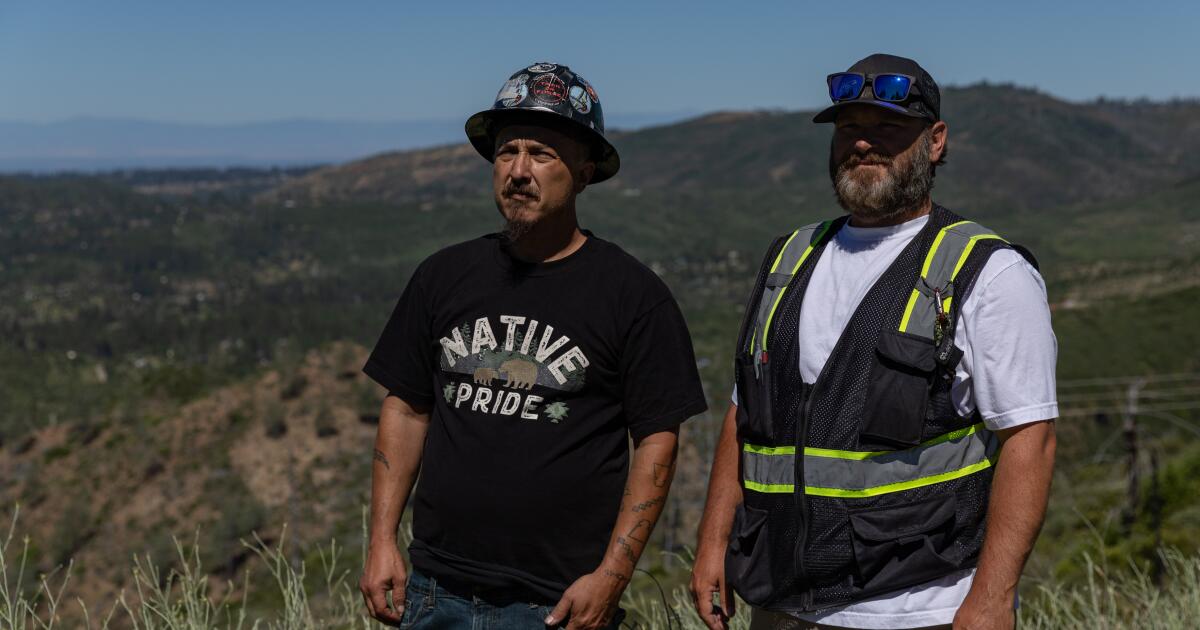
After wildfires destroyed 95% of this California tribe’s forests, members uncovered 1,200 ancestral sites
-
 Sports30 minutes ago
World Cup championship and third-place game: Start times and how to watch
-

 World42 minutes ago
Rule of Law in Hungary shows ‘radical change’ under Magyar, EU says
-

 News1 hour ago
Where Wildfire Smoke Is The Worst Right Now—And What To Do About It
-

 Los Angeles, Ca3 hours ago
LADWP begins long-term repairs after West Hollywood water main rupture

