Virginia
Virginia signs NIL law allowing universities to directly negotiate with players – Yellowhammer News


Thursday morning, Virginia governor Glenn Youngkin signed into law legislation permitting Virginia’s universities to directly sign student-athletes to Name, Image, and Likeness (NIL) deals, a development that could spell massive changes across college athletics.
The NCAA currently prohibits schools from directly paying players, meaning most NIL money is raised and distributed through third-party organizations called collectives. For example, many of the University of Alabama’s NIL resources are distributed through Yea Alabama, which is not directly affiliated with UA.
Virginia’s new law, going into effect on July 1, contradicts the NCAA’s rule. The bill will make it illegal for the NCAA to punish schools for “violat[ing] [the NCAA’s] rules or regulations concerning name, image, or likeness.” Schools in Virginia will still not be able to pay players based on their on-field performance, but will be able to use athletic department resources to compensate athletes for appearing in campaigns and promotions.
The law won’t yet render collectives obsolete — there are too many moving parts and not enough open communication for that to be realistic, said University of Virginia Athletic Director Carla Williams — but it will bring collectives and athletic departments closer to unified entities.
In December, NCAA president Charlie Baker proposed that all schools have the ability to pay athletes via NIL deals, but “the schools who actually make the rules have thus far balked at bringing the athlete marketplace inside the athletic department’s control,” according to ESPN’s Dan Murphy.
NCAA president Charlie Baker has pushed for schools to be able to pay athletes directly for NIL, but the schools who actually make the rules have thus far balked at bringing the athlete marketplace inside the athletic department’s control.
— Dan Murphy (@DanMurphyESPN) April 18, 2024
Virginia’s new legislation may force the issue. If powerful members of D1 athletics don’t expedite their process and bring Baker’s proposal to a vote, the commonwealth’s schools could enjoy a significant recruiting advantage.
The bill is the latest in a series of state-level legislation across the country usurping the NCAA. Prominent NIL attorney Mit Winter, a former basketball player at William & Mary, told a Charlottesville newspaper that “he doesn’t think the NCAA has a whole lot of legal recourse” and pointed out the NCAA’s recent losing streak in court against lawsuits from the attorney generals of Virginia and Tennessee.
Youngkin emphasized his desire to see NIL governed by “colleges and universities,” not by parties like the NCAA.
“This bill takes a most important step that we in fact are first going to make sure that our institutions of higher education, our colleges and universities, are at the forefront with policies and procedures that they can review and approve, that they in fact can help manage this,” said the governor. “This is going to be a program that’s going to be managed by Virginia’s universities and colleges and not by outside institutions or associations.”
Nick Saban, U.S. Senators want to regulate NIL before it’s too late
The bill also explicitly stated that Virginia student-athletes will still not be considered employees.
Several figures representing Virginia’s D1 universities attended the bill’s signing, all of whom lobbied for NIL legislation.
“We are thankful to the state legislature and Governor Youngkin for their proactive work in the NIL space,” said Virginia Tech athletic director Whit Babcock. “We take care of our student-athletes and recognize the value they bring to ensure the longstanding success of our athletic programs.”
UVA’s Williams thanked legislators “for ensuring student-athletes in Virginia have every opportunity to take full advantage of NIL.”
“Ultimately, and most importantly, we have an opportunity to fully support our student-athletes and coaches in NIL activities,” she added.
Charles Vaughan is a contributing writer for Yellowhammer News.
Don’t miss out! Subscribe today to have Alabama’s leading headlines delivered to your inbox.


RICHMOND, Va. — Jerrod Buford first picked up a paintbrush as a kid, never imagining that same creative outlet would carry him through his darkest days in prison.
Buford, who grew up in Williamsburg, was convicted and arrested as a young man and spent almost a decade behind bars. During that time, he struggled deeply.
“Turning to drugs and alcohol to kind of shadow over emotions,” Buford said. “Looking for acceptance, approval. Not just from my parents, but from friends, from, you name it. I mean, I tried to commit suicide, I don’t even know how many times,” Buford said.
WTVR
It was inside prison walls that art became more than a hobby.
“Throughout my prison time, I learned, the freedom that I desired, I’ve always had it. I got, I found it, in a box,” Buford said.
More than three years after his release, Buford continues to advocate for art as a tool for healing. He describes his work as a gift he feels called to share.
“I received a blessing from God that just allowed me to display what he’s given me,” Buford said.
For Buford, creating art is also a way of processing his past.
“That’s what art has done for me. It’s given me the ability to look at parts of my life, all parts of my life, and find the good and the negative, learn from the negative,” Buford said.
He shares his story and artwork with a wide audience through social media, including live sessions on TikTok, and holds art classes with new communities.
The Story Cafe
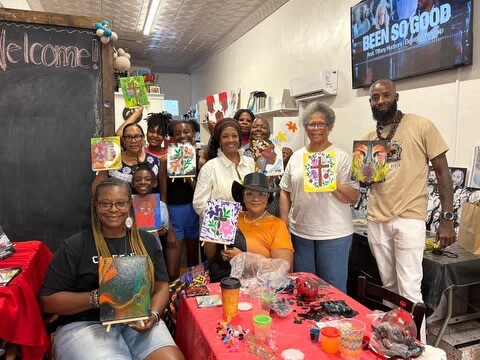
Buford said his mission is to help others find their own path toward healing — whatever form that takes.
“What I strive to do is guide this person to just create, man. Don’t care what people think about your creation, you just need to get it out,” Buford said. “Whether it’s with art, addressing your mental health, getting your life right — just do it.”
CBS 6 is committed to sharing community voices on this important topic. Email your thoughts to the CBS 6 Newsroom.
📲: CONNECT WITH US
Blue Sky | Facebook | Instagram | X | Threads | TikTok | YouTube

This story was initially reported by a journalist and has been converted to this platform with the assistance of AI. Our editorial team verifies all reporting on all platforms for fairness and accuracy. To learn more about how we use AI in our newsroom, click here.

Lovingston, VA (7News) — Good Morning Washington interviews Amanda Beckwith of Virginia Distillery Company- one of the contributing distilleries to the Virginia Spirits Board’s 250th Celebration Trio Pack, a special, exclusive release created to commemorate America’s upcoming 250th anniversary. This limited-edition package features a curated collection of a rum, a gin, and a whiskey, all crafted from scratch by distillers in Virginia to celebrate the rich history and current state of distilling within the Commonwealth.
Beckwith elaborates on VA Distillery Company’s role in the project, noting her focus on Virginia-grown grain to make the bottle of unique whiskey that is included in the Trio Pack. It is also worth noting that the Trio Packs themselves were bottled and produced right here at Virginia Distilling Company!
American single malts are the newest official category of American whiskey, distilled from one grain and from a single distillery. Virginia Distillery Co specializes in this new category of whiskey and crafted their contribution to the Trio Pack with this very specialty. Given the limited remaining availability of the Trio Pack, its historical value and collectible nature, the message it loud and clear encouraging viewers to grab a pack before they are all gone!
BE THE FIRST TO COMMENT
21+ Please drink responsibly, this content is sponsored by Virginia Distillery Company.


Powerball, Mega Millions jackpots: What to know in case you win
Here’s what to know in case you win the Powerball or Mega Millions jackpot.
Just the FAQs, USA TODAY
The Virginia Lottery offers multiple draw games for those aiming to win big.
Here’s a look at June 24, 2026, results for each game:
Powerball
Powerball drawings are held Monday, Wednesday and Saturday at 11 p.m.
13-14-16-21-38, Powerball: 14, Power Play: 2
Check Powerball payouts and previous drawings here.
Saturday, June 27, 2026
Pick 3
DAY drawing at 1:59 p.m. NIGHT drawing at 11 p.m. each day.
Night: 3-1-5, FB: 8
Day: 7-8-8, FB: 4
Check Pick 3 payouts and previous drawings here.
Pick 4
DAY drawing at 1:59 p.m. NIGHT drawing at 11 p.m. each day.
Night: 4-7-2-1, FB: 7
Day: 7-3-4-6, FB: 3
Check Pick 4 payouts and previous drawings here.
Pick 5
DAY drawing at 1:59 p.m. NIGHT drawing at 11 p.m. each day.
Night: 7-5-2-6-9, FB: 0
Day: 6-9-4-0-7, FB: 0
Check Pick 5 payouts and previous drawings here.
Cash Pop
Drawing times: Coffee Break 9 a.m.; Lunch Break 12 p.m.; Rush Hour 5 p.m.; Prime Time 9 p.m.; After Hours 11:59 p.m.
Coffee Break: 12
After Hours: 08
Prime Time: 13
Rush Hour: 01
Lunch Break: 14
Check Cash Pop payouts and previous drawings here.
Cash 5
Drawing every day at 11 p.m.
09-12-15-24-43
Check Cash 5 payouts and previous drawings here.
Bank a Million
Bank a Million draws are held every Wednesday and Saturday at 11 p.m.
18-21-25-33-36-39, Bonus: 13
Check Bank a Million payouts and previous drawings here.
Millionaire for Life
Drawing everyday at 11:15 p.m.
03-04-10-36-37, Bonus: 05
Check Millionaire for Life payouts and previous drawings here.
Feeling lucky? Explore the latest lottery news & results
This results page was generated automatically using information from TinBu and a template written and reviewed by a Center for Community Journalism (CCJ) editor. You can send feedback using this form.
-

 World6 minutes ago
‘Eddie Cochran: Don’t Forget Me’ Director Kirsty Bell on How Legendary Musician Influenced New Generation of ‘Rock Stars’ Like Yungblud
-
 Lifestyle44 minutes ago
‘Supergirl’ has a solid hero but could use a better villain : Pop Culture Happy Hour
-

 Technology53 minutes ago
Of course Meta thinks gambling is the future
-

 World59 minutes ago
Death toll from Venezuela earthquakes rises to at least 589, with thousands reported missing
-

 Politics1 hour ago
McCarthy says Trump will use ‘everything he can’ to force Senate action on SAVE America Act
-

 Health1 hour ago
Switching from cigarettes to vapes linked to higher risk of major eye diseases, large study finds
-

 Sports1 hour ago
2026 World Cup Odds: Which Nations are Favored to Reach Semifinals?
-

 Technology1 hour ago
World Cup ticket scams target desperate fans

