Virginia
Gov. Jim Justice announces plans to introduce more elk in West Virginia, expand wildlife tourism


CHARLESTON, WV — In his State of the State Address on Wednesday, Gov. Jim Justice announced that the West Virginia Division of Natural Resources (WVDNR) will introduce 40 new elk to the state’s growing herd in 2024 and create a visitors center and observation tower in Logan County to help tourists and wildlife enthusiasts see these majestic animals in a natural setting.
“As a lifelong sportsman, I am beyond proud of the work the WVDNR has done since I took office to not only restore elk to West Virginia but to manage our growing herd so that folks can enjoy this magnificent native species for years to come,” said Gov. Justice.
West Virginia’s elk population was 22 when Gov. Justice took office. Since 2018, the WVDNR has introduced 57 elk (15 from Kentucky and 42 from Arizona) to the Tomblin Wildlife Management Area in Logan County. The current elk population is 110.
“Thanks to the leadership of Gov. Justice and the support of our partner agencies, West Virginia’s total elk population is five times greater today than when we started our Elk Restoration Project in 2016,” said WVDNR Director Brett McMillion.
Partner agencies include the West Virginia Department of Agriculture, the U.S. Forest Service and the U.S. Department of Agriculture’s Animal and Plant Health Inspection Service.
The 40 elk will be transported from the Land Between the Lakes National Recreation Area in Kentucky and are scheduled to arrive Jan. 22-26. Upon arrival, the elk will be evaluated and held for a short period of time before being released into the wild.
Since 2018, the WVDNR has offered guided elk tours in Logan County, where participants can learn more about the history of elk in West Virginia and get a chance to see elk in a natural setting. Tours are offered in September and October each year and usually sell out.
Elk visitor center and viewing tower coming to Logan County
In the coming weeks, the WVDNR will be reviewing bids for the construction of an elk viewing tower and visitor center, which will be built in the Tomblin WMA’s elk management area in Logan County. Funding for the project will come from $2.5 million in Abandoned Mine Lands grants awarded by Gov. Justice.
The elk viewing tower will provide an elevated platform for enhanced viewing areas and a level viewing area that will be accessible for those with mobility issues. The visitor center will complement the elk viewing tower with more than 2,000 square feet of displays, conference facilities, offices and other amenities for visitors, volunteers, researchers and staff. There will also be more than 500 square feet dedicated to the history of the elk program and the reclaimed mine areas where they have been introduced.
“The growth of our elk herd and the success of our management program is a testament to the hard work of our wildlife biologists and this administration’s commitment to protecting and preserving our natural resources,” said McMillion.
Since Gov. Justice took office, more than 83,000 acres of public lands and 61 miles of rail trail have been added to the state’s public lands, which are managed by the WVDNR. Major additions include the 72-mile Elk River Trail, 177-acre Summersville Lake State Park and nine new WMAs. Several WMAs have been expanded and all state parks and forests have received major renovations and facility expansions.
To learn more about the WVDNR’s elk restoration program, visit WVdnr.gov/elk. To download a copy of the WVDNR’s Elk Management Plan, visit WVdnr.gov/publications-and-guides.


RICHMOND, Va. — Jerrod Buford first picked up a paintbrush as a kid, never imagining that same creative outlet would carry him through his darkest days in prison.
Buford, who grew up in Williamsburg, was convicted and arrested as a young man and spent almost a decade behind bars. During that time, he struggled deeply.
“Turning to drugs and alcohol to kind of shadow over emotions,” Buford said. “Looking for acceptance, approval. Not just from my parents, but from friends, from, you name it. I mean, I tried to commit suicide, I don’t even know how many times,” Buford said.
WTVR
It was inside prison walls that art became more than a hobby.
“Throughout my prison time, I learned, the freedom that I desired, I’ve always had it. I got, I found it, in a box,” Buford said.
More than three years after his release, Buford continues to advocate for art as a tool for healing. He describes his work as a gift he feels called to share.
“I received a blessing from God that just allowed me to display what he’s given me,” Buford said.
For Buford, creating art is also a way of processing his past.
“That’s what art has done for me. It’s given me the ability to look at parts of my life, all parts of my life, and find the good and the negative, learn from the negative,” Buford said.
He shares his story and artwork with a wide audience through social media, including live sessions on TikTok, and holds art classes with new communities.
The Story Cafe
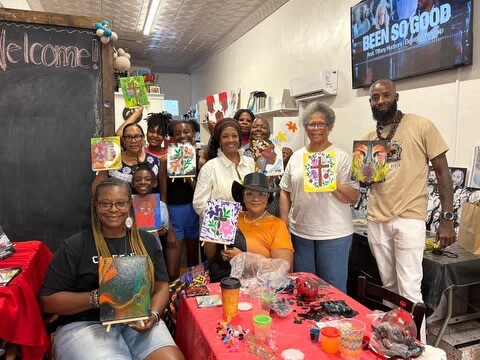
Buford said his mission is to help others find their own path toward healing — whatever form that takes.
“What I strive to do is guide this person to just create, man. Don’t care what people think about your creation, you just need to get it out,” Buford said. “Whether it’s with art, addressing your mental health, getting your life right — just do it.”
CBS 6 is committed to sharing community voices on this important topic. Email your thoughts to the CBS 6 Newsroom.
📲: CONNECT WITH US
Blue Sky | Facebook | Instagram | X | Threads | TikTok | YouTube

This story was initially reported by a journalist and has been converted to this platform with the assistance of AI. Our editorial team verifies all reporting on all platforms for fairness and accuracy. To learn more about how we use AI in our newsroom, click here.

Lovingston, VA (7News) — Good Morning Washington interviews Amanda Beckwith of Virginia Distillery Company- one of the contributing distilleries to the Virginia Spirits Board’s 250th Celebration Trio Pack, a special, exclusive release created to commemorate America’s upcoming 250th anniversary. This limited-edition package features a curated collection of a rum, a gin, and a whiskey, all crafted from scratch by distillers in Virginia to celebrate the rich history and current state of distilling within the Commonwealth.
Beckwith elaborates on VA Distillery Company’s role in the project, noting her focus on Virginia-grown grain to make the bottle of unique whiskey that is included in the Trio Pack. It is also worth noting that the Trio Packs themselves were bottled and produced right here at Virginia Distilling Company!
American single malts are the newest official category of American whiskey, distilled from one grain and from a single distillery. Virginia Distillery Co specializes in this new category of whiskey and crafted their contribution to the Trio Pack with this very specialty. Given the limited remaining availability of the Trio Pack, its historical value and collectible nature, the message it loud and clear encouraging viewers to grab a pack before they are all gone!
BE THE FIRST TO COMMENT
21+ Please drink responsibly, this content is sponsored by Virginia Distillery Company.


Powerball, Mega Millions jackpots: What to know in case you win
Here’s what to know in case you win the Powerball or Mega Millions jackpot.
Just the FAQs, USA TODAY
The Virginia Lottery offers multiple draw games for those aiming to win big.
Here’s a look at June 24, 2026, results for each game:
Powerball
Powerball drawings are held Monday, Wednesday and Saturday at 11 p.m.
13-14-16-21-38, Powerball: 14, Power Play: 2
Check Powerball payouts and previous drawings here.
Saturday, June 27, 2026
Pick 3
DAY drawing at 1:59 p.m. NIGHT drawing at 11 p.m. each day.
Night: 3-1-5, FB: 8
Day: 7-8-8, FB: 4
Check Pick 3 payouts and previous drawings here.
Pick 4
DAY drawing at 1:59 p.m. NIGHT drawing at 11 p.m. each day.
Night: 4-7-2-1, FB: 7
Day: 7-3-4-6, FB: 3
Check Pick 4 payouts and previous drawings here.
Pick 5
DAY drawing at 1:59 p.m. NIGHT drawing at 11 p.m. each day.
Night: 7-5-2-6-9, FB: 0
Day: 6-9-4-0-7, FB: 0
Check Pick 5 payouts and previous drawings here.
Cash Pop
Drawing times: Coffee Break 9 a.m.; Lunch Break 12 p.m.; Rush Hour 5 p.m.; Prime Time 9 p.m.; After Hours 11:59 p.m.
Coffee Break: 12
After Hours: 08
Prime Time: 13
Rush Hour: 01
Lunch Break: 14
Check Cash Pop payouts and previous drawings here.
Cash 5
Drawing every day at 11 p.m.
09-12-15-24-43
Check Cash 5 payouts and previous drawings here.
Bank a Million
Bank a Million draws are held every Wednesday and Saturday at 11 p.m.
18-21-25-33-36-39, Bonus: 13
Check Bank a Million payouts and previous drawings here.
Millionaire for Life
Drawing everyday at 11:15 p.m.
03-04-10-36-37, Bonus: 05
Check Millionaire for Life payouts and previous drawings here.
Feeling lucky? Explore the latest lottery news & results
This results page was generated automatically using information from TinBu and a template written and reviewed by a Center for Community Journalism (CCJ) editor. You can send feedback using this form.
-

 North Carolina2 minutes ago
Former Madison County chief deputy in North Carolina custody after Arizona arrest
-

 North Dakota9 minutes ago
North Dakota composer launches statewide virtual choir project
-

 Ohio12 minutes ago
UC Bearcats baseball playing Ohio State, Vanderbilt in Nashville in 2027
-

 Oklahoma17 minutes ago
Four arrested after 30 pounds of meth, dozens of animals seized from Oklahoma City home
-
Oregon24 minutes ago
Oregon Lottery Pick 4 results for June 25
-

 Pennsylvania27 minutes ago
Measles detected in two more counties in Pennsylvania as health department recommends early vaccination
-
 South-Carolina39 minutes ago
A 1776 midnight battle in Laurens County: The Battle of Fort Lindley
-
South Dakota42 minutes ago
SD Lottery Millionaire for Life winning numbers for June 25, 2026

