Texas
Trump demonizes immigrants. So why is he winning so many Latino votes?

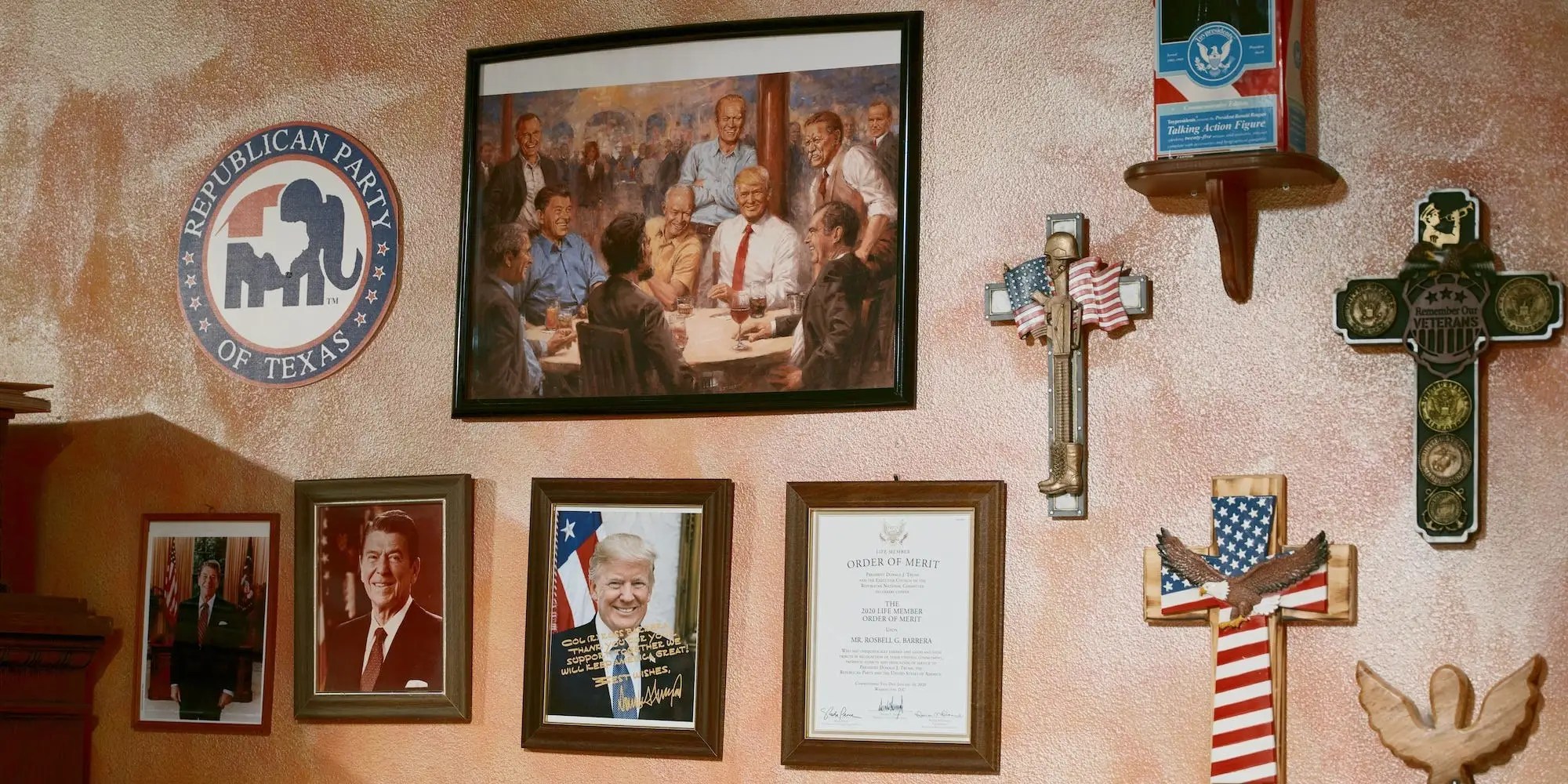
Back in 2015, when Donald Trump first descended from his golden escalator in New York City, Alexis García was attending high school in the Texas border town of Rio Grande City. In those days, it seemed, everyone in his classes hated Trump. The town of 15,000 serves as the seat of rural Starr County, which is 97% Latino and has voted for the Democratic candidate in every presidential election for the past 100 years. García was too young to vote in 2016, but he supported Bernie Sanders. That year, Hillary Clinton destroyed Trump in Starr, winning 79% of the vote.
But after Trump took office, García began to find himself drawn to Trump’s bombast. He liked the nicknames Trump came up with for his opponents — they reminded him of his own nickname, Pelón, meaning baldy for his buzzed hair. “Trump is like a schoolyard bully,” García tells me, meaning it as a compliment. By the end of 2017, as a high-school senior, he’d become a full-fledged Trump supporter.
At first, seeing how his classmates went after other Trump fans, García chose to keep his political conversion to himself. “Tienes nopal en la frente,” his friends would tell Trump supporters — you’ve got a cactus on your face. The meaning of the insult was clear: You’re only Mexican on the outside. When García finally told people he liked Trump, he was denounced as a racist. “How can you do this to your own kind?” people would ask.
“Coming out as a Republican was probably worse than coming out as an LGBT person,” says García, who works at a local supermarket. “They would shame you for it.”
Jordan Vonderhaar for BI
At the time, García felt like he was part of a minority in South Texas. MAGA was a sort of counterculture among Latinos, a tiny band of provocateurs who enjoyed pissing off the dominant Democrats. But beneath the surface, a seismic shift was underway. When the results were counted on election night in November 2020, García was as shocked as everyone else to discover that Republican turnout in Starr County had nearly quadrupled from 2016. Joe Biden still won, but barely — 52% to Trump’s 47%. Trump had gained more ground in Starr than in any other county in America.
Since then, political analysts have been questioning whether Democrats are losing their long-standing advantage among Latino voters. How had a candidate who once called Mexicans “rapists” done so well in a Mexican American county? In July, before Biden exited the race, polls found his support among Latinos had fallen below 50%. And even since Kamala Harris won the nomination, polling has indicated she’s likely to win no more than 58% of Latino voters — a far cry from what Democrats used to muster. That’s especially significant this year because Trump doesn’t need to win a majority of Latino support to retake the White House. If he can peel off enough of the 36 million Latino voters, especially in hotly contested swing states such as Arizona and Nevada, it could prove to be the margin of victory.
Jordan Vonderhaar for BI
In late July, after Biden dropped out of the race, I traveled to Starr County to see why this longtime Democratic stronghold has been shifting steadily to the right. To be sure, Starr differs from other border towns in some significant ways, especially in its relative dearth of recent migrants. But the county underscores how being Latino is becoming less predictive of how someone will vote. The area is working class, and its politics are similar to much of rural America. There’s a reverence for law enforcement and the military, a sense of economic instability, and a nagging suspicion that liberal elites in Hollywood and on Wall Street think of locals as ignorant hicks. In Trump, they see a man who offers something different. “People tell me they’re going to vote for him,” García says. “Trump is going to win.”
On a humid July morning, Benito Treviño, 77, is walking along the dirt road of his ranch, nestled among the thickets of Tamaulipan thornscrub that grow north of Rio Grande City. Reaching up, he grabs a bean pod from one of the large mesquite trees. “We can grind these into flour with a hammer mill we built,” says Treviño, a biochemist and botanist by training who now runs a native-plant nursery. Like the mesquite and huisache that thrive in this arid climate, he has deep roots in Starr County.
Treviño traces his family’s ancestry back to the earliest Spanish colonists, who made their homes on thin ranches along the Rio Grande. When the US annexed half of Mexico in 1848, those Mexican ranchers suddenly became American. Instead of them moving to America, America moved to them. Today, many South Texans like Treviño see themselves as more Tejano than Mexican American.
This explains, in part, why Biden’s campaign struggled to get traction among many Starr residents. His 2020 playbook for Latinos was built around celebrating immigrants and affording them a sense of belonging — one of his slogans was “Todos con Biden.“ But many here don’t identify as immigrants. Treviño was born in 1947 and grew up helping his parents work the lands his family had been on for generations. He’s American.
Like almost everyone in his generation, Treviño was raised as a Democrat, he says, for one simple reason: There were no Republicans in Starr County. “I never heard the word ‘Republican’ growing up,” he says. “There was no Republican Party here.” For more than a century, Democrats enjoyed complete control of local government, often running unopposed in general elections. That dominance, at its worst, led to graft and corruption as powerful families passed down elected offices like heirlooms. When Treviño’s father spoke out against the local leadership in Starr, the Democratic bosses found a way to show their displeasure: Treviño claims that when officials decided to improve a dirt road that ran through the county, they left the stretch in front of the Treviño home unpaved.
Jordan Vonderhaar for BI
The machine politics compelled Treviño to turn away from the Democrats. He was also prodded by his wife, Toni, a chemist turned lawyer who moved to Starr from Houston. As an outsider and self-identified libertarian, she was shocked by the county’s rampant cronyism. “Why are you a Democrat?” she asked her husband. “You’re a hard worker. You’re very conservative in your values.” The Treviños became Republicans, and today Toni serves as the chair of the Starr County GOP.
While the worst instances of machine politics were eradicated by the 1980s, many old-timers like Treviño remain deeply suspicious of the Democratic Party. In South Texas counties where Democrats have controlled local politics for generations, Republicans can offer themselves as the party of something new. And polls indicate the same shift taking place across the country: Latinos are much more likely to see Trump, rather than Harris, as the candidate offering a chance at major change.
If any place embodies the dual identity among Latinos in Starr County, it’s the Rancho Cafe in the tiny town of Roma. On the outside, the restaurant has the wooden facade of an Old Western saloon, complete with a covered wagon in the dirt parking lot. Inside, however, it’s classic Tex-Mex. Traditional Mexican dresses hang for sale along the walls of the café, and the servers greet you in Spanish.
Jordan Vonderhaar for BI
At lunchtime, Aliriam Perez sits sipping a bowl of caldo. Both her parents are from Miguel de Alemán, a Mexican city across the border that would blend in seamlessly with Roma if it weren’t for the heavily patrolled river separating them. Perez grew up mostly on the US side, though she crossed over frequently to spend time with family. Her mother was adamant that Perez never lose touch with her culture — she didn’t want her daughter to become “pocha,” Americanized. Though Perez at times rebelled against her mother’s wishes, at 34 she’s come to appreciate the importance of her Mexican heritage. Now that she has two boys of her own, she’s raising them bilingual. “It’s part of their history,” she says. “It’s where they come from.”
Growing up, Perez wasn’t very political. But that changed when she married a local police officer. In 2020, during the Black Lives Matter protests that followed the murder of George Floyd, Perez was deeply offended by the way Democrats supported calls to “abolish the police.” It felt like an affront to her husband, who was “out there putting himself in danger,” she says. Breaking with her mother, who believes that it’s crucial for Mexican Americans to vote against Trump, Perez began volunteering with the local Republican Party. As she sees it, a vote for “law and order” Trump is a way to both honor and protect her husband and other first responders.
In one recent poll, only 9% of Latino voters cited immigration as their top priority.
Democrats maintain a significant advantage among Latinos like Perez’s mother, first-generation immigrants who speak Spanish as their first language. But that advantage weakens among the second and third generations — not because American-born Latinos like Perez are more distant from their heritage but because they’ve started to prioritize other issues in the voting booth. The top two concerns among Latinos this year are the same as those for their fellow Americans: the economy and healthcare. In one recent poll, only 9% of Latino voters cited immigration as their top priority.
Starr’s economy is propped up not only by law enforcement, including the Border Patrol, but also by the oil and gas industry. During García’s childhood, he recalls, his immigrant father would make the long drive out to the Permian Basin in West Texas, where he worked as pipe fitter. Oil production has grown under Biden, and Harris says she has no plans to ban fracking. But to García, it’s obvious that Republicans are far more keen to expand drilling. Voting for Trump, as he sees it, is his best bet to keep his dad employed.
To be sure, “oil worker” is not a big part of Latino identity in swing states like Arizona and Nevada. Democrats, in fact, have long played to Latino voters by emphasizing the discrimination they face in the energy industry and law enforcement. But that appeal is beginning to lose its appeal. Perez says she knows racism exists in America — a white worker in an Alabama Dairy Queen once refused to serve her because she’s Mexican. But she doesn’t see discrimination as the province of any one political party. “There are Democrats who are racist and there are Republicans who are racist,” she says. Latinos still tell pollsters they consider the Democratic Party more welcoming to them than Republicans. But there are signs the political cohesion of “Latinidad” is beginning to fracture. Across the country, Latino Republicans say they feel more able to wear their politics on their sleeve. When people give them a hard time about voting for Trump, they’ve adopted a proud and defiant comeback. “¿Y qué?” they reply — “So what?”
In his home on his ranch along the northern edge of Starr County, Rick Guerra keeps one room as a sort of museum of his time in the Army: his vest from his days as a tank gunner during the invasion of Iraq, his boots from his deployment in Afghanistan. On one wall, there’s a collection of medals and challenge coins. As a teenager, Guerra helped his father and brothers build this very house. After he retired from the Army, he moved in with his wife and two children.
Jordan Vonderhaar for BI
Leaning conservative since he was a kid, Guerra became a dedicated Republican during his time in the Army — and he’d like to see America return to the days of George W. Bush, when the military was flush with cash. Like many Latino-majority counties in Texas, Starr sends a higher percentage of its young men and women to the military than the rest of the country. Most families have at least one veteran in their family tree, and that has contributed to the fiercely pro-military tenor of the local political culture.
There’s another dynamic at play on Guerra’s ranch: This is rural America, where Democrats have been hemorrhaging support for over two decades. Today, the political gulf between urban and rural areas is a greater divide than the split between North and South. While three-quarters of rural Americans are white, huge swaths of rural counties in Texas and other states are majority Latino. As a result, millions of Latinos are beginning to experience what demographers call “rural resentment” — like other MAGA supporters, they feel disrespected by politicians and the media on the urban coasts. And efforts by Democrats to counter such perceptions, like passing the Inflation Reduction Act to create energy jobs in rural areas, have had little effect on attitudes among Latinos and other rural voters.
“If you’re blue collar, you’re blue collar — it doesn’t matter where you’re from,” Guerra says. “And if you’re blue collar, you want a president who is going to get his hands dirty and do stuff for the country and its people.”
Trump’s working-class support in Starr has been most visible in the string of “Trump Trains” that have been taking place across South Texas. In June, at the first rally of the summer, I speak with a professional portrait photographer named Roel Reyes as he’s adjusting the flags on his motorcycle on the southern edge of Route 83. He’s flying the Texas Lone Star flag next to the Stars and Stripes; on the front of his bike are two signs that proclaim “TRUMP 2024.” Reyes smiles as pickup trucks and other bikes pull over behind him, all of them flying Trump banners. Before long, the parade of vehicles snakes 15 miles southeast from Roma to Rio Grande City.
In 2020, during the early days of the pandemic, Reyes helped organize the county’s first Trump Train. At the time, the riotous parades felt like a protest as much as a rally, a way to openly flout the COVID shutdowns being enforced by local Democrats. Reyes recalls getting plenty of “single-finger salutes” from townspeople. But the trains also gave him the sense that Trump was more popular in Starr than the polls might indicate. During the rallies, he’d get waves from local folks he knew would never admit to supporting Trump in mixed company.
Jordan Vonderhaar for BI
“Trump puts the country first. He puts God first — he’s for border control,” Reyes says. Next to him, an off-duty Border Patrol agent who has joined the Trump Train nods in agreement.
Local Democrats and Republicans agree that the trains gave Trump an electoral advantage in 2020. During the pandemic, Democrats — following strict instructions from the Biden campaign to avoid spreading the virus — stopped knocking on doors and focused instead on their digital strategy. Republicans, meanwhile, kept staging the Trump Trains, knocking on doors, and throwing well-attended barbeques and “asadas.” Democrats have become accustomed to hemorrhaging support from working-class white voters. But now it’s clear that more and more Latinos — who are overrepresented in the working class, especially in South Texas — are flocking to the Republicans. Being Latino, it appears, no longer dictates how someone will vote.
The Trump Train being held is small, but Reyes already has plans to hold larger rallies all across the border lands. This first train, he says, “will be like the trailer before the movie.” But it’s hard to hear him. Every few minutes, passing trucks honk their horns, their drivers waving out their windows at the sea of MAGA flags blanketing the dry, thorny landscape that once belonged to Democrats.
Jack Herrera is a freelance journalist who reports on how immigration and demographic change impacts individual lives. He was previously a national correspondent for the Los Angeles Times and senior editor at Texas Monthly.



In an incident that was horrific beyond words, late last month, a stunned family watched in horror as a car plowed into the Katy, Texas home of a 76-year-old mother and grandmother, killing her. The driver has been charged with manslaughter.
In the aftermath of the crash, it emerged that the car in question was a Tesla, and that the driver was making use of full self-driving mode (FSD) around the time the crash occurred. The victim’s family has named Tesla and the driver as defendants in a lawsuit. But per Electrek, Tesla was able to view crash data very quickly after the incident, and the head of AI at the company, Ashok Elluswamy, said the driver “manually overrode self-driving by pressing the accelerator all the way to 100% of the accel pedal in this residential area.”
In the days after the crash, Tesla fans took issue with coverage that characterized the car as in FSD when the crash occurred. CEO Elon Musk seemed to agree, replying to a post, “Yes, this makes no sense. FSD drives slowly through neighborhood streets and this was a high speed crash!”
But Musk seems to be assuming bad faith, as if coverage implied FSD had suddenly shifted into, perhaps, some kind of previously unannounced homicidal maniac mode and attacked a house. If anyone was saying this is what happened, they should apologize. It’s clearly not what happened.
And on Wednesday, the National Transportation Safety Board (NTSB) largely confirmed Tesla’s version of events. Their report reads, in part:
“Electronic data recovered from the vehicle indicated that before the crash, the driver manually overrode FSD (Supervised) by pressing the accelerator pedal to 100%, and the vehicle’s speed was greater than 70 mph when the crash occurred.”
But cooler heads had noted weeks earlier that, like with good old fashioned cruise control, accelerating doesn’t boot you from FSD. The car takes the input, and stays in FSD. The question isn’t one of mechanics and technology, but one of philosophy: if FSD is meant to be “driving” when someone jams on the accelerator in a residential area, FSD may not be the “driver” in one important sense, but the car was still in FSD mode.
Because as much as Tesla would probably like FSD to be a total non-factor in the incident, that may not be the case either.
ABC News noted that, according to court documents, the driver claimed he “passed out” with the car in FSD on the highway, and that’s the last thing he remembers before the crash. He says he wasn’t sick, and medical records show no seizures, cardiac episodes, drugs, or alcohol.
A local Fox affiliate says records show the car was making deliveries for DoorDash while in FSD in the “hours and minutes leading up to the crash.” While in a neighborhood, it apparently signaled it was going to turn left onto one street, but instead the pedal went to the metal. This took the Tesla onto the victim’s cul-de-sac instead, and put it on its fateful collision course with her house.
To make matters weirder, other court records now show, per Electrek, that the driver had Googled the terms, “Tesla fsd not aggressive enough 2026,” “FSD is not aggressive enough for city driving,” and “Tesla fsd too timid.” That’s the kind of thing you Google when you’re looking for a Reddit post from someone sharing your consumer gripe.
In any case, the odds aren’t good that the driver wanted this to happen, nor that Tesla programmed its cars with evil intent. But FSD was being used around the time of this unusual fatal incident, and the public deserves to know more. Fortunately, a lot more will come out as the lawsuit progresses.

AUSTIN – Texas Attorney General Ken Paxton said Wednesday he has secured a settlement of bankruptcy claims against genetic testing company 23andMe stemming from a 2023 data breach that exposed personal information, including some genetic ancestry data, of 6.9 million customers worldwide.
Paxton’s office said the settlement includes $150 million for a multistate coalition of 42 states. But because of limited funds in 23andMe’s bankruptcy estate and competing claims, the states’ recovery will be $18 million paid immediately, with Texas receiving $1,266,860.
23andMe disclosed in October 2023 that attackers had accessed accounts affecting 6.9 million consumers. Some of the information was later posted for sale on the dark web, according to Paxton’s office, which said the company learned of the breach months after the data became publicly available. The office said 23andMe initially denied a breach and later blamed consumers’ account settings and password practices.
Paxton joined a multistate investigation that concluded 23andMe used unreasonable security practices and failed to implement adequate safeguards against hacking, the office said.
23andMe filed for bankruptcy protection in March 2025. Paxton’s office said the settlement incorporates privacy and cybersecurity requirements, including enhanced security standards, comprehensive risk assessments and creation of an independent advisory board, along with enforcement of state privacy laws and continued consumer data deletion rights.
“Companies that collect and profit from Texans’ most personal information have a legal duty to protect it,” Paxton said in a statement.
The company also agreed to a $46.75 million class-action settlement in the bankruptcy case for affected U.S. consumers who submitted claims by Feb. 17, 2026, Paxton’s office said.
Copyright 2026 by KPRC Click2Houston – All rights reserved.

-

 Indianapolis, IN6 minutes ago
See ‘The Odyssey’ as Nolan intended at one Indiana IMAX theater
-

 Pittsburg, PA12 minutes ago
2 arrested following Downtown Pittsburgh drug bust, police say
-
Augusta, GA18 minutes ago
Augusta, GA Weather Forecast
-

 Washington, D.C24 minutes ago
Calls grow for Green to recall Hawaii National Guard from DC | Honolulu Star-Advertiser
-

 Cleveland, OH30 minutes ago
19 First Alert Days: Smoke in the air today; severe storms possible Saturday
-

 Austin, TX36 minutes ago
Live updates: Flash Flood emergency in Kerr County as rain continues to pound Texas
-

 Alabama42 minutes ago
These 3 questions could define Alabama football 2026 tight ends room
-

 Alaska48 minutes ago
ICE: Alaska state attorney arrested by immigration officials, held in Tacoma detention center

