South-Carolina
South Carolina's top officer not releasing details on 2012 hack that stole millions of tax returns


COLUMBIA, S.C. (AP) — Twelve years after a hacker stole personal data from more than 3.6 million people in South Carolina by obtaining Social Security numbers and credit card information from tax returns, the state’s top police officer said Wednesday he thought he knew who did it but wasn’t ready to name anyone.
State Law Enforcement Division Chief Mark Keel was careful not to release many details during his confirmation hearing for another six-year term. He said what authorities didn’t find shows that the state had the right response after the U.S. Secret Service identified the hack and data breach in October 2012.
RADIO STATIONS IN SEVERAL STATES SAY SIGNALS WERE HACKED WITH ANTI-TRUMP RAP
“I think the fact that we didn’t come up with a whole lot of people’s information that got breached is a testament to the work that people have done on this case,” Keel said.
State Law Enforcement Division Chief Mark Keel waits to answer questions at his confirmation hearing on Wednesday, April 10, 2024, in Columbia, S.C. (AP Photo/Jeffrey Collins)
A contractor with the state Department of Revenue clicked on a malicious link in an email in the summer of 2012, allowing a hacker to access 6.4 million state income tax returns. They collected the Social Security numbers of 3.6 million people and almost 400,000 credit and debit card numbers.
The state paid $12 million for identity theft protection and credit monitoring for its residents after the breach, At the time, it was one of the largest breaches in U.S. history but has since been surpassed greatly by hacks to Equifax, Yahoo, Home Depot, Target and PlayStation.
Democratic Sen. Brad Hutto has been searching for answers for over a decade and has been repeatedly told it was an active investigation and couldn’t be talked about. Hutto decided to ask Keel about the breach Wednesday to try to get answers in public.
“Now you can tell us that y’all paid somebody in Azerbaijan $28,000 or whatever it was,” Hutto said.
Keel refused again to say if South Carolina paid a ransom to the hacker to get the information back.
“I’m probably still not going to be totally transparent with you, OK?” Keel said. “I’m not going to lie to you either.”
Keel justified the insurance for taxpayers and the federal and state investigative work by saying the quick action prevented the hacked information from being used and the proof was what didn’t happen — an onslaught of bogus credit card charges or people using stolen ID information.
In retrospect, the state may not have had to spend $12 million on insurance. But that is with the benefit of hindsight, Keel said.
“We didn’t really have a choice,” Keel said. “It was something that we had to do because at the time this happen we had to start trying to protect people immediately. We didn’t have time for the investigation to play out the way it ultimately played out.”
Hutto responded: “Did it play out? Do you know who did it?”
“Yes, sir, I know who did it,” Keel said, refusing to give any other details.
Hutto asked if the person had been prosecuted, then laughed and said it might have been because the person was paid off.
Keel didn’t respond to the bait. “If we could ever get to this individual, they may be,” he said.
The Senate subcommittee approved Keel’s nomination for an additional six-year term. It now goes to the full Judiciary Committee.
Keel has worked at the State Law Enforcement Division for nearly his entire 44-year law enforcement career, other than a three-year stint as the Department of Public Safety’s director.
CLICK HERE TO GET THE FOX NEWS APP
He rose through the ranks in jobs like helicopter pilot and hostage negotiator before becoming the agency’s chief of staff in 2001. He spent a year as interim director in 2007 before being passed over by then-Gov. Mark Sanford for the top job.
Gov. Nikki Haley chose Keel to lead the State Law Enforcement Division in 2011.


STARKVILLE — Mississippi State baseball landed a potential starting infielder from the transfer portal.
Will Craddock, who played one season at South Carolina, committed to the Bulldogs on June 26.
“Hail State,” Craddock wrote on Instagram.
The freshman batted .260, leading the Gamecocks in home runs (10) and runs (36) while ranking third with 29 RBIs. In SEC play, his average dipped to .172 with two home runs, six RBIs and 14 runs.
Craddock primarily played first base, but also made starts at second base, third base and designated hitter. He started all three games against Mississippi State in April, batting 3-for-14 with a walk, no RBIs but two runs.
He was a standout player for T.L. Hanna in Anderson, South Carolina, and was the state’s 5A Player of the year in 2025. He hit .442 that season with eight doubles, 10 home runs and 10 stolen bases while ranked as the No. 26 player in South Carolina.
Mississippi State’s starting first baseman, Reed Stallman, is out of eligibility.
The transfer portal opened June 1 and closes June 30.
Mississippi State baseball transfer portal class
Craddock is the 10th transfer to commit to Mississippi State and the second South Carolina player, joining relief pitcher Zach Russell.
Other position players who are transferring to MSU include Georgia Southern catcher/outfielder Brady Christman, Samford outfielder Jake Souders, Army utility player Josiah Overbeek, South Dakota State third baseman Nolan Grawe, Oregon catcher Burke-Lee Mabeus and North Florida outfielder Carter White.
Twelve Mississippi State players have entered the transfer portal as of June 26, including relief pitcher Tyler Pitzer who committed to South Carolina.
Sam Sklar is the Mississippi State beat reporter for The Clarion Ledger. Email him at ssklar@usatodayco.com and follow him on X @sklarsam_.


USA TODAY 250th anniversary travel guides and American stories
USA TODAY marks America’s 250th with travel guides, culture, history, and local stories.
As the nation prepares for its 250th anniversary, one of the efforts underway is America’s Time Capsule.
The time capsule project is led by America250 and meant to bring together carefully selected artifacts and documents from all 50 states, five U.S. territories, the District of Columbia, and each branch of the federal government.
This national project is designed to capture the story of the United States at this historic 250th birthday, according to America250.
Here’s what South Carolina contributed to the national project.
What did South Carolina put in the America250 time capsule?
South Carolina is marking the nation’s 250th anniversary by contributing two historic items to the national America’s Time Capsule project, according to America250.
As part of the SouthCarolina250, which is the state’s initiative for the U.S.’s 250th celebration, commemoration effort, the state has provided a commemorative challenge coin and an official SC250 lapel pin.
Both will be buried inside the capsule on July 4, along with items from other states. And it is set to be reopened 250 years later in 2276.
Where will the Americ250 time capsule be buried?
The ceremonial burial of America’s Time Capsule is set to take place at Independence National Historical Park, located at 599 Market Street in Philadelphia, Pennsylvania, on July 4, according to america250.org.
What else is in America’s 250th anniversary time capsule
As America’s 250th anniversary approaches, the national time capsule has been filled with items meant to capture the character and diversity of the country in this moment.
The collection spans a range of items, from archival letters and state proclamations to student work from the America’s Field Trip contest, uncirculated currency, and even pieces of national sports memorabilia.
Time capsule engineered to last centuries
As planners work to ensure America’s Time Capsule endures for the next two and a half centuries, engineers and archivists have focused heavily on long‑term preservation.
The capsule itself is a cylinder‑shaped stainless‑steel vessel, precision‑designed by the National Institute of Standards and Technology in partnership with archival scientists at the Library of Congress, according to the Institute.
Travis Jacque Rose is the trending news reporter for the Greenville News, part of the USA TODAY Network. Reach him at trose@gannett.com.

In Laurens County, a dual-sided historic marker stands next to a mailbox off the side of the road. The name Jonathan Downs was commemorated on one side, while the other side was signed with the story of Lindley’s Fort in the American Revolution.
The Battle of Fort Lindley took place July 15, 1776, some 1,800 feet away from the modern-day historic marker. Private farmland now sits where the battle ensued, but physical pieces of history and oral retellings of the battle have continued to propel the story in Laurens County lore.
Loyalists to the British crown and Cherokee citizens planned an attack on a group stationed at the fort. The Little River Regiment used the fort as their base. Loyalist Capt. David Fanning described the scene as a “fort built with logs” in his autobiographical retelling of the Revolutionary War.
Cherokee land had continually been encroached on, which pushed members of the tribe to retaliate.
The loyalists who joined in the attack were dressed as Native Americans. They – along with other South Carolina backcountry loyalists – were referred to as Scopholites. The group took action at midnight for what became a two-hour fight in one of the first conflicts of the Cherokee War of 1776.
Historian Durant Ashmore said the crux of the battle was a clash of culture and a fundamental lack of understanding among the groups.
“One thing that has been very important to understand is the conflicts between cultures – the misunderstandings between cultures – and the deadly consequences that can result from that,” he said.
Luis-Alfredo Garcia
/
South Carolina Public Radio
Troops at the fort had at first not believed word of the upcoming attack when informed by a group of soldiers, according to a pension application of Matthew Brown, who was a 16-year-old boy stationed at a fort about 20 miles away from Fort Lindley. The men were drunk from a night of indulging in rum, which Ashmore said was a common occurrence during the war.
“The Little River Regiment did not believe them. They actually even leveled their guns at them, saying, ‘Who’s telling you such lies as this?’” he said.
Maj. Downs, however, prepped the troops for defense. Downs was a previous member of the First Provincial Congress, Second Provincial Congress, and South Carolina General Assembly.
A sizable chunk of the Patriot troops had already experienced fighting Cherokee citizens during the Anglo-Cherokee War that lasted from about 1758-1761. Soldiers at Fort Lindley responded to the attack by sending out troops in lines of 10. Eventually, the loyalists and Cherokee citizens retreated.
The patriot victory boosted local morale and belief in their cause, but for some unscathed loyalists and Cherokee citizens, the aftermath’s impact trumped the actual battle loss in consequences.
The morning after the battle, troops from the fort found about 30 horses at a campsite. One saddlebag contained the commission papers of Capt. James Lindley. Lindley was a staunch loyalist and the eponymous owner of Fort Lindley.
Six months prior to the battle, he had been captured at the Battle of Great Cane Break. Lindley had promised to not take up arms against patriot forces again, or he would face death. Although he was not captured in the midnight battle, he did succumb to patriot troops at the Battle of Kettle Creek and was hanged for breaking his parole.
As for the Cherokee citizens, their land was further encroached upon and people killed; about 2,000 were killed during the Cherokee War of 1776.
Ashmore said the consequences from escalating conflict were terrible.
“Patriots gathered together with the idea of a plan, the goal of eliminating the Cherokees. Genocide,” he said. “That’s what was preached to the backcountry settlers along with the ability to make their own decisions. A primary motivating factor in the American Revolution is the right of self-determination.”
Luis-Alfredo Garcia
/
South Carolina Public Radio
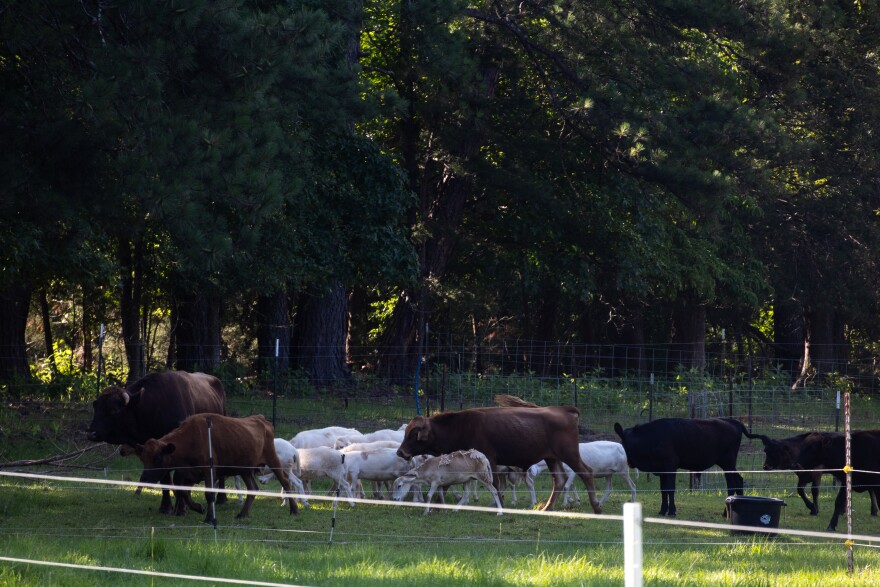
Now, private land with cows and sheep sits on the area where the fort once stood. Ashmore said he gives tours just during the winter to avoid the risk of ticks. The area where trenches once helped shield soldiers are still visible.
Some remnants from the fort now reside at the Laurens County Museum in the city of Laurens’ downtown area. The objects, although not individually labeled, will be part of an upcoming opening collection.

Luis-Alfredo Garcia
/
South Carolina Public Radio
Museum docent Julia Sermons said being informed of local history helps shape modern decisions.
“You have to know where you’re coming from to know where you’re going,” she said.
Ashmore, too, saw the same value.
“We are all in the middle of this,” he said. “This history – the important role that South Carolina played in the Revolution.”
An estimated 14 battles took place in Laurens County, according to Ashmore. He has been keeping track of local history for about 6 years. He said the county has set a 50-year plan to help with future record keeping.

Luis-Alfredo Garcia
/
South Carolina Public Radio
-

 New Mexico2 minutes ago
New Mexico AG opens formal probe into claims DEA let fentanyl pills spread statewide
-

 North Carolina5 minutes ago
Kemba Walker Opens Youth-Focused Multi-Sport Facility in Concord, North Carolina
-

 North Dakota10 minutes ago
Burglars steal from Grand Forks business, cancer fundraiser
-

 Ohio17 minutes ago
20-year-old Emerson homers in Ohio homecoming
-

 Oklahoma20 minutes ago
523 animals rescued in SE Oklahoma City meth bust, animal welfare overwhelmed
-

 Oregon25 minutes ago
The Cost of the Crackdown: How Trump’s immigration enforcement affects Oregon
-

 Pennsylvania32 minutes ago
Federal government sues Pennsylvania, others over SNAP data
-

 Rhode Island35 minutes ago
Target 12: State of RI’s fire hoses

