South-Carolina
Migrant crime is politically charged, but the reality is more complicated


It’s no surprise immigration is a hot political issue this year, as the number of foreign-born people in the United States reaches record levels and waves of migrants throng the southern border applying for asylum. What’s less clear is why candidates are campaigning on the issue of migrant crime.
Donald Trump and the Republicans have highlighted cases such as the killing of nursing student Laken Riley in February, allegedly by a migrant from Venezuela.
“That could have been my daughter. It could have been yours,” Sen. Katie Britt of Alabama said in the Republican response to President Biden’s State of the Union address.
But national statistics show no sign of a migrant-driven crime wave. Violent crime is trending down, after the spikes of 2020-2021, even as migration has surged. Past studies have found immigrants to be less likely to commit crimes. While it’s possible the newer arrivals are contributing to crime rates, it’s nearly impossible to tell how much, as the FBI’s statistics aren’t parsed by immigration status.
Still, at the local neighborhood level, some see a problem.
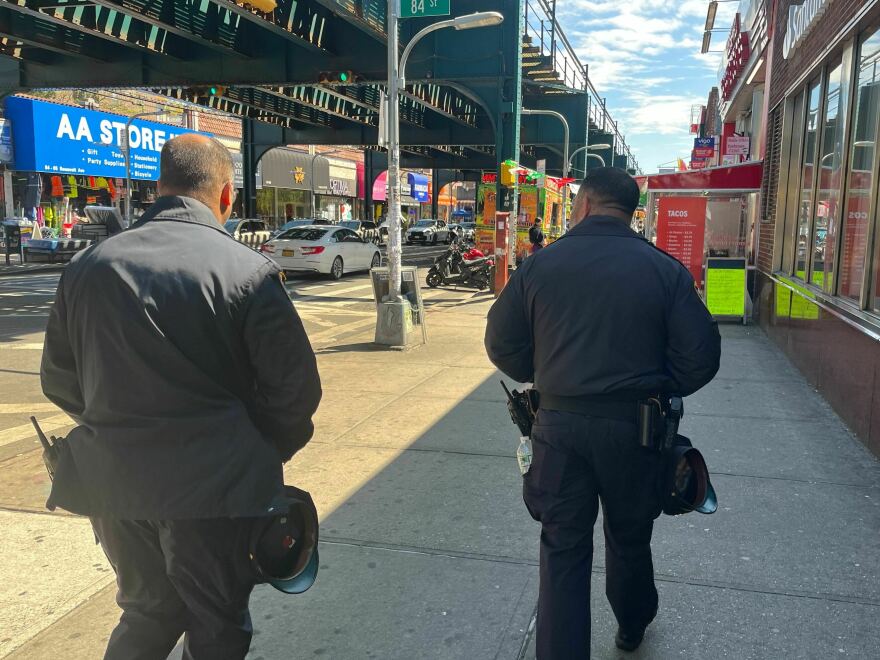
“Unfortunately, crime is up,” Carlos Chaparro says in Spanish. He runs a vocational school on Roosevelt Avenue in Queens, New York. It’s a traditionally Latin American neighborhood that has become a magnet for many of the approximately 190,000 migrants who’ve come through New York in the last two years.
“My clients say that when they leave [the school] at night, they’re being attacked and mugged, increasingly in the last year,” he says.
NPR talked to more than 20 people along this commercial strip, and they all said their impression was that crime has gone up in the last year. It’s a trend that is reflected in the statistics. According to the New York City Police Department’s CompStat system, crime in this precinct is up more than 15% in the first four months of this year compared to the same period last year, while it’s down in the city as a whole. Robbery is up more than 40% in the first four months of this year compared with the same period last year.
“It happens a lot,” says Johnny Velasquez, as he comes from his night shift as a security guard in Manhattan. Like Chaparro, he says there has been a lot more theft in the neighborhood lately — especially the grab-and-run kind.
“It’s an everyday thing. People on the scooters, like driving by while you’re on the phone, they’ll take it. Every day, you walk here, you don’t know what’s gonna happen,” he says.
Velasquez, Chaparro and others on the street blame the influx of newcomers.
“A lot of them [are] standing in front of the store selling lollipops to make a living,” Velasquez says, but “there’s other ones that come here for the wrong reasons.”
Velasquez just witnessed an attempted street theft — a man tried to grab a backpack, but his victim fought back and the suspect was struggling with police just 10 feet away. But in this case, the apparent thief is American, and the victim is a migrant — a young man from Ecuador who’d been trying to fix the wheel on his scooter when he was attacked.

Jack Donohue, who worked for the NYPD for 32 years and is now a senior fellow at the Center on Policing at Rutgers University, calls the rise in crime in that neighborhood “substantial,” but he says you can’t automatically blame the migrants.
“It’s a question of what’s happening and dissecting it. Not just the occurrence, but who gets arrested for it, would shed a little light on what dynamics are in play there,” Donohue says.
The available statistics don’t shed much light, though. Neither the NYPD nor the mayor’s office would talk to NPR for this story.
Meanwhile, the question of migrant crime in New York City has become politically charged, as local news reports focus on migrants accused of attacking police and participating in organized theft rings.
Most alarming to some are the dire news stories about a violent new gang.
Tren de Aragua is a Venezuelan prison gang that has spread to other South American countries, and there have been reports of migrants in the U.S. sporting the gang’s tattoos.
But Steven Dudley, an expert on Latin American gangs and co-director of the research group InSight Crime, says there’s a difference between the arrival of migrants with ties to a gang and the arrival of the gang itself.
“You may see individuals connected to Tren de Aragua that may commit crimes on their own. But that doesn’t mean that Tren de Aragua as a criminal organization is operational,” Dudley says. “For us to consider Tren de Aragua operational in the United States, they would need to be active in a collective manner, committing crimes in a collective manner over a period of time.”
He adds that migrants with “ties” to the gang may be coming to the U.S. to get away from the gang.
Carolina Reyna says she’s worried about regular street crime. She lives in New York’s largest migrant shelter, the Roosevelt Hotel near Grand Central Terminal in Manhattan. She says the constant police presence there makes her feel safe, but she says she’s no longer willing to go to the Latin American neighborhood in Queens — not since she was mugged there coming home from her job at a bar.

“The boy stabbed me on the left side, in the breast,” she says. She says the kid had an Ecuadorian accent. “It’s way too dangerous around there,” she says. “There are people who are doing things that don’t fit with why we came to this country.”
Police took her to the hospital and told her there is security video of the attack. But since February, the case has gone cold.
While the NYPD wouldn’t speak to NPR on the record, police say privately that the real problem is not that migrants commit more crimes. It’s that those who do are difficult to find and prosecute.
“Making cases against the migrants, it’s just very frustrating,” says Christopher Flanagan, a retired NYPD detective who was commander for major cases. He says that migrants typically don’t have the local roots and associations that investigators rely on and that there’s often no criminal record available from the country of origin.
“They’re going in with no information, very few avenues to identify people,” he says. And if they do make an arrest, “they have very little confidence that the person’s going to be present in court.”
Venezuelans working along Roosevelt Avenue in Queens say those who commit crimes and get away are making it harder for the rest of the migrants.
“You have to enforce the law against them,” Jose Villalobos says. He has been in the U.S. for five years and has worked jobs ranging from parking cars to selling snacks — which he does now under a tent draped with a Venezuelan flag. In his home country, he used to have a job with the central bank calculating the inflation rate until he was forced out for political reasons. Now that he’s making his way in the U.S., he thinks his countrymen are getting a bad rap from other Latin Americans in the neighborhood.
“They say, ‘Here come the criminals,’ but no, we’re not all like that. We’ve come to work and do good. As with any country, we have good people and bad,” he says.
Copyright 2024 NPR



NOTE: The above video is a livestream of WIS featuring current newscasts, Soda City Living and Gray Media’s Local News Live.
COLUMBIA, S.C. (WIS) – Lamont Paris will remain the head coach for South Carolina men’s basketball next season.
A source confirmed to WIS that Paris will return for his fifth season at the helm.
The Gamecocks have gone 62-67 under Paris, which included an NCAA Tournament appearance during the 2023-24 season. In the two seasons since, however, South Carolina has gone 12-20 and 13-18, respectively.
Paris’s tenure has also included a 23-49 record against the SEC as of Tuesday.
The Gamecocks will face Oklahoma on Wednesday in the first round of the SEC Tournament in Nashville. Tipoff is scheduled for 9:30 p.m. The game will also be televised on the SEC Network.
Feel more informed, prepared, and connected with WIS. For more free content like this, subscribe to our email newsletter, and download our apps. Have feedback that can help us improve? Click here.
Copyright 2026 WIS. All rights reserved.

NEW YORK — Three brothers, including two of the nation’s most successful luxury real estate brokers, were convicted of sex trafficking Monday after a five-week trial over accusations that they drugged and raped scores of women they had dazzled with their wealth and opulent lifestyle.
The verdict came after 11 women testified in Manhattan federal court they were sexually assaulted by one or more of the brothers: twins Oren and Alon Alexander, 38, and Tal Alexander, 39. All three shook their heads as the jury foreperson said “guilty” 19 straight times, a powerful reckoning that could put them behind bars for the rest of their lives.
Tal Alexander dropped his head into his crossed arms. Their stunned parents sat in the gallery behind them. Alon Alexander’s wife shielded her face with her hand and appeared to fight back tears.
Judge Valerie E. Caproni set sentencing for Aug. 6. The brothers, jailed since their 2024 arrests, will appeal the verdict, their lawyers said.
“We believe in our clients’ innocence and we’re not going to stop fighting until we prevail, and we believe that we will one day prevail,” defense lawyer Marc Agnifilo said outside the courthouse.
U.S. Attorney Jay Clayton lauded the verdict as vindication for victims of crimes that often go unreported and unpunished.
“The truth is sex trafficking and other federal sex offenses are present in many walks of life and we have not done enough to root it out,” Clayton said in a statement.
Dozens of women say they were drugged and assaulted
The verdict represented a spectacular fall for Oren and Tal Alexander, once known as real estate’s “A Team” for their high-ticket sales and celebrity clientele. After smashing sales records at industry powerhouse Douglas Elliman, the brothers started their own firm. Alon Alexander ran their family’s private security company.
Victims testified that they met the brothers at nightclubs, parties and on dating apps, and were attacked after accepting their invitations to all-expense paid getaways to the Hamptons; Aspen, Colorado; and a Caribbean cruise. More than 60 women say they were raped by one or more of the brothers, according to prosecutors.
Defense lawyers suggested the accusers had faulty memories or were hoping to cash in on the brothers’ fortunes. The brothers were womanizers, their lawyers conceded. But they insisted any sex was consensual.
In addition to the top charges, Alon and Tal Alexander were also convicted of sex trafficking of a minor while Alon and Oren Alexander were convicted of aggravated sexual abuse by force or intoxicant and sexual abuse of a physically incapacitated person. Oren Alexander was also convicted of sexually exploiting a minor after prosecutors showed the jury a video he recorded of himself appearing to assault a drugged 17-year-old.
Lawsuits expose an open secret in the real estate world
Besides the criminal case, the brothers have faced about two dozen lawsuits over the last two years, including one filed last week in which Tracy Tutor, a star of Bravo’s “Million Dollar Listing Los Angeles,” alleges Oren Alexander drugged and assaulted her while she was in New York City for a real estate event.
When the first of the lawsuits were filed, multiple women came forward claiming they had also been assaulted, and that the brothers’ misconduct had been an open secret in the real estate world. The government took notice and opened a criminal case.
During the trial, many women who testified said they believed the brothers had spiked their drinks. Some described feeling like they’d lost control of their bodies.
One woman testified that she met the brothers in 2012 at a party at actor Zac Efron’s Manhattan apartment. She said she had almost no interaction with the actor, who was not accused of any misdeeds, and went to a nightclub later in the night before waking up naked with a nude Alon Alexander standing over her.
“I don’t want to have sex with you,” she testified telling him. “Haha, you already did,” she recalled him snapping back as he “laughed in my face.”
Testimony challenges claim that money drove allegations
Prosecutors pushed back against the idea that the accusers were hoping to cash in on lawsuits. Only two have lawsuits pending, prosecutor Elizabeth Espinosa told jurors, and both are wealthy.
One woman who testified said she was raped by Alon Alexander in Aspen, Colorado, in 2017, when she was 17. She said she was the daughter of a billionaire.
“I don’t want their money. I just don’t want them to have it,” she told jurors.
Lindsey Acree, an artist and gallery owner, testified she was raped by Tal Alexander and another man at a home in the Hamptons in 2011 after taking a drink that left her feeling paralyzed.
The woman said she sued last year even though she will “never need their money” because the Alexanders “kept calling us gold diggers, shake down artists, con artists.”
“If there’s a kid with a stick who keeps hitting people, you take their stick away,” she told the jury. “Money is their stick, so you take it away so they can’t hurt people anymore.”
The Associated Press does not typically identify people who say they are victims of sexual assault unless they choose to come forward publicly, as Acree and Tutor have done.
Copyright 2026 NPR

Lulu Kesin of the Greenville News was honored two times by the Associated Press Sports Editors in its annual sports journalism contest.
Sports editors and journalists throughout the country voted on top-10 placements in various writing, website, print newspaper and photography categories, which were split into four divisions based on newspaper circulation and digital readership size. The Greenville News is in the D Division.
The exact order of finish in the writing contests will be announced later.
Kesin was selected in the top 10 for beat writing and short feature.Kesin covers South Carolina’s athletic department with a focus on women’s basketball and football. Her work on the women’s basketball beat was honored in both categories, as she followed coach Dawn Staley’s journey to a second straight national championship game and fifth consecutive Final Four.Her short feature on Sania Feagin highlighted the then senior’s journey to an SEC Tournament title. Kesin spoke with Feagin’s mother fresh off the joyful win, capturing the emotional element to the day.She then dove into Staley’s timeout philosophy to learn more about one of the most successful coaches in college basketball through a fresh, new perspective.She rounded out her March Madness reporting with a story on a young fan whose life was changed by the women’s basketball team before Kesin broke the biggest women’s basketball transfer news of the offseason, reporting that star guard MiLaysia Fulwiley was going to leave the program before all other media outlets did.

Severe weather threat increasing for Oklahoma tonight

Oregon gas prices highest since Sept. 2025 as oil surges on Hormuz disruptions

Fire crews try moving burning barge to shallow water in Delaware Bay

Thousands drop public health insurance coverage in RI after premiums spike

Source: Lamont Paris returning to South Carolina next season

Florida High School Football Rankings: Top 25 teams – Oct. 21

How old is Bo Nix? What to know about Oregon quarterback ahead of 2024 NFL Draft

Cleary's 21 help Le Moyne down Central Connecticut State 69-64 in OT

99th annual Pony Swim held in Virginia

Indiana Members Credit Union announced as new anchor tenant at Bottleworks District

Map: 2.3-Magnitude Earthquake Reported North of New York City

Trump stirs GOP primary drama with visit to Massie’s Kentucky home turf

Israeli air strike targets building in south Lebanon

Ed Martin, outspoken Justice Department lawyer, is formally accused of ethical violations | CNN Politics

Trump reveals top issues GOP should focus on to secure midterms victory: ‘I’ve never been more confident’
-

 Wisconsin1 week ago
Setting sail on iceboats across a frozen lake in Wisconsin
-

 Massachusetts1 week ago
Massachusetts man awaits word from family in Iran after attacks
-

 Maryland1 week ago
AM showers Sunday in Maryland
-

 Pennsylvania5 days ago
Pa. man found guilty of raping teen girl who he took to Mexico
-

 Florida1 week ago
Florida man rescued after being stuck in shoulder-deep mud for days
-

 Sports6 days ago
Keith Olbermann under fire for calling Lou Holtz a ‘scumbag’ after legendary coach’s death
-

 Virginia6 days ago
Giants will hold 2026 training camp in West Virginia
-

 Detroit, MI4 days ago
U.S. Postal Service could run out of money within a year