Mississippi
Possible overdose at the Central Mississippi Correctional Facility, according to officials


RANKIN Co., Miss. (WLBT) – The Rankin County Sheriff’s Department reports that they have been called to the Central Mississippi Correctional Facility for an alleged overdose.
The Rankin County Coronor, David Ruth, confirmed to WLBT staff that he was called to the scene to recover a body. He said he was unable to comment on the cause or manner of death until he performs an autopsy.
The Department of Health also says they have been called by the facility for a hazmat situation.
More law enforcement vehicles were seen by WLBT crews entering the Central Mississippi Correctional Facility as authorities continue to investigate a death at the prison.
Details are currently limited. WLBT has reached out to the Mississippi Department of Corrections for a statement on the situation but have yet to hear back.
WLBT 3 on your side will update with information as it is made available.
Want more WLBT news in your inbox? Click here to subscribe to our newsletter.
See a spelling or grammar error in our story? Please click here to report it and include the headline of the story in your email.
Copyright 2024 WLBT. All rights reserved.



2026 tax filing dates, forms to use and more tips this tax season
A comprehensive guide to the 2026 tax season, featuring filing deadlines, tax document checklists, and new deduction rules.
Are you missing out on free money? The IRS estimates that 1.3 million Americans are missing out on their 2022 income tax refunds because they haven’t filed their taxes. That totals about $1.2 billion in unclaimed money.
Many taxpayers are missing out on income tax returns because they haven’t filed. Some are years late.
The final deadline to be eligible is April 15. If people miss it, the money becomes property of the U.S. Treasury.
How many people in Mississippi could get a check?
According to the IRS, Mississippi taxpayers are owed about $9.9 million.
Approximately 11,800 people who haven’t filed their 2022 taxes could get a refund. The median amount is $635, so half of refunds could be more than that.
What if I didn’t file my 2022 taxes? When is the deadline?
You have until April 15, 2026, to file back-year returns.
The IRS said you might still be eligible for the check, but only people who have filed their taxes will get one.
If you owe money or haven’t filed for 2023 or 2024 tax years, your check could be held. The money could also be garnished for unpaid child support or federal student loans.
People also have to file their 2025 taxes to get any refunds that might be owed.
Bonnie Bolden is the Deep South Connect reporter for Mississippi with USA TODAY NETWORK. Email her at bbolden@gannett.com.

Trista Allain, who manages Kids Markets events in the New Orleans area, said the goal is to connect with local Mississippi organizers and build the program by adding youth vendors to established markets and community gatherings.
Allain said giving children the chance to run their own booths helps them practice real-world skills and build confidence as young entrepreneurs.
“The goal for these kids in the long run is to give them the opportunity to see what it’s like to have lifelong experiences, money management, communication skills,” Allain said. “It helps them to build that as a general foundation for them going forward into adulthood.”
Kids Markets is a farmers market run entirely by children ages 5-17, with vendors selling a variety of goods, including food, drinks, handmade crafts and jewelry, according to the organization’s website. The group started in 2017 in Utah and has expanded to 360 cities, with 80,000 youth entrepreneurs participating.
Families who already attend Kids Markets said they would consider traveling to Mississippi if markets are launched there.
Jayde Pinestraw, 13, of Hammond, Louisiana, was one of the vendors at a Kids Markets event March 28 at the Mandeville Trailhead Community Farmers Market in Mandeville, Louisiana. She helped sell baked treats at her family’s booth, The Cake Drop LLC.
Jayde said being able to sell at Kids Markets has given her a boost in confidence and helped her connect with other vendors her age.
“My favorite part is getting to meet new people and interacting and being more confident with talking to people,” Jayde said.
Her father, Jarrad Pinestraw, said the markets have had a positive impact on his children by pushing them to interact with people and practice skills that they carry beyond the booth.
“This is actually our maybe fifth or sixth market with the Kids Market, and I think it’s helped tremendously with their confidence,” Jarrad said. “Before we started, they were very shy, but now they have more people skills. They learn to be more independent, and they also learn how to communicate in general with other people.”
Jarrad said that if Kids Markets expands into Mississippi, his family would be interested in attending those markets to grow The Cake Drop.
Allain said the current goal is to find and partner with local Mississippi events to help Kids Markets gain traction. Residents can find future Kids Markets locations and more information by visiting the Kids Markets Facebook page or the organization’s website.
This article first appeared on RHCJC and is republished here under a Creative Commons Attribution 4.0 International License.
Mississippi
Mississippi reveals its full history for America’s anniversary year, a contrast to federal efforts

JACKSON, Miss. (AP) — The glass panels of the Lynching Victims Monolith are simple, etched with the names of more than 600 victims of documented racial killings in Mississippi, along with the attackers’ motives.
One man, Malcolm Wright, was beaten to death in front of his family in 1949. His offense? “Hogging the road.” Further research revealed that his mule-drawn wagon was, to his killers, moving too slowly.
The panels are among thousands of exhibits and artifacts inside the Mississippi Civil Rights Museum and the adjoining Museum of Mississippi History. Called the Two Mississippi Museums, the massive complex in sight of the state Capitol is a central part of the state’s America 250 celebration.
“That’s just the people that we know about,” Kiama Johnson, who was visiting from Monroe, Louisiana, said of the victim panels as she sat beyond the display and fought back tears. “Just imagine the ones that we don’t. Imagine the ones that’s never going to be written in history books.”
Mississippi’s warts-and-all approach to reflecting its history as part of the state’s official commemoration of the nation’s 250th anniversary is a stark contrast with what has taken place at the national level since President Donald Trump returned to the White House in January 2025.
Easing the discomfort of a sometimes brutal American history has been a central theme of Trump’s administration. He signed an executive order his first day back in office eliminating diversity, equity and inclusion efforts in the federal government. That, along with a March 2025 executive order, ” Restoring Truth and Sanity to American History,” have led to signs being changed at federal parks, exhibits being altered or in some cases removed, and military bases being renamed.
Part of the Republican administration’s preparations to celebrate the 250th anniversary have included putting pressure on federal institutions, including the Smithsonian, to tell a version of history that is less focused on discrimination and episodes of racial violence.
In Mississippi, a temporary exhibit created specifically for the commemoration — Mississippi Made — fills a space that is routinely changed to entice visitors to return. But it is housed in a space where achievement is intertwined with the state’s dark past involving Native Americans, enslaved people and the Civil Rights era.
Nan Prince, director of collections for the Mississippi Department of Archives & History, said the instructions were simple from scholars, politicians, staff members, and civic and civil rights groups when the museums were being conceived and built.
“Don’t brush over anything, don’t whitewash anything,” she said. “Just tell the absolute truth.”
‘We weren’t going to hide anything’
Jackson Mayor John Horhn was a state senator when he began pushing for the Civil Rights Museum in 1999. His efforts finally got a boost when Haley Barbour, a former Republican National Committee chairman, became governor.
Plans for the museum eventually were combined with a parallel effort to move the state history museum from the Capitol grounds, with the complex opening in 2017.
The approach to creating a state history museum was the same — tell the full story, beginning with how Native Americans were removed from the land.
“We said at the beginning we weren’t going to hide anything,” Barbour said in an interview, noting that he grew up in an era of segregation. “We weren’t gonna try to justify what was done. That’s what the people wanted — to say, ‘Look, we’re not proud of this, but we’re not going to deny it.’”
Other states have made sure to highlight their diversity in their presentations for the 250th anniversary. The America 250 description for neighboring Alabama includes milestones in the Civil Rights Movement.
Mississippi takes its history head-on. Its “America 250 MS” platform says the state’s history mirrors the American story, with the removal of Native Americans making way for slavery and slavery leading to the Civil War, followed by Reconstruction and the Jim Crow era.
Horhn praised the willingness of Mississippi leaders to use the museums to tell the state’s full story.
“We still have issues, we still have a lot of challenges,” he said. “But it’s a demonstration that progress has been made.”
‘It just made me want to weep’
The History Museum opens into a gallery that explores Mississippi’s first people, the Native Americans. The entrance is dominated by a 500-year-old canoe, a vivid reminder that Native Americans were here thousands of years before settlers arrived and forced them out, taking the land to begin growing cotton, which was tended by enslaved people.
Across the lobby sits the Civil Rights Museum. The first audio exhibit is abrupt: “We don’t serve your kind,” a menacing voice tells visitors, triggered when they cross the museum threshold.
It is one of several phrases once commonplace in the nation’s segregated past that bombard visitors at the opening to the gallery.
The museum also does not shy away from presenting one of the state’s most infamous racial killings, that of Emmett Till. The 14-year-old was kidnapped, tortured and killed in 1955 after being accused of whistling at a white woman in a rural Mississippi grocery store.
Till’s murder was a pivotal moment in the Civil Rights Movement. Thousands came to his funeral in Chicago, and his mother, Mamie Till Mobley, insisted on an open casket so the country could see the gruesome state of her son’s body.
At the end of the narrative, by Oprah Winfrey, visitors can see the .45-caliber pistol used to kill the teenager.
Lindsay Ward, 49, cried in the lobby after touring the Civil Rights Museum. Raised in what she described as a sheltered world in Salt Lake City, she said she had not had any exposure to the topics she encountered during her visit — “this heaviness,” as she put it.
Ward, now living in Denver, said she was troubled by how recent some events were.
“We’re not talking about hundreds and hundreds of years ago. We’re talking 60 years. It just made me want to weep,” she said. “It doesn’t feel great, but it’s important we understand what happened in the past.”
Connor Lynch, a history teacher and social justice advocate from Chicago, said deciding how history will be told has always been a struggle.
“All we have is human narrative” and that comes with bias, he said. “I do believe that no matter what sort of erasure the country might be doing, we know the stories. We know the truth.”
‘A very difficult history,’ on full display
For the America 250 celebration, the museums created ”Mississippi Made,” which highlights the state’s products and achievements.
There is the common household cleaner Pine-Sol, a Nissan Frontier and a Toyota Corolla, a section citing the state’s involvement in the U.S. space program and medical advances such as the first human lung transplant.
There is something else — a display by renowned Mississippi quilter Hystercine Rankin. It is a quilt telling the story of her father being killed in 1939.
Jessica Walzer, the exhibit curator, said she included it because it is one of the few story quilts in the museums’ collection and because it tells part of Mississippi’s history.
“I think it’s important to have something kind of striking like that to kind of remind us that Mississippi also has this very difficult history that a lot of people have been through,” she said.
Prince, the state director of collections, said such truth had long been denied. Visitors to antebellum homes, for instance, heard about the families who lived there, but “they would never once tell you about the people that lived behind the house or the people that built the house or the people that worked the fields,” she said.
“For so long,” she said, “we just tried to gloss over that because it was uncomfortable.”

Coroner: Toddler dies after being hit by vehicle in Upstate

PBR | No. 1 John Crimber goes 4-for-4, tops final three rounds to win First PREMIER Bank PBR Sioux Falls

Tennessee immigration bill sparks nonprofit concerns over unintended impacts on vulnerable US citizens

Texas AG opens investigation into Austin over APD guidance on ICE warrants
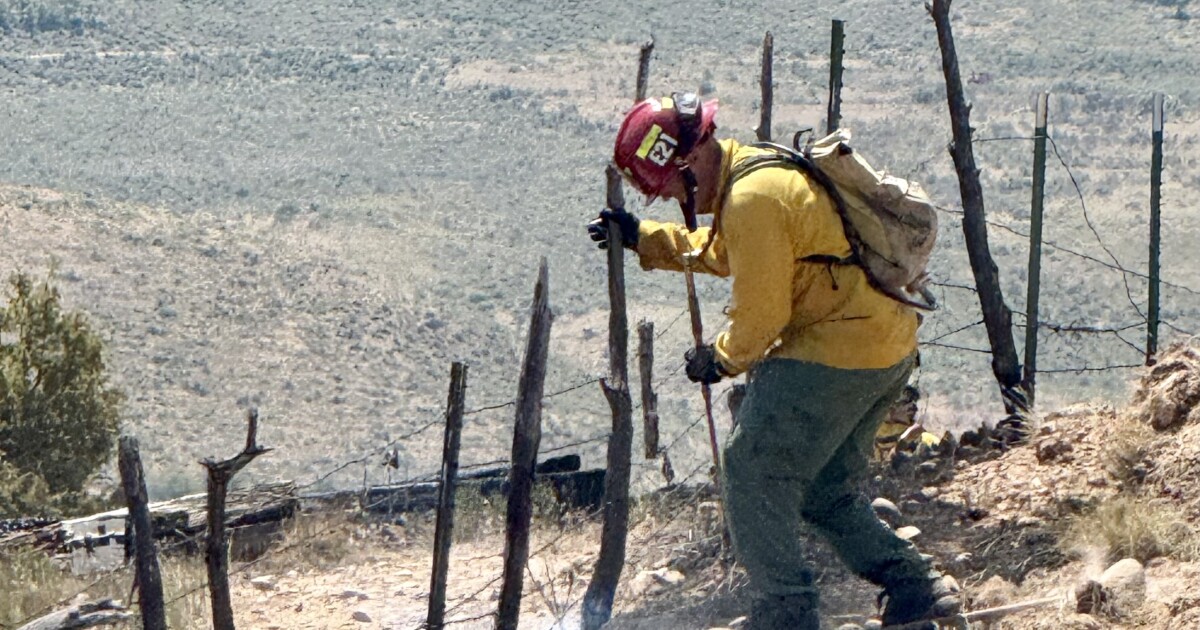
Utah delays imposing fee for wildfire mitigation program

Florida High School Football Rankings: Top 25 teams – Oct. 21

How old is Bo Nix? What to know about Oregon quarterback ahead of 2024 NFL Draft

Cleary's 21 help Le Moyne down Central Connecticut State 69-64 in OT

99th annual Pony Swim held in Virginia

Indiana Members Credit Union announced as new anchor tenant at Bottleworks District

Embattled Rep Tony Gonzales announces plans to resign amid sexual misconduct allegations

UN experts slam attacks on Gaza shelters, forced displacement in West Bank

DOJ fires at least 4 prosecutors involved in FACE Act cases during Biden administration

Melania Trump’s Epstein remarks turn up the heat on DOJ, Acting AG Todd Blanche to do more
Newsletter: Cautious optimism in Brussels as Orbán ousted in landslide Hungarian opposition win
-

 Atlanta, GA1 week ago
1 teenage girl killed, another injured in shooting at Piedmont Park, police say
-

 Georgia6 days ago
Georgia House Special Runoff Election 2026 Live Results
-

 Arkansas3 days ago
Arkansas TV meteorologist Melinda Mayo retires after nearly four decades on air
-

 Pennsylvania1 week ago
Parents charged after toddler injured by wolf at Pennsylvania zoo
-
 Milwaukee, WI1 week ago
Potawatomi Casino Hotel evacuated after fire breaks out in rooftop HVAC system
-

 Technology1 week ago
Anthropic essentially bans OpenClaw from Claude by making subscribers pay extra
-

 Austin, TX6 days ago
ABC Kite Fest Returns to Austin for Annual Celebration – Austin Today
-

 World1 week ago
Zelenskyy warns US-Iran war could divert critical aid from Ukraine