Mississippi
FAMU football’s 23-home game winning streak snapped by winless Mississippi Valley State | recap


WATCH: FAMU coach James Colzie sends condolences to MVSU, previews game
James Colzie III is the head football coach for the Florida A&M Rattlers.
This story will be updated.
Florida A&M football hosts Mississippi Valley State for a Week 12 Southwestern Athletic Conference game at Bragg Memorial Stadium. Keep scrolling for updates, and refresh the page for the latest information.
The Rattlers (5-4, 3-2 in SWAC), fresh off a 31-12 loss at Prairie View A&M, look to return to the win column. Additionally, FAMU aims to extend its second-longest home winning streak in the Football Championship Subdivision to 24 games.
MVSU (0-10, 0-6 in SWAC) is still searching for its first win after faltering at Jackson State 51-14 last Saturday. Today is the Rattlers’ third-to-last game with matchups versus Bethune-Cookman (Nov. 23) and Alabama A&M (Nov. 29). FAMU likely won’t be granted postseason play with two SWAC losses.
FAMU vs Mississippi Valley State score updates
FAMU football highlights vs MVSU
FAMUs winning streak at Bragg Memorial Stadium has snapped, and it handed Mississippi Valley State its first win of the season.
It is also the first time in program history that the Delta Devils have beaten the Rattlers. The Rattlers had a lot of momentum in the second half after shutting MSVU out and scoring 11 unanswered points.
A wasted timeout and a fumble loss on the snap cost the Rattlers. The Rattlers fall to 5-5 for the first time since 2018. Daniel Richardson completed 18 for 24 passes for 259 yards and a touchdown.
The FAMU Rattlers have shown life.
A tunnel screen pass to Jamari Gossett led to the first touchdown score in the second half, cutting MSVU’s lead to three points as the Rattlers trail 24-21 with 7:14 left in the fourth quarter.
FAMU has scored 11 unanswered points. The defense has shut down the Delta Devils’ offense the entire second half.
FAMU has been playing better, especially defensively, as they kept the MSVU scoreless in the third quarter.
However, the Rattlers are still behind 24-13 entering the fourth quarter. The Seminoles need a spark on offense to make it at least a one-possession game.
FAMU’s kicker Cameron Gillis nails a 45-yard field goal for the Rattlers to add more points on the board.
However, the Rattlers are still trailing by two scores, 24-13 with nine minutes left to play in the third quarter.
This could be the worst FAMU has looked in the first half as it trails 24-10 at halftime.
It started with poor special teams play and miscues, which led Mississippi Valley State to capitalize on the Rattlers. The Delta Blue Devils scored two touchdowns after a FAMU turnover.
FAMU quarterback Daniel Richardson has completed 8 of his 10 passes for 116 yards and was sacked twice. FAMU has been running the ball effectively led by Bo Sommersett as he rushed for 80 yards and a touchdown.
MSVU’s quarterback, La’Jarian Williams, has completed 13 of his 17 passes for 176 yards and two touchdowns.
Nathan Rembert has been Williams’ primary target as he recorded 113 receiving yards on six catches.
MSVU decided to take a shot downfield. QB Ty’Jarian Williams threw a deep-ball 60-yard pass to Nathan Rembert for a touchdown.
FAMU trails big 21-10 with under six minutes left to play in the second quarter. The Rattlers allowed two touchdowns after a turnover.
FAMU’s offense was about to respond after running back Bo Sommersett’s 51-yard run that put the Rattlers inside the one.
Sommersett would cough the ball up on the next play and the Delt Devils recovered the fumble.
It was a no-score for the Rattlers, leaving another missed opportunity to put up points. The Delta Devils got the ball back and still up 14-10 with 7:08 left to play in the second quarter.
Special teams miscues continue to hurt the Rattlers, and the winless Delta Devils are taking advantage of it.
After Gregory Martin returned a 71-yard kickoff, MSVU’s quarterback Ty’Jarian Williams connected with Cameron Nelson on a four-yard slant.
The Delta Devils captured their first lead of the day, 14-10, with 10:48 left in the second quarter.
FAMU kicker Cameron Gillis redeemed himself with a 45-yard field goal for fAMU to regain the lead, 10-7, at the start of the second quarter
Daniel Richardson has been efficient so far for the Rattlers, as he completed all seven passes for 106 yards.
Special teams error became an issue for FAMU.
A muffed punt set up a rushing touchdown for Mississippi Valley State, and the Rattlers’ kicker, Cameron Gillis, missed a 36-yard field goal to regain the lead.
Special teams continue to be a problem for the Rattlers early. After going three and out, Cameron Gillis missed a 36-yard field goal. It remains 7-7 with 3:08 left in the first quarter.
Mississippi Valley even the score with a two-yard rushing touchdown by running back Jakobe Thomas.
MSVU scored following a fumble by punter Gunnar Trout, putting the Delta Devils inside the 20. The game is tied at seven with less than five minutes left to play in the first quarter.
After a three and out from FAMU’s offense, a special teams error went to puter Gunnar Trout. The freshman fumbled on the punt and was recovered by the Delta Devils inside the 20.
Daniel Richardson got the green light and didn’t waste any time. In just three plays, the Rattlers are on the board.
Richardson set up a 44-yard pass to receiver Marquez Bell, which would set up a rushing touchdown by running back Bo Summersett. FAMU takes the first lead 7-0 in the first quarter.
FAMU uniform jersey combination
FAMU is wearing all orange uniforms with white helmets.
FAMU quarterback Daniel Richardson is in full uniform and has been doing pregame warmups with the Rattlers.
It is still unclear if he will start against Mississippi Valley State, but he is active for Saturday’s game.
Richardson suffered a concussion in last week’s loss to Praire View A&M. Junior Muratovic is the backup quarterback.
Wide receiver Jamarri Gassett and running back Kelvin Dean Jr are also available to play.
FAMU vs Mississippi Valley State start time today
- Date: Saturday, November 16
- Time: 1 p.m. ET
- Location: Bragg Memorial Stadium (Tallahassee, Florida)
What channel is FAMU vs Mississippi Valley State game on today?
Florida A&M vs. Mississippi Valley State will broadcast on TheGrio TV in Week 12 of the 2024 college football season. The game will stream exclusively on HBCU Go.
The 2024 Rattlers are led by quarterback Daniel Richardson, a grad student who transferred from Florida Atlantic who is second in the SWAC with 2,030 passing yards and first with 19 touchdowns. FAMU has seven preseason All-SWAC selections: offensive lineman Ashton Grable, defensive backs Kendall Bohler and Deco Wilson and kicker Cameron Gillis on the first team, and running back Kelvin Dean, receiver Jamari Gassett and defensive lineman Allen Smith on the second team.
The 2024 Delta Devils are led by quarterback Ty’Jarian Williams, who has 1,177 yards and seven touchdowns passing while also leading the team with 273 yards and five TDs rushing. Wide receiver Nathan Rembert is second in the SWAC with 801 receiving yards.
FAMU vs Mississippi Valley State history
- Series record: FAMU leads, 6-0
- FAMU’s last win: September 30, 2023 (31-7)
Gerald Thomas III, Tallahassee Democrat: FAMU 27, MVSU 10
“FAMU hasn’t lost consecutive conference games since 2018. Nor have the Rattlers lost a home game since 2018. So, expect both to stay the same Saturday. And though the Rattlers are vulnerable right now with vanished postseason hopes and a banged-up roster, they can still defeat the Delta Devils if the execution is there.”
FAMU vs Mississippi Valley State betting odds
As of Friday, there were no game lines or odds from BetMGM.
FAMU vs Mississippi Valley State injury updates
Florida A&M quarterback Daniel Richardson left last week’s game with a concussion. Running back Kelvin Dean Jr. also was injured vs. Prairie View A&M. Wide receiver Jamari Gassett is also battling injuries.
FAMU vs Mississippi Valley State weather updates
Weather.com predicts 72 degrees with sunny skies at kickoff in Tallahassee. Winds are expected to blow out of the northeast at 5 mph. There is a near 0% chance of rain throughout the day.
FAMU football schedule 2024
*- SWAC game
Mississippi Valley State football schedule 2024
- August 31: at Tennessee State (L 41-21)
- September 7: at Lamar (L 28-14)
- September 14: at Murray State (L 59-8)
- September 21: at Nicholls (L 66-0)
- September 28: vs. Alcorn State* (L 42-21)
- October 5: Open
- October 12: at Alabama State* (L 54-17)
- October 19: vs. Bethune-Cookman* (L 20-10)
- October 26: at Arkansas-Pine Bluff* (L 35-21)
- November 2: vs. Prairie View A&M* (L 17-16)
- November 9: at Jackson State* (L 51-14)
- November 16: at Florida A&M*, 1 p.m.
- November 23: vs. Alabama A&M*, 1 p.m.
- Record: 0-10 (0-6 in SWAC)
*- SWAC game
We occasionally recommend interesting products and services. If you make a purchase by clicking one of the links, we may earn an affiliate fee. USA TODAY Network newsrooms operate independently, and this doesn’t influence our coverage.



Mississippi
Mississippi teen accused of killing elderly couple had worked for them before shooting: family

A teenager in Mississippi knew the elderly couple he’s accused of killing before sparking a standoff with law enforcement, according to new testimony in court.
Cordarius Hobbs, 17, is charged with killing 74-year-old Billy Blair and his 71-year-old wife Virginia Carol Blair during a home break-in on June 3 in Mendenhall, Mississippi.
Family members of Hobbs testified during the Thursday preliminary hearing that he knew the couple.
Family members testified that Hobbs did work for the Blairs for things like cleaning around the house before the alleged shooting, according to WAPT.
Billy Newsome, Hobbs’ grandfather, said he believes his grandson was called to work on the day of the alleged shooting but believes he’s innocent.
“My grandson used to work for the man, why you gone rob a man that you work for,” Newsome said. “Why you gone stay there that long and you know the police out there, and then you gone wait until everybody gets there to run, it just ain’t adding up, something just ain’t right here.”
On June 3, three contractors installing a generator at the Blairs’ home discovered Carol Blair’s car door open with several guns on the seats around 10 a.m., prompting them to call the Simpson County Sheriff’s Department for a welfare check at 11:30 a.m, according to a Mississippi Bureau of Investigation investigator.
By noon, the investigator said that officers arrived and were met with shots fired at them, starting a nearly two-hour-long standoff.
Hobbs was captured after trying to run away from officers, the official said, adding that the teen was unarmed when he was caught.
Carol Blair was found in a bedroom curled in the fetal position and had three gunshots to the back of her head. Bill Blair was found lying on his back in the kitchen with three gunshot wounds to his face.
The state investigator said three firearms were found inside the home as well as 280 shell casings, all owned by Bill Blair.
Hobbs’ defense attorney, Zachary Vaugh, argued that there’s a lack of direct forensic evidence connecting the teenager to the shooting.
“There was nothing to say he’s a principal, he’s the one that pulled the trigger on these things,” Vaugh said. “One of the things alone was, one of the victims was shot twice on one side of the head and once on the other. I think that’s pretty compelling that somebody else may have been in there. There’s a lot of things that are possible, just a tremendous amount of things.”
“When you have an officer say there’s no one that can identify him at the time of the shooting, I just don’t see how that adds up,” he said.
Hobbs is charged with two counts of capital murder and one count of burglary, in addition to 10 other charges. He was denied bond.
In a statement on Facebook, the couple’s family previously said, “We are crushed in spirit, bruised, and brokenhearted, but we are not alone.”
Jason Busby, who was friends with the couple, remembered them as being extremely selfless when speaking with WLBT.
“The man would’ve given you the shirt off his back, his wife is the same, and they’re just great people. It’s just a tragedy,” Busby said. “Everybody around here is still in shock. They were just good people.”

Subscribe to Clarion Ledger: Local journalists covering local stories
Clarion Ledger journalists cover the important moments in Mississippi. Support local journalism by subscribing.
Staff
The Mississippi State Legislature will return for a special session not on redistricting, as many conservative politicians have called for, but to resolve issues with youth court and records protection.
Gov. Tate Reeves called the Legislature back into Jackson on July 14 for a special session beginning the next day, July 15, at 3 p.m.
“I am hopeful — and even optimistic — that members of both political parties can and will vote for this common-sense legislation that will help children and families all across Mississippi,” Reeves wrote in a post on X.
The issue stems from statutes that used to govern youth court records. The statutes were put in place to protect the personally identifiable information of children in the youth court system, including those who are under the care of Child Protection Services.
The Legislature is responsible for making the laws and renewing them when they are set to be repealed, but the body did not do so before the end of the legislative session in April. The statutes were repealed on June 30, and CPS employees have been left scrambling to engage in court proceedings without illegally sharing private information about vulnerable children.
Leadership in both chambers have been discussing the new laws governing youth court since the end of the session, and Reeves wrote that he was pleased with the bill that they are set to propose at the special session.
“The agreed upon solution (as proposed and agreed by House and Senate leadership) sets up a far better system for both kids who are abused and neglected, as well as those children facing delinquency proceedings,” he wrote. “For the first time, children and families will have access to full-time judges and moves us toward a uniform youth court system statewide.”
Bea Anhuci is the state government reporter for the Clarion Ledger. She has covered Mississippi politics since the start of 2026. Email her at banhuci@usatodayco.com.
Mississippi
Mississippi AI task force hears competing claims on data center costs, community impacts

JACKSON, Miss. (WLBT) -Mississippi’s artificial intelligence regulation task force opened its first day of hearings Monday, taking testimony from utility representatives, public service commissioners, and community advocates on the costs and consequences of the state’s data center industry growth.
Entergy projects lower bills; critics question the numbers
Entergy told the task force it expects residential customer bills to decrease as data center growth expands the utility’s customer base.
“When you have higher sales volume to spread those costs over, it’s going to produce a lower rate,” said Jeremy Vanderloo, vice president of business operations and strategy for Entergy Mississippi.
The company projected residential bills would be $30 a month less by 2030 than they would have been without data center growth. Entergy pushed back on a recent study commissioned by environmental groups that claims costs are already being passed on to ratepayers.
Commissioners weigh ratepayer protections
Two public service commissioners testified before the task force. Commissioner DeKeither Stamps said the goal of protecting ratepayers goes beyond simply keeping rates low.
“We should be looking for a low rate or a high rate, just the correct rate to maintain the systems,” Stamps said. “And if the citizens don’t want the correct rate, then as a regulator, we still have to put the correct rate on the table.”
Advocates raise questions on accountability
National advocate Jim Walsh questioned what would happen if industry projections prove inaccurate, asking, “Who pays if industry’s projections are wrong?” Walsh said some states and communities have placed moratoriums on data centers while they assess potential impacts.
Shannon Samsa, director of the Safe + Sound Coalition, told the task force she is not opposed to AI and data centers broadly but called for greater transparency.
“It’s about whether the people of Mississippi deserve transparency, accountability, and leaders who will protect the health and well-being of our families and communities before the interests of a private corporation,” Samsa said.
North Mississippi resident cites noise from xAI site
Samsa, who lives in north Mississippi, said residents near the xAI facility in Southaven have experienced near-constant noise for nearly a year.
“There have been numerous occasions where I myself can hear the turbines from inside my home, and I live almost 2 miles away from the site,” she said.
The task force is scheduled to hear Tuesday from local leaders in affected communities as well as companies including Amazon.
Want more WLBT news in your inbox? Click here to subscribe to our newsletter.
See a spelling or grammar error in our story? Please click here to report it and include the headline of the story in your email.
Copyright 2026 WLBT. All rights reserved.
-

 Politics47 seconds ago
Canadian woman accused of slapping Trump-supporting teen turned over to ICE
-

 Health7 minutes ago
Popular diet trend could boost mental health among older adults, study finds
-

 Sports13 minutes ago
Conor McGregor makes 3-word promise for UFC career in video after another devastating injury
-

 Technology19 minutes ago
Insurance breach exposes 7M driver’s licenses
-
Business25 minutes ago
Grocery Outlet restarts expansion with new California branches
-
 Entertainment31 minutes ago
Review: Christopher Nolan’s ‘The Odyssey’ is a mighty Trojan horse of his thematic obsessions
-
 Lifestyle37 minutes ago
They just completed all of L.A. Times’ 101 Best California Experiences — and we’ve got questions!
-
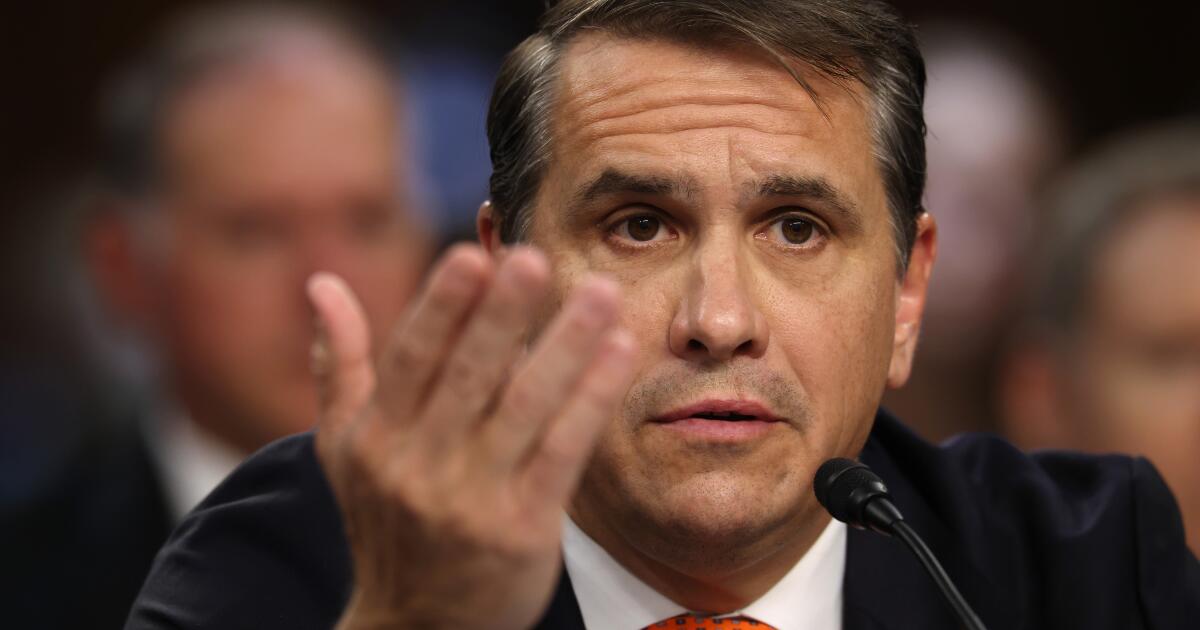 Politics43 minutes ago
Blanche to face questions about his independence at attorney general confirmation hearing


