Mississippi
Carjacking Casts Harsh Spotlight on Jackson, Mississippi Crime


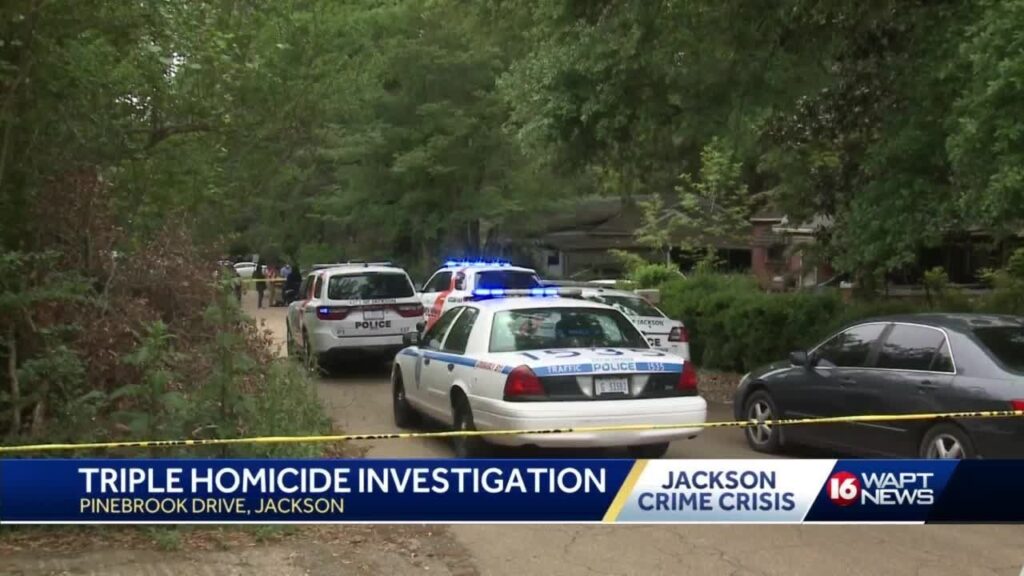
A “descent into dystopia” is how one Jackson, Mississippi resident describes the violent crime, carjackings, and shootings that have been plaguing the city in recent years.
Disturbing new video footage caught on a Ring doorbell camera on Friday shows a Jackson family being attacked and carjacked in their driveway. A mom, her kids and her grandkids were held at gunpoint, pulled out of the car, and even shot at as two suspects — yet to be caught by the police — stole a car and fled.
Fortunately, no one was seriously injured and the stolen car was later recovered. But the mom in the video, Heather Allen, told WAPT that her family plans to move out of the area after the shocking incident, despite only living there for three months.
The Jackson Police department has since said they have identified two persons of interest, and released a surveillance image of a man they believe is connected to the crime.
“It shows you the mindset of the individuals here that we are dealing with,” Chief Joseph Wade told WAPT, Jackson’s Hearst-owned ABC affiliate, of the carjacking video. “They are bold and brave and they will do whatever it takes to commit these criminal acts, and we are going to be just as bold and brave to bring them to justice and hold them accountable for their actions.”
Carjackings such as the one on Friday have becoming commonplace in Jackson, the only difference with this one being that it was caught on video.
“Sadly, this is now an everyday occurrence in Jackson,” the president of the Mississippi Center for Public Policy, Douglas Carswell, who lives and works in downtown Jackson, tells the Sun. “Just last week, someone was murdered at the park where I play tennis,” he says, adding that shootings are a “regular occurrence” in Mississippi’s capital city.

Jackson has outsized violent crime numbers for its population of nearly 150,000 residents. In 2023, there were 118 homicides in Jackson, a WLBT analysis found, and though the numbers decreased from the previous year, following a national trend post-Covid, Jackson nonetheless tops other major cities for killings per capita, that report found.
“Jackson now has one of the highest per capita homicide rates in the country, higher than Memphis, higher than Baltimore, higher than Detroit,” Mr. Carswell says. “Tragically it’s an everyday thing.”
Jackson’s murder rates were “significantly lower” in 2013 but a “dysfunctional city government” has created major crime issues for the city, he adds.
“In the past 10 or 15 years, Jackson has been a story of a descent into dysfunction,” Mr. Carswell says, adding that more than a policing issue, there is a “prosecution problem” in Hinds County, where Jackson is located.


The county’s Soros-backed district attorney, Jody Owens, has been rocked by turmoil during his time on the campaign and on the job, including allegations of sexual harassment and accusations that he pulled a gun on a man in an apartment — claims he denied at the time — and most recently, an FBI raid of his cigar bar. His office did not respond to a request from the Sun for comment on the recent Jackson carjacking and whether he intends to prosecute the perpetrators should they be apprehended.
Over the past several years, Mr. Carswell says criminals took advantage of the justice system not “functioning properly,” but that the crime rates are slowly beginning to decline as the state government steps in.
The state has been extending the purview of the Capitol Police, who used to stay primarily around the Capitol building, to police about one-third of the city, he says, adding that the areas they police have seen crime go down “dramatically.”
“Where crime is under control in the city, the neighborhoods run by the Capitol Police, you’re starting to see people moving back in,” Mr. Carswell says. “ But crime is definitely a big factor in pushing people out of those parts of the city that aren’t run by the Capitol Police.”
The expansion of the Capitol Police was the subject of pushback last year, as some in the majority-Black city saw the increased state police presence as trampling on local control and unfairly targeting Black residents. The city has largely “moved beyond” those racial tensions, Mr. Carswell says, as “quite a lot of the city lawmakers and representatives who used to criticize expansion of the capital base, are now criticizing them for not policing the whole of the city.”
Earlier this year, Mississippi’s governor, Tate Reeves, announced a “major public safety operation” in Jackson aimed at “surging” local, state, and federal law enforcement into the city in an attempt to tackle the violent crime epidemic.
The governor’s office and the Jackson Police Department did not immediately return a request from the Sun for comment on how those operations are proceeding so far.
Even with more state resources and local policing, without more prosecutions, the violent crime will continue to plague Jackson, Mr. Carswell notes.
“Having a D.A. who’s soft on crime, I think has been a real problem,” he says. “And there’s only so much the police can do until we’ve got an effective D.A. in Jackson.”



STARKVILLE — Mississippi State football landed its first four-star in the 2027 recruiting class.
Ridgeland safety Trae’kerrion Collins committed to the Bulldogs on April 9.
“I am grateful to the entire coaching staff for believing in me and giving me the opportunity to continue my academic and athletic career in Starkville,” Collins wrote on X. “I’m ready to work, compete, and represent the Bulldog family with pride.”
He picked MSU after decommitting from Ole Miss on Nov. 30. Collins holds numerous offers from power conference teams including Alabama, Georgia Tech, LSU and Michigan.
Collins is ranked No. 404 nationally, No. 12 in Mississippi and as the No. 12 safety, according to the 247Sports Composite.
Collins recorded 62 tackles in 2025 with five interceptions, two tackles for loss and one fumble recovery. He also had four receptions for 45 yards and one touchdown, plus 11 carries for 111 rushing yards and one rushing touchdown. Ridgeland (11-2) lost to Warren Central in the MSHAA Class 6A semifinals.
Mississippi State football 2027 recruiting class
Collins is Mississippi State’s fifth commitment for the 2027 recruiting class:
- S Trae’kerrion Collins
- WR Javarious Griffin Jr.
- CB Brandon Allen Jr.
- S Hudson Fuqua
- IOL Caleb Unger
The class ranks 32nd nationally and ninth in the SEC.
Sam Sklar is the Mississippi State beat reporter for The Clarion Ledger. Email him at ssklar@usatodayco.com and follow him on X @sklarsam_.
Mississippi
No. 6 Arkansas softball preparing for ‘battle’ at No. 15 Mississippi State | Whole Hog Sports


Subscribe to Clarion Ledger: Local journalists covering local stories
Clarion Ledger journalists cover the important moments in Mississippi. Support local journalism by subscribing.
Staff
The veto pen is among the most powerful tools of the Mississippi Legislature, and Gov. Tate Reeves has wielded it habitually in his tenure. This year, his vetoes have mostly been directed toward public health bills so far, with more likely to come.
Reeves can handle bills that passed both chambers in three ways. He can sign bills that he supports into law, and he can allow them to become law without his signature. He can also hit the brakes on pieces of legislation that he disagrees with, vetoing all or part of a bill and resigning it to a future legislative session.
He has vetoed four bills as of Wednesday, April 8, half as many as he did the previous two sessions, but Reeves will continue reviewing legislation and potentially reject more proposals over the coming days.
Medical marijuana
Reeves vetoed both of the medical marijuana bills that passed through the Legislature this session, issuing the fatal blow for bills that had already faced unfriendly chambers.
One of the bills, the “Right to Try Medical Cannabis Act,” had a single, specific provision that Reeves took issue with. The bill’s original intent, which Reeves described as commendable, was to extend the opportunity to try medical marijuana to those with debilitating conditions that fall outside of the current law’s scope.
Mississippi law identifies approximately two dozen qualifying conditions, but medical professionals, including state health officer Daniel Edney, argued that there were many other conditions that could benefit from medical marijuana. The bill would have allowed patients, with the support of their doctors, to apply for a limited treatment course to see whether marijuana might help them.
“I believe nearly all reasonable people would agree that a Mississippian suffering from a painful and debilitating terminal illness should be afforded an opportunity, subject to medical review,” Reeves wrote, “to try any medication or treatment to ease their suffering when they are near the end of life.”
The issue, Reeves wrote in his veto letter, came in the Senate, where the bill was amended to extend the right to try to “every person on the planet.” Legislators inserted a provision that would allow non-residents to participate in the program. Under the bill, people who live in Tennessee, where medical marijuana isn’t legal, could have pursued treatment across the state border.
“I share the State Health Officer’s concerns that the amendment of HB 1152 beyond its original intent has the potential to upset the tenuous balance struck by the Act,” Reeves wrote, “and poses an unreasonable risk of pushing the medical marijuana program in the direction of facilitating recreational use.”
Reeves generally supported the bill, he wrote, and would sign it if the Legislature filed it again with only the narrow changes included at the start.
The other bill took a tumultuous path from inception to Reeves’ denial. Its initial proposal would have loosened the state’s medical cannabis program restrictions, including by doubling the validity of medical user cards to two years and extending caretaker card validity to five years.
It also would have eliminated the requirement for a patient to follow up with their provider six months after receiving their medical cannabis card.
Nearly immediately, legislators pushed back against the House bill. Some senators, heeding advice from doctors and medical lobbyists, reined the provisions in.
Two years of user card validity reverted to one, and five years of caretaker card validity was clawed back to two instead. Both chambers approved the more modest changes in the amended bill and sent it to the governor’s desk, where Reeves slammed the door on the bill and, likely, most other proposed changes to medical marijuana law.
The Mississippi Medical Cannabis Act has been “largely successful,” Reeves wrote, and he believes “there is no reason to alter it now.”
The disaster loan program
Reeves’ first veto of the session targeted the disaster loan program, a legislative proposal meant to help cities and counties in Mississippi recover from the devastating winter storm that occurred at the start of the year.
With the veto and harshly worded veto letter, Reeves took aim at the state senate again, having previously attacked the chamber’s leadership after it killed the school choice initiative without discussion.
The loan program conflict emerged over interest rates and, as Reeves wrote, legality.
The program was simple enough on its face: the state would loan money out to needy municipalities and, when the loan was repaid, send more money back out to other places, doubling or tripling the impact of the fund.
Reeves said he and legislators compromised on a monthly 1% interest rate on recovery loans, down from the 2% rate he initially favored. That language made its way into the bill, but lawmakers decreased it to a 1% rate for the year instead.
Disagreement ensued. Reeves wrote in his veto letter that lawmakers went behind his back to change the bill sneakily, and potentially illegally, while members of the Legislature maintained that everything was done above board and the governor’s proposal would have crushed already vulnerable municipalities.
“The plainly unconstitutional (and possibly criminal) act of the person or persons that attempted to surreptitiously change a material (and negotiated) term of Senate Bill 2632 is unconscionable,” Reeves wrote, “and calls into question the validity of every bill that I have signed into law this session.”
Writing that it “plainly violates multiple provisions of the Constitution,” Reeves vetoed the bill. The veto came during the session, though, so lawmakers added the loan program, now with a 3% annual interest rate, in a different bill. Reeves signed the second attempt on April 6.
Will there be more vetoes?
Based on numbers from previous years, there is a chance that Reeves will veto more bills in the coming days. He has five days to reject or sign a bill after it hits his desk, otherwise allowing the law to go into effect without his participation.
Some provisions that he has vetoed in the past, including a government efficiency bill and $13 million grant for LeFleur’s Bluff State Park, are back on the table this session. In both bills, the language that Reeves identified as problematic last year has been altered, potentially indicating that it has a better chance of passing into law.
Bea Anhuci is the state government reporter for the Clarion Ledger. She covered the 2026 Mississippi legislative session and the decisions that lawmakers made. Email her at banhuci@usatodayco.com.

Home of Sam Altman, CEO of OpenAI, hit with Molotov cocktail

Review: Sicily Comes to Dallas at Caffe Lucca, With Some Kinks to Work Out

A long line awaited the opening of Uniqlo in Downtown Crossing. Take a look inside. – The Boston Globe

Broncos owners buy 40% ownership stake in the Colorado Rockies

New Music You Shouldn’t Miss – The Stranger

Florida High School Football Rankings: Top 25 teams – Oct. 21

How old is Bo Nix? What to know about Oregon quarterback ahead of 2024 NFL Draft

Cleary's 21 help Le Moyne down Central Connecticut State 69-64 in OT

99th annual Pony Swim held in Virginia

Indiana Members Credit Union announced as new anchor tenant at Bottleworks District

Rep Randy Fine joins House Freedom Caucus: ‘Strongest group of conservative patriots in Congress’

Trump issues NATO ultimatum to reopen Strait of Hormuz ‘within days’

Women are getting most of the new jobs. What’s going on with men?

Video: How Trump’s Advisers Felt About Going to War With Iran

Unearthed clip exposes shocking claim by Newsom’s wife about inmates at violent California prison
-

 Atlanta, GA6 days ago
1 teenage girl killed, another injured in shooting at Piedmont Park, police say
-

 Education1 week ago
Video: We Put Dyson’s $600 Vacuum to the Test
-

 Movie Reviews1 week ago
Vaazha 2 first half review: Hashir anchors a lively, chaos-filled teen tale
-

 Education1 week ago
Video: YouTube’s C.E.O. on the Rise of Video and the Decline of Reading
-

 Georgia3 days ago
Georgia House Special Runoff Election 2026 Live Results
-

 Pennsylvania4 days ago
Parents charged after toddler injured by wolf at Pennsylvania zoo
-

 Education1 week ago
Video: Toy Testing with a Discerning Bodega Cat
-
 Milwaukee, WI4 days ago
Potawatomi Casino Hotel evacuated after fire breaks out in rooftop HVAC system